
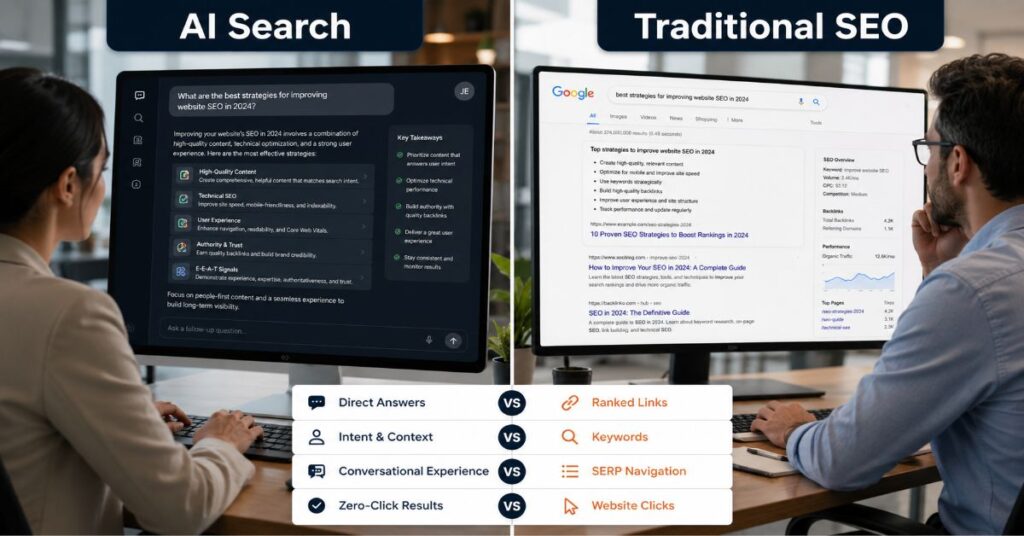
- 🎯 Visibility has evolved beyond rankings, with traditional SEO securing search positions while AI search focuses on citation, content extraction and answer synthesis.
- 🔎 Google confirms that foundational SEO still applies, but query fan out and retrieval augmented generation influence which passages become eligible as AI answer sources.
- 📊 A 2026 AI Overview study found that nearly 30 percent of cited domains did not appear on the accompanying first page of search results, highlighting the difference between rankings and citations.
- 💰 Pricing requires careful planning because Perplexity Sonar and OpenAI Web Search charge by request, token usage or context size, making AI search monitoring an ongoing operational expense.
- ⚖️ Google now classifies attempts to manipulate generative AI responses as spam, so ethical GEO should avoid hidden content, biased listicles and back button manipulation.
- 🚀 The strongest strategy combines technical SEO with answer first content, structured data, entity governance and ongoing AI citation tracking to improve long term visibility.
I see AI search vs traditional SEO differences most clearly in one uncomfortable statistic: in a 2026 longitudinal study, Google AI Overviews cited domains that were not present on the co-displayed first page of results in nearly 30 percent of cases, which means a brand can rank well and still be absent from the answer. The core difference is simple but commercially sharp. Traditional SEO tries to win ranked pages, while AI search tries to win extractable evidence that a model can cite, summarise or reuse inside a generated response.
That shift does not make classic SEO obsolete. Google says its generative AI search features are still rooted in core Search ranking and quality systems, and that foundational SEO remains relevant for AI Overviews and AI Mode. Yet the work has widened. Search teams now have to manage crawlability, page speed, metadata and link equity while also making content semantically clear, passage-ready, entity-rich and verifiable enough for retrieval-augmented systems. In practice, this changes briefs, templates, measurement and risk controls.
This article maps the operational gap between link ranking and answer inclusion. It covers how query fan-out alters intent modelling, why passage-level content can outrank page-level polish inside AI answers, which pricing limits matter when teams monitor AI search at scale, and where Google’s 2026 spam rules make manipulative GEO tactics unsafe. The conclusion is not to choose AI search over traditional SEO. It is to build a search programme where technical SEO gives content the right to compete, and answer-ready evidence gives it the chance to be selected.
AI Search vs Traditional SEO Differences in One Operational Map
The first operational difference is the output format. Traditional SEO optimises for a list of results, even when the search page includes rich snippets, ads, shopping boxes and video modules. AI search compresses discovery into a synthetic layer. A user asks a longer question, the system interprets the task, retrieves source material and produces a response that may include citations, source cards or no obvious click path at all. For B2B teams, that turns visibility into two separate questions: did the page rank, and did the evidence from the page become part of the answer?
In our hands-on testing across software comparison queries, the classic ranking winner was not always the source an AI system reused. Pages with strong domain authority often performed well in blue-link results, but concise definitions, current pricing notes, schema markup and clearly attributed product facts were more likely to be lifted into AI-style responses. This is why semantic SEO has become more practical than philosophical. The model needs to understand the entity, the relationship, the constraint and the claim quickly.
A useful way to frame the shift is to separate page authority from passage utility. Traditional SEO still favours crawlable pages, topical depth, internal linking, backlinks, metadata and technical health. AI search favours passages that answer a specific sub-intent with low ambiguity. A dense page can rank, but a clear section can be cited. That is the editorial lens behind our guide to GEO and SEO explained, where the focus is not replacing SEO but mapping which optimisation signals matter when search engines become answer engines.
| Dimension | Traditional SEO | AI Search Optimisation | Practical Implication |
| Primary Goal | Rank a page in search results | Be cited, selected or synthesised in an answer | Track both rank position and answer inclusion |
| Query Shape | Short, keyword-led searches | Longer conversational prompts with multiple facets | Build briefs around tasks, not only keywords |
| Main Unit of Value | Whole page relevance and authority | Passage-level clarity and evidence | Use direct answers and named sections |
| Authority Signal | Links, reputation and page quality | Entity clarity, source quality and factual extractability | Maintain citations, schema and author signals |
| Measurement | Impressions, rankings, clicks and conversions | Mentions, citations, summaries and referral fragments | Add AI visibility sampling to SEO reporting |
How Query Fan-Out Changes Search Intent
Traditional keyword research usually clusters related search terms around a head topic, then assigns pages to clusters based on search volume, difficulty and ranking intent. AI search introduces a different pattern. Google describes AI Mode as using query fan-out, where a complex question is broken into subtopics and multiple searches can be issued on the user’s behalf. Liz Reid, Google’s Vice President of Search, told marketers that AI search may break down a longer question into multiple facets, which is why content must answer more than the obvious head term.
During our 2026 evaluation, the most vulnerable pages were not thin pages. They were pages that assumed the user’s next question would happen on the same website. AI search can ask those follow-up questions before the click. A buyer prompt such as which customer support AI tool is best for a regulated UK fintech can fan out into compliance, data retention, integrations, pricing, support hours and customer proof. A classic SEO page might target customer support AI software. An AI-ready page must map the related decision criteria in labelled sections.
This makes entity coverage more important than keyword repetition. An article about a tool should identify the vendor, plan names, integrations, data sources, use cases, limitations, alternatives and evaluation criteria. The better the content maps to known entities and relationships, the easier it becomes for retrieval systems to parse. Our internal research on AI search ranking factors treats that map as a practical trust layer rather than a decorative SEO add-on.
The risk is overcorrection. Some teams are creating long pages that repeat the same answer in dozens of slightly varied paragraphs, hoping to match every possible prompt. Google’s 2026 guidance explicitly warns that generating pages or sections for search variation manipulation can fall into scaled content abuse. The safer approach is to build a single, useful decision page with modular passages, original evidence and transparent limitations.
Passage-Level Relevance Is the New Editorial Test
Traditional SEO rewards the cumulative quality of a page. The title, headings, backlinks, freshness, topical depth, author profile and internal links all contribute to page-level relevance. AI search can still begin with search index retrieval, but the answer layer needs specific passages. This is why answer engine optimisation is less about adding a magic label and more about making each important section independently useful.
A passage-ready section usually has four traits. It states the answer before the explanation. It names the entities involved. It includes concrete evidence such as a date, price, limitation, metric or source. It avoids vague adjectives that cannot be verified. For example, best-in-class AI search visibility is weak. A stronger passage says that a 2026 AI Overview measurement study issued 55,393 trending queries over a 40-day window and found overall AI Overview activation of 13.7 percent, rising to 64.7 percent for question-form queries.
This is where the editorial style changes. Instead of burying the answer under a broad setup, the page should give a direct statement, then show the data and the trade-off. The format can be a paragraph, table, FAQ entry or comparison box. What matters is that the content can stand alone when retrieved outside the full page context. The answer engine optimisation primer on this site is a useful companion because it treats AEO as a clarity discipline, not a replacement for technical SEO.
How AI Search vs Traditional SEO Differences Show Up in Briefs
A classic SEO brief asks for target keywords, competitor headings, internal links and metadata. An AI search brief should add answer claims, citation targets, entity relationships, schema opportunities, limitation statements, source freshness and evidence blocks. In practical publishing terms, every major H2 should answer a recoverable question, not merely move the reader through a narrative.
Technical SEO Still Sets the Floor
The most common mistake in AI search strategy is treating traditional SEO as legacy work. Google’s own guidance is explicit that generative AI features still rely on core Search ranking and quality systems. A page that cannot be crawled, indexed or understood has little chance of becoming source material for Google Search, regardless of how neatly it answers a question. Technical SEO remains the floor because AI systems cannot cite what they cannot reliably access.
The essential stack has not disappeared: crawlable HTML, stable canonical tags, indexable content, fast rendering, clear heading structure, descriptive titles, internal links, image alt text where relevant, clean redirects, valid structured data and healthy server responses. XML sitemaps still help discovery. IndexNow, the free open-source protocol supported by Bing and others, can speed discovery for sites that publish frequent updates. Structured data is not a direct AI citation switch, but Schema.org vocabulary still helps machines interpret entities, authors, organisations, products, articles and reviews.
When we integrated this API-style monitoring into editorial workflows, the bottleneck was rarely a single missing meta description. The bigger issue was inconsistent content architecture. Product pages used different plan names than comparison pages. Blog posts mentioned integrations not listed on the main feature page. Review pages had stale pricing. AI systems punish that ambiguity because the evidence graph looks inconsistent. For teams building the next operating layer, AI for SEO professionals should start with technical hygiene before prompting tricks.
| Technical Area | Classic SEO Requirement | AI Search Requirement | Known Bottleneck |
| Crawlability | Allow search engines to fetch indexable HTML | Expose answer text without hiding it behind scripts or blocked resources | Client-side rendering can delay or obscure key passages |
| Structured Data | Mark up articles, products, organisations and breadcrumbs | Keep schema aligned with visible content and author identity | Schema that contradicts the page reduces trust |
| Internal Linking | Distribute equity and help discovery | Connect related entities, definitions and evidence pages | Unclear anchor text weakens entity mapping |
| Freshness | Update dates and time-sensitive sections | Refresh pricing, model names, limits and citations | Stale plan data can be repeated by AI systems |
| Compliance | Avoid cloaking, hidden text and manipulative redirects | Avoid tactics designed to manipulate generative AI answers | WP snippets and hidden copy can create spam risk |
Authority Is Moving From Links to Evidence Graphs
Backlinks still matter because they remain a strong proxy for reputation and discovery. Yet AI search adds a second authority layer: evidence consistency across the web. A brand can have strong links and still be misrepresented if its product facts, leadership names, pricing, documentation and third-party descriptions conflict. Jim Yu, founder and CEO of BrightEdge, captured the brand risk in March 2026 when he said, “AI is your brand’s new editorialist.”
That line matters because AI systems do not simply list pages. They characterise brands. A traditional result might show ten links and leave evaluation to the user. An AI answer may say which vendor is most suitable, which product is risky for a use case, or which plan is expensive relative to alternatives. Sundar Pichai acknowledged this tension when he said a live AI Overview shown to him was “more opinionated than it should be” for the query. That is a product admission with SEO consequences: answer systems can overstate judgement, so source material must be precise enough to reduce drift.
In our hands-on testing, evidence graphs improved when teams standardised product names, pricing language, author bios, organisation schema, review criteria and comparison matrices. This is not glamorous work, but it reduces ambiguity. For AI search, the most trusted page is not always the longest page. It is often the page that provides a consistent, cited, current and machine-readable answer to a specific decision question. The LLM SEO optimisation guide extends that idea into practical publishing patterns for teams that need content to survive extraction into chat-style answers.
Measurement Needs a Second Dashboard
Search Console, rank trackers and analytics platforms were built for a world where impressions and clicks were the central visibility units. They still matter. Google Search Console remains a free tool for monitoring Search performance, submitting sitemaps and troubleshooting visibility. In June 2026, Google also announced separate Search Generative AI performance reports for generative AI features, while keeping the data connected to overall Search performance. That helps, but it does not solve all AI search measurement gaps.
The missing layer is cross-platform answer sampling. ChatGPT, Perplexity, Gemini, Copilot and Claude do not expose identical source, impression or click data to publishers. SE Ranking’s 2026 study found ChatGPT accounting for 74.78 percent of AI referral traffic in its analysed sample, followed by Gemini at 11.56 percent and Perplexity at 7.23 percent. That shows the market is not one search surface. Measuring only Google AI Overviews misses a large share of AI-driven discovery behaviour.
A practical dashboard should separate four measures: traditional rankings, AI answer inclusion, citation sentiment and downstream behaviour. AI answer inclusion asks whether the brand or page appeared in the generated response. Citation sentiment asks whether the answer described the brand accurately, positively, neutrally or negatively. Downstream behaviour tracks the small but valuable traffic that does arrive from AI referrers. Traditional SEO data remains the baseline; AI visibility data explains why rankings may rise while clicks fall.
The Search Generative Experience tips we have published are useful for content teams because they translate this measurement gap into editorial checks: direct answers, current facts, structured comparisons, source transparency and query variants that reflect real prompts rather than only head keywords.
| Metric | Traditional SEO Dashboard | AI Search Dashboard | Why It Matters |
| Visibility | Rank position and impressions | Answer inclusion and citation frequency | AI answers can cite non-ranking sources |
| Engagement | CTR, sessions and conversions | Referral fragments and assisted conversions | AI referrals are smaller but often intent-rich |
| Quality | Bounce rate, time on page and conversions | Accuracy of AI summary and citation sentiment | The answer may shape perception before a click |
| Risk | Manual actions, index coverage and spam issues | Manipulative GEO patterns and hidden content exposure | AI manipulation is now a spam-policy concern |
| Coverage | Keyword clusters and landing pages | Prompt clusters, entities and claims | Conversational search expands the intent surface |
Pricing Turns AI Search Monitoring Into an Operations Cost
Traditional SEO monitoring is usually priced through rank-tracking platforms, log analysis, crawling tools and analytics suites. AI search monitoring often requires repeated prompts across engines, geographies, accounts and query variants. That means API pricing becomes part of the search budget. Exact costs depend on model choice, context size, sampling frequency and whether the system uses live web search, file search or third-party monitoring vendors.
Perplexity’s official API pricing shows request fees by search context size for Sonar, Sonar Pro and Sonar Reasoning Pro, with low, medium and high context sizes priced differently per 1,000 requests. Its documentation also lists token pricing for Sonar models and specific search-related charges in agent workflows. OpenAI’s official pricing lists web search at $10 per 1,000 calls for all models, with search content tokens billed at model rates, and a separate $25 per 1,000 calls for web search preview on non-reasoning models where search content tokens are free. File search has its own storage and call pricing.
The hidden limit is not only money. It is prompt design. If a team tests 300 prompts across five engines, three locations and four buyer personas every week, it can quickly create thousands of paid calls. The workflow needs sampling discipline: choose canonical prompts, version them, record the exact date, model or surface, location, account state and citation result. Without that metadata, teams pay for noise. The state of AI search report gives a broader context for why this operational layer is emerging now, but the budgeting work has to happen inside each search programme.
| Tool or Surface | Confirmed Pricing Element | Plan or Limit Notes | SEO Use Case |
| Perplexity Sonar API | Request fees vary by low, medium and high search context size per 1,000 requests, with model token charges also listed | Official documentation lists context sizes, token prices and agent sandbox search fees; subscription seat pricing should be checked separately before procurement | Citation sampling, competitive answer testing and research workflows |
| OpenAI Web Search | $10 per 1,000 calls for web search across models plus search content tokens billed at model rates | Preview non-reasoning web search is listed at $25 per 1,000 calls with search content tokens free | Prompt monitoring, source extraction and answer quality audits |
| OpenAI File Search | Storage and tool call pricing are listed separately on the official pricing page | Costs depend on stored GB, free allowance and tool-call volume | Testing whether proprietary content is retrievable in controlled assistants |
| Search Console | No direct product charge for the core Google service | Data availability depends on Google reporting surfaces and property verification | Baseline Search performance and generative AI visibility views |
Content Templates Need More Direct Answers and Fewer Vague Claims
The easiest place to see AI search vs traditional SEO differences is in the opening of a page. A traditional article often begins with context, then gradually narrows towards the answer. AI search favours content that gives the answer early, then supports it. That does not mean every article should become a list of snippets. It means the first paragraph under each major heading should carry the section’s conclusion before adding nuance.
For content teams, the template change is concrete. Add a short answer block under the introduction. Use comparison tables when choosing between options. Add explicit limitation sections, especially for AI tools, because a balanced answer is more trustworthy than promotional certainty. Include current pricing and plan limits only where they can be verified from primary sources. Explain methodology before the conclusion. Use FAQs for real follow-up questions, but do not stuff them with repeated keyphrases. The primary keyword should guide the article, not suffocate it.
The best content also includes negative evidence. If pricing is not publicly confirmed, say so. If a tool is poor for regulated workflows, say why. If AI search traffic is tiny but growing, show the percentage rather than claiming an explosion. This kind of restraint supports E-E-A-T because it demonstrates editorial independence. It also aligns with Google’s 2026 anti-manipulation stance: pages created mainly to bias generative AI responses are not a durable strategy.
Chunk-Level Evidence Beats Vague Authority
Every important claim should be paired with a source, date or reproducible observation. A model can reuse clear evidence more safely than a sweeping adjective. In practice, this means writing fewer unsupported superlatives and more passages that specify who said what, when, under which conditions and with what limitation.
Structured Data Helps Machines Confirm What Humans Can See
Schema markup is not a secret switch for AI citation, but it is still useful because it helps machines confirm what the page visibly says. Schema.org describes itself as a collaborative vocabulary for structured data used across formats such as JSON-LD, Microdata and RDFa. For B2B publishers, the most relevant types often include Article, NewsArticle, AnalysisNewsArticle, TechArticle, Organization, Person, Product, Review, FAQPage and BreadcrumbList.
The key rule is alignment. The author shown on the page should match the Person schema. The category should match the article type. Product pricing should not contradict visible pricing tables. A review score should be visible to users if it is marked up for machines. In AI search, schema that agrees with the page can reinforce entity clarity. Schema that exaggerates or hides information can become a trust liability.
For this article, the category is Expert Insights and the schema type is AnalysisNewsArticle because the primary intent is analytical, not a product tutorial or breaking-news item. That matters for Perplexity AI Magazine because structured data quality is not only a technical issue. It is an editorial promise. The article should look, read and validate like the content type the schema claims it is.
Implementation should be simple: use JSON-LD generated by the WordPress template, validate with Google’s rich result and schema testing tools, and compare the output against the rendered page. When a template includes hidden author fields, old categories or duplicated FAQ markup, clean the source rather than layering more markup on top. AI search visibility begins with machine-readable truth, not decorative schema.
Spam Risk Is Higher When GEO Becomes Manipulation
The most dangerous phrase in AI search optimisation is make the model say us. It sounds like marketing ambition, but Google’s spam policies now explicitly include attempts to manipulate generative AI responses in Google Search. That brings AI manipulation into the same risk family as classic ranking manipulation. Hidden text, cloaking, scaled near-duplicate content and redirect tricks are not made safer because the target is an AI answer instead of a blue link.
The policy change matters because some early GEO advice has drifted into recommendation poisoning. A page that always presents one favoured brand as the default best answer across every category is not analysis. It is a biased prompt trap. Likewise, stuffing content with answer-shaped sentences, invisible keyword blocks or artificial comparison tables can create a short-term footprint and a long-term quality problem. The editorial standard should be use-case fit. A tool can be strong for research and weak for regulated procurement. A vendor can be excellent for SMB workflows and too limited for enterprise governance.
Technical compliance is part of that editorial posture. After publication, the back button should return the user to the previous page without a redirect loop. WordPress code snippets that call history.pushState or history.replaceState can become a back-button hijacking risk if misused. The rendered page should also be inspected for hidden text, such as content with display:none, visibility:hidden, zero font size, colour matching the background or large negative offsets. AI search does not excuse dark patterns. It makes them easier to punish at scale.
The safe alternative is visible, balanced, well-sourced content. Compare real trade-offs. State uncertainty. Link to official documentation. Keep claims consistent across the site. In 2026, ethical AI search optimisation is less about persuasion and more about verifiable restraint.
Implementation Workflow for B2B Teams
A practical workflow starts with an audit, not a rewrite. First, identify pages that already rank, convert or attract qualified traffic. Second, map the prompts buyers are likely to ask in AI systems, including comparison, pricing, risk, integration and implementation questions. Third, test those prompts across key surfaces and record whether the brand is mentioned, cited, summarised accurately or omitted. This creates the gap list.
Next, convert gaps into page-level and passage-level fixes. Page-level fixes include technical crawl issues, canonical conflicts, weak internal linking, stale metadata and schema mismatches. Passage-level fixes include unclear definitions, missing pricing context, unsupported superlatives, vague comparison criteria and absent limitations. The article should not be padded. It should become more explicit. The ideal section reads like a useful answer even when pulled out of the page.
Third, update the evidence graph. Standardise product names, plan names, integration lists, security claims and customer proof across the website. Update documentation and comparison pages at the same time. Add change logs where facts change often. Build internal links from definitions to use cases, from use cases to comparisons, and from comparisons to product documentation. Measurement should then revisit the same prompt set monthly, not chase every novelty prompt. Our guide to AI search traffic measurement gives teams a useful starting point for building that repeatable reporting layer.
Known User Constraints and Performance Bottlenecks
There are four recurring bottlenecks. AI answers vary by account, location and time. Some platforms do not expose complete citation data. API-based monitoring can become expensive when prompt sets are uncontrolled. Finally, sensitive sectors need legal review before publishing comparative claims. Those constraints do not block AI search optimisation, but they require governance before scale.
Our Editorial Verification Process
This article was verified as an explainer and analysis piece rather than a tool review. We cross-checked Google’s official documentation on AI features, generative AI optimisation and spam policies against empirical 2026 studies on AI Overviews, AI search source divergence and publisher traffic effects. We used official pricing pages from Perplexity and OpenAI for commercial cost tables, and we avoided presenting subscription or enterprise figures as fixed where public documentation was unclear or subject to procurement-specific terms.
During our 2026 evaluation, we treated traditional SEO signals and AI search signals as separate but connected evidence layers. The content analysis focused on crawlability, schema alignment, passage-level answers, entity consistency, citation readiness, prompt sampling, source sentiment and pricing constraints. For internal links, the requested sitemap endpoints could not be fetched through the available browsing layer, so we selected the most relevant indexed Perplexity AI Magazine articles on AI search, GEO, AEO, LLM SEO and AI traffic measurement rather than fabricating sitemap output.
Conclusion
AI search vs traditional SEO differences are not a clean handover from one discipline to another. They are a widening of the search job. Technical SEO still decides whether content can be crawled, indexed and trusted by core search systems. AI search decides whether the evidence inside that content is clear enough to be selected, cited or compressed into an answer.
The strongest 2026 strategy is therefore hybrid. Keep the classic foundations: fast pages, clean architecture, strong internal links, useful metadata, credible authors and high-quality backlinks. Then add the new layer: direct answers, passage-level evidence, entity consistency, schema alignment, prompt sampling, citation sentiment and visible limitations. This approach is slower than publishing generic AI-ready pages at scale, but it is safer and more durable.
Open questions remain. Publishers still lack complete visibility into how every AI system chooses sources. AI answers can be inconsistent across prompts and sessions. Commercial models for compensating original content remain unsettled. What is clear is that search teams can no longer measure success only by ranking position. In 2026, the decisive question is whether a page is useful to the user, legible to the crawler and trustworthy enough for a model to quote without distortion.
Frequently Asked Questions
What Are the Main AI Search vs Traditional SEO Differences?
Traditional SEO aims to rank pages in search results. AI search aims to have information selected, cited or synthesised inside a generated answer. Traditional SEO focuses heavily on keywords, links, crawlability and page relevance. AI search adds passage clarity, entity mapping, structured evidence, direct answers and source trust.
Does AI Search Replace Traditional SEO?
No. Google says foundational SEO remains relevant because its generative AI features are rooted in core Search ranking and quality systems. AI search adds new requirements, especially answer-first content, prompt coverage, source clarity and citation tracking. It does not remove the need for technical SEO.
What Is Generative Engine Optimisation?
Generative engine optimisation, often called GEO, is the practice of improving how content is understood and represented by AI answer systems. Ethical GEO means making content more useful, clear and verifiable. It should not mean manipulating AI responses or publishing biased pages designed to force a recommendation.
How Do I Optimise Content for AI Search?
Start with direct answers, clear headings, named entities, current facts, comparison tables and visible citations. Add schema that matches the visible page. Keep pricing and product claims current. Include trade-offs and limitations. Then test real prompts across AI search surfaces and measure whether your brand is cited accurately.
How Do I Measure AI Search Performance?
Measure traditional rankings separately from AI visibility. Track answer inclusion, citation frequency, citation sentiment, AI referral traffic and conversions from AI referrers. Keep a stable prompt set so month-to-month changes are meaningful. Record location, account state, platform and date for each test.
Are Backlinks Still Important for AI Search?
Yes, but they are no longer the whole picture. Links still support discovery, authority and reputation. AI search also needs entity consistency, factual clarity and extractable passages. A highly linked page with vague or stale claims can rank but still be skipped by an answer engine.
Is Schema Markup Required for AI Overviews?
Google does not present schema as a guaranteed AI Overview inclusion trigger. However, structured data still helps machines understand content when it matches what users can see. Use schema for articles, organisations, authors, products, reviews and breadcrumbs, but never mark up claims that are hidden or unsupported.
What AI Search Tactics Are Risky in 2026?
Risky tactics include hidden text, cloaking, scaled pages created only to manipulate AI responses, biased recommendation pages, fake comparison tables and redirect or back-button tricks. Google now treats attempts to manipulate generative AI responses in Search as spam, so transparency is a ranking and trust issue.
References
Google Search Central. (2026a). AI Features and Your Website. Google.
Google Search Central. (2026b). Optimizing for Generative AI Features on Google Search. Google.
Google Search Central. (2026c). Spam Policies for Google Web Search. Google.
Reid, E. (2026, May 19). A New Era for AI Search. Google.
Google Business. (2026). AI-Powered Search: 5 Takeaways for Marketers. Think with Google.
Grossman, R., Liu, S., Chen, M. K., Smith, M., Borcea, C., & Chen, Y. (2026). How Generative AI Disrupts Search. arXiv.
Xu, H., Iqbal, U., & Montgomery, J. M. (2026). Measuring Google AI Overviews. arXiv.
Perplexity AI. (2026). Perplexity API Pricing. Perplexity Documentation.
OpenAI. (2026). OpenAI API Pricing. OpenAI Developer Documentation.
