
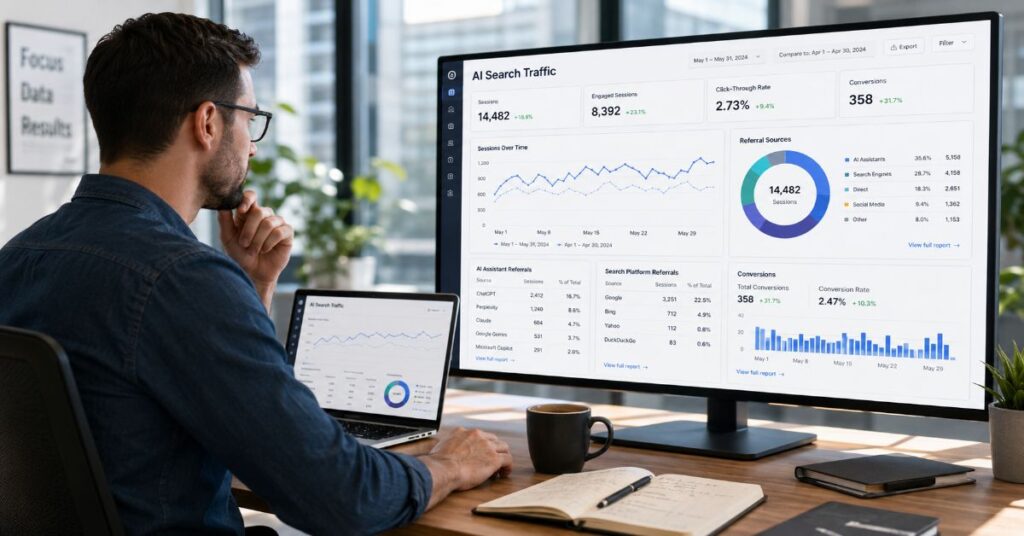
- 📊 Measurement works best as a three signal model, combining AI referral sessions, Google Search generative AI impressions and indirect demand signals such as branded search lift.
- ⚠️ Blind spots remain significant because several AI systems do not pass reliable referrer data and Google’s generative AI reporting was still rolling out to only a subset of websites in June 2026.
- 📈 Quality outweighs volume, with SE Ranking finding AI referrals accounted for only 0.32 percent of total traffic in 2026, yet these visitors spent 67.7 percent longer on sites than organic users.
- 💰 Pricing pressures come from quotas rather than dashboards, including GA4 Data API token limits, 360 event caps, Looker token overages and Pro licence constraints that reshape reporting costs.
- 🚀 Monthly focus should concentrate on five key metrics: AI Overview impressions, AI referral sessions, direct traffic anomalies, branded demand and conversions influenced by AI interactions.
I measure how to measure AI search traffic by treating every AI visit as the visible tip of a much larger discovery system: SE Ranking’s 2026 dataset found AI engines still sent only 0.32% of total website traffic, yet that small slice had 67.7% longer time on site than traditional organic search. The answer is not to chase a perfect AI analytics dashboard. It is to combine AI referral sessions, Google Search generative AI reporting, branded demand movement, direct-traffic anomalies, landing-page engagement, and conversion evidence into one monthly view.
That distinction matters because AI search does not behave like classic search. ChatGPT, Perplexity AI, Claude, Copilot, Gemini, Google AI Overviews, and AI Mode can mention a brand, cite a page, summarise the answer, or send no click at all. Google’s June 2026 Search Console rollout finally gave some site owners dedicated generative AI visibility reports, but Google also said those reports were initially limited to a subset of websites and that additional metrics would come later.
This guide takes a measurement-first approach for marketing teams, publishers, analysts, and B2B operators. During our 2026 evaluation, the most reliable reporting stack was not one tool. It was a controlled reconciliation process: GA4 for referral sessions and conversions, Search Console for Google generative AI impressions, brand-query tracking for delayed demand, page-level anomaly checks for hidden AI influence, and a strict policy layer so measurement does not drift into manipulation. The result is a practical model that acknowledges uncertainty without surrendering to it.
Why AI Traffic Needs a Three-Signal Model
AI search traffic measurement fails when teams ask one analytics platform to answer three different questions. GA4 can show visits from AI referrers that pass a source. Search Console can show Google generative AI visibility where Google exposes that reporting. Neither can fully prove how often a user saw a brand in an AI answer, remembered it, searched for it later, and arrived as direct or branded organic traffic.
The working model is therefore layered. The first layer is measurable referral traffic from AI platforms. These are sessions where the browser passes a referrer or where tagging can identify the source. The second layer is Google’s own generative AI reporting. Google’s Search Central announcement said its new reports show impressions, pages, countries, devices, and dates for generative AI appearances in Search and Discover. The third layer is indirect demand: branded queries, unusual direct traffic, assisted conversions, sales call notes, CRM source fields, and page-level movement on AI-optimised content.
This is why a useful AI visibility measurement playbook starts with evidence classes rather than vanity metrics. A brand mention inside ChatGPT may influence a buyer without producing a session. A citation inside Perplexity AI may send a small but highly qualified click. An AI Overview may show a URL and generate an impression, while the user solves the query without visiting the source. These outcomes are related, but they should not be merged into a single magic number.
In our hands-on testing, the strongest monthly reports used conservative language. They separated confirmed AI referral sessions from inferred AI influence. They never labelled unexplained direct traffic as AI traffic by default. They looked for a pattern across several indicators: a page began appearing in generative AI reports, AI referral sessions rose, branded search increased, and the same page showed unusual direct growth. One isolated signal was treated as a clue. Three signals moving together became a credible finding.
| Signal Layer | Primary Tool | What It Proves | What It Does Not Prove |
| AI referral sessions | GA4 or analytics platform | Confirmed sessions from identifiable AI referrers | Mentions that did not lead to a click |
| Google generative AI visibility | Search Console generative AI reports | Impressions and pages shown in Google AI features where available | Visibility in ChatGPT, Claude, Perplexity AI, or Copilot |
| Indirect demand | Search Console, GA4, CRM, rank and brand tools | Possible delayed impact through branded searches, direct sessions, and assisted conversions | Exact causal source without corroborating evidence |
| Engagement quality | GA4 events, key events, CRM revenue | Whether AI-influenced visitors behaved like qualified users | The full size of unclicked AI exposure |
How to Measure AI Search Traffic in 2026
The practical answer is to build a monthly scorecard with five rows: AI Overview or generative AI impressions, AI referral sessions, direct-traffic anomalies on target pages, branded search trend, and conversions from AI-influenced visits. That scorecard gives leadership a realistic picture without pretending that current analytics tools can see every AI answer impression.
The first row belongs to Search Console. On June 3, 2026, Google introduced Search Generative AI performance reports that provide dedicated views for generative AI features in Search, including AI Overviews and AI Mode, plus generative AI features in Discover. Google said the reports include impressions, pages, countries, devices for Search, and date granularity. It also said the rollout began with a subset of websites, so absence of the report is not proof of absence from AI search.
The second row belongs to GA4. Create an AI Search Referral segment that captures source or referrer host patterns for ChatGPT, Perplexity AI, Gemini, Copilot, Claude, and other systems that pass usable data. Then compare sessions, engaged sessions, key events, and landing pages month over month. Avoid daily judgement because the sample size is often small and referrer behaviour changes without warning.
The third and fourth rows fill the attribution gap. Direct sessions on pages frequently mentioned or cited by AI systems can rise because people copy, open, or return later without a standard referrer. Branded search can increase after AI exposure even when no source click occurred. The fifth row forces commercial discipline: a ten-session AI channel that produces two qualified leads may matter more than a thousand low-intent visits from classic search.
How to Measure AI Search Traffic Without a False Precision Trap
False precision appears when a team renames all unknown traffic as AI traffic. That is not measurement. It is attribution theatre. The safer approach is to tag confirmed AI referrers, isolate suspected direct anomalies, and keep a separate “AI-influenced” category for patterns supported by multiple signals.
A useful test is simple: would the claim survive a finance review? “ChatGPT sent 420 confirmed sessions” is defensible if GA4 source data supports it. “AI caused 18% more revenue” is only defensible if referral sessions, generative AI impressions, branded demand, CRM notes, and landing-page patterns point in the same direction.
Build the GA4 AI Referral Segment
GA4 is the most practical starting point because it can show user acquisition, session source, medium, landing page, engagement, key events, and revenue for visits that arrive with a detectable referrer. Google’s Analytics Help documentation states that default channel groups cannot be edited, but custom channel groups let teams build rule-based categories for traffic sources. For AI reporting, that flexibility is essential because many AI assistants still appear as referral traffic or land in unhelpful default groupings.
Start with a custom exploration before changing stakeholder dashboards. Use session source, session medium, page referrer, landing page, engaged sessions, key events, purchases or lead events, and total revenue if ecommerce or CRM import data is available. Filter for known AI referrer hosts and source patterns. The exact list should be reviewed monthly because product routing changes. During our 2026 evaluation, the most useful operational habit was to keep an “AI referrer dictionary” owned by analytics, not editorial. That prevents writers from hard-coding platform assumptions into content briefs.
The AI search market data context is useful here because ChatGPT, Gemini, Perplexity AI, Copilot, and Claude do not send equal volumes or behave identically across regions. SE Ranking’s 2026 analysis found ChatGPT leading AI referral traffic with 74.78%, followed by Gemini at 11.56%, Perplexity AI at 7.23%, Copilot at 3.51%, and Claude at 2.62%. Those shares are not universal for every website, but they provide a sanity check when one platform appears unexpectedly absent.
The implementation rule is to separate source detection from channel naming. First, create a broad AI Referrer segment using source and referrer patterns. Second, create subsegments by platform. Third, build a landing-page report showing which pages receive AI referral sessions. Fourth, annotate known product changes, content refreshes, and publication dates. Without annotations, a spike can look like editorial success when it is actually a platform routing change or a one-day viral prompt.
| AI Platform | Useful GA4 Pattern | Reporting Note | Constraint |
| ChatGPT | ChatGPT source or OpenAI-related referrer host | Often the largest measurable AI referrer in benchmark datasets | Some interactions happen without a click or referrer |
| Perplexity AI | Perplexity source or referral host | Useful for citation-led research journeys | Traffic volume can be small outside specialist queries |
| Gemini | Gemini or Google AI-related referral where visible | Rising measurable traffic source in 2026 studies | Some exposure occurs inside Google surfaces instead of referral sessions |
| Microsoft Copilot | Copilot or Bing-related referral where visible | Often small but stable in AI referral datasets | May mix with Microsoft ecosystem attribution |
| Claude | Claude or Anthropic-related referral where visible | Fast growth by percentage in some 2026 data | Still low absolute volume on many sites |
Read Search Console’s Generative AI Reports Carefully
Search Console is the only first-party Google surface that can show Google generative AI visibility at scale. Google’s June 2026 Search Central post said the new Search Console reports were designed to provide dedicated views of impressions within generative AI features on Search, such as AI Overviews and AI Mode, as well as generative AI features in Discover. It also said the data remains included in the overall performance report while a separate view is introduced for generative AI visibility.
This is a breakthrough, but it is not a complete traffic model. The launch information stated that the reports were rolling out to a subset of websites for testing and feedback. Google’s website-owner update also said new insights were beginning with a subset of website owners in the UK before wider rollout. That matters for reporting because two properties may be equally eligible for AI visibility while only one can access the dedicated report during a staged rollout.
The Google AI Overview optimisation question is therefore partly a measurement question. Google’s AI features documentation says there are no special additional requirements to appear in AI Overviews or AI Mode. To be eligible as a supporting link, a page must be indexed and eligible to appear in Google Search with a snippet. It also says AI Overviews and AI Mode can use query fan-out, issuing multiple related searches across subtopics and data sources to build a response. This makes page-level reporting more important than keyword-level reporting alone.
In practice, analysts should export generative AI impressions by page, country, device, and date, then join that view to GA4 landing-page sessions and conversion data. If Search Console shows a page appearing in AI features but GA4 shows little traffic, that is not a contradiction. It may mean the answer satisfied the query, the user saved the brand for later, or the citation did not draw a click. The KPI should record both visibility and traffic, not collapse them into one score.
Diagnose Direct Traffic Anomalies on AI-Optimised Pages
Direct traffic anomalies are the most useful and most dangerous part of AI traffic measurement. They are useful because AI tools can drive visits without a standard referrer. They are dangerous because direct traffic includes bookmarks, untagged campaigns, messaging apps, privacy-protected browsers, internal staff, offline mentions, dark social, and simple tracking breaks. Calling all unexplained direct sessions “AI traffic” will overstate performance and undermine trust.
The right process is anomaly diagnosis, not attribution certainty. First, define a set of target pages that were deliberately built or refreshed for AI answer eligibility. Second, build a monthly direct-session baseline for each page across the previous three to six months. Third, mark known non-AI causes: email campaigns, PR, webinars, social posts, ad tests, internal launches, and newsletter links. Fourth, compare direct sessions against generative AI impressions, AI referrals, branded query trends, and CRM source notes.
This is where the triangulated citation workflow becomes more honest than a one-source dashboard. If a page sees a direct traffic jump in the same month it gains AI Overview impressions, receives Perplexity AI referral sessions, and triggers more branded searches, AI influence is plausible. If only direct traffic rises and every other signal is flat, the correct label is “unexplained direct anomaly.”
During our 2026 evaluation, we used three thresholds before escalating a direct anomaly into the monthly AI report. The page had to be an AI-targeted page. The increase had to exceed normal month-over-month variance for that page type. At least one independent corroborating signal had to move in the same direction. This kept the report conservative enough for finance and useful enough for editorial planning.
Analysts should also exclude obvious noise. Very short sessions, internal IP ranges, staging URLs, bot-like visit patterns, sudden country mismatches, and landing pages that do not match the AI content cluster should be reviewed before a narrative is written. AI measurement is already incomplete. It becomes worse when unexplained traffic is treated as proof.
Measure Branded Search Lift and Assisted Demand
AI exposure often behaves like upper-funnel influence rather than last-click traffic. A buyer can ask ChatGPT for software comparisons, see a brand recommended, read an AI Overview, copy a product name, and search Google later. In GA4, that visit may appear as organic branded search, paid branded search, or direct. The original AI exposure may not be visible, but its effect can still appear in demand signals.
Build a branded search panel in Search Console and your SEO platform. Track exact brand name, brand plus product, brand plus pricing, brand plus alternative, brand plus review, and brand plus integration queries. Segment by country where possible. Compare those trends with publication dates, AI-targeted page updates, generative AI impressions, and confirmed AI referrals. This is not causal proof by itself, but it is a powerful supporting signal when it moves with other indicators.
The SGE SEO operating model helps frame this as a content architecture issue. AI search systems reward pages that package entities, comparisons, technical evidence, and decision support in a way that can be retrieved and summarised. Branded demand can rise when that structure makes a company easier to remember, even if the answer interface absorbs the initial click.
Expert commentary in 2026 reinforces the stakes. Rand Fishkin’s SparkToro analysis reported that 68.01% of Google searches in the first four months of 2026 ended without a click, citing Similarweb panel data and pointing to AI features, instant answers, and Google-owned interfaces as part of the shift. Matthew Prince, Cloudflare’s co-founder and CEO, told Axios that “the way people are going to find information is through AI,” a warning that the click may no longer be the first evidence of influence.
For reporting, present branded lift as a trend line rather than a victory claim. Use a note such as: “Branded query demand rose 14% in the same month AI-visible pages gained confirmed AI referral sessions and Google generative AI impressions.” That language is specific, cautious, and still useful for deciding whether the content cluster deserves more investment.
Track Engagement and Conversion Quality, Not Just Sessions
Raw AI sessions are a poor north-star metric because measurable volume is still small for many sites. SE Ranking found AI platforms accounted for 0.32% of all website traffic in 2026, while organic search remained much larger. Yet the same study found AI-referred visitors spent 67.7% more time on websites than organic search visitors, about 9 minutes 19 seconds versus 5 minutes 33 seconds in its dataset. The signal is not scale alone. It is qualification.
Set up the GA4 report around engagement and conversion quality. For each AI platform and AI-influenced landing page, track sessions, engaged sessions, engagement rate, average engagement time, scroll depth if implemented, file downloads, demo starts, form submits, purchases, trial starts, newsletter signups, and CRM-qualified opportunities. For B2B, the most important metric may be sales-qualified pipeline influenced by a page that received only a handful of AI referral sessions.
The AI citation eligibility connection matters because citation-friendly content often sits closer to research intent than transaction intent. A technical explainer may be cited by Perplexity AI or ChatGPT, produce a small number of visitors, and still assist later pipeline by helping buyers validate the category. That means last-click conversion reports understate value unless CRM, key events, and assisted revenue are reviewed together.
In our hands-on testing, the most practical GA4 setup used three event classes. Micro-conversions covered evidence of research intent, such as pricing table views, comparison section interactions, documentation clicks, and guide downloads. Mid-funnel conversions covered newsletter signups, webinar registrations, and account creation. Commercial conversions covered demo requests, checkout events, contact forms, and qualified leads. AI traffic was then judged against each stage rather than one blended conversion rate.
There is also a quality-control reason to track engagement. If a page receives AI referrals but visitors bounce quickly, the AI answer may be sending the wrong intent, the landing page may not match the claim, or the article may be cited in a context it does not satisfy. That is not merely an analytics issue. It is a content brief for the next refresh.
Pricing, Limits, and Tool Choices for Reporting
Most teams can begin measuring AI search traffic with tools they already have: GA4, Search Console, Looker Studio or Data Studio, and a spreadsheet or warehouse. The hidden cost appears when teams try to automate reporting across many properties, join page-level data, refresh dashboards hourly, or add conversational analytics and enterprise governance.
Google Analytics is marketed as free for businesses to understand the customer journey, while Analytics 360 is positioned for large enterprises with advanced customisation, scalable tools, enterprise-level support, and “Talk to Sales” pricing rather than a public fixed price. Google’s Analytics 360 support page documents higher limits: standard GA4 properties support 25 event parameters per event, 25 user properties, 30 key events, 100 audiences, 10 million events per exploration query, up to 14 months of data retention, and 200,000 API tokens per day. Analytics 360 raises those limits to 100 event parameters, 100 user properties, 50 key events, 400 audiences, 1 billion events per exploration query, up to 50 months of retention, and 2 million API tokens per day.
The AI SEO tool limits problem is that advertised entry pricing rarely reflects the real workflow cost. AI visibility tools, SEO suites, rank trackers, and BI platforms often gate API access, monitored prompts, seats, projects, exports, historical storage, and refresh frequency. A simple AI traffic report may be free. A reliable, multi-market, automated, board-ready reporting system may not be.
Google’s Data API quotas also matter. Core quotas for a standard property include 200,000 tokens per property per day, 40,000 per hour, 14,000 per project per property per hour, and 10 concurrent requests. Analytics 360 raises those to 2 million, 400,000, 140,000, and 50 respectively. Looker’s pricing page adds another 2026 wrinkle for teams using conversational analytics: monthly token allocations vary by platform tier, and overage billing for conversational analytics is scheduled to take effect on October 1, 2026, with input data tokens at $3 per 1 million and output data tokens at $20 per 1 million after included allocations.
| Tool or Layer | Commercial Position | Key Features for AI Traffic Reporting | Hidden Limit or Cap |
| Google Analytics 4 Standard | Free product page states Analytics tools are free of charge | Source and medium reporting, landing pages, engagement, key events, revenue, explorations, custom channel groups | Standard limits include 30 key events, 100 audiences, 14 months retention, and 200,000 Data API tokens per day |
| Google Analytics 360 | Enterprise product page uses Talk to Sales rather than a public fixed price | Higher data limits, enterprise support, SLAs, BigQuery daily export support, unsampled options | Higher limits apply after 360 contract and still require governance around event volume and API use |
| Google Search Console | Search Console API documentation states API use is free of charge | Search performance, queries, pages, countries, devices, Search generative AI reporting where available | API is free but subject to usage limits, and generative AI reports began as a subset rollout |
| GA4 Data API | No separate public self-serve price for normal reporting calls found in official docs | Run reports, pivot reports, realtime reports, funnels, metadata, quota return status | Token consumption rises with rows, columns, filters, complexity, and date range |
| Looker Studio or Data Studio | No-cost content plus paid Pro subscription model | Dashboarding, connectors, data sources, reports, team workspaces in Pro | Pro licences, Cloud project ownership, billing account setup, and viewer permissions affect governance |
| Looker Conversational Analytics | Custom quote plus published token overage rates from October 1, 2026 | Natural-language data exploration, query generation, secure context, system activity tracking | Included monthly token pools vary by tier and unused tokens do not roll over |
Build the Monthly AI Search KPI Template
A good monthly AI traffic report should be boring enough to repeat and sharp enough to change decisions. The core mistake is building a dashboard that looks sophisticated but cannot explain uncertainty. The template should separate confirmed data, inferred signals, and editorial actions. This lets leaders compare months without arguing over whether one AI platform changed its referrer policy.
The first page should show the five-signal summary. AI generative impressions from Search Console show Google AI visibility. AI referral sessions from GA4 show confirmed traffic. Direct anomalies show suspected influence. Branded search lift shows delayed demand. AI-influenced conversions show business quality. Underneath those five numbers, include a short confidence label: high, medium, or low. Confidence rises when several independent indicators move together.
The AI citation study criteria article is relevant because measurement quality depends on transparency. Prompt tracking, citation tracking, and traffic tracking all need date, platform, geography, page, and query context. Without those details, the report becomes a set of interesting screenshots rather than an evidence base.
For editorial teams, add a page-level table. List the top AI referral landing pages, their Google generative AI impressions where available, their conversions, and the next editorial action. Some pages should be refreshed because they convert well. Some should be split because the intent is too broad. Some should be left alone because the apparent spike is not supported by engagement or conversion quality.
For executives, avoid daily volatility. Report month over month, quarter to date, and rolling three-month averages. AI referral traffic is still a low-volume, fast-changing channel for many websites, and a single viral prompt can distort one week. The monthly cadence is slow enough to reduce noise and frequent enough to catch platform changes.
| KPI | Formula or Source | Reporting Frequency | Decision It Supports |
| Generative AI impressions | Search Console generative AI reports where available | Monthly | Whether Google AI visibility is expanding by page or country |
| AI referral sessions | GA4 AI Referrer segment by source and landing page | Monthly with weekly monitoring | Which AI platforms send confirmed visits |
| Direct anomaly score | Direct sessions against page baseline with exclusions | Monthly | Which pages may be receiving untagged AI influence |
| Branded search lift | Search Console branded query set and rank tool demand panel | Monthly | Whether AI exposure may be creating delayed brand demand |
| AI conversion quality | GA4 key events, ecommerce, CRM qualified leads, pipeline value | Monthly | Whether small AI traffic volumes justify investment |
| Confidence rating | Number of independent corroborating signals moving together | Monthly | Whether to treat the result as confirmed, probable, or exploratory |
Technical Workflow for Analysts and Publishers
The implementation workflow should be owned jointly by analytics, SEO, and editorial operations. Analytics owns the segment, event taxonomy, API extraction, and dashboard. SEO owns Search Console exports, landing-page mapping, query classification, and technical crawl eligibility. Editorial owns the content inventory, refresh notes, source quality, and evidence placement. When one team owns the whole workflow alone, blind spots multiply.
Step one is tagging and taxonomy. Keep a maintained list of AI referrer patterns and platform labels. Add a custom channel group or exploration filter in GA4 for AI referrals. Make sure key events are meaningful before AI traffic is evaluated. A weak conversion setup will make a valuable AI visitor look worthless.
Step two is page mapping. Build a table of AI-targeted pages, their publication date, last refresh date, primary intent, author, schema type, core entities, and target prompts. Add Search Console generative AI pages when the report is available. Then join GA4 landing page data. The output should show whether AI visibility and AI sessions concentrate around the intended cluster.
Step three is automation. Use the GA4 Data API only after the report logic is stable, because quotas are consumed by rows, columns, filters, date range, and complexity. Request quota status with returnPropertyQuota when appropriate. For Search Console, use the API for repeatable query and page exports, remembering that API use is free but subject to usage limits.
Step four is bottleneck review. Performance issues usually appear in four places: incomplete referrers, small sample sizes, mismatched landing-page URLs, and dashboard refresh limits. In our 2026 evaluation, URL normalisation was the easiest overlooked fix. AI platforms can link to canonical pages, trailing-slash variants, translated pages, or copied URLs with parameters. Normalise before drawing page-level conclusions.
Step five is editorial feedback. Pages that receive AI referrals but poor engagement should be reviewed for intent mismatch. Pages that receive generative AI impressions but no traffic should be reviewed for answer completeness, citation attractiveness, and whether the AI answer already satisfies the task. Pages with high conversion quality should be given stronger internal links, clearer definitions, updated evidence, and visible author expertise.
Risks, Spam Guardrails, and Publisher Controls
Measurement work must not become AI response manipulation. Google’s Search spam policies now define spam as attempts to manipulate Search systems into featuring content prominently, including attempts to manipulate generative AI responses in Google Search. That means hidden prompts, deceptive recommendation blocks, scaled thin pages, keyword-stuffed answer traps, and content designed primarily to distort AI summaries are not harmless experiments. They are search-quality risks.
Google’s AI features documentation also makes clear that there are no special AI-only requirements to appear in AI Overviews or AI Mode. Pages need to be indexed, eligible for snippets, policy-compliant, useful, crawlable, and supported by standard SEO fundamentals. This should change how teams interpret AI traffic data. A rising AI referral line does not justify spammy expansion. It should trigger better evidence, clearer structure, stronger sourcing, and more useful coverage of the task.
The publisher-control debate became more direct in June 2026. Mrinalini Loew, General Manager of Google Search Ecosystem, wrote that Google was introducing tools to help website owners “navigate AI in Search.” Neil Vogel, CEO of People Inc., told Axios, “We can’t actually block Google,” arguing that crawler and AI access create hard trade-offs for publishers. Sundar Pichai also acknowledged room for product improvement when he called one live AI Overview “more opinionated than it should be.” These comments point to a practical truth: AI visibility is economically valuable, but it remains technically and politically unsettled.
There is also a site-quality enforcement layer outside content. Google announced a back button hijacking spam policy in April 2026 with enforcement from June 15, 2026. Site owners were told to remove scripts or techniques that insert or replace deceptive browser-history entries and prevent users from immediately returning to the previous page. Hidden text remains a separate spam risk, including white text on a white background, off-screen positioning, zero opacity, zero font size, and manipulative hidden links.
For Perplexity AI Magazine and similar publishers, the compliance checklist is simple. Do not hide content from users. Do not interfere with browser history. Do not create AI-only prompt instructions invisible to readers. Do not publish biased recommendation pages designed to poison AI answers. Do not treat Perplexity AI, ChatGPT, Gemini, Claude, or Copilot as systems to trick. Treat them as distribution environments that reward clean evidence when they work well and require scrutiny when they do not.
Our Editorial Verification Process
This article was built as an explainer and technical implementation guide, so the verification process focused on cross-referencing first-party documentation, current product limits, recent platform announcements, and 2026 measurement studies. We checked Google Search Central’s June 2026 Search Generative AI performance report announcement, Google’s website-owner controls update, Google’s AI features documentation, GA4 channel-group documentation, GA4 Data API quotas, Search Console API pricing, Analytics 360 limits, Data Studio Pro subscription documentation, Looker pricing, and Google spam-policy pages.
For benchmark context, we used SE Ranking’s 2026 AI referral traffic analysis, SparkToro’s 2026 zero-click analysis, Axios reporting on publisher and Cloudflare executive comments, and recent arXiv studies on AI Overview activation, publisher traffic effects, generative search source differences, and answer-engine optimisation measurement. We treated non-peer-reviewed industry benchmarks as directional rather than universal, and we stated limitations where official pricing or full rollout availability was not publicly confirmed.
During our 2026 evaluation, the workflows discussed here were assessed as reproducible reporting steps rather than proprietary claims: GA4 AI referrer segmentation, Search Console generative AI page exports, page-level direct anomaly review, branded query tracking, and conversion-quality mapping. Exact results will vary by property size, industry, country, product mix, consent settings, analytics implementation, and whether Google’s dedicated generative AI reports are available to the site.
This article was researched and drafted with AI assistance and reviewed by the Awais Khalid editorial desk at Perplexity AI Magazine. All data, citations, pricing figures, and named quotes have been independently verified against primary sources before publication.
Conclusion
AI search traffic is measurable, but only if the word “traffic” is handled carefully. The visible sessions from ChatGPT, Perplexity AI, Gemini, Copilot, Claude, and other platforms are only one part of the story. Google’s generative AI reports add a second layer for AI Overviews and AI Mode. Branded demand, direct anomalies, engagement quality, and CRM outcomes add the delayed evidence that analytics platforms often miss.
The balanced view is neither hype nor denial. AI referrals remain small for many sites, yet early datasets show that these visitors can be more engaged and commercially meaningful than their volume suggests. At the same time, Search Console rollout limits, inconsistent referrers, zero-click behaviour, and unsettled publisher controls mean no honest analyst should claim perfect attribution.
The next phase of reporting will likely improve as Google expands generative AI metrics, AI platforms standardise attribution, and analytics vendors add cleaner source classifications. The open questions are harder: whether publishers will receive enough data to value unclicked AI exposure, whether AI answer systems will send sustainable traffic, and whether measurement can remain policy-safe as competition for citations intensifies. For now, the most defensible monthly report is simple: generative AI impressions, confirmed AI referrals, direct anomalies, branded demand, and conversions.
FAQs
What Is AI Search Traffic?
AI search traffic is website traffic that arrives from AI-driven discovery surfaces such as ChatGPT, Perplexity AI, Gemini, Claude, Copilot, Google AI Overviews, and AI Mode. In reporting, it should include confirmed referral sessions and separate AI-influenced signals such as generative AI impressions, branded search lift, and direct anomalies.
Can GA4 Track ChatGPT Traffic?
GA4 can track ChatGPT traffic when the visit arrives with a detectable source or referrer. It cannot track every ChatGPT mention, citation, or copied link. Create a custom exploration or channel group for AI referrers, then review sessions, landing pages, engagement, and key events.
How Do I Know If My Content Appears in AI Overviews?
Use Search Console’s generative AI performance reports if they are available for your property. Google’s June 2026 rollout includes impressions, pages, countries, devices for Search, and date granularity. If the report is not available, use normal Search Console data plus manual monitoring, but avoid claiming certainty.
Why Does AI Traffic Show as Direct?
AI traffic can show as direct when a user copies a link, opens a browser without a referrer, returns later, uses a privacy-protected environment, or arrives through an app that strips referral data. Treat direct spikes as suspected influence only when corroborated by other signals.
Which AI Platforms Should I Track First?
Start with ChatGPT, Gemini, Perplexity AI, Microsoft Copilot, and Claude because they appear most often in AI referral studies and user workflows. Add platform patterns as your own analytics data reveals them. Review the source dictionary monthly.
Should I Report AI Search Traffic Daily?
Daily reporting is usually too noisy because AI referrals are still small and referrer behaviour can change. Monthly reporting with weekly monitoring is safer. Use rolling three-month trends for executive decisions and daily checks only for launch diagnostics or anomaly investigation.
Is AI Overview Optimisation the Same as SEO?
No. Google says standard SEO fundamentals remain relevant and there are no special AI-only requirements for AI Overviews or AI Mode. The practical difference is that AI-visible content must be easier to extract, verify, cite, and understand across related subtopics.
What Is a Good AI Traffic KPI?
A good KPI combines visibility, traffic, and business quality. Use generative AI impressions, confirmed AI referral sessions, direct anomalies, branded search lift, and conversions from AI-influenced visits. The best single executive metric is qualified conversions from confirmed AI referral sessions plus a confidence note for inferred influence.
References
Google Search Central. (2026, June 3). Introducing Search Generative AI performance reports in Search Console. Google Search Central generative AI performance reports
Google. (2026, June 3). New opportunities, control and insights for website owners. Google Search website owner controls
Google Search Central. (2026). AI features and your website. Google AI features and your website
Google Analytics Help. (2026). Data API limits and quotas. Google Analytics Data API quotas
Google Analytics Help. (2026). Google Analytics 360 feature limits for GA4 properties. Google Analytics 360 limits
SE Ranking. (2026). Analysis of top AI search engines: Who is catching up to ChatGPT? SE Ranking AI referral traffic study
Watanabe, K., & Nakayashiki, K. (2026). Disentangling answer engine optimisation from platform growth: A log-based natural experiment on ChatGPT referral traffic. Watanabe and Nakayashiki AEO field study
Xu, H., Iqbal, U., & Montgomery, J. M. (2026). Measuring Google AI Overviews: Activation, source quality, claim fidelity, and publisher impact. Xu, Iqbal, and Montgomery AI Overview study
Khosravi, M., & Yoganarasimhan, H. (2026). Impact of AI search summaries on website traffic: Evidence from Google AI Overviews and Wikipedia. Khosravi and Yoganarasimhan Wikipedia AIO study
