
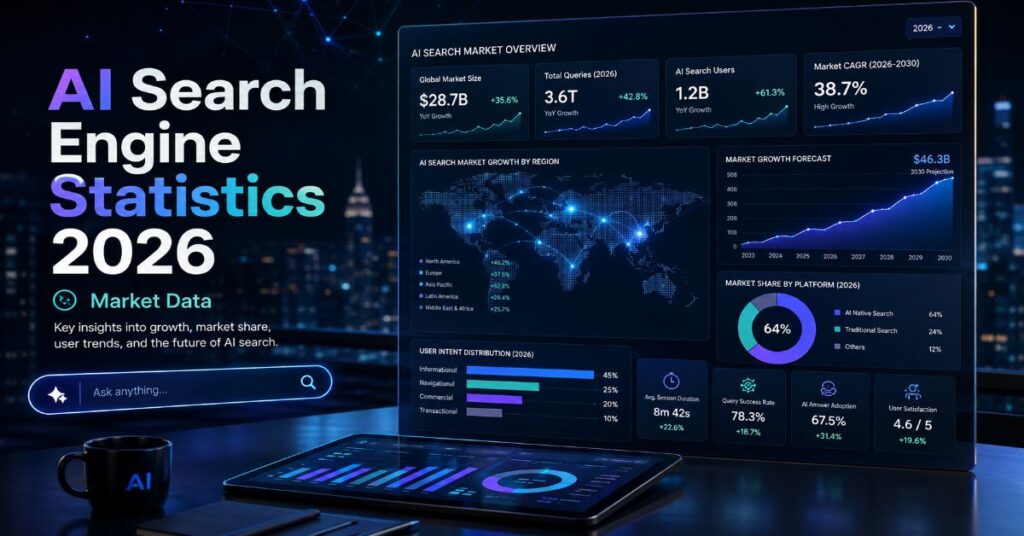
AI search engine statistics 2026 reveal a market expanding at extraordinary speed, although not in the clean, linear way suggested by many online forecasts. ChatGPT reportedly serves more than 900 million weekly active users, Google AI Overviews reaches approximately 2 billion people per month and Google’s Gemini application has exceeded 650 million monthly users. Traffic from AI assistants to external websites is rising by triple-digit percentages in several industries.
Those figures do not mean AI assistants already control more than half of worldwide search volume. Available evidence does not support the widely repeated claim that AI systems account for 56% of global searches or generate 45 billion monthly search sessions. Traditional search remains substantially larger. Statcounter measured Google alone at approximately 90.4% of the conventional worldwide search-engine market in May 2026.
The more consequential shift is occurring inside the search journey. AI Overviews increasingly answer informational questions without requiring another click. Standalone assistants conduct research, compare products and narrow choices before sending a smaller number of highly qualified visitors to websites. A person may spend several minutes discussing a purchase with an assistant, then arrive at a retailer or software provider only after making most of the decision.
This creates a measurement problem. Weekly active users, monthly visits, prompts, searches, AI-generated summaries and referral sessions represent different behaviors. None can be exchanged directly for another.
In our review of current platform disclosures, browsing studies and analytics reports, the clearest conclusion is that AI has become a major discovery layer. It has not yet displaced conventional search at the global level, but it is changing which sources consumers consult, how many results they click and where commercial decisions begin.
AI Search Engine Statistics 2026 at a Glance
The most reliable ai search engine statistics 2026 come from platform disclosures, observed browsing panels and large-scale analytics datasets. Even then, each number needs a precise denominator.
| Metric | Latest Defensible Figure | Period | Source | Methodological Note |
| ChatGPT weekly active users | More than 900 million reported | June 2026 | Reuters reporting | Product users, not searches or website visits |
| ChatGPT weekly active users | More than 800 million | December 2025 | OpenAI | First-party product figure |
| Google AI Overviews users | Approximately 2 billion monthly | 2025–2026 | Users exposed through Google Search | |
| Gemini application users | More than 650 million monthly | November 2025 | App usage, not total Google AI reach | |
| AI Overviews availability | More than 200 countries and territories | May 2025 onward | Available in more than 40 languages | |
| AI Overview traditional-result CTR | 8% of visits | March 2025 | Pew Research Center | Observed U.S. browsing behavior |
| Non-AI Overview traditional-result CTR | 15% of visits | March 2025 | Pew Research Center | Nearly twice the AI-summary rate |
| AI-summary citation click rate | About 1% of visits | March 2025 | Pew Research Center | Measures clicks on links inside summaries |
| Google worldwide search share | About 90.4% | May 2026 | Statcounter | Conventional search-engine activity |
| Bing worldwide search share | About 5.0% | May 2026 | Statcounter | Conventional search-engine activity |
| AI share of website traffic | About 0.1% in one study | Early 2025 | Ahrefs | Analysis of roughly 35,000 websites |
| AI referral growth to U.S. sites | More than tenfold | July 2024–Feb 2025 | Adobe | Growth from a small starting base |
| Retail AI referral growth | 693% year over year | 2025 holiday period | Adobe | U.S. retail websites |
| Ecommerce ChatGPT conversion rate | 11.4% | 2025 | Similarweb | Compared with 5.3% for organic search |
| Transactional-site AI conversion | Around 7% | 2025 data published in 2026 | Similarweb | Compared with roughly 5% from Google |
| Ahrefs AI visitor conversion multiple | 23 times organic traffic | 2025 | Ahrefs | Company-specific result, not a universal benchmark |
| ChatGPT referral visits | Approximately 1.1 billion | June 2025 | Similarweb | External referral visits rather than prompts |
Several popular claims are absent because their original methods could not be verified. There is no credible basis for treating 883 million monthly website users, 45 billion AI search sessions and 2.5 billion monthly prompts as directly comparable measures. The frequently cited prompt figure was actually reported as approximately 2.5 billion prompts per day during 2025, not per month.
How Large Is AI Search in 2026?
AI search is already one of the largest digital behavior categories, but its precise size depends on what is counted. ChatGPT’s reported weekly audience places it among the world’s most widely used software products. Google’s reach is broader because AI Overviews are embedded within a search engine used by billions of people.
Google said AI Overviews reached 1.5 billion monthly users in May 2025. By July, Alphabet CEO Sundar Pichai said the feature had surpassed 2 billion monthly users across more than 200 countries and territories. Google continued to cite the 2 billion figure in November, while reporting more than 650 million monthly users for the separate Gemini application.
These groups overlap. Someone can encounter an AI Overview during a Google search, use Gemini on a phone and consult ChatGPT during the same day. Adding the three audiences would produce an inflated estimate of unique AI search users.
The same caution applies to sessions and prompts. One user can submit dozens of prompts per day. A single session can include several requests, follow-up questions, source checks and product comparisons. Only some of those interactions function as substitutes for a search engine.
AI Search Engine Statistics 2026 by Platform
ChatGPT remains the most prominent standalone assistant. OpenAI stated in December 2025 that the service had more than 800 million weekly users. Reuters reported in June 2026 that the audience had moved above 900 million weekly active users. The product supports conversational answers, live web research, source links, image understanding, file analysis, shopping assistance and agent-style workflows.
Google operates the broadest hybrid search system. AI Overviews appear above or among conventional results, while AI Mode offers a more conversational interface for longer, multipart questions. Google disclosed that AI Mode questions were approximately twice as long as ordinary searches during early testing. The company has not published a clean global count of AI Mode users separate from AI Overviews.
Microsoft combines Bing search, Copilot answers and links to web sources. Public disclosures describe significant Copilot adoption across Windows, Microsoft 365 and enterprise environments, but Microsoft has not released a directly comparable 2026 measure of consumer search prompts.
Perplexity is smaller than ChatGPT and Google but is particularly important to publishers because searching, citation and source navigation are central to its interface. Claude, Gemini, Brave Search and You.com also offer web-grounded answers. Reliable platform-level query totals remain undisclosed for most of them.
AI Search Traffic Growth From 2023 to 2026
The first phase of AI search growth was dominated by direct usage. The second phase added web browsing, live citations and product research. The third phase, now visible in 2026, is integrating those capabilities into operating systems, browsers, workplace products and conventional search pages.
| Period | AI Search Development | Traditional Search Indicator | Major Change | Measurement Limitation |
| 2023 | Standalone chatbot adoption accelerated | Google retained above 90% of conventional search | Conversational interfaces entered mainstream use | Many prompts were not search-related |
| 2024 | AI Overviews launched broadly in the U.S. | Search remained the dominant web acquisition channel | Generative answers moved onto results pages | Early deployments changed frequently |
| Early 2025 | ChatGPT reached 400 million weekly users | Google remained close to 90% globally | Assistants added stronger browsing and citations | Website traffic omitted app usage |
| Mid-2025 | AI Overviews reached 1.5 billion, then 2 billion monthly users | AI summaries reduced downstream clicking | AI became embedded in mass-market search | Exposure did not necessarily equal active use |
| Late 2025 | ChatGPT passed 800 million weekly users | Search advertising revenue continued growing | AI shopping and research journeys expanded | Referral traffic captured only final clicks |
| 2026 | ChatGPT reportedly exceeded 900 million weekly users | Google held about 90.4% of global conventional search in May | Discovery became increasingly multimodal and agentic | No universal definition of an AI search exists |
Adobe found that generative AI referrals to U.S. websites grew more than tenfold between July 2024 and February 2025. During the 2025 holiday period, AI-driven traffic to retail websites increased 693% year over year. Similarweb reported approximately 1.1 billion AI chatbot referral visits in June 2025, representing 357% annual growth.
The percentages are dramatic because the channel began from a small base. Ahrefs found in early 2025 that AI assistants generated only about 0.1% of total traffic across approximately 35,000 websites. Search accounted for 43.8%. Google reportedly sent 345 times more visits than the three principal AI platforms combined.
Both findings can be true. A channel can expand by several hundred percent while remaining small relative to search.
AI Overviews, Click-Through Rates and Zero-Click Search
The strongest independent evidence of AI’s effect on search clicks comes from Pew Research Center. Researchers examined the March 2025 browsing activity of U.S. adults who consented to share their online behavior. When a Google results page displayed an AI-generated summary, users clicked a traditional result during 8% of visits. When no summary appeared, users clicked a result during 15% of visits.
Clicks on citations within the summary were even rarer. Only about 1% of visits containing an AI summary produced a click on a cited source. Users also ended their browsing session more frequently after encountering a summary, doing so during 26% of those visits compared with 16% of visits without one.
These findings support the argument that AI-generated answers reduce downstream website traffic for many informational searches. They do not establish that 60% of all searches are resolved by AI or that 70% of users never scroll beyond an overview. Those broader claims often combine older zero-click studies, survey responses and analytics from limited samples.
Independent SEO research points in the same direction. Ahrefs originally estimated that AI Overviews reduced clicks to top-ranking pages by 34.5%. Its updated analysis, published in February 2026, estimated a larger reduction of approximately 58%.
The commercial effect varies by query. A concise factual question may be answered completely on the results page. A search for expensive software, legal services or a complex product can still generate external research, comparison and conversion activity.
Does AI Search Convert Better Than Google?
AI referral traffic often converts better than broad organic search traffic, but a universal 14.2% versus 2.8% benchmark is not supported by a sufficiently representative public dataset.
Similarweb estimated that visits referred by ChatGPT to ecommerce sites converted at 11.4%, compared with 5.3% for organic search. A separate Similarweb analysis of U.S. transactional websites placed generative AI referral conversion near 7%, compared with approximately 5% for Google referrals.
Adobe has also reported stronger engagement from generative AI visitors. Its analyses found that these users viewed more pages, spent more time on websites and increasingly approached parity with other acquisition channels in conversion and revenue per visit. During the 2025 holiday period, AI-driven retail traffic rose 693% year over year.
Ahrefs produced one of the most dramatic findings. AI referrals represented only about 0.5% of the company’s traffic but generated 12.1% of its signups, giving those visitors a conversion rate approximately 23 times higher than traditional organic traffic.
That result should be treated as a company case study. Ahrefs sells technical SEO software to an audience unusually likely to use AI assistants. The same multiple should not be applied automatically to consumer retail, healthcare or local services.
The conversion premium is nevertheless plausible. AI visitors often arrive after explaining their requirements, comparing options and requesting a recommendation. The assistant completes part of the qualification process before the external click occurs.
Factors Driving Higher AI Search Conversion Rates
Intent concentration is the first factor. Traditional search captures the entire funnel, including definitions, casual research, troubleshooting and navigational queries. AI assistants can sustain a longer conversation and narrow a broad question into a shortlist. The resulting click is often closer to a commercial decision.
Referral scarcity also matters. Assistants usually present fewer external options than a conventional results page. Being selected as one of three cited products or sources can confer more perceived authority than appearing among numerous blue links.
Attribution creates another distortion. AI platforms influence many decisions without receiving referral credit. Similarweb found that much of AI-assisted shopping activity occurred during early interest and consideration stages. A user may later type the retailer’s name, open its application or conduct a branded Google search. Analytics then credits direct or organic search even though AI helped create the demand.
Small sample sizes can inflate reported conversion rates. A website receiving 100 AI visits and 10 purchases records a 10% conversion rate, but a handful of transactions can shift the result sharply.
Industries Receiving the Most AI Search Value
B2B software is among the clearest beneficiaries. Buyers use assistants to compare features, generate shortlists, evaluate integrations and understand technical trade-offs. The category has high order values and long research cycles, making a small number of qualified referrals commercially meaningful.
Retail has produced the largest publicly documented traffic-growth figures. Adobe measured a 693% year-over-year increase in AI-driven retail visits during the 2025 holiday season. Similarweb found that ChatGPT-referred ecommerce visitors converted at more than twice the rate of organic search visitors in its dataset.
Travel also benefits from conversational planning. Users can specify dates, budget, weather preferences and family requirements before visiting a booking platform.
Financial services attract research demand but face greater trust, accuracy and regulatory constraints. AI visitors may arrive with detailed questions, yet users remain likely to verify information through official institutions.
Healthcare follows a similar pattern. Assistants can explain terminology and prepare questions, but sensitive decisions encourage users to seek authoritative clinical sources.
Media and informational publishers face the greatest zero-click risk. Their facts can support generated answers without producing proportional referral traffic. Professional-services firms may be better protected because users still need a lawyer, consultant, accountant or agency after receiving preliminary guidance.
Content Strategy: Adapting to the Zero-Click Era
The measurable reduction in clicks following AI summaries reframes what successful content production means in 2026. Content optimized purely for organic click acquisition faces growing headwinds. High-traffic publishers are increasingly prioritizing citation inclusion within AI Overviews and LLM responses alongside traditional ranking objectives.
Generative Engine Optimization (GEO), as the discipline is now commonly labeled, centers on three technical pillars: structured data markup that makes factual claims machine-parsable, entity authority building through high-citation external linking patterns, and content specificity that creates unique data points AI systems preferentially cite over generic summaries.
Publishers who have invested in original research — proprietary surveys, first-party usage data, exclusive expert interviews — consistently report higher AI citation rates than publishers relying on aggregated secondary sources. Content with verifiable first-party data points tends to achieve citation inclusion at a higher rate than narrative-only content.
The practical implication: track AI citations and brand mentions alongside referral visits, because much of AI’s influence on discovery does not produce an immediately measurable click.
Why AI Search Statistics Often Conflict
The first problem is terminology. A monthly active user is not a visit. A visit is not a prompt. A prompt is not necessarily a search. A search is not necessarily an external referral. Reports that move between these terms without qualification exaggerate the apparent replacement of traditional search.
Website measurement also misses application activity. ChatGPT, Gemini, Copilot and other assistants are used through mobile applications, desktop software, browsers and integrated workplace tools. Website rankings capture only part of the audience.
Referral data misses journeys in which the assistant does not pass a referrer or the user returns later through another channel. Privacy controls, mobile applications and browser restrictions can cause AI-influenced visits to appear as direct traffic.
Market-share claims create the largest confusion. Statcounter measures activity among conventional search engines. It does not place every ChatGPT prompt into the same denominator. Consequently, Google can retain about 90% of measured search-engine share while AI assistants simultaneously attract hundreds of millions of users.
The claim that Google fell from 89% in 2023 to 71% by late 2025 does not match Statcounter’s worldwide all-device series. In May 2026, Statcounter placed Google at approximately 90.4%, Bing at 5.0%, Yahoo at 1.4% and Yandex near 1%.
Analytics Workflow for Measuring AI Referral Traffic
Businesses should avoid relying on a single default analytics channel. AI referrals are fragmented across domains and can be misclassified as referral, organic, direct or unassigned traffic.
Step 1: Establish the Referral Source List
Create and maintain a source list containing known domains from ChatGPT, Perplexity, Gemini, Claude, Copilot, Bing, Brave and emerging assistants. Store the list in a version-controlled document because platform domains and redirect patterns change.
Step 2: Build a Custom GA4 Channel
Create a dedicated AI referral channel group in Google Analytics 4. Match session sources with a carefully tested regular expression. Preserve the original source, medium, campaign and landing-page fields rather than overwriting them with a generic label.
Step 3: Compare Session and User Acquisition
Session acquisition shows which channel generated the current visit. First-user acquisition estimates the channel that originally acquired the person. Reviewing both prevents returning customers from being treated as newly acquired AI users.
Step 4: Add Server-Side Evidence
Compare analytics records with web-server or content-delivery-network logs. Server logs can reveal visits omitted by client-side tracking, script blockers or consent settings.
Step 5: Exclude Bots and Internal Activity
AI crawlers are not human referrals. Separate indexing agents, training crawlers and monitoring systems from users who actively clicked an answer.
Step 6: Standardize Conversion Definitions
Use the same conversion event and attribution window when comparing AI, organic search, paid search and direct traffic. Track purchases, qualified leads, subscriptions and assisted conversions separately.
Step 7: Segment by Intent
Group landing pages into informational, comparison, product, pricing and transactional categories. AI traffic landing on pricing pages should not be compared directly with organic traffic reaching broad educational articles.
Step 8: Measure Value, Not Only Visits
Monitor conversion rate, revenue per session, average order value, engaged-session rate, pages viewed, return visits and sales-qualified leads. A small AI channel may matter if it contributes disproportionate revenue.
Step 9: Track Citation Visibility
Referral analytics measure clicks, not mentions. Use manual prompt testing or specialist visibility platforms to record whether the brand is named, cited positively, compared with competitors or omitted entirely.
Step 10: Audit Monthly
New products, domains and attribution behaviors appear frequently. Review source rules monthly and annotate major platform changes so unusual traffic movements can be interpreted correctly.
The 2028 AI Search Tipping-Point Forecast
Forecasts that AI platforms will overtake traditional search by 2028 depend on what ‘overtake’ means. AI may surpass conventional search in time spent on some research activities without generating more total queries. It may dominate informational discovery while Google remains the largest navigational and commercial gateway.
| Scenario | AI Search Position in 2028 | Traditional Search Position | Main Assumptions |
| Low adoption | AI remains a complementary research channel | Search retains clear dominance | Trust concerns, cost and uneven answer quality slow migration |
| Base case | AI becomes a major discovery and comparison layer | Search remains larger but absorbs more conversational behavior | Continued integration into browsers, devices and Google itself |
| High adoption | AI becomes the primary interface for many informational and commercial journeys | Traditional results lose substantial informational volume | Agents become reliable, fast and widely embedded |
The base case is the most defensible. Google is not standing outside the transition. AI Overviews and AI Mode convert part of conventional search into generative search while preserving Google’s distribution, advertising infrastructure and index.
Standalone assistants should continue gaining share of complex research, planning and comparison. Their external referral volume may grow much faster than total web traffic. Publishers could therefore experience falling informational clicks even while assistants send more commercial traffic.
The decisive metric will not be raw prompt volume. It will be the percentage of commercially valuable journeys in which an AI system influences the shortlist, recommendation or final action.
Expert Perspectives
OpenAI CEO Sam Altman announced at the company’s October 2025 developer event that ChatGPT had reached approximately 800 million weekly users. The milestone illustrated how quickly conversational interfaces had moved from experimental tools to mass-market infrastructure.
Google CEO Sundar Pichai described artificial intelligence as an “expansionary moment” for search during Alphabet’s February 2026 earnings remarks. Google reported that Search usage had reached a record level during the fourth quarter of 2025 despite rapid adoption of standalone assistants.
Pichai had previously said AI Overviews were encouraging people to search more frequently for the categories of queries that displayed them. Google reported more than 10% growth in relevant query types in major markets such as the United States and India.
These statements reflect company measurements and strategic positioning. Independent click studies show that greater search activity does not guarantee more traffic to external publishers.
Takeaways
- ChatGPT reportedly serves more than 900 million weekly users, while Google AI Overviews reaches approximately 2 billion monthly users.
- AI platforms do not yet account for 56% of global measured search-engine activity. Google retained about 90.4% of conventional worldwide search share in May 2026.
- Google users clicked traditional results during 8% of visits containing an AI summary, compared with 15% when no summary appeared.
- AI referral traffic is expanding by triple-digit percentages but remains far smaller than organic search for most websites.
- AI visitors frequently convert better because assistants narrow choices before sending an external click, but results differ sharply by industry and website.
- Publishers should track AI citations and brand mentions alongside referrals because most AI influence does not produce an immediately measurable visit.
- Generative Engine Optimization (GEO) — structured data, original research, and entity authority — is emerging as the complement to traditional SEO for AI citation visibility.
- The most plausible 2028 outcome is a hybrid market in which AI dominates more research tasks while traditional search remains a major navigational and commercial gateway.
Conclusion
The defining feature of ai search engine statistics 2026 is not the collapse of traditional search. It is the fragmentation of discovery across conventional results, AI summaries, standalone assistants, applications and agents.
Google remains dominant within measured search-engine activity, contradicting claims that its worldwide share has already fallen to 71%. At the same time, ChatGPT’s reported audience, Google’s 2 billion AI Overview users and triple-digit referral growth demonstrate that AI discovery is no longer experimental.
The economic consequences are uneven. Informational publishers can lose clicks when generated answers satisfy a query directly. Retailers, software providers and professional-services firms may receive fewer but more qualified visitors. Analytics systems capture only the final external visit, leaving much of AI’s earlier influence invisible.
Marketers should therefore measure three separate outcomes: appearance within generated answers, qualified traffic from AI platforms and revenue influenced by AI-assisted journeys. The companies that make this distinction will understand the channel more clearly than those chasing a single global market-share figure.
By 2028, AI may not replace the search engine. It is more likely to become the interface through which an increasing share of searching, comparing and deciding takes place.
FAQs
How many people use AI search engines in 2026?
No complete unique-user count exists because audiences overlap. ChatGPT reportedly exceeds 900 million weekly users, Google AI Overviews reaches roughly 2 billion monthly users and Gemini exceeds 650 million monthly users. These figures cannot be added together because many people use more than one platform.
What percentage of searches use AI in 2026?
No reliable global study proves that 56% of searches occur through AI assistants. AI features reach billions of users, but Google still held approximately 90.4% of the conventional worldwide search-engine market in May 2026. AI usage and traditional search share use different denominators.
Does AI search reduce website clicks?
Yes, particularly for informational queries. Pew Research Center found that users clicked a traditional result during 8% of Google visits containing an AI summary, compared with 15% of visits without one. Only about 1% clicked a citation inside the summary.
Does AI search traffic convert better?
It often does, but there is no universal rate. Similarweb measured 11.4% conversion for ChatGPT-referred ecommerce visits compared with 5.3% for organic search. Ahrefs reported a 23-times conversion multiple on its own website, which should be treated as a specialized case study.
What is Generative Engine Optimization (GEO)?
GEO refers to optimizing content for citation inclusion within AI-generated answers, rather than solely for organic ranking positions. It emphasizes structured data markup, original research with verifiable data points, and entity authority signals that AI systems preferentially cite.
Will AI search replace Google by 2028?
A complete replacement is unlikely by 2028. AI assistants should capture more research and comparison activity, but Google is integrating AI directly into Search. A hybrid market — combining generated answers, conversational research and conventional results — is more likely.
References
Adobe. (2025, March 17). Traffic to U.S. retail websites from generative AI sources jumps 1,200 percent. Adobe Blog. https://blog.adobe.com/en/publish/2025/03/17/adobe-analytics-traffic-to-us-retail-websites-from-generative-ai-sources-jumps-1200-percent
Adobe. (2026, January 12). AI traffic surges across industries, retail sees biggest gains. Adobe for Business. https://business.adobe.com/blog/ai-driven-traffic-surges-across-industries
Ahrefs. (2025, March 26). AI makes up 0.1% of traffic, but clicks are not everything. https://ahrefs.com/blog/ai-traffic-research/
Ahrefs. (2026, February 4). AI Overviews reduce clicks by 58%. https://ahrefs.com/blog/ai-overviews-reduce-clicks-update/
Google. (2025, May 20). AI Overviews expand to over 200 countries and territories. The Keyword. https://blog.google/products-and-platforms/products/search/ai-overview-expansion-may-2025-update/
OpenAI. (2025, December 8). The state of enterprise AI. https://openai.com/index/the-state-of-enterprise-ai-2025-report/
Pew Research Center. (2025, July 22). Do people click on links in Google AI summaries? https://www.pewresearch.org/short-reads/2025/07/22/google-users-are-less-likely-to-click-on-links-when-an-ai-summary-appears-in-the-results/
Similarweb. (2025). Similarweb’s third annual global ecommerce report: Growth shifts to apps and AI. https://ir.similarweb.com/news-events/press-releases/detail/132/similarwebs-3rd-annual-global-ecommerce-report-growth-shifts-to-apps-and-ai
Statcounter Global Stats. (2026). Search engine market share worldwide. https://gs.statcounter.com/search-engine-market-share
