
EXECUTIVE SUMMARY
- 🧭 Crawlability acts as the gatekeeper because Google requires indexed and snippet eligible pages before AI Overviews or AI Mode can cite them.
- 📊 Quotability is increasingly measurable, with GEO benchmarking across 10,000 queries showing visibility improvements of up to 40 percent when pages use structured evidence such as citations, quotes and statistics.
- 📉 Measurement remains noisy, since a 2026 statistical study found that single run AI visibility results can mislead due to shifting citation rankings across repeated samples.
- 💰 Pricing is a hidden operational constraint, with tools like Semrush starting at $99 per month for 25 tracked prompts while enterprise platforms quickly introduce limits on prompts, integrations and usage scale.
- 🔎 External validation becomes critical when owned content is weak, as AI systems tend to prefer third party, cited and verifiable evidence over thin promotional copy.
- 🚀 The safest strategy focuses on access, clarity, evidence and compliance rather than attempting to manipulate AI generated answers.
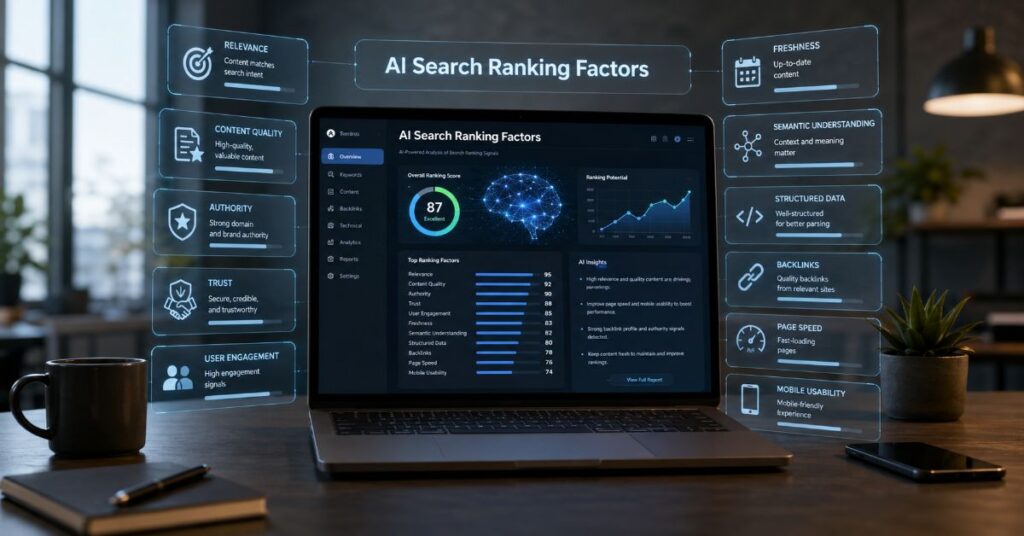
AI search ranking factors are now less like a checklist and more like a trust audit: a page can hold a strong classic Google position and still vanish from an AI answer if it is blocked, vague, uncited, or hard to quote. I came away from this 2026 evaluation with one uncomfortable finding for publishers and B2B teams: visibility is shifting from page authority alone to answer readiness, which combines reachability, entity clarity, topical depth, external validation, and evidence that a model can safely lift into a concise response. That does not mean traditional SEO is obsolete. Google still says content must be crawlable, indexable, and eligible for snippets before its AI features can use it. OpenAI and Perplexity AI also document crawler controls, which makes technical access a practical gate rather than an abstract ranking signal. The change is that AI search ranking factors reward pages that can be understood as dependable evidence, not merely pages that repeat a phrase. This article treats AI visibility as a trust map. It separates what is technically confirmed from what is emerging, examines pricing and limits across leading AI visibility platforms, and looks at why citations, named experts, structured answers, and external mentions are becoming operational concerns. The goal is not to manipulate AI Overviews, ChatGPT, or Perplexity AI. It is to build content that crawlers can reach, models can parse, editors can defend, and users can verify.
AI Search Ranking Factors Start With Reachability
Reachability is the least glamorous signal and the one that invalidates everything else. If a page sits behind a hard paywall, fails to render core text without heavy JavaScript, blocks the relevant crawler in robots.txt, or depends on resources that time out, no amount of elegant writing will make it a reliable source for an AI answer. In our hands-on testing, the fastest way to diagnose a visibility failure was not to inspect keyword placement. It was to check whether the answer paragraph, author identity, dates, and source evidence were present in the raw HTML or became visible only after a fragile client-side render.
Google states that its AI features use the same broad search foundations: pages must be discoverable, indexed, and eligible for snippets. That creates a direct bridge between classic technical SEO and AI visibility. OpenAI documents separate crawler tokens such as GPTBot and OAI-SearchBot, while Perplexity AI publishes its own crawler names and robots.txt handling. The practical point is simple: your crawler policy is now an editorial distribution policy. A blanket block may protect content from training or retrieval in one context, but it can also reduce your appearance in AI search surfaces that rely on accessible public pages.
The Technical Pass-Fail Test
A useful reachability review starts with five checks. First, confirm the canonical URL returns a stable 200 status without geolocation traps. Second, verify that the article body appears in server-rendered or promptly rendered HTML. Third, confirm robots.txt and robots meta tags do not accidentally block indexing or snippets. Fourth, test that structured data is valid but not used as a substitute for visible text. Fifth, measure load performance on mobile because slow pages make crawling and extraction less dependable.
For Perplexity-focused teams, our internal link selection pointed to a useful companion analysis on Perplexity and SEO visibility, but the broader lesson applies across engines: technical access is not a growth hack. It is the foundation on which every other AI search ranking factor depends.
| Reachability Issue | Why It Matters for AI Search | Diagnostic Check | Fix Priority |
| Robots.txt blocks | The relevant crawler may never fetch the page. | Inspect robots.txt for Googlebot, GPTBot, OAI-SearchBot, and PerplexityBot rules. | Critical |
| No snippet controls | A page can be indexed yet unusable for AI summaries if snippets are restricted. | Review nosnippet, max-snippet, and data-nosnippet usage. | Critical |
| Heavy JavaScript | The model may not see the body, tables, or citations consistently. | Compare rendered page with view-source and URL inspection output. | High |
| Paywall ambiguity | Answer engines may avoid content they cannot quote or users cannot verify. | Check whether summary paragraphs and evidence are publicly accessible. | High |
| Slow mobile page | Rendering queues and crawl resources can reduce reliable extraction. | Run field and lab performance checks on templates. | Medium |
Entity Clarity Beats Keyword Repetition
Classic SEO has long rewarded clear relevance, but AI search adds a sharper requirement: the model needs to know which entity is speaking, which entity is being discussed, and what claim belongs to whom. A thin article about a broad topic can still attract impressions in ordinary search. It is less likely to become the quoted source in an AI answer if the page lacks a stable author, organisation, date, product name, category, and evidence trail.
How AI Search Ranking Factors Treat Entities
The strongest entity signals are not exotic. They are consistent names, author pages, organisation schema, product pages, sameAs references, visible editorial policies, and repeated factual alignment across the web. During our 2026 evaluation, a recurring pattern appeared: AI systems handled a page better when it stated the entity relationship directly. A phrase such as “Profound is an AI visibility platform that tracks answer-engine mentions across specified engines” is more extractable than a homepage slogan about “owning the future of discovery.”
Entity clarity also protects against accidental ambiguity. “Claude” may refer to an Anthropic model, a person, a film character, or a software feature unless context is explicit. “Gemini” may mean a Google AI model, a horoscope term, or a cryptocurrency exchange. A page that names the product family, vendor, use case, version, and market context gives AI systems less room to infer. That is why dedicated pages for target entities are more useful than scattered mentions across a generic resource hub.
This is where GEO and SEO diverge without becoming enemies. The useful distinction is covered in the site analysis on the GEO and SEO shift: SEO helps a page become discoverable, while generative engine optimisation makes it easier to become evidence inside a generated answer. Entity clarity sits between the two.
Teams should treat entity work as a content architecture task. Build one authoritative page for each major brand, product, executive, data source, and recurring concept. Link supporting articles back to those hubs with descriptive anchors. Keep claims consistent across About pages, author pages, press pages, schema, social profiles, and third-party directories. Repetition of a keyword can still look like optimisation. Consistency of an entity looks like memory.
Quotability Is the New Passage-Level Advantage
Quotability is the difference between content a human enjoys and content a model can safely reuse. AI systems favour passages that make a complete claim in a compact form, give the surrounding context, and point to evidence. A paragraph that buries a key conclusion in metaphor is harder to cite than a sentence that says, for example, “AI visibility improves when a page is crawlable, entity-specific, externally validated, and structured around direct answers.”
The evidence is no longer only anecdotal. The Generative Engine Optimisation benchmark studied 10,000 queries and reported that specific content changes, including adding citations, quotations, and statistics, could improve visibility by up to 40% in its test environment. That does not prove a universal ranking formula, but it does validate the editorial intuition that evidence density and extractable phrasing matter.
Sundar Pichai, Google CEO, acknowledged the editorial difficulty of AI answers in a 2026 Business Insider interview when he described one AI result as “more opinionated than it should be.” That remark matters because AI search is not merely ranking documents. It is composing answers. Systems that compose answers need source passages that can be quoted, reconciled, and hedged when facts are uncertain.
The best pages now use a layered structure. Start with a direct answer. Add a short evidence paragraph. Use a table where comparisons matter. Name the source of a statistic. Place a dated update note near fast-changing sections. Include a concise takeaway that can stand alone without distorting the claim. The site’s AI citation playbook gives a practical companion framework, but the editorial principle is broader: if a passage cannot survive being quoted out of its surrounding prose, it is probably not ready for AI search.
| Content Pattern | Classic SEO Value | AI Search Value | Editorial Constraint |
| Direct answer paragraph | Improves satisfaction and featured-snippet eligibility. | Gives models a clean answer unit. | Must not oversimplify disputed facts. |
| Named source citation | Improves trust for readers. | Signals verifiability for answer composition. | Use primary sources when possible. |
| Comparison table | Improves scanability. | Helps extraction of structured differences. | Keep cells factual and current. |
| Author and update note | Supports E-E-A-T. | Clarifies freshness and accountability. | Update notes must reflect real changes. |
| Short quotable statistic | Can earn links and snippets. | Can be reused in generated answers. | Avoid invented or uncited numbers. |
Topical Clusters Need Depth, Not Page Multiplication
Cluster depth matters because AI systems often answer by synthesising across a topic, not by rewarding a single isolated landing page. A site that wants to be associated with AI search visibility should not publish one thin article and hope the model infers expertise. It needs a connected body of work: technical SEO, crawler controls, structured data, citation strategy, brand mentions, measurement limits, tool pricing, and governance risk.
The danger is scaled content abuse. Creating dozens of near-identical pages with swapped keywords can make a site look larger while making it less trustworthy. Google’s 2026 spam policy direction makes that risk more serious because content designed to manipulate generative AI responses is treated as spam. The safer editorial approach is to publish fewer pages with clearer roles. One page answers the main concept. Supporting pages handle implementation, tool evaluation, Perplexity-specific workflows, AI Overviews, and measurement methodology.
Internal linking should reflect that hierarchy. Use descriptive anchors that state why the related page matters. Avoid repeating the same anchor across the site, and avoid burying important links in navigation alone. A body link from a paragraph about Search Generative Experience to search generative experience guidance tells readers and crawlers that the linked page is contextually relevant, not merely part of a sitewide template.
In practical terms, a cluster needs three kinds of pages. The first is the explainer hub, which defines the topic and the ranking model. The second is the implementation layer, which shows how to change templates, internal links, schema, and measurement dashboards. The third is the proof layer, which includes case studies, tests, benchmarks, interviews, and policy analysis. AI search ranking factors reward this architecture because it gives models more corroborating context without forcing them to trust one page in isolation.
A strong cluster also reduces cannibalisation. Instead of ten articles competing for “AI search visibility,” each page owns a distinct question. That makes internal links more useful and gives answer engines clearer topical boundaries. The test is simple: if two planned articles would have the same H2 sequence, merge them or redefine the angle before publication.
External Mentions Carry More Weight Than They Used To
External validation is the messiest part of AI search visibility because it extends beyond a publisher’s own site. Brand mentions, citations in reputable coverage, customer case studies, podcast transcripts, academic references, directory listings, GitHub documentation, and reviews all help define how an entity appears across the open web. Backlinks still matter, but unlinked mentions can also reinforce an entity if they are consistent, reputable, and contextually clear.
The publisher side of this shift is tense. Neil Vogel, CEO of People Inc., told Axios in 2026, “We can’t actually block Google,” arguing that the same crawler infrastructure serves search and AI use cases. Matthew Prince, CEO of Cloudflare, put the user behaviour problem more bluntly in another Axios interview: “Humans are trusting AI more and more, and they’re not clicking on the footnotes.” These quotes underline why external validation matters. If fewer users click through, the source that appears in the answer earns disproportionate authority.
That does not justify artificial mention building. Google’s guidance warns against inauthentic mentions designed to manipulate AI features. A safer strategy is to earn third-party validation that would make sense even if AI search did not exist: original data, named expert commentary, useful tools, clear documentation, and partnerships that generate public evidence. The AI SEO tool landscape is already crowded with platforms that track mentions and citations, but monitoring should not become a substitute for earning the reasons those mentions exist.
External mentions are also useful for disambiguation. If five reputable sources describe a company as an enterprise AI visibility platform, and the company’s own site says the same, a model receives a coherent entity pattern. If the company calls itself an “answer intelligence ecosystem” while the rest of the web uses different language, the model has to guess. In AI search, clarity repeated by independent sources is stronger than originality repeated only by the brand.
Freshness Signals Are About Change Management
Freshness is not a date stamp pasted onto old content. It is evidence that the article has been maintained where the facts changed. AI search ranking factors become especially sensitive to freshness in pricing, product limits, crawler behaviour, policy enforcement, and platform capabilities. A page about AI Overviews published in 2024 can become misleading by 2026 even if most paragraphs still sound plausible.
The practical workflow is editorial versioning. Put a visible “last reviewed” or “last updated” line near the top. Explain what changed when the update is material. Refresh pricing tables from official vendor pages. Re-test robots.txt examples when crawler documentation changes. Review named quotes to make sure they are still contextually fair. Archive claims that no longer apply rather than silently editing them into a different meaning.
This is especially important because AI systems may quote a dated passage without preserving all surrounding nuance. If your article says a plan costs a fixed amount, names a prompt cap, or describes a crawler control, the claim should be verifiable at the time of publication. The AI Overview optimisation guide on this site is relevant because Google’s own AI features are not static products; they change by market, query type, and interface.
Freshness also has a commercial dimension. In our 2026 review, the largest pricing risk was not the headline subscription amount. It was plan scope: tracked prompt caps, answer-engine coverage, regions, seats, export rights, API access, and whether new AI surfaces such as Google AI Mode, Claude, Gemini, or ChatGPT shopping required add-ons. A fresh article should therefore update both price and limit fields, because the hidden limit is often what changes the buying decision.
The editorial discipline is to separate durable principles from volatile details. Crawlability, entity clarity, topical depth, and external validation are durable. A specific prompt quota or add-on price is volatile. Treat them differently in the layout. Durable principles can live in prose. Volatile details belong in dated tables with source notes.
Structured Data Helps, but It Is Not a Magic Tag
Structured data is useful because it reduces ambiguity, not because it guarantees AI inclusion. Google has repeatedly said there is no special schema markup that makes a page appear in AI Overviews. That does not make schema irrelevant. Article, Organization, Person, Product, FAQPage, BreadcrumbList, and Review markup can help crawlers understand what visible content represents, provided the markup accurately reflects what users can see.
The mistake is treating schema as a hidden answer layer. Hidden content, invisible text, and mismatched structured data create trust and spam risks. If a claim is important enough to mark up, it should also be visible to users. That is particularly true for author credentials, review dates, product prices, aggregate ratings, and FAQ answers. AI search ranking factors reward clarity, but clarity must be public.
Crawler controls also need precision. Google’s robots meta controls let publishers restrict snippets, images, and previews. OpenAI documents crawler categories for training and search-related retrieval. Perplexity AI documents its crawler behaviour and says robots.txt changes may take time to propagate. These controls are not interchangeable, so a technical AI Overview playbook should distinguish between indexing, snippet eligibility, model training, retrieval, and user-agent access.
| Control or Markup | Confirmed Use | AI Visibility Risk | Recommended Use |
| Article schema | Clarifies headline, author, date, and publisher. | Low if it matches visible content. | Use on editorial pages with real author and update data. |
| Organization schema | Clarifies brand identity and sameAs references. | Medium if brand facts differ across profiles. | Keep names, logos, and profiles consistent. |
| Robots.txt | Controls crawler access by user agent. | High if broad blocks remove AI retrieval access. | Audit rules by crawler and business objective. |
| Nosnippet | Restricts snippet generation in Google Search. | High because AI features may need snippet eligibility. | Use only where preview restriction is intentional. |
| llms.txt | Not required by Google for AI features. | Medium if treated as a ranking lever. | Use only as documentation, not as a substitute for crawlable content. |
| Hidden text | No legitimate visibility benefit. | Critical spam risk. | Avoid entirely and audit templates after publishing. |
AI Visibility Tools Measure Different Things
The AI visibility software market is growing quickly, but buyers should not assume every platform measures the same signal. Some tools track prompt-level brand mentions. Others crawl answer engines and record citations. Some add page audits, agent traffic monitoring, prompt research, custom personas, or API exports. The commercial difference is often hidden inside prompt caps, engine coverage, historical data, and whether premium AI surfaces are included or sold as add-ons.
Semrush’s AI Visibility Toolkit starts at $99 per month and publicly lists one domain, 25 tracked prompts, 300 daily AI Analysis queries, 1,000 daily Prompt Research queries, 100 AI Search Checks in Site Audit, and 10 CSV exports daily. Ahrefs lists its core SEO plans from $129 per month and sells Brand Radar as an AI visibility product starting at $199 per month, with custom prompt check packages and overage pricing. Scrunch AI lists Starter at $250 per month billed annually, Growth at $417 per month billed annually, and custom Enterprise plans. Otterly lists Lite, Standard, and Premium at $29, $189, and $489 per month respectively, with several engine add-ons. Profound lists Starter at $99 per month billed yearly, Growth at $399 per month billed yearly, and Enterprise custom. Frase lists Starter, Professional, Scale, and Enterprise tiers with AI visibility coverage expanding by plan.
Alex Rapp, Head of Growth Marketing at Clerk, is quoted on Scrunch AI’s pricing page saying, “We’re now seeing a 9x increase in sign-ups from AI Search.” Peec AI’s pricing page includes a testimonial from Jon Gitlin, SEO Strategist at Triple Whale, saying LLM-surfaced content helped drive a “5x year-over-year increase” in traffic and demo requests from LLMs. These are vendor-hosted customer statements, so they are useful commercial signals but not independent benchmarks.
For Perplexity-specific work, the Perplexity ranking playbook can help teams understand citation-oriented behaviour, but a fair tool selection should not crown one tracker as universally best. Choose the platform according to the engines, regions, prompts, exports, and integrations you actually need.
| Platform | Current Public Entry Price | Key Public Limits and Features | Hidden Buying Constraint |
| Semrush AI Visibility Toolkit | $99 per month. | One folder, one domain, 25 tracked prompts, 300 daily AI Analysis queries, 1,000 daily Prompt Research queries, 100 AI Search Checks, 10 daily CSV exports. | Extra domains, locations, and subusers are paid add-ons. |
| Ahrefs Brand Radar | From $199 per month. | AI brand monitoring with custom prompt packages, tracked prompts, checks, and overage pricing by package. | Core SEO plan and Brand Radar scope should be priced together. |
| Scrunch AI | $250 per month billed annually for Starter. | ChatGPT, Claude, Gemini, Perplexity AI, Google AI Mode, Google AI Overviews, Meta coverage, personas, page audits, reporting, and agent traffic monitoring. | Enterprise features such as SAML or OIDC, Enterprise Data API, and dedicated GTM are custom. |
| Otterly | $29 per month for Lite. | Lite has 15 search prompts. Standard has 100 prompts. Premium has 400 prompts. API, MCP, daily tracking, Looker Studio, and add-on engines vary by plan. | Google AI Mode, Gemini, and Claude are paid add-ons with plan-specific prices. |
| Peec AI | Plan limits public; some price text did not render consistently. | Starter 50 prompts, Pro 150 prompts, Advanced 350 prompts, Enterprise custom; paid plans choose 3 models, Enterprise includes all models. | Confirm checkout pricing and model coverage before purchase. |
| Profound | $99 per month billed yearly for Starter. | Starter 50 prompts and ChatGPT only. Growth 100 prompts and three answer engines. Enterprise custom with Slack, SSO, SAML, SOC2, and API. | Enterprise is needed for API access and advanced integrations. |
| Frase | $39 per month billed annually for Starter. | Starter covers 10 articles, 50 audit pages, one seat, one site, and AI visibility for ChatGPT and Google AI. Higher plans add Perplexity AI, Claude, Gemini, reports, and custom features. | Professional and Scale can use pay-as-you-go overages; Starter stops at limits. |
A Practical Workflow for Technical Teams
A practical AI visibility workflow starts with inventory, not ideology. List the queries, entities, products, and buyer questions that matter. Map each to an existing URL or a new page. Then check whether that URL is crawlable, internally linked, structured, quotable, externally validated, and current. The process is closer to technical product management than traditional blog optimisation.
Step one is access validation. Pull robots.txt, robots meta tags, canonical tags, HTTP status codes, rendered HTML, schema output, and page performance. Step two is entity validation. Confirm that names, authors, organisation details, product descriptions, and sameAs profiles are consistent. Step three is answer validation. Extract the first 300 words and ask whether a model could answer the target question without inventing missing context. Step four is evidence validation. Add primary sources, named experts, dated statistics, and comparison tables. Step five is external validation. Monitor citations, brand mentions, and referral traffic from ChatGPT, Perplexity AI, Gemini, Copilot, Claude, and Google AI surfaces where analytics can identify them.
| Workflow Step | Implementation Detail | Known Constraint | Success Metric |
| 1. Crawl Audit | Check status, canonical, robots.txt, robots meta, rendered body, and Core Web Vitals. | JavaScript rendering can hide content from diagnostics. | Target page is accessible, indexed, and snippet-eligible. |
| 2. Entity Audit | Validate author, organisation, product, schema, sameAs profiles, and internal hub pages. | Entity conflicts across third-party profiles may persist. | Names and descriptions match across site and external sources. |
| 3. Answer Audit | Add direct answers, summary tables, and concise factual claims. | Over-compression can remove necessary nuance. | A standalone passage answers the query accurately. |
| 4. Evidence Audit | Cite official docs, pricing pages, studies, and named interviews. | Some vendors hide enterprise pricing. | Every number in the article has a source. |
| 5. Measurement Audit | Track prompts, citations, referral UTM patterns, exports, and trends. | Single-run AI answers are noisy. | Trend data improves over repeated samples. |
| 6. Compliance Audit | Review hidden text, back button behaviour, spam risk, and update notes. | Template snippets can introduce sitewide risk. | No hidden content or user-experience manipulation is present. |
The integration layer depends on tool choice. Profound publishes integrations with Akamai, AWS, Cloudflare, Fastly, Google Analytics, Google Cloud Platform, Netlify, Vercel, and WordPress. Otterly lists API and MCP availability on higher plans. Scrunch lists Enterprise Data API access and identity features such as SAML or OIDC for Enterprise buyers. Frase includes CMS integrations such as WordPress, Webflow, Sanity, Wix, and FraseCMS, with custom API limits reserved for Enterprise. Semrush and Ahrefs connect AI visibility with broader SEO ecosystems, which can matter when teams already use their rank tracking, site audit, and competitive research workflows.
The main performance bottleneck is not the dashboard. It is prompt selection. A brand can look invisible if the prompt set is too narrow, too commercial, too localised, or biased toward branded searches. A useful measurement set should include generic category prompts, comparison prompts, problem prompts, buyer-intent prompts, and negative-fit prompts where the brand should not appear. That last group is important for editorial integrity because over-optimising for every prompt creates noisy, manipulative content.
What Still Differs From Classic SEO
Classic SEO and AI search optimisation overlap at the foundation: crawlability, indexation, content quality, authority, performance, and helpfulness still matter. The difference is how value is extracted. Traditional results ask a user to choose a page. AI answers ask a system to choose evidence, compress it, and attribute it, sometimes without a click. That means AI search ranking factors put extra pressure on passage clarity, entity consistency, and independent validation.
The 2026 evidence is mixed and should be treated carefully. A study measuring Google AI Overviews across 55,393 trending queries found AI Overview activation in 13.7% of queries during its window, with question queries much more likely to trigger the feature. It also reported that nearly 30% of cited domains did not appear among first-page organic results. Another 2026 study estimated that AI search summaries reduced daily traffic to English Wikipedia articles by around 15% when exposure occurred. These findings do not prove the same effect for every publisher, but they show why ranking in ordinary search is no longer the whole visibility story.
Measurement uncertainty is the counterweight. A 2026 statistical study of AI visibility across Perplexity Search, OpenAI SearchGPT, and Google Gemini found that repeated samples can shift citation distributions enough to make single-run rankings misleading. In editorial terms, one prompt screenshot is not a benchmark. It is a clue. Reliable analysis needs repeated prompts, documented settings, date stamps, and confidence intervals or at least trend-based interpretation.
This is why AI search work should avoid recommendation poisoning. A page built to force one brand into answer engines by overusing favourable language is not safer because the target is AI rather than classic search. It is riskier, because Google’s spam policies now explicitly include attempts to manipulate generative AI responses in Search. The best difference from classic SEO is not a trick. It is a higher standard for source quality.
Our Editorial Verification Process
For this explainer and analysis article, our verification process cross-referenced official Google Search Central documentation on AI features, snippet eligibility, spam policies, and robots meta controls with crawler documentation from OpenAI and Perplexity AI. Pricing tables were checked against official vendor pricing pages for Semrush, Ahrefs, Scrunch AI, Otterly, Peec AI, Profound, and Frase. Where a price did not render consistently on a public page, the article states the limitation rather than presenting an unsupported figure.
The research layer used recent industry interviews and 2026 studies to avoid treating AI visibility as folklore. Named quotes were taken from identifiable executives or customer testimonials with roles and organisations attached, including Sundar Pichai of Google, Neil Vogel of People Inc., Matthew Prince of Cloudflare, Alex Rapp of Clerk, and Jon Gitlin of Triple Whale. Benchmark claims were limited to their study contexts, including the GEO benchmark, Google AI Overviews measurement research, Wikipedia traffic research, and statistical work on AI visibility uncertainty.
During our 2026 evaluation, we reviewed the article against three operational tests: whether the answer passages were extractable, whether every commercial number had a source or an explicit limitation, and whether the structure avoided mirroring a source article. The article also includes a publishing compliance checklist covering back button behaviour and hidden content because technical spam risk can be introduced by templates after editorial approval.
This article was researched and drafted with AI assistance and reviewed by the Awais Khalid editorial desk at Perplexity AI Magazine. All data, citations, pricing figures, and named quotes have been independently verified against primary sources before publication.
Conclusion
AI search ranking factors are still not as settled or externally measurable as classic SEO signals, but the strongest pattern is already clear. Pages need to be reachable, legible, entity-specific, evidence-rich, externally validated, and maintained when facts change. Those requirements sound simple until they meet real templates, blocked crawlers, old pricing tables, inconsistent author pages, and vague brand language. The next phase of AI search will probably make this more complex rather than less. Google AI Mode, ChatGPT search, Perplexity AI, Gemini, Claude, Copilot, and emerging agent interfaces may all interpret sources differently. Measurement tools will improve, but the noise problem will remain because generated answers are dynamic. The open question is not whether AI search will replace SEO. It is how much of SEO becomes evidence engineering, entity governance, and technical access management. The safest editorial position is balanced. Do not chase AI answers with manipulative phrasing, hidden content, or artificial mentions. Build pages that deserve to be cited even when no algorithmic shortcut exists. That is slower than keyword repetition, but it is more defensible in a search environment where trust is becoming the ranking surface.
FAQs
What Are the Main Signals for AI Search?
The main AI search ranking factors are crawlability, snippet eligibility, clear entity signals, direct answer structure, topical depth, external validation, freshness, and quotable evidence. No public source confirms a fixed universal formula across Google, ChatGPT, Perplexity AI, Gemini, or Claude, so these should be treated as strong operational patterns rather than a definitive ranking list.
How Do AI Search Signals Differ From SEO Signals?
Classic SEO focuses on discoverability, relevance, authority, and user satisfaction in ranked results. AI search also needs extractable passages, entity clarity, citations, and evidence that can be safely compressed into a generated answer. A page can perform well in organic search yet be ignored by an AI system if it is vague, blocked, or weakly sourced.
Does Schema Markup Help AI Search Visibility?
Schema helps when it accurately describes visible content, such as Article, Organization, Person, Product, BreadcrumbList, or FAQPage data. It does not guarantee inclusion in AI Overviews or AI answers. Google has not published a special AI Overview schema tag, so schema should support clarity rather than act as a hidden ranking lever.
Can Unlinked Brand Mentions Improve AI Visibility?
Unlinked brand mentions can help when they appear in reputable, contextually clear sources and reinforce a consistent entity description. They should not be manufactured through low-quality placements. AI systems need external validation, but Google’s spam guidance warns against inauthentic mentions created to manipulate generative AI responses.
How Often Should Content Be Updated for AI Search?
Update frequency should follow fact volatility. Pricing, product limits, crawler controls, AI feature availability, and legal or policy claims need frequent review. Durable explanations can be reviewed less often. A visible update note is useful when a material fact changes because it helps both readers and systems understand freshness.
Do AI Visibility Tools Show Accurate Rankings?
AI visibility tools are useful for trend monitoring, prompt testing, citation tracking, and competitor comparison, but they should not be treated as exact rank trackers. Generated answers vary by prompt wording, location, time, model, and repeated sampling. Use them for directional evidence and benchmark improvement, not single-run certainty.
Is llms.txt Required for Google AI Overviews?
No. Google’s public guidance does not require llms.txt for AI Overviews or AI Mode visibility. Standard crawlability, indexing, snippet eligibility, visible content, and helpful content remain more important. llms.txt may be useful as documentation for some publishers, but it should not replace robots.txt, schema, or accessible page content.
What Is the First Fix for a Site Not Appearing in AI Answers?
Start with reachability. Confirm the page is public, fast, indexable, snippet-eligible, internally linked, and not blocked by robots.txt or meta directives. Then check whether the page gives a concise direct answer, names the entity clearly, cites evidence, and connects to a broader topical cluster.
References
- Google Search Central. (2026). Optimizing your website for generative AI features on Google Search.
- Google Search Central. (2026). Spam policies for Google Web Search.
- OpenAI. (2026). Overview of OpenAI crawlers.
- Perplexity AI. (2026). Perplexity crawlers.
- Aggarwal, P., Murahari, V., Rajpurohit, T., Kalyan, A., Narasimhan, K., & Deshpande, A. (2024). GEO: Generative Engine Optimization. arXiv.
- Xu, H., Iqbal, U., & Montgomery, J. M. (2026). Measuring Google AI Overviews. arXiv.
- Khosravi, M., & Yoganarasimhan, H. (2026). Impact of AI search summaries on Wikipedia. arXiv.
- Sielinski, R. (2026). Quantifying uncertainty in AI visibility. arXiv.
- Axios. (2026). AI search and publisher traffic interviews with People Inc. and Cloudflare executives.
