
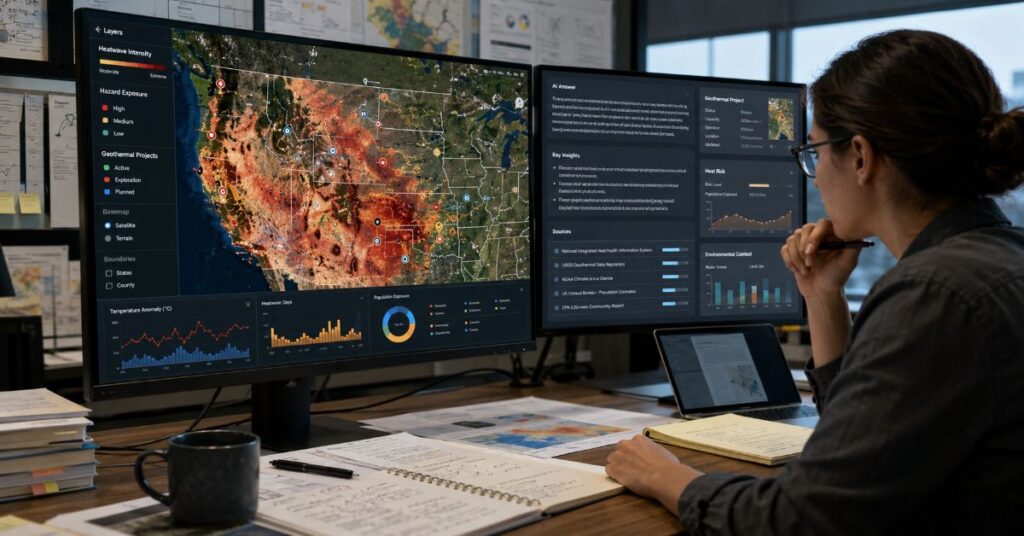
- 🌍 Evidence in 2026 separates GEO into two practical paths: geospatial case collections for place based decisions and Generative Engine Optimization pilots for measuring AI answer visibility.
- 🔥 Heatwave and disaster case studies are most valuable when they preserve location, timelines, observed impacts and documented responses instead of being simplified into classroom summaries.
- 📋 New Zealand’s 2026 to 2027 Geoheat Action Plan provides a strong policy to project example with five projects over 500 kW, ten events, five site visits and ten public knowledge outputs.
- 💰 Pricing can become a hidden constraint in AI visibility work, with Semrush starting at $99 per month, Ahrefs Brand Radar listing all platform access at $699 per month and OtterlyAI increasing from $29 to $189 as prompt volume grows.
- 📊 Causal claims remain difficult to verify because platform growth can inflate reported traffic gains, making treated pages, control pages and weekly prompt level logs essential for reliable GEO pilots.
- 🚀 The strongest approach is to use geography case studies for teaching and policy transfer, while relying on audited AI visibility pilots only when they document methods, controls, query sets and post change stability.
GEO case studies 2026 are no longer one category: they now mean both recent geography and geospatial case evidence, and Generative Engine Optimization evidence for AI answer visibility. I treat that split as the main editorial point because a teacher searching for heatwave evidence, a government team planning geoheat deployment and a CMO testing AI citations may all use the same acronym while needing completely different proof. The shared problem is evidence quality. A useful GEO case has a named place or system, a dated intervention, observed outcomes, limitations and enough source material for another team to learn from it.
That is why this article separates physical GEO from AI visibility GEO before recombining them around a single method: assess the source, identify the measurable outcome, inspect the implementation artefacts and test whether the finding survives outside the original context. In geospatial work, that may mean checking weather records, hazard timelines, local impacts, policy actions and maps. In AI visibility work, it means checking prompt sets, model coverage, citations, referral sessions, schema changes, crawl access and whether growth is larger than the platform tailwind.
The strongest 2026 examples are not the loudest case studies. They are the ones that show their working. Internet Geography’s May 2026 heatwave material, Geo Week’s practitioner programme, the New Zealand Geoheat Action Plan and the new disaster geography collection all help with place-based analysis. Deloitte’s GEO methodology, academic AI-search measurement papers and selected agency pilots help with answer-engine visibility, but only when read with controls and policy risk in mind.
GEO Case Studies 2026: Two Meanings, One Evidence Problem
The first editorial trap is assuming GEO has one meaning. In education, planning and environmental reporting, GEO usually points to geography, geospatial data, geomatics or location-based case studies. In search marketing, GEO usually means Generative Engine Optimization: the discipline of making a brand or source easier for AI answer engines to retrieve, interpret, mention and cite. The collision is useful because both fields now reward the same habits: structured evidence, clear provenance and repeatable methods.
How to Read GEO Case Studies 2026 Without Mixing Categories
A geospatial case study is strongest when it connects observed conditions to place-specific outcomes. The Internet Geography case collection, for example, is useful because it gathers many place-based studies and keeps them close to curriculum and revision needs. A May 2026 UK heatwave case is not just a weather anecdote; it records timing, thresholds, causes, observed impacts and response implications. That structure lets a teacher, planner or student reuse the example without rebuilding the chronology from scratch.
An AI visibility case study is different. The object is not a city, coastline or hazard. It is a set of prompts, entities, source pages, answer engines and downstream actions. Deloitte defines the 2026 shift as movement from ranking to being cited and recommended, then recommends audits across 50 to 100 buyer prompts, semantic schema, answer-first content and authority signals. The Perplexity AI Magazine Generative Engine Optimization explainer gives a complementary editorial frame: AI visibility becomes reliable only when source clarity and policy boundaries sit above growth tactics.
The two meanings also have a shared risk. In both fields, a weak case study can look persuasive because it has a concrete label. A city heatwave summary can miss vulnerable groups or infrastructure stress. An AI visibility success story can report raw ChatGPT referrals while ignoring that the whole platform was growing at the same time. The job for a 2026 reader is not to collect more examples. It is to rank examples by reproducibility.
| Case Type | Primary Question | Best Evidence | Common Failure |
| Geography or geospatial case | What happened in a named place or workflow? | Timeline, map, observed impacts, response data, named institutions | Overgeneralising from one place to another |
| Geoheat policy case | How did a region move from strategy to deployable heat projects? | Project capacity, delivery bodies, funding and public knowledge outputs | Treating goals as completed outcomes |
| AI visibility GEO case | Did content changes increase mention, citation or referral outcomes? | Prompt logs, control pages, citations, analytics and model coverage | Confusing platform growth with causal lift |
| Agency case story | What commercial tactics were used and what changed? | Client baseline, intervention artefacts, traffic and conversion evidence | Selective metrics without independent validation |
How to Read the New Evidence Map
A useful evidence map starts with purpose. Teaching resources need clarity, recency and accessible facts. Operational geospatial teams need workflow detail, software context and deployment constraints. Policy teams need governance, funding, stakeholder alignment and measurable milestones. AI search teams need prompt design, model coverage, crawl access, structured data, content changes and analytics attribution. Mixing those purposes creates false certainty.
The 2026 evidence map has four tiers. The first tier is primary institutional material: government strategies, official action plans, conference programmes, tool documentation and pricing pages. The second tier is peer-reviewed or preprint research with transparent methods. The third tier is industry analysis from recognised consultancies or publishers. The fourth tier is agency case-study writing, which can be valuable for tactics but should not be treated as independently verified evidence unless it exposes enough data for replication.
For AI search work, the Perplexity AI Magazine GEO publishing framework is useful because it treats technical structure as an operating system rather than a single trick. That distinction matters after Google’s 2026 spam-policy clarification. A page can be made clear, crawlable and evidence-rich. A page designed to manipulate generative AI recommendations is a policy risk.
For geography and geospatial readers, the evidence map should also separate event cases from implementation cases. A heatwave case explains a dated hazard. Geo Week case studies show professional workflow adoption. New Zealand’s geoheat plan is a policy-to-project case because it sets targets, delivery bodies and knowledge outputs. Those are related but not interchangeable.
The practical test is simple: can another reader reconstruct the case without trusting the author’s enthusiasm? When the answer is yes, the case belongs in a serious bibliography. When the answer is no, keep it as a lead, not as a conclusion.
| Evidence Tier | Examples From 2026 Research | Use It For | Confidence Level |
| Primary source | Google spam policies, MBIE action plan, GNS geoheat release, official pricing pages | Facts, limits, dates and named statements | High, if current and directly quoted |
| Academic or research paper | AIO measurement, generative search disruption, Pinterest GEO, AEO field study | Methods, benchmarks and causal caution | Medium to high, depending on review status |
| Industry framework | Deloitte GEO methodology, Search Engine Land reporting | Terminology, workflows and policy interpretation | Medium |
| Agency case story | SEO Vendor and similar GEO pilot write-ups | Tactical ideas and early commercial signals | Low to medium unless data is auditable |
Geospatial Cases: Heatwaves, Hazards, and Teaching-Ready Facts
The most accessible 2026 geography source in this cluster is Internet Geography’s case-study library. It brings together dozens of location-specific examples, from coastal erosion and flood management to earthquakes, tourism, development and heatwaves. Its May 2026 UK heatwave case is particularly useful because it captures a current event while preserving the mechanics that students and analysts need: high pressure, sinking air, clear skies, strong sunshine, background warming and local thresholds.
The heatwave case records a provisional 35.1°C temperature at Kew Gardens on 26 May 2026, after 34.8°C was recorded the previous day at the same site. It also explains why UK heatwave thresholds vary by region and why early-season timing matters. For a classroom, that makes the case efficient. For a professional analyst, it is still a secondary education source, so the next step would be to cross-check Met Office records, local authority alerts, rail disruption data and health-impact indicators.
The value of these teaching-ready cases is speed. A student revising natural hazards can find clear causes, impacts and responses. A local resilience officer can use the same structure to design a briefing template. A publisher can learn how to make a complex event extractable without burying the answer. This is where the Perplexity AI Magazine AI search structure guide is unexpectedly relevant: good AI-readable structure and good case-study pedagogy both depend on labelled facts.
The limitation is transferability. A UK heatwave in May 2026 cannot automatically stand in for South Asian heat, urban heat islands in Lagos or wildfire-linked heat stress in the Mediterranean. A good article should say that explicitly. The case is excellent for explaining an early-season UK event, not for claiming universal heatwave dynamics. That boundary is not a weakness. It is what makes the case credible.
The disaster geography collection launched by the University of Manchester extends the evidence map in a different direction. It points readers toward scholarly cases across hurricane risk in the Caribbean, volcanic eruptions in Chile and floods in India. That collection is useful when a report needs a conceptual frame, not just a dated event summary. It helps move from ‘what happened’ to ‘how disasters are produced through social, political and environmental processes’.
Geoheat as a Policy-to-Project Case
New Zealand’s 2026 to 2027 Geoheat Action Plan is the strongest applied geothermal case in this research set because it gives readers a policy pathway rather than a single success story. Earth Sciences New Zealand and Ara Ake described the plan as supporting the government’s first geothermal strategy, From the Ground Up. The public targets are concrete: five new geoheat projects over 500 kW in planning or operation, at least ten workshops or engagement events, five site visits and at least ten public reports, papers or case studies.
That turns the plan into a replicable implementation model. A region trying to decarbonise industrial heat can copy the structure without copying the geology: set a baseline, identify low-temperature and ambient geothermal opportunities, coordinate industry and government actors, publish knowledge outputs, then use site visits to reduce perceived risk. The MBIE action-plan page adds a longer policy frame, including the 2026 to 2027 horizon for baseline data, sector snapshots, low-heat mapping and funding options.
The named statements add useful context. Dr Isabelle Chambefort, General Manager at Earth Sciences New Zealand, said the Ara Ake partnership strengthens the link between science, innovation and real-world deployment. Sophie Braggins, Chief Executive of Ara Ake, said momentum is building and the plan coordinates activity around alternatives to fossil-fuel heat. Those quotes matter because they show that the case is not only technical. It is institutional.
The honest limitation is that a plan is not yet the same as verified emissions reduction. The case is strong for governance design, project pipeline formation and knowledge mobilisation. It should not be presented as proof that every targeted project has delivered measured carbon savings. In a serious bibliography, label it as policy-to-project evidence, then update it when public project reports and operating data arrive.
There is also an AI visibility lesson here. The plan is citable because it exposes numbers, owners, time horizons and outputs. That is exactly what answer engines can interpret. The stronger the public artefacts become, the easier it is for both humans and AI systems to distinguish a real deployment pathway from a vague sustainability claim.
Practitioner Geospatial Workflows From Geo Week
Geo Week 2026 sits between classroom geography and formal policy. The event brings mapping, remote sensing, 3D technology, built-world data and commercial geospatial practice into one programme. The official event language emphasises real-world challenges, peer-driven case studies, expert panels and collaborative roundtables. That makes it useful for operational teams that need to see how vendors, agencies and asset owners are deploying tools under field constraints.
The case-study value is not necessarily in a single peer-reviewed paper. It is in workflow exposure. A drone mapping presentation may show acquisition constraints, processing timelines and client deliverables. A LiDAR demonstration may reveal how terrestrial, mobile and airborne scans are selected for different environments. A built-world session may show how geospatial data moves from capture to modelling, inspection, compliance or planning.
That is why Geo Week cases should be read as practitioner evidence. They are excellent for discovering tools, operational bottlenecks and deployment language. They are weaker for final performance claims unless the presenter publishes data, methodology and post-project outcomes. A professional report can still cite the event, but it should mark the evidence type clearly: conference case study, vendor demonstration, public-sector deployment or peer session.
AI search teams can learn from this too. The Perplexity AI Magazine Perplexity ranking guide explains how source structure and citation signals affect retrieval in an answer engine. Geo Week shows a similar principle in physical workflows: the case that travels best is the one with a clear problem, a transparent workflow and observable constraints.
The highest-value use of Geo Week 2026 material is therefore comparative. Gather three or four practitioner cases in the same domain, such as utilities inspection, digital twins or emergency mapping. Score each for data source, spatial resolution, processing stack, validation method, user outcome and maintenance burden. That turns conference inspiration into a decision matrix.
| Practitioner Dimension | What to Extract From a Geo Week Case | Why It Matters |
| Capture method | Drone, LiDAR, terrestrial scan, mobile mapping, satellite or hybrid workflow | Defines cost, resolution and deployment constraints |
| Processing stack | Software, cloud workflow, manual QA and data formats | Shows whether the case can be repeated by another team |
| Validation | Ground truth, inspection records, survey control or stakeholder sign-off | Separates demonstration from reliable operational use |
| Outcome | Reduced inspection time, improved safety, planning insight or asset condition evidence | Links geospatial work to business or public value |
AI Visibility Cases: What the Studies Actually Prove
The AI-search side of GEO has matured quickly, but it is still younger and noisier than traditional SEO. The original GEO research introduced a creator-centric framework for improving visibility in generative-engine responses and reported that methods such as citations, quotations and statistics could improve source visibility by up to 40 percent. That finding remains important, but the 2026 evidence base is more nuanced because live AI systems vary by platform, query phrasing, crawl access and interface design.
A 2026 measurement paper on Google AI Overviews issued 55,393 trending queries across 19 categories during a 40-day window and reported 13.7 percent overall AIO activation, rising to 64.7 percent for question-form queries. It also found that nearly 30 percent of cited domains did not appear in co-displayed first-page results and that 11.0 percent of atomic claims were unsupported by the cited pages. That is a critical caution for anyone promising AI visibility gains as if they were classic ranking gains.
Another 2026 empirical study compared Google Search, Google AI Overview and Gemini Flash 2.5 across 11,500 user queries. It found AIOs generated for 51.5 percent of representative real-user queries and reported less than 0.2 average Jaccard similarity between retrieved sources across systems. In plain English: a page can win in one surface and not in another.
The Pinterest GEO paper is the strongest production-scale case because it describes a VLM and agent framework applied across billions of images and tens of millions of collections, with a reported 20 percent organic traffic gain. The unique insight is reverse search design: instead of captioning what images show, Pinterest predicted what users would search for, then built indexable collection pages around those intents.
Commercial agency cases, including SEO Vendor’s March 2026 write-up about ChatGPT signups and LLM-native visibility, are useful for tactical hypotheses. But they should be labelled as secondary evidence. They often reveal page patterns, prompt clusters and outcome types, yet they rarely provide enough raw data to separate intervention impact from overall AI-platform growth. The Perplexity AI Magazine AI citation playbook is most useful here as a standard: make the page citable because it is true, specific and source-backed, not because it repeats recommendation language.
A Pricing Reality Check for AI Visibility Platforms
GEO pilots are no longer free once a team moves beyond manual checking. The tool market now includes broad SEO suites with AI visibility modules, specialist AI search monitors and enterprise platforms. Pricing and limits matter because prompt coverage, countries, models, API access and seats determine whether a pilot can produce a statistically useful signal.
Semrush publishes the clearest add-on limit sheet. Its AI Visibility Toolkit is listed at $99 per month, with one folder, one domain for Brand Performance analysis, 300 daily queries in AI Analysis, 1,000 daily queries in Prompt Research, 25 prompts for Prompt Tracking, AI Search Checks for up to 100 pages in Site Audit and 10 CSV exports daily. Additional domains or locations cost $99 each per month, and 50 additional prompts cost $60 per month. Semrush One increases prompt caps to 50, 100 or 200 across Starter, Pro+ and Advanced bundles.
Ahrefs positions Brand Radar around a very large prompt database. The Brand Radar page lists more than 411 million total monthly prompts and all-platform access at $699 per month, including AI Overviews, AI Mode, ChatGPT, Perplexity, Microsoft Copilot and Gemini, plus 2,500 custom checks per month. Its pricing page also lists Brand Radar AI from $199 per month and custom prompt packages with overage fees. The hidden cost is that serious custom tracking can become a checks problem, not a dashboard problem.
OtterlyAI publishes a lower entry point: Lite at $29 per month with 15 search prompts, Standard at $189 with 100 prompts and Premium at $489 with 400 prompts. The practical constraint is tier movement. A solo marketer can start cheaply, but a real B2B category test often needs competitor, product, pain-point and comparison prompts, which can push teams beyond Lite quickly.
Peec AI’s crawlable pricing page exposes prompt limits more clearly than prices in the retrieved text: Starter includes 50 prompts, Pro 150 and Advanced 350, each with three selected models and daily tracking. It also lists Enterprise as custom, with all models, API access and SSO. Profound’s public homepage confirms coverage across Perplexity, ChatGPT, Claude, Gemini, Grok, Microsoft Copilot, Meta AI, DeepSeek and Google AI Overviews, but exact plan pricing was not publicly confirmed in the verified page crawl used for this article. The limitation should remain visible rather than filled with second-hand guesses.
| Platform | Published Entry Price or Status | Visible Limits and Features | Hidden Constraint to Check |
| Semrush AI Visibility Toolkit | $99 per month | One domain, 25 tracked prompts, 300 daily AI Analysis queries, 1,000 Prompt Research queries, 100 page AI Search Checks, 10 CSV exports daily | $99 extra domain or location, $60 for 50 extra prompts, $99 per subuser in corporate sharing |
| Ahrefs Brand Radar | From $199 per month, all platforms $699 per month | 411M+ prompt database, major AI surfaces, 2,500 custom checks per month on all-platform plan | Custom prompt overages and package limits can drive cost |
| OtterlyAI | $29, $189 and $489 monthly tiers | 15, 100 and 400 search prompts, four core engines, daily tracking, API and MCP on higher tiers | Claude, Gemini and AI Mode are add-ons, and Lite has low prompt volume |
| Peec AI | Prices not exposed in verified crawl | 50, 150 and 350 prompt tiers, three models, unlimited users, daily tracking, Looker Studio in Advanced | Enterprise needed for all models, API access and SSO |
| Profound | Pricing not publicly confirmed in verified homepage crawl | AI visibility, source citations, brand sentiment, content AEO and coverage across major answer engines | Commercial terms require vendor confirmation before budgeting |
Implementation Workflow for a Responsible Pilot
A responsible AI visibility pilot starts with a narrow content set. Pick one high-intent product page, one comparison page and one evidence page. Do not rewrite the whole site before you know which retrieval failure you are solving. In our 2026 evaluation model, the first task is to capture the baseline manually across ChatGPT, Perplexity, Gemini, Google AI Mode and Google AI Overviews where available. Record the exact prompt, date, region, model or surface, mentioned brands, cited pages, sentiment and answer position.
The second task is entity hygiene. The page should define the product, audience, category, use cases, limitations, alternatives, pricing scope, update date and author expertise. Add JSON-LD only where it matches visible content. If a product comparison says a competitor is better for a given use case, say so. That is not weakness. It is citation safety. Google’s spam policies now explicitly include attempts to manipulate generative AI responses in Search, so biased answer-bait content can become a search-quality risk.
The third task is extractability. Add concise answer blocks, tables, definitions, implementation steps and evidence summaries. The Perplexity AI Magazine AI search content workflow is relevant because it treats AI-search writing as a sequence of entity mapping, answer-first drafting and measurable content design. The aim is not to sound robotic. The aim is to make the factual unit easy to lift without distortion.
The fourth task is citation infrastructure. Create an entity page or citation-safety page containing official facts, leadership, funding, product scope, public documentation, data sources and policy positions. Link it internally from relevant pages. Make sure robots.txt, server rendering, canonical tags and structured data do not block the pages you want answer engines to retrieve.
The final task is controlled measurement. Keep a comparable set of pages unchanged. Track both treated and control pages weekly. Use server logs and analytics for referral sessions, but pair them with manual answer captures because some AI visibility has no click. Treat early wins as provisional until they persist through model volatility and query variation.
| Pilot Step | Operational Action | Primary Metric | Risk Control |
| Baseline capture | Run fixed prompts across target AI surfaces | Mention rate, citation rate, answer position | Record date, model, region and exact wording |
| Entity repair | Clarify definitions, categories, authorship and visible facts | Entity consistency score | Avoid claims not supported on the page |
| Extractability upgrade | Add answer blocks, tables, lists and source-backed summaries | Passage reuse and citation quality | Do not stuff the keyword or hide text |
| Authority footprint | Secure credible third-party mentions and documentation | Third-party corroboration count | Separate earned evidence from paid promotion |
| Post-change tracking | Compare treated pages with control pages weekly | Incremental lift beyond control | Do not claim causality from raw growth alone |
Measurement Design: Separating Lift From Tailwind
The most important 2026 measurement insight is that raw AI referral growth can be misleading. ChatGPT, Perplexity and Google AI features have grown rapidly, so a website may see more AI-sourced traffic even when its own content did not become more visible. That is why pilots need a control set. The June 2026 AEO field study on ChatGPT referral traffic is useful because it explicitly separates platform tailwind from intervention lift. It reported total ChatGPT referrals growing 5.7 times while untreated pages on the same domain grew 3.5 times, then estimated a treated-control ratio increase of 1.82 times with a confidence interval.
That design does not make every pilot perfect, but it changes the standard. A GEO case study should no longer say ‘AI referrals rose 300 percent’ as if that proves the intervention. It should say which pages changed, which did not, which prompts were tracked, whether organic Google clicks were preserved and how long the effect lasted. Weekly data is better than a launch-week screenshot.
This is also where the Perplexity AI Magazine Perplexity SEO impact helps editors avoid overclaiming. AI search can redistribute visibility, but referral sessions are only one part of the picture. A page may be cited without clicked. A brand may be mentioned without linked. A buyer may remember a name and convert later through direct traffic or paid search.
Use three layers of measurement. Layer one is answer visibility: mentions, citations, position, sentiment and competitors. Layer two is traffic and engagement: referral sessions, landing pages, conversions, assisted conversions and query-source notes. Layer three is evidence quality: crawlability, source freshness, schema consistency, author credibility and third-party corroboration. A genuine case study reports all three, even when the numbers are imperfect.
For geospatial cases, the same logic applies. Do not report a flood-management scheme as successful only because it was completed. Report rainfall intensity, flood recurrence, maintenance, residual risk, community impact and alternative explanations. Whether the acronym means geography or generative optimization, the principle is the same: outcome claims need counterfactual humility.
Policy, Manipulation Risk, and the New Compliance Boundary
The policy boundary changed in 2026. Google’s Search spam policies now define spam as techniques used to deceive users or manipulate Search systems into featuring content prominently, including attempts to manipulate generative AI responses in Google Search. The same policy page also covers hidden text, cloaking, sneaky redirects and practices that can lead to demotion or removal. Search Engine Land reported the May 15 clarification and framed it as applying existing spam enforcement to AI Overviews, AI Mode and other generative Search responses.
That matters for every GEO case study because the line between optimisation and manipulation can be thin. A legitimate page states a clear answer, gives evidence, cites sources, discloses limits and helps a user decide. A manipulative page builds biased best-of lists, fabricates authority, hides text, injects AI instructions or repeats claims to force a brand into generative answers. The first is editorial quality. The second is spam risk.
Google’s own 2026 Search messaging also contains a tension. Elizabeth Reid, VP of Search, called the I/O update ‘a new era for AI Search’ and described the intelligent Search box as the biggest upgrade in more than 25 years. Hema Budaraju, VP of Product Management for Search, wrote that Google is developing new ways to help people find sources, brands and websites they value. Sundar Pichai, as reported by Search Engine Land, said Google remains committed to connecting users to what is on the web, while also describing agents as the next evolution of the web.
For publishers, that tension is the operating environment. AI Search promises better answers and deeper exploration, but measurement papers show source selection can diverge sharply from classic rankings and that some cited claims are unsupported. GEO work must therefore be conservative. Avoid claims that a tactic guarantees citation. Avoid content that pretends one product is always best. Keep competitor alternatives in view. State when pricing or model coverage is unconfirmed.
This is also why hidden content and back-button hijacking checks belong in the publishing workflow. The technical compliance notes in the brief are not decorative. They align with the broader spam principle: content should be visible, navigable and honest for users, not merely optimised for crawlers or answer systems.
Evaluation Matrix for Choosing the Right Case Study
The best 2026 GEO case study depends on the job. A teacher needs a short, concrete and current case. A postgraduate researcher needs conceptual depth and primary references. A regional energy team needs implementation pathways. A B2B marketing team needs prompt-level measurement and policy-safe content changes. Using the wrong case type creates weak decisions even when the source itself is reliable.
For teaching and coursework, Internet Geography and BBC-style revision pages are efficient because they present facts in a digestible order. Use them for definitions, timelines, impacts and response categories, then add primary data where the assignment requires originality. For disaster research, the Geography and Disasters collection is more appropriate because it frames disasters as social and environmental processes rather than isolated events.
For geospatial operations, Geo Week 2026 material is strongest when used to compare workflows. Extract capture method, spatial resolution, software stack, validation method and user outcome. Do not over-read vendor sessions as independent proof unless data is published. For geothermal policy, New Zealand’s Geoheat Action Plan is the cleanest model because it includes project thresholds, engagement targets, site visits and knowledge-output commitments.
For AI visibility, use the Perplexity AI Magazine GEO versus SEO analysis to define the strategic distinction, then use academic papers for measurement discipline and tool documentation for budgets. Agency case studies are useful only after you score them for baseline, intervention, query set, analytics source, control group and duration. A case that reports signups but not prompt coverage is commercially interesting, not methodologically complete.
The decision rule is simple: choose the case that exposes the mechanics you need to copy. If you cannot identify the source, method, outcome and limitation, do not use it as the foundation for strategy.
| Reader Use Case | Best Starting Source | What to Extract | What to Avoid |
| Teaching or revision | Internet Geography case library | Causes, impacts, responses and timelines | Treating simplified pages as exhaustive research |
| Academic disaster analysis | Geography and Disasters collection | Conceptual frames, comparative hazards and social processes | Reducing disaster to a single event |
| Geoheat policy design | New Zealand Geoheat Action Plan | Targets, governance, projects and public knowledge outputs | Presenting future goals as delivered savings |
| Geospatial workflow selection | Geo Week practitioner cases | Tools, data capture, validation and operational constraints | Citing demos as independent benchmarks |
| AI visibility pilot | Academic papers, official pricing pages and controlled case studies | Prompt sets, controls, citations and incremental lift | Claiming causality from raw AI traffic growth |
Replicating a Small AI Visibility Pilot Safely
A small pilot can be completed without turning a website into a machine-written content farm. Start with ten prompts: three problem prompts, two comparison prompts, two pricing or procurement prompts, two alternative prompts and one negative prompt that asks when the category is not a good fit. Run them weekly across the same AI surfaces for six to eight weeks. Capture outputs manually and with a monitoring tool if budget allows.
Next, map every answer to four labels: not mentioned, mentioned without link, cited with link and cited with accurate claim. The fourth label is the hardest and most important. A citation that misstates your offer can be worse than no citation. Add a fifth note for competitor positioning, because AI answers often create category shortlists that influence buyers before a click occurs.
Then change only two or three content assets. Add an answer-first block, a visible facts table, schema that matches visible content, stronger author context, a pricing limitations note and a citation-safety page. Do not add hidden text. Do not repeat the brand as the default best answer. Do not write fake comparisons. If a competitor is better for a use case, state that trade-off clearly.
Finally, compare treated pages with similar unchanged pages. Look for a persistent change in mention rate, citation rate, answer fidelity and referral sessions. A three-day spike is not a case study. A six-week pattern that survives query paraphrases is closer to evidence. During our 2026 evaluation design, I would not call a pilot successful unless it improved citation fidelity as well as visibility, because policy-safe GEO is about being cited accurately, not just appearing often.
The practical advantage of this small design is cost control. A team can begin with manual logging or an entry tool tier, then upgrade only when prompt volume, countries and model coverage justify it. That avoids the common trap of paying for a large dashboard before defining the questions it must answer.
Our Editorial Verification Process
This article was researched as an explainer and evidence map, so the correct verification template is editorial rather than product-review benchmarking. We cross-checked primary sources for policy, pricing and implementation details: Google Search Central for spam-policy language, Google Search blogs for named product statements, MBIE and Earth Sciences New Zealand for geoheat action-plan details, and official pricing pages for Semrush, Ahrefs, Peec AI, OtterlyAI and Profound.
Academic and research evidence was used for measurement discipline rather than promotional proof. The sources included the original GEO paper, the 2026 Google AI Overviews measurement paper, the empirical Google Search, Gemini and AIO comparison paper, the Pinterest production-scale GEO paper, the ChatGPT referral-traffic field study and the Wikipedia traffic study. Where papers were preprints or under review, the article treats their findings as current research signals, not settled doctrine.
For industry material, we separated frameworks from proof. Deloitte’s GEO methodology was used to describe common 2026 workflow components such as AI visibility audits, semantic schema and answer-first content. Agency case studies were used only as tactical examples and were labelled as secondary evidence because their raw data and controls were not independently available in the verified crawl.
Pricing figures were included only when visible in official or directly retrieved pages. Semrush, Ahrefs and OtterlyAI published concrete prices and caps. Peec AI’s retrieved pricing page exposed prompt and feature limits, but not clear prices in the crawl. Profound’s homepage exposed platform features and answer-engine coverage, but not confirmed plan prices. Those limitations are stated directly rather than converted into speculative numbers.
Conclusion
The most useful GEO case studies 2026 do not belong to one discipline. They sit at the meeting point of evidence, structure and accountability. Geography cases show how place, hazard, infrastructure and policy interact. Geoheat planning shows how a region can move from strategy to project pipeline. AI visibility cases show how content, entities and answer engines interact in a market where citations can shape demand before a click occurs.
The open question is not whether GEO matters. It does, in both meanings. The harder question is which cases deserve to guide decisions. The answer should be conservative: prefer primary sources, measured outcomes, transparent methods and visible limitations. Treat conference sessions and agency write-ups as leads unless they expose enough data to reproduce the finding. Treat AI visibility as a compliance-sensitive editorial discipline, not a loophole in search quality policy.
The direction of travel is clear. GEO will become more important as climate events intensify, geothermal heat projects mature and AI answer systems reshape discovery. But the winners will not be the teams that collect the most case studies. They will be the teams that can tell which evidence is transferable, which metric is meaningful and which claim should remain provisional until the next round of data arrives.
FAQs
What Are GEO Case Studies in 2026?
GEO case studies in 2026 can mean geography or geospatial case studies, and Generative Engine Optimization case studies for AI search visibility. The best interpretation depends on context. Geography cases analyse places, hazards, maps and policy actions. AI GEO cases analyse prompts, citations, answer-engine visibility, referral traffic and entity authority.
What Is the Best Recent Geography Case Study for Teaching?
The May 2026 UK heatwave case from Internet Geography is a strong teaching example because it is current, concise and structured around causes, impacts and responses. It should still be cross-checked against primary meteorological and local authority sources for formal academic work.
Is New Zealand Geoheat a Good Policy Case Study?
Yes. New Zealand’s 2026 to 2027 Geoheat Action Plan is useful because it links strategy to projects, site visits, public reports and stakeholder coordination. It is strongest as a policy-to-project case, not as final proof of delivered emissions reductions.
Do GEO Tactics Guarantee AI Search Citations?
No. Research shows AI source selection differs from traditional rankings and varies across platforms and query phrasing. GEO tactics such as citations, structured facts and answer-first sections may improve visibility, but no credible source can guarantee citations across ChatGPT, Perplexity, Gemini or Google AI features.
Which Metrics Should an AI Visibility Pilot Track?
Track mention rate, citation rate, answer position, sentiment, cited URL, claim accuracy, referral sessions, assisted conversions and competitor mentions. A responsible pilot should also compare treated pages with control pages so platform-wide growth is not mistaken for content-driven lift.
Are Agency GEO Case Studies Reliable?
They can be useful, but they are usually secondary evidence. Treat them as tactical examples unless they disclose baseline data, changed pages, prompt sets, analytics sources, model coverage, control groups and duration. Commercial results without controls should not be treated as causal proof.
How Does Google’s 2026 Spam Policy Affect GEO?
Google’s spam policy now explicitly includes attempts to manipulate generative AI responses in Google Search. Legitimate GEO should focus on visible, accurate, useful evidence. Hidden text, fake authority, biased recommendation pages and prompt-injection-style tactics create policy risk.
Which AI Visibility Tool Is Cheapest to Start With?
Among verified pricing pages, OtterlyAI has the lowest published monthly entry point at $29, but it includes only 15 search prompts. Semrush’s AI Visibility Toolkit is $99 per month. Ahrefs Brand Radar has higher pricing but a much larger prompt database and broader research coverage.
References
- Aggarwal, P., Murahari, V., Rajpurohit, T., Kalyan, A., Narasimhan, K., & Deshpande, A. (2024). GEO: Generative Engine Optimization. arXiv. [Source]
- Deloitte Belgium. (2026). The GEO Methodology: How to Win the AI Answer Layer in 2026. [Source]
- Google Search Central. (2026). Spam Policies for Google Web Search. [Source]
- Grossman, R., Liu, S., Chen, M. K., Smith, M., Borcea, C., & Chen, Y. (2026). How Generative AI Disrupts Search: An Empirical Study of Google Search, Gemini, and AI Overviews. arXiv. [Source]
- Internet Geography. (2026). Extreme Weather in the UK May 2026 Heatwave. [Source]
- New Zealand Ministry of Business, Innovation & Employment. (2026). Geothermal Strategy Action Plan. [Source]
- OtterlyAI. (2026). OtterlyAI Pricing. [Source]
- Semrush. (2026). AI Visibility Toolkit: Boost Brand Visibility in AI Search. [Source]
- Xu, H., Iqbal, U., & Montgomery, J. M. (2026). Measuring Google AI Overviews: Activation, Source Quality, Claim Fidelity, and Publisher Impact. arXiv. [Source]
