
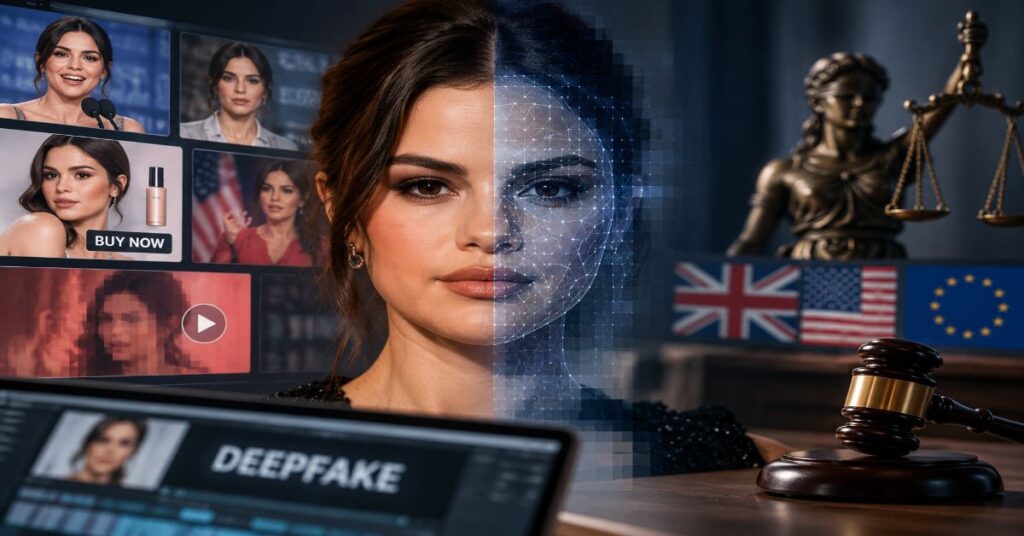
For the question “is it illegal to make a deepfake of a celebrity”, the direct answer is: not automatically; the risk turns on what the image, video or voice recording depicts, how it is used and which law applies. A clearly labelled satirical clip may be lawful expression, while using the same performer’s likeness in a fake advertisement or a non-consensual sexual image can create very different consequences.
The word deepfake bundles together conduct that the law does not treat as interchangeable. A creator might generate a harmless parody and keep it on a private device, publish a synthetic interview to mislead voters, sell a product using a celebrity’s apparent endorsement, or create an intimate image without consent. Each situation raises different questions about free expression, defamation, intellectual property, consumer protection, privacy and criminal law.
As of 29 October 2026, the legal landscape is moving quickly. The United Kingdom has a specific offence covering the creation or requested creation of certain non-consensual synthetic intimate images of adults. The United States has federal law addressing the publication of non-consensual intimate depictions and a developing patchwork of state identity rights. The European Union has begun applying transparency duties for AI-generated content, including deepfakes, under Article 50 of the AI Act. These are significant changes, but none means that every celebrity face-swap is automatically unlawful.
This guide separates the act of creating a file from publishing, monetising, labelling and targeting someone with it. It concentrates on UK, US and EU rules because they illustrate the main differences in approach; other countries may reach different results. It is a general legal explainer, not individual legal advice. If a real publication, commercial campaign or investigation is at stake, the relevant statutes, contracts and jurisdiction-specific advice matter more than a broad online summary.
A Deepfake Is Not One Legal Act
The most useful starting point is to separate five stages: training or preparing a model, generating the likeness, editing a file, publishing it and using it to persuade someone to act. Different legal rules attach to different stages. A country may regulate the creation of an intimate image even if it is never uploaded; another rule may focus on publication, commercial use or the harm caused by a false factual claim. Treating the entire process as a single act hides the legal detail that determines the answer.
The law also distinguishes the subject’s fame from the creator’s purpose. A celebrity’s public profile does not amount to blanket consent for every imitation. At the same time, being recognisable does not automatically give a person ownership of every new image that depicts them. Depending on the case, the relevant rights may belong to the person shown, a photographer, a record label, a film producer, a brand owner or several of them. Those interests can overlap without being identical.
A serious assessment therefore asks what the content communicates to an ordinary audience, whether a viewer could mistake it for a genuine event or endorsement, whether it contains intimate material, whether it copies protected source material, and whether a jurisdiction has a specific rule for synthetic likenesses. It also matters whether the creator is making commentary about a public issue, exploiting someone’s identity to sell a product, or using fabricated content to threaten, harass or defraud.
| Type of conduct | Legal question | Why the distinction matters |
| Generate a non-sexual parody | Is it protected expression or does another right apply? | Satire and commentary may receive protection, but context and presentation matter. |
| Publish a false factual clip | Could it mislead, defame, threaten or interfere with an election? | A realistic fake can create harm beyond the act of generation. |
| Use a celebrity in an advert | Does it imply endorsement or exploit a protected identity? | Commercial context can make publicity, passing-off, trade mark or advertising rules relevant. |
| Create or distribute a sexual deepfake | Does a statute prohibit creation, request, publication or threats? | Some laws apply before distribution; consent and the depicted person’s age are crucial. |
| Re-use a photograph, song or film clip | Does the source material carry copyright or performers’ rights? | A likeness claim and a copyright claim are different routes with different owners. |
The decision should be based on what is actually being made and done, not on the tool’s marketing language. An AI generator can produce lawful and unlawful outputs; its presence does not answer the legal question by itself.
The UK: Creating Certain Intimate Deepfakes Is Now Criminal
The United Kingdom is a useful example of why a simple yes-or-no answer is unsafe. Section 138 of the Data (Use and Access) Act 2025 inserted sections 66E and 66F into the Sexual Offences Act 2003. The new provisions cover intentionally creating a purported intimate image of another adult without consent and without a reasonable belief in consent, as well as intentionally requesting that such an image be created. The commencement regulations brought section 138 into force on 6 February 2026 (Crown Prosecution Service [CPS], 2026).
The word “purported” matters: the image need not be an authentic photograph of the person in the intimate state. The legislation is designed to reach synthetic or AI-generated material that appears to depict a real adult in an intimate state. Consent is not a mere upload permission. Someone’s public photographs being available online does not authorise another person to transform them into a fabricated sexual image. The statutory wording and the facts—including what the image appears to show and what the creator believed—remain important.
The UK has also strengthened the rules around sharing and threats to share intimate material. The Crime and Policing Act 2026 added an offence relating to making or supplying tools designed for generating purported intimate images; the CPS records that this provision came into force on 29 June 2026. The CPS’s current communications-offences guidance describes these offences and should be checked for the precise elements, exceptions and commencement of any specific provision before a case is assessed. Child sexual abuse material raises separate and especially serious offences; a synthetic depiction involving a child should never be treated as a harmless workaround just because no genuine photograph of an abusive act exists.
In a January 2026 statement to Parliament, then Science, Innovation and Technology Secretary Liz Kendall said: “No woman or child should live in fear of having their image sexually manipulated by technology” (Kendall, 2026). The quotation expresses the policy concern, but the legal answer still comes from the enacted provisions and the facts of an individual case. A minister’s statement cannot substitute for reading the statute.
Outside those more specific offences, the UK does not offer a general standalone right that automatically lets every person veto any use of their face or voice. The Government’s March 2026 report on copyright and AI describes a patchwork of possible protections, including defamation, data protection, online-safety regulation, criminal offences, trade marks and passing off. These routes have different requirements. For instance, passing off ordinarily requires goodwill and a misleading representation that causes or is likely to cause damage; it is not simply a general personality right (Department for Science, Innovation and Technology, 2026).
The practical UK rule is therefore narrow but important: the absence of a universal “image right” does not make a non-consensual intimate deepfake safe to create. For a non-sexual parody or documentary reconstruction, legality instead turns on the surrounding rights, the message conveyed, the source material and the circumstances of publication.
The US: Federal Intimate-Image Law and State Identity Rights
In the United States, the legal route depends on both the type of deepfake and the state connected to the dispute. The federal TAKE IT DOWN Act, signed in May 2025, criminalises publication of covered non-consensual intimate visual depictions, including digital forgeries, subject to its statutory conditions and exceptions. The federal offence is not a shortcut for treating every manipulated celebrity image as criminal; the relevant provisions include requirements concerning the nature and context of the depiction and the harm involved. Its platform obligations are also now in force: the Federal Trade Commission began enforcing the notice-and-removal requirements on 19 May 2026. A covered service receiving a valid request must remove qualifying content and known identical copies within 48 hours (Federal Trade Commission [FTC], 2026).
That federal law is significant, but it is not a general federal ban on all celebrity deepfakes. A labelled parody of a film star, a fake political video, a fabricated advert and a sexual deepfake do not all fall under the same legal provision. Depending on the facts, a creator may face other claims involving defamation, fraud, false endorsement, consumer protection, copyright, trade marks or a state right of publicity. The rules and defences differ between states, and a commercial identity claim does not automatically apply to every expressive use.
The federal picture is also developing. The NO FAKES Act of 2026, intended to protect rights in voice and visual likenesses, appears in the official Government Publishing Office record as a bill reported in the Senate with an amendment on 24 June 2026. That record is not an enacted nationwide likeness statute. As of the research cut-off of 29 October 2026, the article treats the bill as a proposal, not as a current legal right (U.S. Government Publishing Office, 2026). State laws and existing causes of action therefore remain important.
Enforcement against intimate deepfake distribution is no longer hypothetical. In June 2026, the US Department of Justice announced the seizure of domains used to publish non-consensual sexual digital forgeries of well-known women. Acting Attorney General Todd Blanche called the seizures “a significant victory in the fight against deepfake pornography” (U.S. Department of Justice, 2026). That statement describes an enforcement action; it does not establish that every synthetic depiction of a public figure is criminal.
The FTC’s enforcement announcement also quoted Chairman Andrew N. Ferguson saying that “in the age of AI, anyone can be targeted” (FTC, 2026). The comment is broader than celebrity protection, and that is a useful corrective: the law’s core concerns—sexual exploitation, extortion and unauthorised distribution—apply to ordinary people as well as famous subjects. The presence of a public figure may make a case more visible, but it is not a prerequisite for harm or legal exposure.
The EU: Deepfake Disclosure Is Not a Blanket Ban
The European Union’s AI Act takes a different approach from a law that simply bans creating a likeness. Article 50 sets transparency obligations for providers and deployers of certain AI systems. The European Commission’s guidelines published in July 2026 state that these obligations start applying on 2 August 2026. Providers of systems that generate synthetic audio, images, video or text must support machine-readable marking in the circumstances set out by the Act; deployers using an AI system to create or manipulate content that qualifies as a deepfake must disclose that the content has been artificially generated or manipulated, subject to the legal text’s exceptions (European Commission, 2026).
A disclosure duty and a permission requirement answer different questions. A labelled synthetic video can still unlawfully defame someone, infringe copyright, falsely imply a commercial endorsement, or depict a non-consensual sexual scenario governed by another rule. Conversely, the mere fact that an image is AI-generated does not establish that it is illegal. Article 50 is primarily a transparency mechanism, intended to make the synthetic nature of content visible to audiences and detectable through technical marking.
The Act also recognises context. Where deepfake content forms part of an evidently artistic, creative, satirical, fictional or analogous work, the disclosure obligation is framed to acknowledge generated or manipulated content in an appropriate way without hampering the display or enjoyment of the work. That is not a universal exemption from other laws; it illustrates the EU’s attempt to make transparency compatible with expression. The wording of the full Article 50, its exceptions and the Commission’s current guidance should be read before relying on a label as a compliance solution.
The important point for an international publisher is territorial scope. EU law may apply because of the service, audience or activity even where a creator is located elsewhere. At the same time, the details can depend on whether the person is a provider of an AI system or a deployer using it, and on which part of the Act applies. Creators should not assume that one small “AI-generated” caption covers every applicable duty or that labelling cures a false endorsement.
Six Scenarios That Produce Different Legal Outcomes
The most practical way to apply the law is to test the intended use, not just the appearance of the output. The examples below are illustrative rather than universal legal rulings. Facts such as the country, the person depicted, whether the content is intimate, the rights in the source media, the disclosure and the audience can change the result.
| Example | Typical legal risk | Practical interpretation |
| Clearly labelled comic parody of an actor delivering a fictional line | Often lower risk, but not risk-free | Expression and parody may be protected; avoid defamatory factual implications or unauthorised source material that creates a separate claim. |
| Synthetic celebrity promoting a supplement or investment scheme | High commercial risk | A false endorsement can mislead consumers and implicate publicity, passing off, trade mark, advertising or fraud rules. |
| Non-consensual sexual deepfake of an adult celebrity | Very high risk | UK law criminalises certain creation and request conduct; US federal law addresses covered publication; other local laws may add remedies. |
| Political deepfake posted with an explicit satire label | Context-dependent | Political expression may receive protection, but disclosure alone will not cure every false claim, election offence or targeted deception. |
| AI-generated scene built from a copyrighted film or photograph | Rights depend on the material used | The celebrity’s likeness and the underlying film, photograph, soundtrack or performance create distinct rights questions. |
| Fake clip showing a celebrity admitting a crime | High reputational and publication risk | A realistic factual implication can raise defamation or other claims even if the publisher says it was a joke after the fact. |
A practical rule follows: if the clip would lose its effect when the audience knows it is fictional, the risk of deception is worth examining before publication. If the creator intends viewers to believe a false endorsement or scandal, a disclaimer hidden in the description is unlikely to be an adequate safeguard. Where the content is sexual or targets a minor, stop and obtain jurisdiction-specific legal advice rather than treating consent as a matter of platform etiquette.
Copyright, Publicity Rights and Defamation Protect Different Things
One reason legal explanations of deepfakes often talk past each other is that the phrase “using someone’s likeness” can describe several separate interests. Copyright protects qualifying creative works, such as photographs, film, sound recordings or music. It does not ordinarily mean that a person owns every representation of their face as a copyrighted work. A generated clip that resembles a singer may raise a likeness issue without copying a specific recording; another clip may reproduce a protected photograph or performance as well. The rights holder may be the photographer, producer, record company or another party rather than the celebrity whose image appears.
Publicity or personality rights address the commercial use of identity in jurisdictions that recognise them. In some US states, a person may challenge unauthorised commercial exploitation of their name, voice, photograph or likeness. The elements and exceptions vary, particularly for expressive works, news, political comment, parody and deceased performers. It is inaccurate to say that US celebrities always own their image everywhere, just as it is inaccurate to say that a public figure has no rights because the person is famous. The academic literature identifies the mismatch between a celebrity’s commercial value and the uneven protection offered by current law (Arnwine, 2025).
In the UK, passing off can be relevant where a creator’s use of identity misrepresents an endorsement and damages established goodwill. It is not a free-standing rule that all unapproved imitations are unlawful. Trade mark law may matter if registered marks or brand identifiers are used. Defamation focuses on false statements or imputations that harm reputation and has its own thresholds and defences. Privacy and intimate-image laws focus on another set of interests. A person may have several claims, none, or a claim that belongs to someone else.
That means there can be two wrongs in a single file. A creator might take an unauthorised photograph, use it to build a synthetic video, then publish it as a real endorsement for a product. The original photograph can create a copyright question; the product claim can create false endorsement or consumer-deception risk; the message can harm reputation; and a jurisdiction may separately regulate the use of the person’s likeness. Analysing just one of those layers can miss the decisive issue.
Commercial creators should also distinguish a generator’s licence from the subject’s consent. An AI tool’s terms may permit commercial use of the output while leaving third-party rights unresolved. The magazine’s guide to selling AI-generated images legally explains that a creator’s right to sell an output and a claim to exclusive copyright are different questions; a celebrity deepfake adds identity and endorsement questions that a general generator licence does not settle.
Parody, News, Fan Edits and the “It’s Only a Joke” Defence
Parody and satire matter because a rule against every imitation would affect political commentary, comedy, documentary work, education and ordinary cultural discussion. A deepfake might allow a satirist to make an obviously fictional actor deliver an absurd line; it might also be used to fabricate a confession and circulate it as breaking news. The technology can look similar, but the purpose, audience and implied claim can be different. Legal systems that protect expression often ask how an ordinary viewer would understand the work, whether it contributes to public discourse and whether the use is misleading or exploitative.
The label “parody” is not a magic word. A creator cannot safely assume that adding “for entertainment only” excuses a sexual image, a threat, a knowingly false endorsement or a fabricated factual allegation. Courts and regulators may examine the total presentation: thumbnail, caption, account name, editing style, ad placement, link destination, distribution context and whether viewers are likely to understand the claim as fiction. A disclaimer that appears only after a viewer has seen or shared the clip may not neutralise the original impression.
News and documentary contexts present a different challenge. A newsroom may need to reconstruct a scene or demonstrate what a false clip looks like, but should distinguish authentic footage, generated illustration and reconstruction in the frame itself and in accompanying text. The EU transparency framework explicitly recognises artistic and satirical contexts, yet it does not replace the publisher’s obligation to avoid misleading readers or to respect other people’s rights. A “news” label does not make fabricated evidence true, and a deepfake label does not remove the need for accurate captioning.
A useful editorial test has three questions. First, could a reasonable viewer mistake the depiction for genuine speech, conduct or endorsement? Second, does the piece need the identifiable likeness to make its point, or could a fictional face communicate the same criticism? Third, does publication impose a foreseeable harm that is unrelated to the point being made—for example, sexual humiliation or a fraudulent purchase request? The answers do not mechanically decide legality, but they can identify a high-risk concept before money is spent and publication becomes difficult to reverse.
For political clips, source verification matters as much as visual appearance. The magazine’s practical guide to checking a politician’s video covers corroboration and the limits of relying on visual artefacts. Those same limits matter when a creator wants to present a synthetic clip as satire: viewers need a clear signal about what is generated, rather than being expected to infer it from glitches.
The Pre-Publication Test for Creators and Businesses
Before making or publishing a celebrity deepfake, identify the intended use in one sentence. “A labelled fictional parody for a private comedy sketch” is materially different from “an advertisement intended to make viewers believe that a public figure recommends our service”. The sentence forces the creator to name the objective, rather than relying on vague descriptions such as “content”, “fan edit” or “AI experiment”. If the stated objective depends on audience confusion, that is a warning sign, not a reason to hide the synthetic nature of the work.
Next, build a simple rights inventory. Record the celebrity or performer whose likeness is reproduced, the owner and source of every photo, recording, song or film clip, the licence for the generator, any permission from the performer or estate, and the territories where the work will be published. A tool’s own terms may allocate rights between the provider and the customer, but they do not necessarily obtain permission from the person whose identity or source material is used. A freelancer’s invoice or a stock image licence may also fail to cover synthetic manipulation unless the conditions allow it.
The third step is a harm and disclosure review. Does the image imply an endorsement, make a false factual allegation, show a purported intimate state, include a minor, reveal sensitive information or invite viewers to transfer money? Would a prominent label change how the audience understands it? Could the same creative goal be met with a fictional or non-identifiable character? If a sexual or coercive angle exists, do not proceed merely because a generator allows the prompt or a platform has not blocked the output. Technical availability is not legal permission.
Fourth, assess where the activity touches the law. The creator’s location is only one factor; the depicted person, target audience, place of publication, platform and commercial campaign may point to another jurisdiction. A multinational brand should use a stricter release process than a personal parody account because the potential audience, transaction and expectation of endorsement differ. Where the concept touches intimate imagery, political advertising, children, healthcare, finance or allegations of criminal conduct, a legal review before release is proportionate.
Finally, preserve the basis for your decision. Keep copies of licences, consent records, prompts, the generated source files, intended captions, disclosure language and final versions. If questions arise later, a contemporaneous record is more useful than a retrospective assurance that “everyone knew it was AI”. It will not cure an unlawful publication, but it may clarify what the creator intended, what they relied on and whether the final file materially differed from the approved concept.
| Pre-publication question | Evidence to record | Stop and review if… |
| What am I trying to communicate? | Brief, audience and intended context | The intended effect requires viewers to believe a fabricated fact. |
| What source material did I use? | Photo, audio, video and licence records | The licence excludes manipulation, synthetic use or commercial use. |
| Does the person appear to endorse or say something? | Permission, script approval and disclosure treatment | The clip could imply an untrue endorsement or damaging quote. |
| Is the image intimate or is a child depicted? | Consent and a jurisdiction-specific legal review | Consent is absent, uncertain or the subject is under 18. |
| Where will it be seen? | Target territories, platforms and campaign plan | The laws or platform rules have not been checked for the target market. |
Where the clip could be tendered as evidence or used to allege that a real person said something, the creator should not confuse a synthetic reconstruction with an authentic recording. See the magazine’s explanation of deepfake audio in court for the narrower point that authenticity depends on what the exhibit is offered to prove, not merely on whether the voice sounds familiar.
If You Are Targeted: Preserve Evidence and Choose the Right Route
Someone whose likeness has been deepfaked should not have to become a forensic expert before seeking help. The first response is to preserve the published URL, account name, date and time, relevant messages, threats, payment demands and the surrounding page that explains how the content was presented. Take screenshots of the post and profile, but do not repost intimate material to argue that it is fake. Re-publication can increase the audience and make a removal problem harder to contain. If the content includes a minor, do not download, forward or send it to an unfamiliar “analysis” service.
Choose the report route based on the harm. A non-consensual intimate deepfake should be reported through the platform’s specific intimate-image process, not only a generic misinformation form. In the United States, a valid TAKE IT DOWN Act request to a covered platform triggers the requirement to remove qualifying intimate images and known identical copies within 48 hours; the FTC began enforcing those platform duties on 19 May 2026. If a platform has no process or fails to comply, the FTC provides a reporting route. That is a defined statutory process, not a guarantee that every copy on the wider internet will disappear.
Other harms require different routes. A fake investment endorsement may need reporting to the platform, the relevant financial or consumer regulator and law enforcement if fraud is occurring. A defamatory statement may require a lawyer’s assessment of the publication, jurisdiction and available defences. A copied photograph or recording can require a copyright notice from the actual rights holder. Threats, extortion or stalking should be documented and escalated through appropriate police or support channels rather than debated in public comment threads.
The creator’s identity may not be immediately clear. A platform takedown, a search-result removal or a digital fingerprinting service each has limits. They may remove or reduce access to certain copies; they do not prove who created the material or erase every screenshot, private message or re-upload. Keep reference numbers and copies of notices, and track which URL each request refers to. If a publication is spreading quickly, use one trusted support person to coordinate reports and limit unnecessary circulation.
For victims seeking a more detailed sequence, the magazine’s guide on responding to a celebrity-style deepfake explains evidence preservation, reporting and the limits of removal tools. The main principle is simple: document the incident without amplifying it, then direct each request to the organisation that can act on the specific type of harm.
Platforms, Provenance and the Limits of Detection
Platform rules can be stricter than the minimum law, and a post may therefore be removed even where the legal position is unsettled. That does not mean a platform’s terms are a universal statute. At a UK Parliament Foreign Affairs Committee hearing on 9 March 2026, TikTok’s Director of Public Policy for Northern Europe, Ali Law, said that “anything that is violative in our community guidelines is violative whether it is AI or not” (Foreign Affairs Committee, 2026). The statement illustrates a content-first enforcement policy: the fact that AI was used does not itself determine whether the content is allowed.
Labelling is useful, but it is only one layer of trust. A clear statement that a video is generated can prevent some viewers from treating it as a real recording. Machine-readable metadata and provenance credentials may provide information about how a file was created or edited. However, metadata can be stripped by platforms or altered by later processing, and a valid credential does not prove that the staged event depicted in a file actually happened. Conversely, a file without provenance data is not automatically a deepfake.
Detection systems have similar limitations. A classifier can estimate that a file has features associated with synthetic media, but that result normally does not identify the author, establish intent or decide whether publication was illegal. Errors may arise when the model encounters an unfamiliar generator, compression, editing, short clips or a different recording environment. A confident score should be treated as one item of evidence, not a courtroom verdict or an all-purpose legal test.
That is why source verification remains important. Compare the clip with the original release, seek an independent copy, check whether the depicted person or their representative has confirmed the event, and verify any claimed endorsement through the brand’s official channels. If the content alleges a major event or criminal conduct, seek independent reporting and primary documentation before repeating it. Do not rely solely on unnatural blinking, lip movement or other older visual heuristics; modern output quality varies, and authentic footage can also look distorted after editing or compression.
Readers can explore how realistic deepfakes are now for context on why obvious visual errors are no longer a dependable test. Audio requires the same caution: the magazine’s guide to detecting cloned voices on phone systems distinguishes synthetic-speech detection from speaker identity and transaction authorisation. Neither visual inspection nor a voice detector can resolve the full legal question on its own.
Our Editorial Verification Process
This explainer was prepared by comparing current UK Crown Prosecution Service guidance on communications offences; the UK Government’s March 2026 report on copyright and digital replicas; the commencement of the Data (Use and Access) Act 2025 provisions; the European Commission’s July 2026 guidance on Article 50 of the AI Act; Federal Trade Commission guidance on the TAKE IT DOWN Act; the U.S. Department of Justice’s 2026 enforcement announcement; the official Government Publishing Office record for the proposed NO FAKES Act of 2026; the UK parliamentary record of platform-policy evidence; and academic legal analysis of right-of-publicity protections.
The comparison prioritises enacted law and official implementation guidance over general commentary. Proposed legislation is labelled as proposed; dates are tied to the published source; and platform statements are attributed to the speaker rather than presented as law. The article does not claim a complete worldwide survey, does not provide a legal opinion on any individual fact pattern, and does not report a detector benchmark or hands-on AI tool test. There is no software pricing matrix because the article evaluates legal questions rather than a commercial product.
This article was researched and drafted with AI assistance. Legal sources, dates and named quotations were checked against primary sources during preparation; independent editorial and legal sign-off by the Awais Khalid editorial desk is still required before publication. This draft does not claim that such sign-off has already occurred.
Conclusion
Making a deepfake of a celebrity is not automatically illegal, but neither is it a legally neutral act. The strongest predictor of risk is the use being made of the likeness: a labelled comic scene, a false commercial endorsement, a defamatory allegation and a non-consensual sexual image raise different questions. The same file can also involve more than one set of rights, including the subject’s identity, the owner of a source photograph or recording and the interests of people misled by the publication.
As of October 2026, the UK’s specific intimate-image offences, the US TAKE IT DOWN Act and the EU AI Act’s transparency obligations demonstrate that lawmakers are responding to different parts of the problem. None replaces the need to distinguish criminal publication, identity rights, copyright, defamation, consumer deception and protected expression. Nor should a proposed bill be mistaken for an enacted rule simply because it has advanced through a committee.
The most defensible practical approach is to establish the purpose, verify rights in source material, consider consent and foreseeable harm, disclose synthetic content where required, and check the laws of the places connected to publication. Where intimate material, children, a high-stakes endorsement or a damaging factual claim is involved, pause for specialist advice. The legal boundary is not the word “deepfake”; it is the combination of conduct, context, rights and jurisdiction.
Frequently Asked Questions
Is It Illegal to Make a Deepfake of a Celebrity?
Not automatically. The result depends on the country, the content and how it is used; non-consensual intimate imagery, fraud, defamation, false endorsement or copyright infringement can create serious legal exposure. Check the relevant law and official guidance for your jurisdiction.
Can I Make a Celebrity Deepfake for Parody?
Sometimes. Parody and satire may be protected expression, but the label alone does not excuse a false endorsement, harmful factual allegation, unlawful intimate image or unlicensed use of protected source material. How a reasonable audience understands the content matters.
Is It Illegal to Create a Sexual Deepfake Without Posting It?
In some jurisdictions, yes. UK law criminalises certain non-consensual purported intimate images at the creation or request stage. Other laws focus on publication or threats, so the answer depends on the location and facts.
Can a Celebrity Sue if an AI Video Uses Their Face?
Potentially, but there is no single worldwide claim. Depending on the facts and place, a case may involve publicity rights, passing off, defamation, trade marks, copyright in source works, privacy or a specific intimate-image statute.
Does Adding an “AI-Generated” Label Make a Deepfake Legal?
No. Labelling can satisfy a disclosure duty or reduce deception, but it does not automatically authorise the use of someone’s likeness, cure defamation, grant copyright permission or excuse non-consensual sexual content.
Can I Use a Celebrity Face in an Advertisement if the Video Is Obviously Fake?
That is high risk. Viewers may still understand the use as an endorsement or commercial association. Obtain appropriate permission and check publicity, passing-off, trade mark and advertising rules rather than relying on the appearance of the clip alone.
Does the US NO FAKES Act of 2026 Already Apply?
The official Government Publishing Office record reviewed for this article lists the bill as reported in the Senate with an amendment on 24 June 2026. That is a proposed bill status, not proof of an enacted nationwide likeness right; check the current official record before relying on any later change.
Do EU AI Rules Ban All Celebrity Deepfakes?
No. Article 50 of the EU AI Act introduces transparency obligations for certain AI-generated or manipulated content, including deepfakes, from 2 August 2026. Other laws may still prohibit particular uses, and applicable disclosure exceptions and duties depend on the circumstances.
References
Crown Prosecution Service. (2026). Communications offences.
Department for Science, Innovation and Technology. (2026, March). Report on copyright and artificial intelligence.
European Commission. (2026, July 20). Guidelines on transparency obligations for providers and deployers of certain AI systems.
Federal Trade Commission. (2026, May 19). FTC begins enforcing the TAKE IT DOWN Act.
Foreign Affairs Committee, House of Commons. (2026, March 9). Oral evidence: Disinformation diplomacy (HC 703).
Kendall, L. (2026, January 12). Secretary of State statement to the House of Commons.
United States Department of Justice. (2026, June 12). United States seizes domain names publishing nude digital forgeries of famous women.
United States Government Publishing Office. (2026, June 24). S. 4591—NO FAKES Act of 2026, reported in the Senate.
Arnwine, D. A. (2025). When deepfakes make celebrities a dime a dozen: Can the right of publicity save their worth? Journal of Technology Law & Policy, 29(1).