
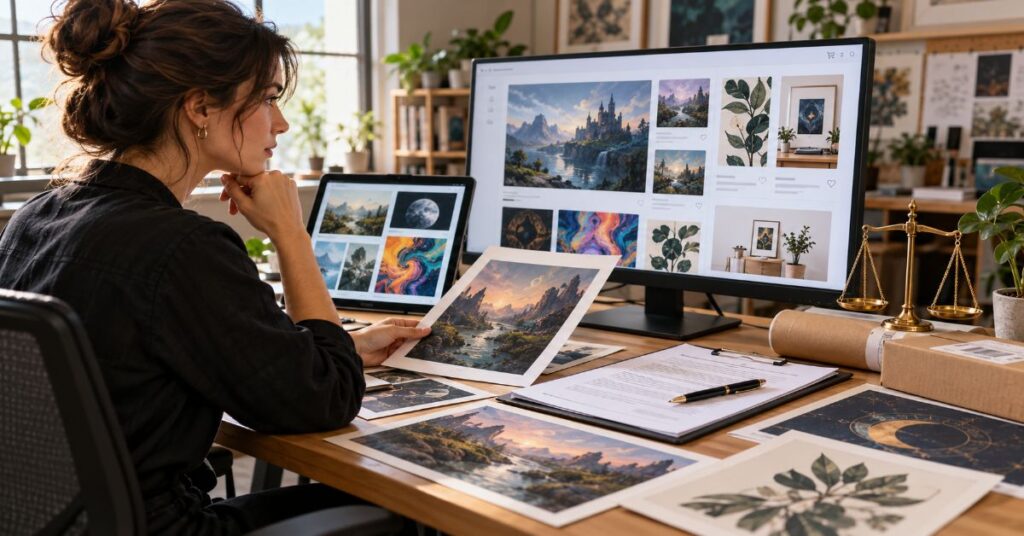
Yes, you can usually sell AI-generated images legally in 2026, provided the generator permits the intended commercial use and the image does not violate another party’s rights. Yet the most consequential limitation is less obvious: a sale may be lawful even when the seller cannot claim exclusive copyright over the image. In the United States, the distinction matters particularly because the Copyright Office says copyright requires sufficient human-authored expression, not merely a detailed prompt.
A designer may sell a fantasy landscape as a print, a marketing agency may deliver a generated background to a client, and a contributor may license a labelled AI illustration through an accepting stock platform. Each arrangement has its own risk. A character recognisable from a film, an unauthorised celebrity likeness, an image built from someone else’s uploaded artwork or a misleading assurance of exclusivity can change the answer dramatically.
This guide treats the sale as a chain of permissions, rather than treating an AI generator’s “you own the output” wording as a complete legal opinion. It examines rights in the tool, rights in what appears in the picture, the ability to assert copyright, terms of downstream marketplaces and promises to buyers. It also offers a practical audit trail and contract checklist. The discussion is general information rather than legal advice; rules differ between jurisdictions and some AI disputes remain unresolved.
The Five-Rights Test Before You List an Image
Commercial permission
The first gate is contractual. Open the generator’s current terms and determine whether the account, model, subscription and creation date allow commercial exploitation. “Commercial use” should cover the actual use contemplated: a client advertisement, a standalone downloadable file, sublicensing to a stock customer, or physical merchandise. These are not necessarily identical. A platform may let a user print an image but impose separate restrictions on redistributing an underlying model or on sublicensing assets through other services.
Copyright and third-party rights
The second gate is copyright in the output itself. The third is infringement risk: an unprotected AI output can still reproduce protected elements of another work. A seller may lack copyright in a picture while also infringing someone else’s protected character illustration. Neither a prompt history nor a subscription payment proves that the result is original or non-infringing.
Identity, contract and marketplace
The fourth gate is a depicted person’s likeness, privacy and publicity rights, as well as trademarks, property and advertising rules. The fifth gate is the destination marketplace’s policies. An image acceptable for an internal slide deck may fail Adobe Stock contributor rules or be unsuitable for an advertising campaign. These five independent questions give sellers a stronger decision than the simple “the AI company said I own it” approach.
Can You Sell AI Generated Images Legally in 2026 Across Different Countries?
United States: Human Authorship Matters
In January 2025, the US Copyright Office concluded that material created with AI can receive copyright protection where a human has determined sufficient expressive elements. Human-authored material visible in an output, and original human selection, arrangement or modifications, may qualify. Merely providing prompts is not by itself sufficient. This is a copyrightability conclusion, not a general ban on commercial sales. [1] The US Supreme Court declined to hear the Thaler AI-art case in March 2026, leaving the lower-court human-authorship ruling in place. [2]
United Kingdom: A Distinct Statutory Rule
The UK Copyright, Designs and Patents Act 1988 includes section 9(3), which identifies the author of a computer-generated literary, dramatic, musical or artistic work as the person making the necessary arrangements. Section 12(7) provides a 50-year duration for qualifying computer-generated works. Applying these provisions to modern generative systems is not always straightforward: identifying the person making the arrangements, showing originality and analysing particular outputs remain questions for professional assessment. The UK government’s March 2026 copyright report considered reform options but did not turn all AI imagery into automatically safe commercial property. [3]
EU and Cross-Border Sales
EU copyright law generally centres on an author’s own intellectual creation. Consequently, claims of protection for autonomously produced images should not be imported uncritically from UK terminology. Selling to buyers internationally may engage multiple legal regimes: the place of creation, the seller’s contracts, the buyer’s intended territory and the jurisdiction where alleged infringement occurs. A product listing available worldwide does not produce a single worldwide answer on authorship.
Copyright Ownership Is Not a Commercial-Use Licence
Why “You Own Your Output” Has Limits
OpenAI’s January 2026 consumer terms say that, as between the user and OpenAI and to the extent permitted by law, the user owns output and receives an assignment of OpenAI’s rights, if any. They also warn that outputs may not be unique. [4] Those qualifications are material. A contract cannot transfer copyright that never existed, extinguish another artist’s rights, or guarantee that no customer will receive a similar result.
The Three Promises Buyers Confuse
“You may use this image” is permission. “I created the protectable artwork” is an authorship or ownership assertion. “No one else can use a similar image” is an exclusivity assurance. Sellers should not merge these into one vague claim. For example, a client might pay for a customised website illustration but still have no automatic right to stop another user generating a visually similar background. Contracts should define whether the deliverable is the file, protectable human-created edits, or exclusive rights to identifiable licensed components.
A Better Customer Licence
State the permitted uses, formats, territory and duration; clarify whether the buyer may edit, print, resell or sublicense; identify AI-produced material; and disclaim any promise of worldwide exclusivity that cannot be substantiated. If genuine human-created components exist, describe them accurately. Anyone planning to license art at scale should have counsel review the promise being sold, especially if a platform calls the asset “royalty-free” or “exclusive”.
AI Image Generator Rules: What the Official Terms Actually Say
OpenAI and ChatGPT Images
Under OpenAI’s consumer Terms of Use, users generally own their output as against OpenAI to the extent permitted by applicable law. Inputs must be authorised and output must be reviewed for appropriateness; terms do not deliver independent legal clearance of characters, trademarks or likenesses. API and enterprise arrangements can differ, including conditions around any indemnity. The sensible workflow is to save the applicable version of the terms and confirm which service produced the file. [4]
Midjourney Commercial Rights
Midjourney says creators own assets to the fullest extent possible under law. Its current terms contain an important enterprise condition: if the user is a company or an employee of a company with more than US$1 million annual revenue, the creator must subscribe to Pro or Mega to own assets. It also says upscaling another user’s picture does not transfer that user’s rights. Publicly posted content may be viewable or remixable, meaning business confidentiality deserves separate attention. [5]
Adobe Firefly and Stock Licensing
Adobe says its own Firefly models are trained on licensed and public-domain material, and that it does not claim ownership of users’ content. The firm describes Firefly as designed for commercial safety, but this should not be rewritten as an unconditional warranty for every output or for third-party models accessed inside Adobe products. Adobe Stock contributor rules independently require compatible generation licences, appropriate releases and AI disclosure. [6]
| Provider | Verified rights position | Practical qualification |
| OpenAI | Output assigned to user as between parties, to extent permitted by law | No uniqueness or universal IP clearance guarantee |
| Midjourney | Creator owns assets to extent possible by law | Pro/Mega rule for businesses above US$1m revenue |
| Adobe Firefly | Adobe does not claim ownership of user-created content | Examine specific model/product and Stock terms separately |
Where You Can Sell AI Art—and What Each Platform Requires
Etsy and Seller-Prompted Work
Etsy’s Creativity Standards expressly include seller-prompted AI creations within eligible designed-by-a-seller items when the applicable conditions are met, and require sellers to disclose AI use in the listing description. Etsy separately excludes standalone AI prompt bundles from its definition of eligible designed products. This is a useful distinction for creators who sell finished downloadable illustrations rather than instructions for generating them. selling reusable AI prompts provides related advice on packaging prompts as products, but the legal category is different. [7]
Adobe Stock and Licensing Chains
Adobe Stock accepts eligible AI-generated images when contributors label them and meet its content, technical and legal standards. The contributor must check generator rights first. Real identifiable people may require model releases, recognisable property may need property releases and fictional subjects should be labelled according to the submission process. Adobe also prohibits certain prompts, titles and keywords referencing third-party intellectual property. [8]
Direct Shops, Agencies and Print-on-Demand
Selling a file through a personal website, delivering it through a design agency or putting it on a printed product moves responsibility onto the seller and the relevant payment, storefront or fulfilment contracts. Do not assume that a general website builder or print-on-demand provider has cleared infringement merely by allowing upload. For owners building a larger content business, monetising an AI-written blog considers AI-related monetisation, while AI affiliate revenue models explains a different revenue channel that does not depend on claiming ownership of individual image outputs.
| Channel | AI listing rule | Main concern |
| Etsy | Seller-prompted AI creations require description disclosure | Seller-design eligibility and IP rights |
| Adobe Stock | AI checkbox and content/release requirements | Broad sublicensing rights and accurate metadata |
| Personal website | Site/provider terms vary | Full responsibility for customer representations |
| Print-on-demand | Provider-specific rights rules | Logos, images, quality and fulfilment |
Common Legal Hazards Hidden Inside a Beautiful Picture
Recognisable Characters and Protected Artwork
An AI-generated image can look new while still reproducing protected visual expression. Recreating a copyrighted comic-book hero, a recognisable film character, or a near-identical piece of artwork may trigger infringement analysis even when generated from text rather than copied by hand. The exact facts matter: similarity, protectable elements, access, exceptions and jurisdiction. A routine visual originality check should compare distinctive poses, outfits, backgrounds and character features, not just inspect for watermarks.
Celebrities, Private Individuals and False Endorsements
Photorealistic images of real people introduce personality, privacy and deceptive-advertising issues independent of copyright. The risk is highest when the presentation suggests endorsement or depicts sensitive or fictional conduct as if it occurred. A licence from an AI provider does not constitute consent from the person depicted. Even images of fictional people warrant review for resemblance to identifiable individuals.
Logos, Packaging and Trade Dress
Text-to-image tools often produce approximations of brand marks or recognisable product packaging. Using such output to market a competitor, imply affiliation or mislead a buyer can create trademark and passing-off exposure. Avoid brand names and protected characters in prompts for stock submissions, and remove accidental marks before sale. A lack of exact replication does not rule out consumer confusion.
What Human Editing Can—and Cannot—Change
Meaningful Authorship Versus Routine Cleanup
A single prompt, several rerolls, resizing, upscaling and trivial colour correction are not a reliable route to US copyright. By contrast, original hand-drawn components, substantial creative compositing, human-authored typography or expressive retouching may support claims in those specific contributions. The legal question is about human expression, not time spent or the number of prompt iterations. Preserve layered project files and dated creative records rather than assuming an editing badge proves authorship.
The Compilation Approach
Consider a poster made of an AI-generated textured background, a human-designed illustration, original lettering and a distinctive original layout. Even if the generated texture itself lacks US copyright, the human-authored illustration and qualifying selection or arrangement may still receive protection. Registration should identify and exclude unprotectable AI-produced material where required. This limits overclaiming and helps a buyer understand exactly what intellectual property is being transferred.
Editing for Search Visibility Is a Different Question
Copyrightability is a legal assessment, not an SEO rule. The related discussion of Google treatment of human-edited AI content concerns whether human-edited AI material is penalised in search, which is distinct from whether a court would protect an image. A creator may publish an image-heavy guide and earn traffic without gaining exclusive rights in the underlying generated pictures.
A Documented Production Workflow for Commercial Sellers
Step 1: Start With a Rights-Safe Brief
Write a short brief naming the buyer, distribution channel, intended countries, subject matter and any requested exclusivity. Flag real people, film characters, logos, living artists and uploaded reference images before generating. Obtain permission to use third-party reference images, and record what the permission actually allows. For agency work, include a disclosure question in the client intake form.
Step 2: Keep an Evidence Trail
Record the tool name, model or product, account plan, generation date, prompt and any reference inputs. Save a copy of the provider’s relevant terms or a dated link, and keep exported intermediate files. This is not a magic certificate of copyright; it is an audit trail showing what was done, what permissions were checked and which human edits can be described accurately.
Step 3: Examine and Correct the Output
Review at full size for unwanted logos, copyrighted character elements, likely real-world likenesses, malformed details and quality problems. Use a reverse-image search or other similarity review when the composition resembles known art, recognising that these tools are incomplete. Export a print-ready or web-appropriate file and preserve the original generation separately. Do not describe a synthetic photograph as documentation of a real event.
Step 4: Match the Listing and Delivery Licence
Compare the marketplace policies with the exact product: a stock asset, an Etsy downloadable, a printed poster or a client advertisement. State whether AI was used where required, avoid “copyrighted by me” as an unqualified claim, and set the buyer’s permitted uses in writing. Check the terms again before a new listing batch: provider contracts change independently of copyright law.
Pricing the Product Without Selling Imaginary Exclusivity
Price a Useful Deliverable
A high price is not justified by the mere fact that an AI image looks polished. Price based on buyer utility, production time, genuine creative additions, the effort of revisions, print quality, licensing scope and the ability to solve a particular visual need. A custom illustration with documented human art direction, carefully finished details and a deliverable tailored for packaging is meaningfully different from a generic file dumped into a saturated download category.
Separate Production From Rights
Use different line items where appropriate: design labour, asset delivery, revision allowance, licensed third-party components and any rights actually transferable. If the customer requests exclusive worldwide rights, do not simply multiply the fee. First determine whether there is copyright to assign and whether the generator or reference licences permit the promised exclusivity. An honest non-exclusive licence is safer than an expensive fiction.
Revenue and Platform Economics
The illustrated numbers below are hypothetical arithmetic, not reported seller outcomes. If a £12 print yields £4 after fulfilment and transaction charges, 100 sales would produce £400 contribution before advertising, refunds, taxes, software and labour. If the same seller spends £300 in advertising, the residual is £100 before other costs. Product-market fit, not raw generation speed, determines profitability. Related guidance on AI content and AdSense eligibility and realistic AI-site ranking timelines is useful when a seller uses search content to attract traffic, but neither is a substitute for product economics.
| Illustrative metric | Amount | Interpretation |
| 100 prints × £12 | £1,200 | Gross receipts, not profit |
| 100 × £8 fulfilment/fees | £800 | Example variable costs |
| Remaining before advertising | £400 | Contribution before other overheads |
| Illustrative advertising | £300 | Leaves £100 before tax, labour and refunds |
A Commercial-Risk Decision Matrix for Three Example Sellers
Example A: A Fantasy Print Shop
A seller generates abstract landscapes from original prompts, avoids protected characters, uses a generator plan granting commercial rights and discloses AI on Etsy. The principal remaining challenges are image quality, misleading originality claims and weak ability to exclude imitators. This is generally a lower-risk pattern than selling franchise lookalikes, although no output is automatically cleared.
Example B: A Brand Agency Delivering a Campaign
An agency uses AI to draft a product background and combines it with commissioned photography and extensive human graphic design. The agency should secure rights to the uploaded photography, document the human-authored elements and expressly state what its client receives. A recognisable celebrity figure in a background or an unlicensed competitor mark changes the risk substantially. Agency indemnities should not exceed the rights and evidence the agency actually controls.
Example C: A Stock Contributor
A contributor generates photorealistic lifestyle scenes and uploads to Adobe Stock. Even if the AI provider permits commercial use, Adobe’s metadata, releases, quality and intellectual-property restrictions still govern acceptance. Being legally able to sell privately does not guarantee the contributor has the rights or documents required for broad stock sublicensing. The platform’s licence chain creates a higher clearance burden than a simple one-off print sale.
| Use case | Most relevant checks | Risk to escalate |
| Fantasy digital print | Tool terms, originality, Etsy disclosure | Protected character resemblance |
| Client brand campaign | Inputs, likeness, licensing scope, contract | Exclusive rights and identity issues |
| Adobe Stock submission | Generator sublicensing, AI labelling, releases | Recognisable people/property |
Licensing Scenarios That Often Surprise First-Time Sellers
A Digital Download Is Not a Stock Licence
When a buyer purchases a downloadable artwork file, the seller can grant narrow personal printing rights, broader commercial printing permission, or rights to incorporate that asset into another product. These are different licences. A stock marketplace commonly grants downstream customers rights under its own licence, making the contributor responsible for providing a wider chain of permissions. The fact that an AI platform permits a creator to sell a poster does not necessarily answer whether its terms allow the creator to sublicence the same image through a stock library. Read the licence granted by each intermediary, and compare it with the rights that were received upstream.
Custom Portraits Present Extra Consent Questions
Personalised AI pet portraits generally have different identity concerns from images that reproduce living people. A client-supplied photograph should still be authorised for use as input, particularly if another photographer holds rights in the image. For human portraits, record the sitter’s consent for commercial uses if necessary, especially when artwork could be reused in advertising or visible to the public. Personalisation does not automatically extinguish the source photographer’s copyright, and a paid commission should not be interpreted as universal permission to repurpose reference photographs.
Templates, Bundles and Reusable Backgrounds
Sellers often create themed bundles of wallpapers, presentation backgrounds or printable patterns. Bundle size does not by itself create copyright in every generated component. Human curation and layout may give rise to protectable compilation elements depending on the jurisdiction and originality, but the licence should separate the bundle as arranged from its individual images. If files are advertised for resale or incorporation into unlimited products, the seller must also anticipate buyers redistributing files in ways that compete directly with the original store.
A Pre-Publication Checklist for Small Creative Businesses
Validate the Chain of Title
Before taking payment, make a simple one-page register for each product. Enter the generation service, version of terms checked, account category, creator and intended channel. List each uploaded photo, reference image, font or graphic, who owns it and what permission was obtained. If a buyer expects assignments or broad sublicensing, identify the specific human-authored and licensed components that can support that promise. Absence of a record does not make a sale illegal, but it makes later assurance difficult.
Match Disclosure to the Channel
There is no single universal AI disclosure label sufficient for all stores and advertising purposes. Etsy asks sellers to disclose AI use for qualifying seller-prompted creations in descriptions. Adobe Stock uses submission fields for generative content and fictional people or property. Client agreements may have entirely different confidentiality and provenance requirements. The business should keep a channel-specific checklist rather than pasting a generic sentence onto every listing and assuming compliance.
Escalate Higher-Risk Uses Early
Use additional review when images feature famous people, children, distinctive trademarks, fictional franchises, sensitive or regulated advertisements, or materials meant to impersonate real events. Escalate as well when a customer demands legal indemnities, worldwide exclusivity or high-value trademark registration. None of those issues can be resolved solely by checking a generator subscription. The lowest-cost intervention is usually to identify the issue while drafting the brief, before producing a large inventory or signing a client contract.
How to Handle Disputes, Takedowns and Buyer Questions
Preserve the Record Before Removing Anything
If a buyer, marketplace or claimant challenges an image, preserve the relevant listing, correspondence, inputs, output versions, licence terms and human editing files. A prompt log will not disprove a well-supported infringement allegation, but it can establish provenance and identify accidental use of source material. Avoid public claims that a complaint is impossible because “AI made it”.
Assess the Claim by Legal Category
A copyright allegation about a recognisable work is different from an objection by a person whose likeness appears in an advertisement. A trademark complaint focuses on origin or consumer confusion; a marketplace moderation notice may simply mean a contractual rule was broken. The response should match the claim. Where stakes are material, seek qualified local legal advice before disputing a takedown, sending counter-notices or offering compensation.
Respond to Buyers With Precision
When a buyer asks whether a design is unique, explain whether it was customised and whether any enforceable exclusivity is promised. When asked whether it can be printed commercially, reference the buyer licence and the generator conditions applicable to the work. When asked whether it is “copyright-free”, avoid that ambiguous phrase: say which parts are AI-generated, which human-authored parts may be protected and which third-party permissions were checked.
A Final Question: What Exactly Is the Customer Paying For?
Provenance, Utility and Clear Expectations
A robust image business has three distinct products: the finished pixel file, the creator’s service and any intellectual-property rights genuinely available to license. Treating all three as synonymous invites disappointed customers. A buyer may be purchasing a finished web banner and several rounds of revisions, not exclusive copyright in the underlying generator output. Another may value your human composition, visual consistency, localisation, accessibility checks and a set of properly cleared supporting assets. Those elements are tangible services even if part of the image is unprotectable. When a dispute arises, contracts that describe precisely which of these elements were purchased are easier to interpret than broad statements that the customer now owns everything. Sellers should also avoid implying that generator-provided ownership means they have verified global copyright status. No general AI platform can settle that question for all courts and all outputs. In practice, sensible commerce begins with an accurately described deliverable and a permission chain that can be demonstrated, rather than an untestable guarantee of originality.
Our Editorial Verification Process
For this explainer, the editorial evidence base is the US Copyright Office’s 2025 copyrightability report and announcement; the UK government’s March 2026 report and official explanation of computer-generated works; OpenAI’s January 2026 Terms of Use; Midjourney’s current Content Rights terms; and Etsy and Adobe Stock’s official commercial-submission policies, including Adobe Stock’s June 2026 update. Reuters’ March 2026 account of the Supreme Court decision supplies a dated legal development. No image-generation experiments, legal opinions, live sales tests or pricing-plan audits were conducted, and none are claimed. Specific contractual terms should be rechecked on the sale date.
This article was researched and drafted with AI assistance for the Sami Ullah Khan editorial desk at Perplexity AI Magazine. It requires editorial and, where appropriate, legal review before publication. Claims are cited to identified public sources; the magazine has not independently performed hands-on testing or a formal legal clearance review of individual outputs.
Conclusion
AI-generated images can be sold in 2026, but a legal sale rests on more than pressing Generate and downloading a file. Provider contracts can authorise commercial exploitation without establishing statutory copyright, and the image may still create exposure through third-party artwork, trademarks or real people’s likenesses. US rules for human authorship differ from the UK’s statutory treatment of computer-generated works, and cross-border licensing complicates broad exclusivity claims.
For most small sellers, the strongest commercial practice is modest but systematic: generate with authorised inputs, verify the current account licence, examine the output for recognisable protected material, keep records of meaningful human creative work, and describe the buyer’s licence accurately. Marketplace eligibility is a second check, not an assumption derived from the image tool’s contract. A high-value client commission may justify a tailored legal review; a low-priced printable may not, but neither should be marketed with unsupported promises.
The unresolved questions are significant. Courts and policymakers are still determining how human control, training practices and machine-produced outputs fit existing rights frameworks. Sellers who build their offers around documented permissions and clearly defined deliverables will be better positioned than those who rely on the slogan that every AI-generated image is automatically theirs to copyright.
Frequently Asked Questions
Can You Sell AI-Generated Images Legally in 2026?
Usually yes, provided the generator’s terms permit the intended commercial use and the image does not infringe third-party rights. Copyright ownership is separate: wholly machine-generated images may lack US copyright protection. Check your tool, jurisdiction and marketplace rules.
Can I sell AI art on Etsy?
Etsy permits eligible seller-prompted AI creations and requires disclosure of AI use within the listing description. The item must meet its other Creativity Standards. Standalone AI prompt bundles are treated differently and do not qualify as designed-by-a-seller items.
Can I sell ChatGPT-generated images?
OpenAI’s consumer terms generally assign output rights to users as between the parties, to the extent permitted by applicable law. That does not guarantee a unique picture or protection against third-party IP complaints.
Do I automatically own copyright in Midjourney images?
No universal copyright guarantee exists. Midjourney gives creators contractual rights as far as the law permits, with a specific Pro/Mega condition for certain businesses above US$1 million revenue. Statutory copyright still depends on applicable law and human authorship.
Does editing an AI picture make it copyrightable?
Not automatically. In the US, original human-authored expression, creative selection or meaningful arrangement may be protectable, but merely prompting, upscaling or making routine edits does not itself establish sufficient authorship.
Can I sell AI images featuring celebrities?
Such sales may create publicity, privacy, false-endorsement and related risks, even when a generator authorises commercial use. Obtain relevant permissions and advice before commercialising a recognisable real person’s likeness.
Can I upload AI images to Adobe Stock?
Adobe Stock accepts eligible AI-generated content with appropriate labelling, compatible generation licences, required releases and quality compliance. Its submission rules are independent of your generator’s general permissions.
Can buyers get exclusive rights to AI-generated artwork?
They can receive contractual exclusivity where the seller has the authority to grant it, but this does not automatically create enforceable copyright in purely AI-generated components or bind unrelated people who produce similar images.
References
US Copyright Office. (2025). Copyright and Artificial Intelligence, Part 2: Copyrightability. https://copyright.gov/policy/artificial-intelligence/
US Copyright Office. (2025, January 29). Copyright Office releases Part 2 of Artificial Intelligence report. https://copyright.gov/newsnet/2025/1060.html
UK Government. (2026, March). Report on copyright and artificial intelligence. https://www.gov.uk/government/publications/report-and-impact-assessment-on-copyright-and-artificial-intelligence/report-on-copyright-and-artificial-intelligence
OpenAI. (2026, January 1). Terms of use. https://openai.com/policies/terms-of-use/
Midjourney. (n.d.). Terms of service. https://docs.midjourney.com/hc/en-us/articles/32083055291277-Terms-of-Service
Adobe. (n.d.). Approach to generative AI with Adobe Firefly. https://www.adobe.com/ai/overview/firefly/gen-ai-approach.html
Etsy. (n.d.). Etsy’s Creativity Standards. https://www.etsy.com/legal/creativity/
Adobe Stock. (2026, June 11). Submit generative AI content. https://helpx.adobe.com/stock/contributor/submit-your-content/submit-generative-ai-content/submit-generative-ai-content.html
Reuters. (2026, March 2). US Supreme Court declines to hear dispute over copyrights for AI-generated material. https://www.reuters.com/legal/government/us-supreme-court-declines-hear-dispute-over-copyrights-ai-generated-material-2026-03-02/
