
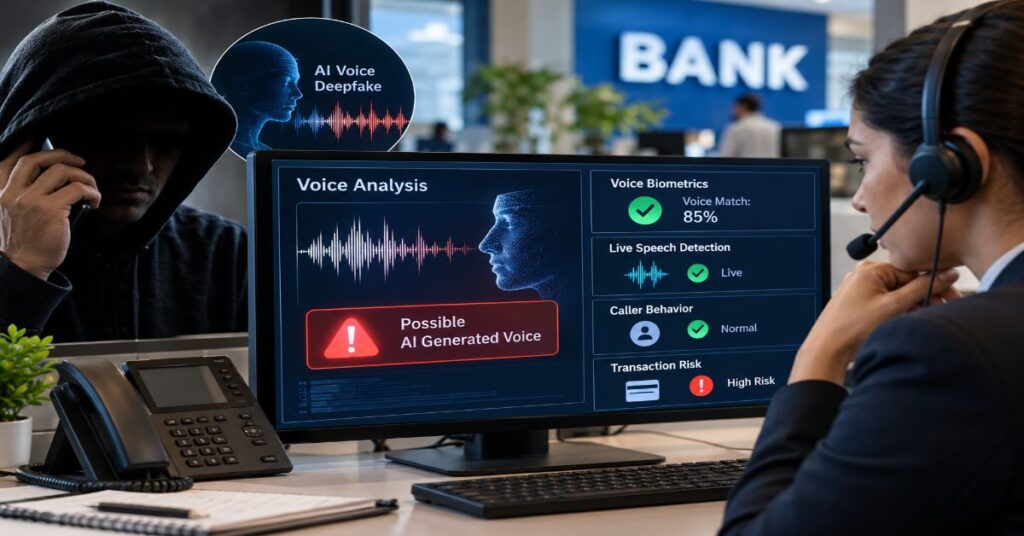
Banks detect AI voice fraud on the phone by combining specialist audio analysis with voice biometrics, behavioural signals, identity checks and transaction controls; no single test can reliably carry the decision. That is the practical answer to “how do banks detect ai voice fraud on the phone”: they assess risk across the whole interaction, not merely whether a voice sounds human.
The threat is no longer limited to a crude recording played through a handset. A synthetic voice can imitate a customer, executive or bank employee closely enough to support a believable conversation. The FBI’s 2025 IC3 Annual Report recorded 22,364 complaints involving AI-related information and adjusted losses of approximately $893.3 million. These are broad AI-related cybercrime figures, not a count of bank voice-cloning cases, which is an important distinction when judging the scale of the specific threat.
For a bank, the challenge is bigger than telling real speech from generated speech. A voice may match a stored profile yet be used in a replay, a manipulated recording or a socially engineered call. A genuine customer may also be tricked into approving a payment themselves. Banks therefore need several independent answers: does the audio look live, does the speaker resemble the enrolled customer, does the call context make sense, and is the requested action consistent with the customer’s normal activity?
This article follows those decisions in order. It separates documented bank practices from emerging capabilities, explains where voice biometrics can fail, and shows why payment monitoring and safe escalation still matter when an audio detector is uncertain. The aim is not to promise that banks can identify every deepfake. It is to explain how layered controls can make a fraudulent call harder to turn into a successful transfer.
How Banks Detect AI Voice Fraud on the Phone: Four Separate Questions
A bank does not have to solve the problem with one classifier. Four security questions remain separate because each examines a different risk. Confusing them creates false assurance: caller ID is treated as identity, a voice match as proof of intent, or a clean audio score as permission to move money.
| Question the Bank Must Answer | Typical Control | What That Control Cannot Prove Alone |
| Was the speech generated, replayed or manipulated? | Audio anti-spoofing or liveness analysis. | It cannot identify the speaker or decide whether a request is legitimate. |
| Does the voice match an enrolled customer? | Speaker verification or voice biometrics. | A match does not guarantee the call is live or that the customer is acting freely. |
| Is the caller and request consistent with known context? | Call metadata, session behaviour, prior history and agent review. | A plausible pattern may still be deliberately staged or appear for a legitimate reason. |
| Should this transaction proceed? | Payment-risk models, payee checks, step-up verification and intervention. | A risk score cannot remove the need for policy, judgement and a recovery plan. |
This separation reflects the defensive direction outlined in the Federal Reserve’s 2025 speech: identity verification, multi-factor authentication, account monitoring, audio or video analysis and scrutiny of unusual recipients can be used together. The speech does not say that every bank already deploys every capability, and readers should not infer universal adoption from examples of individual products.
The distinction is also important for customers. An ordinary telephone network transports the audio; caller ID can be spoofed; and not every handset performs deepfake-audio analysis. Our companion guide on phone-system voice-cloning detection explains why a phone call should not be assumed authentic simply because it rings from a familiar number or sounds convincing. The bank has to add the relevant detection and verification controls at points where it can lawfully inspect audio, account activity or transaction context.
In practical terms, the objective is not to label a voice “real” or “fake” and stop thinking. The objective is to decide what level of assurance is needed before the caller receives account access, changes a customer detail or initiates a payment. A low-risk call asking for general opening hours may require little additional friction; a request to reset credentials, add a new payee or move a large sum should demand stronger evidence.
What Voice Biometrics Measure—and What They Do Not Prove
Voice biometrics compare characteristics of a caller’s speech with a previously enrolled voice profile. Systems may evaluate pronunciation, rhythm, pitch-related patterns, timing and other physical or behavioural properties of speech. The details vary by provider and deployment; public marketing pages rarely expose every model feature, decision threshold or error rate used in a live bank environment.
HSBC’s US Voice ID page, for example, says its service analyses more than 100 behavioural and physical vocal traits and is designed to recognise a customer even when the customer has a cold or sore throat. That is a description of HSBC’s particular service, not proof that all banks use the same number of traits or that a voiceprint is immune to modern spoofing. It illustrates a key design point: speaker verification aims to assess whether a voice resembles the enrolled customer, rather than simply comparing the raw sound with a recording.
Voice biometrics can be useful because static knowledge questions—such as an address, date of birth or recent transaction—may be exposed through data breaches or social engineering. But a biometric result is only one element in the decision. A fraudster may attempt a replay or synthetic reproduction; a genuine customer may have a speech impairment or poor connection; and the model may be operating on a short or noisy phrase. These situations create false acceptance and false rejection risks.
A voice match also says little about intent. A customer can pass authentication while a scammer coaches them in real time, stays on the line while they use mobile banking or persuades them that an urgent transfer is needed to protect their money. The person pressing “confirm” may be the legitimate account holder, which is why identity-only controls often struggle with authorised push-payment fraud.
This is why a useful security interface should show separate results for speaker match, audio liveness and transaction risk, rather than collapsing all three into a single green tick. It should also let an agent see when a result is uncertain and what additional check is appropriate. A system that can recognise a stored voice but cannot flag a payment that contradicts the customer’s ordinary behaviour solves only part of the problem.
What Audio Anti-Spoofing Looks for in a Synthetic or Replayed Voice
Audio anti-spoofing systems look for patterns associated with generated, transformed or replayed speech. Depending on the technology, analysis may use spectral and temporal features, learned acoustic representations, evidence of replay or other model-derived signals. The precise features are implementation-specific; banks generally do not publish enough detail to reconstruct an individual production model, and a vendor’s claims should not be treated as a universal description of the field.
The important point is that the system evaluates patterns across audio rather than listening for a cartoonishly robotic voice. Obvious stutters, strange breaths or unnatural intonation may be clues for a person, but high-quality synthesis can sound natural, while legitimate calls can sound distorted because of codecs, background noise, Bluetooth headsets, low signal strength or a language model that was trained more heavily on some speech patterns than others. A manual “does this sound fake?” test is not a reliable substitute for a documented anti-spoofing process.
No single audio artifact should decide the outcome. A short greeting may not supply enough speech for a stable score; music and silence can confuse timing; compression can suppress cues; and an attacker may switch tactics during a call. The bank should know when the model has sufficient signal, how quickly its assessment stabilises, and how it behaves when the input falls outside its validated conditions. A detector that returns a fast answer from poor evidence is not necessarily a better detector.
The Federal Reserve has described the potential role of AI-powered voice analysis alongside behavioural biometrics and other verification. Meanwhile, the magazine’s separate explainer on the triad defence model combining voice, identity and behaviour covers why institutions may place audio checks inside a wider system rather than expect one product to stop every attack. The architecture matters more than a marketing phrase: a detector is useful when its result changes the next security decision in a controlled and auditable way.
A bank should therefore test not only whether a model flags a clean laboratory sample, but also how it responds to real telephone codecs, varied accents, background noise, short calls, speakerphone playback and legitimate speech-assistance tools. That testing is a deployment requirement, not a claim that every model has been proven across all these conditions.
Why the Caller’s Story Matters as Much as the Sound
The most persuasive fraud call is often successful because its story fits the victim’s expectations. The caller may know a name, an account relationship, a recent purchase, a business deadline or a family emergency. AI can help make those conversations more fluent and personalised, but the central technique is still social engineering: pressure the target to reveal information or make a decision that bypasses normal safeguards.
Banks can use contextual indicators such as a new device, an unusual session, sudden credential-reset activity, repeated failed attempts, an abrupt change in the normal call pattern or a risky action requested soon after a phone contact. A contact-centre agent may also record whether the caller appears to be following a script, whether a third party is speaking in the background, or whether the caller becomes unusually urgent when a verification step is proposed. Such indicators are not proof of wrongdoing. They are reasons to ask for more evidence, because genuine customers also travel, change devices and need help in stressful situations.
The wider threat environment is changing quickly. The magazine’s coverage of the AI cybersecurity threat landscape and AI agents and enterprise fraud risk discusses how automation can lower the effort required to generate and adapt social-engineering attempts. That does not mean every suspicious caller is an automated agent. It means banks should not rely on the old assumption that an attack must be labour-intensive, poorly written or visibly amateurish.
The 2026 Thomson Reuters Institute report includes a warning from Uri Rivner, chief executive and co-founder of Refine Intelligence: “we don’t know exactly what’s coming”. Rivner’s comment concerns the pace of AI-enabled financial scams, not a claim about a particular bank detector. Its relevance is operational: fraud patterns can change faster than annual rules reviews, so systems need monitored performance, incident feedback and a route for analysts to update controls.
Contextual analysis also reduces over-reliance on a single biometric. If the voice score is uncertain but the customer’s session and intended transaction are ordinary, the bank may choose a low-impact verification. If the voice passes but the call coincides with a new payee, a new device and a time-pressured request, the bank may increase scrutiny. The signals are strongest when independent, explainable and evaluated together.
How Transaction Monitoring Closes the Gap After Authentication
Even a successful caller-verification step does not settle whether a payment should be allowed. Transaction monitoring evaluates the proposed action itself: the amount, timing, destination, account history, device and other available risk signals. Banks already use account monitoring and analytics for suspicious activity; deepfake risk adds another reason to connect call-centre and payment workflows rather than treat them as isolated departments.
A request to add a new recipient and immediately send a large transfer may deserve scrutiny if it conflicts with the customer’s routine. A new payee is not automatically fraudulent, and unusual behaviour may be perfectly legitimate, but an unexpected call plus an unfamiliar recipient plus time pressure can be more informative than any one signal by itself. The bank may ask the customer to confirm the purpose of the payment through a separate, trusted channel or introduce a pause that gives a person time to review the context.
| Signal | Why It May Matter | Proportionate Bank Response |
| New payee combined with an unusual amount | The payment differs from the customer’s established pattern. | Request stronger confirmation or refer for review. |
| Password reset followed by a high-risk action | The account may be under takeover pressure. | Re-authenticate and review recent account changes. |
| Suspicious call indicators during a banking session | The customer may be receiving coaching or pressure. | Use a separate-channel check and ask a neutral question. |
| Multiple weak signals appearing together | Independent indicators can form a more meaningful risk picture. | Pause, investigate and document the decision. |
The Federal Reserve notes that banks can scrutinise large or unusual transactions and consider the legitimacy of the recipient, not just the sender. The FBI’s 2025 IC3 report also illustrates why AI-related fraud figures need careful interpretation: its 22,364 complaints and roughly $893.3 million in adjusted losses span many types of crime. The report describes AI-related techniques in business email compromise, confidence schemes and investment fraud; it does not imply that the entire total arose from cloned bank calls.
Payment monitoring is especially important in authorised-payment scams. In these cases, ordinary authentication may work exactly as designed because the customer initiates the payment. The bank must infer possible coercion or manipulation from context, introduce friction where justified and make the intervention early enough to matter. Real-time payments can leave less opportunity to recover funds after they have moved, so the point of intervention is before authorisation or release—not only after a confirmed loss.
How a Risk Score Should Change the Call, Not Decide It Alone
A detector output is best treated as a risk signal with an explicit confidence range and known limitations. A high score may justify step-up verification; a low score should not silently remove other checks. Banks need to decide in advance what each result means, who can override it, which actions require a second factor and how decisions will be recorded for later investigation. Otherwise, a model can create an illusion of certainty without a consistent control policy behind it.
A useful response ladder has several levels. A low-risk call about a routine question can proceed normally. An uncertain result can trigger an additional identity factor. A high-risk call connected to a sensitive account change can be transferred to a specialist fraud team. A suspected coercion or payment scam may warrant a pause, callback through an independently verified number or review by an authorised employee. The intervention should fit the harm at stake and avoid burdening ordinary customers unnecessarily.
A callback is only independent if it uses a number already trusted or obtained from an official source. Calling the number displayed by a suspicious inbound call can simply reconnect the customer to the same attacker or to a spoofed route. The FCA tells consumers to end suspicious calls and use contact details on a bank statement or the bank’s own trusted materials. For customers, that means never accepting the suspected caller’s own number as the only method of verification.
Banks should plan for false positives. A customer who is ill, uses speech technology, calls from a noisy environment or speaks differently may be challenged incorrectly. If every uncertain score triggers an account lock, customers can lose access to funds and staff may learn to override alerts. Thresholds should be tuned against measured outcomes and reviewed as attacks and user populations change.
The opposing risk is a false negative: a convincing synthetic voice passes the initial check and the bank proceeds as if nothing is wrong. A layered workflow limits the damage by preserving independent checks for high-risk activities, even when the audio signal appears clean. “Voice passed” should be one recorded fact in the case, not a universal authorisation to change an address, reset a credential or move money.
What a Layered Detection Workflow Looks Like in Practice
Consider an illustrative call in which someone claims to be a customer who has lost access to an account and asks to reset credentials before transferring money to a new recipient. The following sequence is a reference architecture, not a claim that all banks follow this exact workflow. Each stage produces evidence for the next stage; no single result should override a serious warning from another layer.
| Stage | Evidence Examined | Example Decision |
| 1. Intake | Call route, available telephony metadata and consent or policy requirements for audio analysis. | Confirm that the call can be assessed within the bank’s authorised system. |
| 2. Audio screening | Audio quality, potential replay or synthesis indicators and whether enough speech is available. | Continue, gather more signal or mark the result uncertain. |
| 3. Identity verification | Voice match where enrolled, plus an independent factor appropriate to the action. | Do not allow a voice match alone to approve a high-risk reset. |
| 4. Context review | Device, session history, recent account changes, customer behaviour and agent observations. | Escalate when the narrative conflicts with the account context. |
| 5. Transaction assessment | Amount, payee history, destination and combined fraud indicators. | Add friction or hold the payment for authorised review. |
| 6. Outcome and learning | Documented decision, customer confirmation, analyst finding and eventual outcome. | Use confirmed cases and false alarms to improve controls. |
The workflow is designed to keep distinct verdicts separate: whether speech appears synthetic, whether the speaker matches the profile, whether the caller is authorised to request the action, and whether the proposed action is safe. A strong result in one dimension should not erase an unknown or high-risk result in another. It should be possible to explain after the event why the bank proceeded, challenged the customer or delayed a transfer.
For this workflow to work, teams need clear ownership between contact-centre operations, fraud analytics, identity engineering, payments and privacy or compliance staff. If the voice model flags a call but the transaction engine never sees the flag, the control may have no effect. If the call centre can override every challenge without recording a reason, its safeguards may be weakened in daily practice. Integration is not simply a matter of connecting APIs; it means agreeing which evidence can be shared, who can take action and how the result is audited.
The best sequence varies with the bank’s risk profile, available systems and the action being requested. An informational query, a balance inquiry, a credential reset and a large transfer should not all have the same threshold. A risk-based design uses stronger steps where the likely harm is greater, while preserving accessible routes for customers who cannot pass a particular biometric method.
What Banks Should Require From a Detection Vendor
A vendor’s headline accuracy is not enough to establish that a system will work in a bank’s actual call environment. The bank needs to know what the score means, which data it was tested on and how the system behaves when the customer is legitimate but the call is difficult. Public articles about how realistic deepfakes have become underline a broader evaluation problem: capabilities shown in demonstrations or on a fixed benchmark do not automatically predict performance on unfamiliar audio, compression or new synthesis methods.
| Vendor Question | Evidence a Bank Should Request | Why It Matters |
| What attacks were included? | Test cases covering replay, synthesis, voice conversion, varied durations and call conditions. | An unknown attack type may not behave like familiar benchmark samples. |
| What is the false-positive rate? | Results on legitimate callers, segmented by relevant conditions and populations. | Overblocking can harm access, create complaints and train staff to bypass controls. |
| When is a score reliable? | Time to first stable result and performance by audio duration, codec and signal quality. | A fast answer from insufficient speech can create false confidence. |
| How is performance monitored? | Drift metrics, incident review, model updates, versioning and rollback procedures. | Attack methods and customer behaviour change after deployment. |
| How does it integrate? | Documented inputs, outputs, latency, security controls and tested integration paths. | An alert that fails to reach an agent or payment system cannot protect the transaction. |
A useful pilot measures false acceptances, false rejections, challenge completion, added call time, agent overrides, complaints and fraud outcomes—not accuracy alone. Compare results across languages, accents, customer groups, devices and network conditions, with a baseline that helps distinguish product impact from general changes in fraud volume.
Banks should ask whether the model is calibrated for the decision it informs. “Likely synthetic” might be suitable for triage but insufficient for denying access. It should also be clear whether customer audio is retained, how long any voice profile is held, whether data is used to train models and which external parties can access it. These questions are not secondary procurement details; they affect privacy, regulatory obligations and the acceptability of the control.
The bank should not assume that a vendor’s published latency or benchmark result generalises to its production system. Ask for performance under the same telephony codecs and network conditions, verify the integration end-to-end and define a fallback for unavailable services. Do not state that a particular vendor has achieved a universal accuracy rate unless the claim is supported by an independently verifiable evaluation with a relevant test population.
Why Defences Differ Across Banks, Markets and Customer Groups
Not every bank has the same call infrastructure, data access, fraud operations or budget. A large institution may have a dedicated contact-centre security team and systems that join call signals with payment events. A smaller bank may depend on a third-party contact-centre provider or managed fraud tools. A feature advertised by one bank should not be assumed to be available through a different bank, in a different country or on every customer account.
This is particularly important when writing for a global audience. HSBC’s public Voice ID page documents a specific service; it does not establish that every bank has voice authentication. The FCA’s guidance describes consumer risks such as vishing and caller-ID spoofing, while the Federal Reserve addresses defensive measures in the US banking context. Those sources provide examples of controls and advice, not a universal map of implementation across all jurisdictions.
A 2026 study in Humanities and Social Sciences Communications examined AI-driven financial fraud detection in Pakistan’s banking sector through literature review and interviews across banking roles. Its abstract reported that advanced techniques such as machine learning, anomaly detection, deep learning and natural-language processing are available, while operational use can be constrained by staff understanding, customer awareness and organisational readiness. That finding is relevant to deployment strategy, but it does not measure the prevalence of voice cloning or establish which individual Pakistani banks have adopted voice anti-spoofing.
The practical questions are concrete: does the bank offer an independently verifiable callback route, use additional checks for risky account changes, and provide a clear route to report a suspected voice clone or stop a suspicious transfer? Customers should ask what their own bank supports rather than assume a feature described elsewhere is included.
Institutional governance matters as much as technology. Teams need training, escalation authority, incident reporting and a way to learn from cases. The magazine’s coverage of European regulators’ AI cybersecurity concerns considers the broader challenge of incorporating AI-driven risk into institutional resilience. The lesson for voice fraud is that purchasing a detector is not the same as building a complete process for preventing financial harm.
What Customers Should Do When a Caller Sounds Exactly Right
Customers do not need to diagnose a deepfake during the call to protect themselves. The safest response to an unexpected request for a payment, login credential, one-time code, remote-access session or account reset is to stop the interaction and verify independently. A convincingly familiar voice is a reason to pay attention, not a reason to bypass the bank’s normal process.
Hang up and contact the bank using the number on the payment card, the bank statement or an official app or website opened separately. Do not call back using a number supplied by the suspicious caller or rely only on caller ID. The FCA explicitly warns that criminals can spoof the displayed number to make an incoming call appear to come from a bank or regulator. The FBI similarly advises people to verify a caller by contacting the organisation through a known, independently sourced number and not to share sensitive information with someone solely because they reached the person by phone.
Treat urgency, secrecy, unusual payment instructions and claims that the customer must move money to a “safe account” as red flags. Do not share one-time passcodes with the caller or install remote-access software at their request. A bank might contact a customer about suspected fraud, but the customer should be able to end the call and verify through an official channel rather than obeying an instruction to stay on the line.
If money has already been transferred or credentials were disclosed, contact the bank’s fraud team immediately through a trusted route, explain what happened and ask whether the transaction can be stopped or recalled. Preserve call times, displayed numbers, messages, payment references and any other relevant evidence. Report the incident to the appropriate local authority or cybercrime reporting service. Do not delay reporting while trying to prove whether the caller used AI; the immediate priority is to protect the account and any remaining funds.
More advice on containment and reporting is available in our guide to what to do after a suspected deepfake. The principle is the same for a cloned voice, a fake video or a conventional impersonation scam: preserve evidence, stop the risky action and use a channel that the person making the demand does not control. Human suspicion is useful, but independent verification is stronger than trying to hear a flaw in an artificially generated voice.
The Next Frontier Is Detecting Intent, Not Just Synthetic Audio
As voice synthesis improves, banks will have reasons to invest in both better audio analysis and better understanding of a customer’s situation. Yet even a technically flawless detector cannot prevent every scam. The attack may use a human caller, an authentic recording, a real customer who is under pressure, or a mix of synthetic and ordinary social engineering. For this reason, the long-term objective is not simply to classify the sound; it is to identify when a legitimate account is being used to carry out a harmful or manipulated action.
The September 2026 Thomson Reuters Institute report quotes Garrett Sadler, a senior account executive at ThreatMark, warning of “smarter scams, faster scams, and at more volume”. The quotation is a forward-looking industry assessment, not a measured rate of growth for bank voice fraud. It highlights why defence processes need monitoring and adaptation rather than a fixed set of rules based on last year’s attacks.
The same report quotes Lesley Park, Thomson Reuters’ global director for financial services, saying that “you can run a sophisticated scam”. The report also quotes Ayelet Biger-Levin, founder of RangersAI, observing that attackers “don’t need a Masters” to build sophisticated tools. The point is not that every fraudster can defeat every control; it is that lower barriers to attack increase the importance of sound operating procedures. Banks should combine technical signals with human judgement, cross-institution intelligence where appropriate and a way to interrupt risky activity before the money leaves the account.
That shift has trade-offs. Extra verification frustrates legitimate customers, and indiscriminate payment pauses can create hardship. Too little friction lets attackers exploit customers who passed authentication. The defensible approach is targeted friction: challenge when independent signals warrant it, explain escalation where safe, and record whether the intervention prevented loss or inconvenienced a genuine customer.
For banks, success should be measured in outcomes rather than slogans: reduced fraud losses, faster identification of high-risk cases, lower false-positive burden, well-documented overrides and better customer recovery when scams occur. A system that detects synthetic speech but does not connect to the payment workflow may provide useful intelligence without preventing the transfer. A system that examines context and slows a suspicious payment may prevent loss even when the audio itself remains uncertain. In a layered defence, both capabilities have a place.
Our Editorial Verification Process
This is a document-based explainer, not a live audit of proprietary bank systems. Research was cross-checked against the Federal Reserve, the FBI’s 2025 IC3 Annual Report, HSBC Voice ID, FCA guidance, U.S. Bank and the Thomson Reuters Institute’s 2026 report, alongside peer-reviewed research on Pakistan’s banking sector. The review also considered coverage from the American Bankers Association, FIS and Check Point Research.
Ten relevant results for the exact query and close variants were reviewed. Their recurring patterns were voice-cloning definitions, warning-sign lists, product explanations and general safety advice. This article instead follows four verification questions through to the payment decision. The sitemap.xml, sitemap_index.xml and post-sitemap.xml endpoints did not return parseable XML, so internal links were selected from verified indexed magazine pages rather than guessed.
No proprietary bank call was replayed, no voice-biometric product was benchmarked and no lab test was conducted. The article therefore makes no original accuracy or latency claims, universal adoption claims or product-pricing comparisons. FBI figures are described as broad AI-related complaints, not voice-fraud totals; quotations are brief and attributed to the named speakers in the 2026 Thomson Reuters Institute report.
This article was researched and drafted with AI assistance for review by the Awais Khalid editorial desk at Perplexity AI Magazine. Sources and named quotations were checked against the linked material during preparation; independent human editorial sign-off remains necessary before publication.
Conclusion
Banks detect AI voice fraud most effectively when they treat it as a connected security problem rather than a contest between a human ear and a synthetic voice. Audio anti-spoofing can flag suspicious speech; voice biometrics can compare a caller with an enrolled profile; behavioural analysis can test whether the request fits the context; and transaction monitoring can still interrupt an unusual payment. Each layer answers a different question, so none should be treated as conclusive proof on its own.
The hard cases expose the limits of detection-first thinking. A real customer can pass authentication while being manipulated into authorising a transfer. A legitimate caller can be challenged by a false positive. A familiar number can be spoofed, and a model can be uncertain when the audio is short or compressed. Banks therefore need clear escalation rules, tested vendor performance, privacy controls and a practical way to pause high-risk activity before funds leave the account.
The next stage of financial fraud defence depends on linking signals to intent and payment risk while keeping controls proportionate. Public evidence confirms multiple defensive options, but not universal adoption or guaranteed detection. For customers, the durable rule remains independent verification: end a suspicious call and recontact the bank through a trusted channel.
Frequently Asked Questions
How Do Banks Detect AI Voice Fraud on the Phone?
Banks combine audio anti-spoofing, voice biometrics, identity checks, behavioural context and transaction monitoring. No single detector proves that a caller is genuine or that a payment is safe; the specific controls vary by bank.
Can Banks Always Tell When a Voice Is AI-Generated?
No. Audio detectors can produce useful risk signals, but performance depends on audio quality, duration, model design and the attack method. Banks should treat uncertain results as a reason for additional verification, not assume every synthetic voice will be caught.
Is Voice Biometrics the Same as Deepfake Detection?
No. Voice biometrics checks whether a speaker resembles an enrolled customer. Anti-spoofing attempts to detect replayed or synthetic speech. A bank may use both, but either result alone is insufficient for every high-risk action.
Can a Fraudster Spoof a Bank’s Phone Number?
Yes. Caller ID can be spoofed to make an incoming call appear to come from a legitimate organisation. End suspicious calls and contact the bank through a number from your card, statement or independently opened official app.
What If the Caller Sounds Exactly Like a Family Member or Bank Employee?
Do not rely on voice familiarity. Stop any urgent financial request and contact the person or organisation through a previously trusted channel. Never share one-time codes or move money to a purported “safe account” just because the voice sounds right.
Do All Banks Use AI Voice Fraud Detection?
Public evidence does not show that all banks use the same systems or deploy specialised audio anti-spoofing. Some provide voice biometrics, while others may depend on other identity, call-centre and transaction controls. Ask your bank which protections are actually available.
What Should I Do If I Already Shared Details With a Suspicious Caller?
Contact your bank’s fraud team immediately using a trusted number, explain which details were shared and ask about securing the account or stopping the transfer. Preserve call records, messages and payment references, then report the incident to the appropriate local authority.
References
Federal Bureau of Investigation, Internet Crime Complaint Center. (2025). 2025 IC3 Annual Report.
Federal Bureau of Investigation, Internet Crime Complaint Center. (2024, December 3). Criminals use generative artificial intelligence to facilitate financial fraud.
Financial Conduct Authority. (2026, March 31). Banking and online account scams.
Federal Reserve Board. (2025, April 17). Michael S. Barr, Governor. Deepfakes and the AI arms race in bank cybersecurity.
HSBC Bank USA. (n.d.). Voice ID: Customer service.
Thomson Reuters Institute. (2026, September 24). Deception in the AI age 2026: Understanding, preventing & fighting financial scams.
U.S. Bank. (n.d.). AI fraud: Protecting your business from deepfake calls.
Rahim, A., Jan, S. U., Ali, S., Shah, D., et al. (2026, May 5). AI-driven financial fraud detection in Pakistan’s banking sector: Bridging strategic intent and operational implementation. Humanities and Social Sciences Communications, 13, Article 1085.