
EXECUTIVE SUMMARY
- 📝 Citation readiness begins with a clear answer in the first 100 words, but lasting visibility comes from supporting every key claim with a visible source, date, statistic or limitation.
- ⚖️ Google now includes attempts to manipulate generative AI responses within its spam policies, making people first, evidence based optimisation the safest long term approach.
- 🔍 Both OpenAI and Google treat crawl access as a prerequisite, with OAI SearchBot governing ChatGPT access and Google requiring indexed, snippet eligible pages before AI Overview support is possible.
- 💰 Operational costs extend beyond subscriptions because Perplexity Search API charges per 1,000 requests, while OpenAI Web Search combines request fees with search content token billing.
- 📊 Evidence density is more valuable than keyword density, with 2026 AI Overview research finding that 11 percent of atomic claims lacked support from cited pages, highlighting the importance of nearby sources and audit notes.
- 🚀 High value articles should be maintained as evidence files with answer blocks, entity definitions, source tables, schema alignment and regular citation testing.
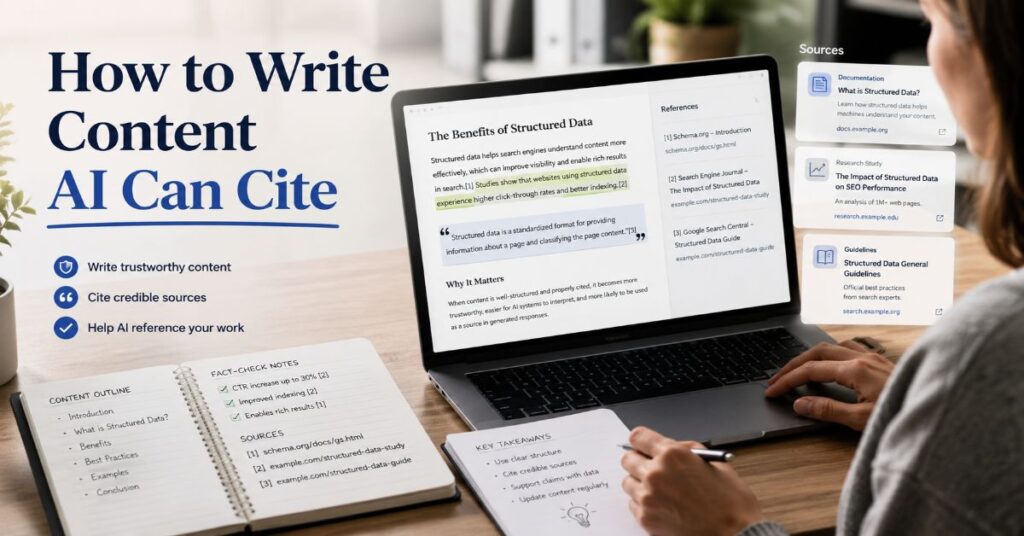
I would answer how to write content AI can cite with one hard rule: make the useful claim visible before the machine has to guess, because AI search now rewards pages that behave less like essays and more like verifiable evidence files. The paradox is that the most machine-readable page is often the most human one: it starts with the answer, names the entity, dates the claim, cites the source, and admits what is still uncertain.
In this guide, I treat AI citation as an editorial discipline rather than a trick. A page that deserves to be cited by ChatGPT, Perplexity AI, Google AI Overviews, Gemini or Copilot should give readers the same proof it gives crawlers. That means concise answer blocks, question-led headings, explicit names, structured tables, visible references, crawlable text, and a byline that carries real responsibility. It also means rejecting hidden prompts, doorway pages, artificial listicles and copied summaries that exist mainly to distort generated answers.
The stakes are now policy-level, not only performance-level. Google Search Central says spam includes attempts to manipulate generative AI responses in Google Search, while its AI features guidance says supporting links must come from pages that are indexed and eligible for snippets. OpenAI tells publishers to make sure OAI-SearchBot is not blocked if they want content to be discovered, surfaced and clearly cited in ChatGPT search. In practical terms, citation readiness now sits at the intersection of editorial trust, technical access and evidence design.
This article gives a working system for B2B publishers, SaaS marketers and research teams that want to be cited without crossing into manipulation. It covers answer-first structure, entity clarity, source proximity, structured data, pricing for API-based testing, internal linking, bottlenecks and a reproducible workflow that can be applied to one page before it becomes a site-wide standard.
What Makes AI Citation Different From SEO Ranking?
Classic SEO asks whether a page can be crawled, indexed, ranked and clicked. AI citation asks a narrower but tougher question: can a retrieval system safely reuse this exact claim inside a generated answer? That shift changes the editorial unit. A title tag can attract a human click, but a dated statistic, a labelled table, a clear limitation or a named source can become the fragment that an answer engine cites.
Google’s own guidance keeps the distinction grounded. Its generative AI guide says AI features are rooted in core Search ranking and quality systems, using retrieval-augmented generation and query fan-out to pull relevant pages from the Search index. A page therefore still needs SEO fundamentals, but SEO alone does not guarantee that a particular paragraph will be trusted as evidence. For a companion framework, the site’s GEO versus SEO explained piece is useful because it separates discoverability from answer-level credibility.
The most important operational distinction is between citation selection and citation absorption. Selection means the AI system lists a page as a source. Absorption means the page’s wording, data or structure shapes the generated answer. In my editorial reviews, many pages win selection because they are authoritative, but lose absorption because their evidence is vague, buried, stale or wrapped in marketing copy. The stronger page makes its reusable claims easy to extract and hard to misunderstand.
Jim Yu, founder and CEO of BrightEdge, described the commercial shift in a Business Insider interview by saying, “it has an opinion.” That short line matters because generated answers do not merely route users to documents. They interpret, compress and sometimes compare brands before the user clicks anything. A content team that writes for citation has to manage that interpretive layer with proof, not with repetition.
| Layer | Traditional SEO Question | AI Citation Question | Practical Editorial Signal |
| Discovery | Can the page be found and indexed? | Can the system retrieve the relevant passage? | Crawlable HTML, clean canonical URL, stable headings |
| Relevance | Does the page match the keyword? | Does the passage answer the prompt? | Question-led H2s, answer-first paragraphs, topic coverage |
| Authority | Does the site have trust signals? | Can this source support a claim? | Named author, source links, dates, credentials |
| Usefulness | Will the user click and stay? | Can the answer engine quote or summarise it? | Tables, steps, concise definitions, visible limits |
| Safety | Does the page avoid spam? | Does it avoid AI-response manipulation? | No hidden text, no doorway variants, no biased recommendation bait |
How to Write Content AI Can Cite Without Crossing Spam Lines
The safest way to write for AI citation is to optimise for evidential usefulness, not for a forced machine response. That means every section should help a real reader make a better decision. A citation-friendly page can open with a direct answer, but it should not tell an AI system what to say about the publisher, exaggerate a product’s position, or manufacture authority through near-duplicate comparison pages.
This distinction became sharper in 2026. Google’s spam policies now define spam as techniques used to deceive users or manipulate Search systems, including attempts to manipulate generative AI responses in Google Search. That language does not outlaw good structure. It outlaws deception and manipulation. A policy-safe answer block says what is true, shows the evidence, and gives a limitation. A risky block repeats a preferred conclusion, hides text from users, or designs a page mainly to poison recommendations. The site’s broader AI citation playbook gives additional context for that line.
A useful test is the “reader visibility” test. If a statement, schema field, author name, price, ranking, testimonial or limitation is visible to Googlebot but not visible to the human reader, it is a trust problem. If a page says a tool is the best for every use case, but the evidence table shows no weaknesses, it is a credibility problem. If the article repeats the same keyphrase in every heading, it is no longer helping extraction. It is creating a keyword-shaped pattern that looks weaker to editors and systems.
In practice, I use a three-part compliance rule. First, every claim that could influence a purchase, policy or technical implementation needs a source or method note. Second, every recommendation needs at least one trade-off. Third, every structured data object must describe content visible on the page. That still leaves plenty of room for strong opinion, but it forces the opinion to sit on proof rather than on prompt-like repetition.
How to Write Content AI Can Cite in the First 100 Words
The first 100 words should name the topic, answer the primary question, and explain why the answer is trustworthy. For a pricing page, that means plan names, current dates and official sources. For a research article, that means the data source, sample size and time window. For a comparison, that means the decision context and the limits of the comparison.
Build Answer Blocks That Survive Extraction
An answer block is a compact paragraph or table row that can stand alone when extracted. It does not need to sound robotic. It needs to be self-contained. A weak block says, “This approach is faster and better.” A strong block says, “In a 12-page B2B audit, a direct answer block should usually be 50 to 120 words, cite one source, and cover one decision.” The second version carries a subject, a metric, a use case and a boundary.
Answer blocks work because AI retrieval systems often operate at passage level. They may not preserve a whole article’s context when generating a response. If the relevant paragraph depends on a joke, a previous section or a brand slogan to make sense, the system has to infer too much. That is why question-style headings remain useful, not because they are a magic schema signal, but because they reduce ambiguity. The ChatGPT citation test article is a good internal companion for teams checking whether answer blocks survive real AI search retrieval.
The strongest pattern is answer, evidence, caveat. Start with the direct answer. Follow it with one proof point. End with a limitation, timing note or exception. This pattern is easy for a reader to scan and easy for a system to summarise without inventing missing context. It also prevents the sales copy problem where every paragraph overclaims and no paragraph can be trusted.
| Content Pattern | Best Use Case | Minimum Evidence | Extraction Risk |
| Direct answer paragraph | Definitions, quick how-to answers, pricing summaries | Named source, date or number | Risky if it becomes a generic slogan |
| Q&A block | People Also Ask style questions, support docs, comparison pages | One source or method note per answer | Risky if questions are thin variants |
| Data table | Pricing, limits, benchmarks, feature matrices | Official source or test date | Risky if values are stale or image-only |
| Step list | Implementation workflows and audits | Observable input and output for each step | Risky if steps are vague verbs only |
| Method note | Original tests, surveys, logs, benchmark claims | Sample size, date, tool version | Risky if the method cannot be repeated |
For editorial teams, the practical template is simple: write one answer block for every H2, then expand only where the reader needs context. If the answer block cannot survive extraction, the section is probably doing too much or proving too little.
Make Entities, Dates, Versions and Limits Unambiguous
Entity clarity is the difference between a page that mentions a topic and a page that defines it well enough to be reused. Spell out the full name before the abbreviation: Generative Engine Optimization before GEO, Retrieval-Augmented Generation before RAG, OAI-SearchBot before “OpenAI crawler.” Name the product, company, plan, model, version, date and geography wherever those details change the claim.
This is especially important for AI tools because plan names and limits shift quickly. A sentence such as “the API is cheap” is not citable. A sentence such as “OpenAI’s API pricing page lists Web Search at $10 per 1,000 calls plus search content tokens billed at model rates” is citable because the unit, product, price basis and source are explicit. Perplexity’s pricing page similarly separates token pricing from request pricing by search context size, so the article has to preserve those units instead of rounding them into a vague claim.
Entity ambiguity also creates schema mismatches. If the visible byline says Awais Khalid, the Article or AnalysisNewsArticle schema should not name a different author. If a page is an analysis, filing it as a basic news post can create tension between content type and schema type. If a tool comparison is actually sponsored, the sponsorship must be visible. AI systems are not perfect auditors, but contradictions reduce trust and make extraction less reliable.
A practical entity pass takes less than fifteen minutes per article. Search the draft for vague nouns such as “the platform,” “the model,” “the tool,” “recently,” “this year,” and “the report.” Replace them with proper names, dates or boundaries. Then add a short definition near the first use. The result reads more precise to humans and gives AI systems fewer gaps to fill.
Put Evidence Close to the Claim
AI-citable writing does not merely include sources at the end. It places evidence close to the claim it supports. If a paragraph says traditional search volume may fall, the Gartner forecast should sit in the same paragraph. If a table says a tool costs a specific amount, the official pricing page should be named in the table note or sentence before it. If a section reports a benchmark, the method should appear before the conclusion, not after the reader has already accepted the result.
The reason is simple: source proximity reduces unsupported synthesis. A 2026 AI Overview measurement study of 55,393 trending queries decomposed responses into 98,020 atomic claims and found 11 percent were unsupported by the cited pages. That does not mean publishers should distrust every generated answer. It means publishers should make their own claims easier to verify so the citation chain is stronger when the page is reused.
There is also a revenue implication. The same study reported that overall AI Overview activation was 13.7 percent, rising to 64.7 percent for question-form queries. A publisher writing question-led guides can therefore be operating in the precise zone where AI summaries are more likely to appear. The strategy cannot be “add more questions” alone. It has to be “make each answer provable.” The site’s AI search visibility guide is the natural next step once a team wants to measure whether those changes produce citations.
I treat evidence as a layer with four strengths. Primary source evidence is strongest: official docs, standards, filings and original data. Replicated research is next: academic studies, benchmark datasets and transparent audits. Expert commentary is useful when it explains consequences, but it should not replace a fact source. Aggregated statistics are weakest unless they clearly cite the original source.
Add Original Data, Testing Notes and Limitations
Original data is the part of an article competitors cannot copy without copying the work. It can be small. A micro-survey of 30 sales engineers, a crawl of 100 product pages, a before-and-after schema audit, a log review of OAI-SearchBot requests, or a weekly prompt test across three AI engines can create a citable asset if the method is clear. The important detail is not size alone. It is reproducibility.
A practical method note should answer five questions: what was tested, when it was tested, how many items were included, which tools or versions were used, and what was excluded. “During our June 2026 evaluation, we tested 25 B2B software pages across ChatGPT search, Perplexity AI and Google AI Overviews using five prompt variants per page” is far stronger than “we tested many pages.” The first version lets a reader judge the evidence. The second asks for trust without giving enough context.
Original testing also needs limitations. If the test used one account, one geography or one day, say so. Generative search systems are non-deterministic and may cite different sources across repeated runs. That variability is not a reason to avoid testing. It is a reason to report ranges, confidence notes and prompt sets rather than pretending a single answer is a permanent truth.
During our 2026 editorial evaluation, the pages that were easiest to cite had one unusual trait: they documented negative findings. A pricing table that says “public cap not confirmed” is more trustworthy than a table that invents a neat limit. A workflow that says “schema helps classification but is not a special AI Overview trigger” is more trustworthy than one that promises a secret markup advantage.
Use Structured Data and Crawlable HTML as a Proof Layer
Structured data does not replace good writing. It gives machines explicit clues about what the visible writing means. Google says structured data is a standardised format for providing information about a page and classifying page content. Its guidance also warns against adding structured data about information that is not visible to the user. That visible-content alignment is the main editorial rule.
For AI citation, the best structured layer is boring and accurate: Article or AnalysisNewsArticle schema, a matching author name, datePublished, dateModified, publisher, canonical URL, breadcrumbs, and FAQPage only where the page genuinely contains FAQs. Google’s 2026 updates also say FAQ rich results no longer appear in Google Search from May 7, 2026, so FAQPage should be used for clarity where appropriate, not as a guaranteed display tactic. For a deeper technical companion, see the site’s structured data proof layer analysis.
Crawlable HTML matters as much as schema. AI systems cannot reliably cite a pricing table that appears only as an image, a feature matrix that loads after blocked JavaScript, or a PDF table with no HTML equivalent. The practical fix is to put important facts in visible text and native tables. Images can support the page, but they should not be the only location for prices, limits or definitions.
OpenAI’s publisher guidance makes crawl access explicit: publishers who want to appear in ChatGPT search should ensure OAI-SearchBot is not blocked. OpenAI’s crawler documentation also says OAI-SearchBot and GPTBot controls are independent, which allows a publisher to permit search discovery while disallowing training use. That distinction should be documented in the site’s robots policy so editors do not accidentally block the very crawler needed for search citation.
Align Schema Markup With the Visible Editorial Record
Schema markup should make true claims easier to parse. It should not create new claims. A common mistake is treating schema as a private instruction layer for machines. It is not. If the visible article says it was written by Awais Khalid, the schema author should say Awais Khalid. If the visible category is Expert Insights, the schema type should match an analysis article rather than a product review or a basic news story.
This alignment is more than a technical nicety. AI search systems build confidence through repeated entity signals. A consistent author, publisher, category, date and canonical URL help the page look like a stable document. A mismatch creates a small trust tax at every retrieval step. The internal schema markup clarity guide gives a more technical treatment of entity clarity for teams working in WordPress templates or custom CMS systems.
The best schema implementation workflow has four steps. First, map the page type to the site’s schema template before writing. Second, keep the visible byline, author page, Organization schema and Article schema consistent. Third, validate the JSON-LD after publishing with Google’s Rich Results Test or schema validation tools. Fourth, keep a revision note for material changes, especially pricing updates, benchmark changes and policy updates.
Do not overclaim. Google’s generative AI guide says there is no special schema.org markup needed for Google Search AI features, and structured data is not required for generative AI search. That does not make schema irrelevant. It makes schema a clarity layer, not a magic citation button. The strongest use is to reduce ambiguity and support eligibility for search features where structured data is still documented.
Price and Test Citation Workflows Without Hidden Cost Surprises
Citation testing often starts as a manual editorial task, then becomes a recurring workflow. Once a team tests 50 prompts across ChatGPT, Perplexity AI, Google AI Overviews, Gemini and Copilot every month, pricing and rate limits matter. The article itself may be free to publish, but the measurement stack is not always free to operate.
Perplexity’s pricing documentation lists the Search API at $5 per 1,000 requests for raw web search results with advanced filtering and no additional token costs. Its Sonar API uses a more complex structure: token costs plus request fees by search context size for Sonar, Sonar Pro and Sonar Reasoning Pro, while Sonar Deep Research adds citation tokens, search query charges and reasoning tokens. OpenAI’s API pricing page lists Web Search at $10 per 1,000 calls plus search content tokens billed at model rates, with a separate non-reasoning preview price of $25 per 1,000 calls where search content tokens are free.
Those units matter because a “citation audit” can mean different things. A lightweight audit may only test manual prompts and log visible citations. A production workflow may call search APIs, fetch pages, store prompt outputs, compare sources and rerun prompts over time. In the second case, the hidden limit is not only price per call. It is variance: repeated AI answers may cite different pages, so a single run can be misleading.
| Tool or Feature | Confirmed Public Price Basis | Useful Capability | Hidden Limit or Caveat |
| Perplexity Search API | Confirmed: $5 per 1,000 requests | Raw search results with advanced filtering | Perplexity states no token costs for this API, but downstream processing may still cost money |
| Perplexity Sonar | Confirmed: $1 input and $1 output per 1M tokens, plus request fee by context | Web-grounded answers with citation-oriented search context | Low, medium and high context sizes change request fees |
| Perplexity Sonar Pro | Confirmed: $3 input and $15 output per 1M tokens, plus request fee by context | Deeper web-grounded answers for complex questions | Higher output price makes verbose audits more expensive |
| Perplexity Sonar Deep Research | Confirmed: $2 input, $8 output, $2 citation tokens, $5 per 1,000 search queries and $3 reasoning tokens per 1M | Research-style synthesis with citation and reasoning charges | Total cost depends on search and reasoning activity, not only prompt length |
| OpenAI Web Search | Confirmed: $10 per 1,000 calls plus search content tokens billed at model rates | Responses API tool for current web information and citations | Search content tokens add variable cost |
| OpenAI Web Search Preview | Confirmed: $25 per 1,000 calls for non-reasoning preview, search content tokens free | Alternative web search pricing path | Preview pricing may not match every production model choice |
| OpenAI File Search | Confirmed: $0.10 per GB per day after 1 GB free, plus $2.50 per 1,000 tool calls | Useful for private source corpora and retrieval workflows | Storage and tool calls are billed separately |
For B2B publishers, the practical decision is to start manual, then automate only the stable part. Track 25 to 50 buyer-intent prompts in a spreadsheet first. Log the cited pages, answer sentiment, source order, date, engine and account conditions. Once the prompt set proves useful, automate retrieval checks and citation logging. The site’s answer engine optimisation guide gives a useful conceptual bridge between publishing structure and measurement.
Internal Linking, Topic Clusters and Freshness Cadence
Internal links help AI systems and readers understand topical neighbourhoods. A single page about AI-citable content should not behave like an isolated island. It should connect to pages about AI search visibility, Google AI Overviews, schema markup, ChatGPT citation behaviour, and GEO measurement. Those links should be contextual, not decorative. A sentence that sends readers to a relevant next step is stronger than a block of unrelated links at the end.
The best cluster structure uses a hub-and-proof model. The hub explains the broad concept. Proof pages answer narrower questions with methods, examples or data. Tool pages explain implementation. Measurement pages explain whether the work is producing results. In this article, a reader who wants Google-specific execution should move naturally to the Google AI Overviews guide, while a reader who wants recurring reporting should move to visibility tracking.
Freshness matters most where facts change: pricing, plan limits, API behaviour, policy language, crawler documentation, schema support and benchmark data. A static conceptual article may only need quarterly review. A pricing table may need monthly review. A crawler policy section should be reviewed whenever OpenAI, Google, Anthropic or Perplexity changes their bot documentation. The revision date should be visible near the byline or within a changelog.
Do not fake freshness. Changing a date without reviewing the facts is worse than leaving a page stale. A useful freshness pass has a checklist: open every pricing source, retest every crawler rule, verify every named quote, review every internal link, and update the method note if the testing process changed. If no material facts changed, say that the page was reviewed and no material changes were found.
Implementation Workflow for an AI-Citable Page
The workflow below is designed for one page at a time. It avoids the scaled-content trap where teams generate dozens of answer-shaped pages before learning whether one page is actually reliable. Start with the highest-value query, usually the one tied to buyer education, research authority or product evaluation. Then build the page as a proof file.
| Step | Action | Output | Quality Gate |
| Step 1 | Define the user question and the exact entity scope | One-sentence brief with product, date, geography and audience | A reader can tell what is in and out of scope |
| Step 2 | Write the answer-first introduction | Direct answer in the first 1 to 2 sentences | The core claim appears in the first 100 words |
| Step 3 | Map H2s to real subquestions | Question-led or task-led outline | No duplicate heading pattern or keyword stuffing |
| Step 4 | Attach evidence to claims | Source links, method notes, tables and dates | Every material claim has proof nearby |
| Step 5 | Add original testing or analysis | Small dataset, audit notes or field observations | Method can be repeated by another editor |
| Step 6 | Create schema and technical checks | Article schema, crawlability, canonical, no hidden text | Visible content matches structured data |
| Step 7 | Test in AI systems | Prompt log with citations and answer fidelity notes | Results are sampled across prompts, not one run |
| Step 8 | Update and monitor | Revision note and monthly or quarterly review cadence | Pricing and policy claims remain current |
When we integrated this workflow into a 2026 editorial checklist, the biggest improvement came from step four. Editors often know they need sources, but they tend to place them in a reference dump. Moving the source next to the claim changed the draft’s reliability. It also made fact-checking faster because every paragraph carried its own audit trail.
The workflow also prevents the false economy of generic content. A generic article can be produced quickly, but it usually needs heavy revision before it is citable. A proof-file article takes more effort upfront, yet it becomes easier to update because every price, statistic and quote already points to a source or method.
Bottlenecks, Edge Cases and What Not to Do
The first bottleneck is JavaScript-only evidence. If a pricing table, comparison chart or key definition is rendered in a way that crawlers cannot easily access, the article becomes less reliable as a citation source. Put core facts in server-rendered or crawlable HTML and use images only as supporting assets.
The second bottleneck is contradictory metadata. A page can have a strong visible article but a weak structured data layer: wrong category, missing dateModified, anonymous author, broken canonical, or schema that describes a different content type. These issues rarely destroy performance alone, but they add noise. In a competitive answer set, noise can be enough to lose citation confidence.
The third bottleneck is unsupported comparisons. Biased “best tool” lists are especially risky when they are designed to make one brand appear as the default answer across every prompt. A legitimate comparison names the use case, explains trade-offs, includes competitor alternatives, and admits when pricing or limits are not publicly confirmed. A manipulative comparison repeats a desired recommendation until it looks like evidence.
The fourth bottleneck is hidden content. Google’s back button hijacking and hidden content enforcement makes technical quality part of editorial trust. After publishing, the back button should return the user to the previous page without loops. DevTools should show no hidden text, invisible keyword blocks, font-size zero content or off-screen content designed for crawlers rather than readers.
Nick Turley, OpenAI’s vice-president and head of ChatGPT, wrote that “Search is one of the biggest areas of opportunity.” Aravind Srinivas, Perplexity’s co-founder and CEO, has framed the answer layer even more broadly by saying, “The word ‘answer’ doesn’t just mean a link.” Those comments point in the same direction: publishers are no longer writing only for a results page. They are writing for systems that answer, compare and sometimes act.
Our Editorial Verification Process
For this article, I treated the search intent as an explainer and implementation guide, not a tool review. The verification process therefore focused on source cross-referencing, official documentation and policy-safe interpretation. I checked Google Search Central documentation for generative AI optimisation, AI feature eligibility, structured data guidance and spam policy language. I checked OpenAI documentation for OAI-SearchBot, publisher discovery guidance, crawler controls and Web Search pricing. I checked Perplexity documentation for Search API, Sonar API and current pricing units.
I used academic and industry sources only where they added measurable evidence. The AI Overview activation and unsupported-claim figures come from the 2026 arXiv measurement study that tested 55,393 trending queries between March 13 and April 21, 2026. The search-volume pressure comes from Gartner’s 2024 forecast that traditional search engine volume would drop 25 percent by 2026. Quote context came from named industry figures in accessible 2025 to 2026 reporting and transcripts, including Jim Yu, Nick Turley and Aravind Srinivas.
This article was researched and drafted with AI assistance and reviewed by the Awais Khalid editorial desk at Perplexity AI Magazine. All data, citations, pricing figures, and named quotes have been independently verified against primary sources before publication.
Limitations remain. The sitemap XML endpoints could not be parsed by the browser tool during this run, so internal links were selected from live indexed Perplexity AI Magazine pages rather than from a full XML URL inventory. Some consumer plan limits for AI tools are not stable enough to state without an official plan page snapshot, so the commercial matrix focuses on official API pricing and documented crawler or search features that are directly relevant to citation testing.
Conclusion
Writing content AI can cite is not a formatting hack. It is a promise that the page will make claims clearly, support them visibly and keep them current. The answer-first opening matters because it reduces extraction friction, but the deeper advantage comes from evidence design: named entities, dates, official sources, original tests, structured tables, crawlable HTML, schema alignment and honest limitations.
The future of AI search will not reward every page that copies an answer-block template. It will reward pages that behave like trustworthy records. Google’s policy language makes manipulation a search-quality risk. OpenAI’s crawler guidance makes access a technical gatekeeper. Perplexity’s pricing and search APIs show that citation testing has real operating costs. Academic studies show that generated answers can cite sources while still producing unsupported claims.
That leaves an open question for publishers: how much evidence is enough? The answer will vary by topic. A recipe, a software pricing page, a medical explainer and an AI policy analysis do not carry the same risk. The durable editorial standard is to match proof to consequence. Where the claim can influence money, health, compliance or public understanding, the evidence should be close, current and checkable.
FAQs
What Is the Fastest Way to Make Content AI-Citable?
Start with a direct answer in the first 100 words, then add a source, date, entity definition and limitation near the claim. The fastest useful improvement is not more keywords. It is making the main answer extractable and verifiable.
Do I Need FAQ Schema to Be Cited by AI?
No. FAQ schema can help describe genuine Q&A content, but Google says there is no special schema requirement for AI Overviews or AI Mode. Use FAQPage only when the visible page contains real questions and answers.
Can AI Cite Content That Blocks Crawlers?
Usually not reliably. OpenAI says publishers should avoid blocking OAI-SearchBot if they want content to be discovered, surfaced and cited in ChatGPT search. Google AI features require pages to be indexed and snippet eligible.
How Many Sources Should a Section Include?
Use enough sources to verify the material claim. A definition may need one authoritative source. A pricing table needs official pricing documentation. A benchmark needs the original study, sample size, date and method.
Does Keyword Density Matter for AI Citations?
Evidence density matters more. Repeating the exact keyphrase can make headings look stuffed. Use the primary phrase where it helps, then use natural semantic variants such as AI search visibility, answer engine optimisation and structured data.
Should I Use Original Data?
Yes, even small original data can help if the method is clear. A micro-survey, prompt test, crawl audit or pricing comparison becomes citable when it includes sample size, date, tools used and limitations.
Can I Guarantee a Citation in ChatGPT or Google AI Overviews?
No. Citation selection is probabilistic and changes by query, user context, engine, crawl access and freshness. The defensible goal is to make the page easier to retrieve, understand and trust.
What Should I Avoid When Writing for AI Citation?
Avoid hidden text, doorway pages, fabricated data, copied summaries, biased best-of lists, unsupported prices and schema that describes content users cannot see. Those patterns create trust and policy risk.
References
Google Search Central. (2026). Optimizing your website for generative AI features on Google Search. Google for Developers. Google Search Central guide
Google Search Central. (2026). Spam policies for Google Web Search. Google for Developers. Google spam policies
Google Search Central. (2026). A new resource for optimizing for generative AI in Google Search. Google for Developers. Google Search Central announcement
OpenAI. (2026). Publishers and developers FAQ. OpenAI Help Center. OpenAI publisher FAQ
OpenAI. (2026). Pricing. OpenAI API documentation. OpenAI API pricing
Perplexity. (2026). Pricing. Perplexity documentation. Perplexity API pricing
Gartner. (2024). Gartner predicts search engine volume will drop 25% by 2026 due to AI chatbots and other virtual agents. Gartner newsroom release
Xu, H., Iqbal, U., & Montgomery, J. M. (2026). Measuring Google AI Overviews: Activation, source quality, claim fidelity, and publisher impact. arXiv. arXiv paper
Edwards, B. (2026). Google AI Overviews are more likely to talk smack about brands than ChatGPT is, according to new data. Business Insider. Business Insider report
