
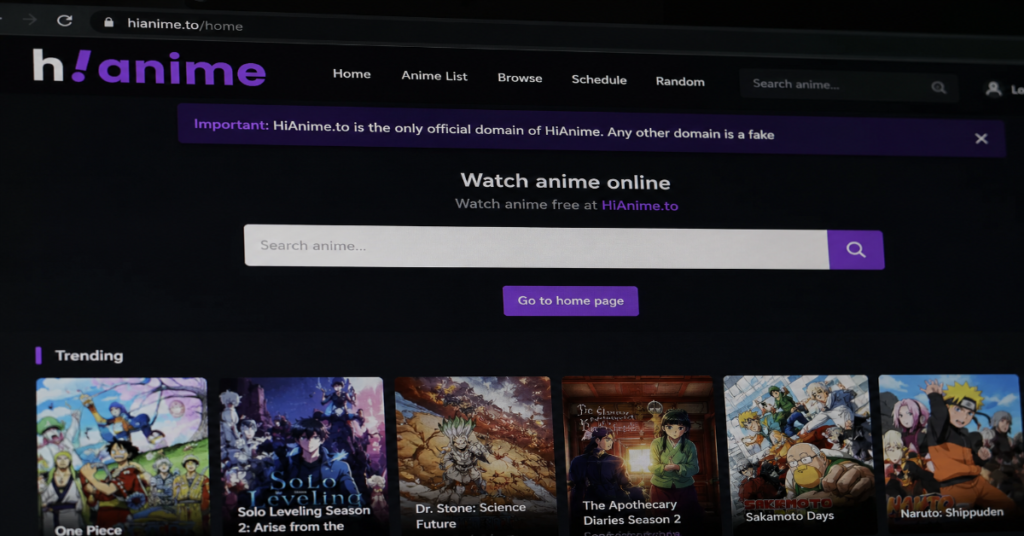
Hianime became one of the most searched anime streaming names because it sat at the center of a bigger shift in anime piracy: users wanted fast access, large libraries and simple interfaces, while rights holders, courts and enforcement groups increased pressure on unauthorized streaming networks.
The site was not a normal licensed streaming service. Reports described it as a piracy-focused anime streaming portal that followed earlier brands including Zoro.to and Aniwatch.to. Zoro.to was reported to have more than 205 million monthly visits before it redirected to Aniwatch.to in July 2023. Aniwatch then rebranded to HiAnime in March 2024.
By March 13, 2026, HiAnime’s official domains showed a goodbye message. TorrentFreak reported that the notice read like a shutdown message, though it also noted uncertainty around whether the site might stay offline, return or rebrand again.
That uncertainty is part of the story. HiAnime was not just a website name. It was a case study in how unauthorized streaming operations use branding, redirects, mirrors and user communities to survive disruption. It also showed the real trade-off anime viewers face: illegal platforms often feel convenient in the short term, but they carry legal, security, reliability and ethical risks that licensed services are built to avoid.
What Was HiAnime?
HiAnime was an unauthorized anime streaming site associated with the earlier Zoro.to and Aniwatch.to brands. It offered access to anime content without the licensing structure used by legal platforms such as Crunchyroll, HIDIVE, Netflix or regional broadcasters.
The U.S. Trade Representative’s 2025 Notorious Markets List named HiAnime as hianime.to and identified related domains including hianime.nz, hianime.sx, hianime.tv, hianimez.to and hianimez.is. The report described HiAnime as a successor to Aniwatch, which itself was a rebrand of Zoro.to, and said stakeholders reported that the site provided pirated versions of popular movies and television, particularly anime.
That matters because the brand history was not accidental. Large piracy sites are often less like single websites and more like moving networks. A domain can disappear while the interface, user accounts, watchlists, community channels or backend infrastructure continue elsewhere.
HiAnime Branding Timeline
| Period | Brand name | What changed | Verified context |
| Before July 2023 | Zoro.to | Operated as a major anime piracy site | TorrentFreak reported more than 205 million monthly visits before the shift to Aniwatch. |
| July 2023 | Aniwatch.to | Zoro.to redirected to Aniwatch.to | The redirect was described as seamless, with old logins appearing to work. |
| March 2024 | HiAnime | Aniwatch rebranded to HiAnime | TorrentFreak reported the switch on March 1, 2024. |
| March 13, 2026 | Offline or inactive | Domains displayed a goodbye message | TorrentFreak reported the farewell notice and legal pressure context. |
Why Did Zoro.to Become Aniwatch?
The Zoro.to to Aniwatch transition happened in July 2023. TorrentFreak reported that Zoro.to began redirecting visitors to Aniwatch.to, with a staff message claiming the site had been acquired by a new development team. The same report noted that pirate sites frequently move domains due to seizures, suspensions, anti-piracy investigations or search visibility problems caused by DMCA activity.
The practical result was simple: users experienced continuity while the brand changed. That is a common survival tactic. It keeps audience habits intact, reduces the shock of disruption and gives the new domain time to build recognition.
The deeper implication is that a piracy site’s “brand” is often disposable. What matters more is traffic, search demand, community trust and operational continuity.
Why Did Aniwatch Become HiAnime?
Aniwatch rebranded to HiAnime in March 2024. TorrentFreak reported that the site did not provide a clear official explanation, but noted that a dynamic site-blocking order in India may have influenced the timing. The same report said nearly a quarter of the site’s visits came from India, making blocking pressure there commercially important for the operators.
The move likely served several purposes:
| Pressure point | Why a rebrand helps | Limitation |
| ISP blocking | A new domain can temporarily bypass blocks | Dynamic blocking orders can be updated |
| Search visibility | A fresh brand can rebuild search demand | Search engines may demote repeat piracy networks |
| Legal tracking | Domain changes complicate enforcement | Rights holders track networks, not just names |
| User confidence | Familiar interface reduces churn | Confusion can weaken trust |
| Advertising continuity | New domains may reconnect revenue channels | Ad networks and blocklists can follow |
This is why the HiAnime rebrand should not be read as a normal consumer-facing rebrand. It was more likely a defensive move inside a high-pressure piracy ecosystem.
Why Did HiAnime Go Offline in 2026?
HiAnime went offline on March 13, 2026, with a goodbye message displayed across official domains. TorrentFreak said the message read like a shutdown notice but also cautioned that the final status was not fully clear at the time.
The strongest verified context is legal pressure. TorrentFreak reported that the Motion Picture Association’s Alliance for Creativity and Entertainment had targeted the site multiple times and that USTR had added HiAnime to its annual notorious piracy markets list earlier in March 2026.
The USTR release said the 2025 Notorious Markets List identified 37 online markets and 32 physical markets reported to facilitate substantial trademark counterfeiting or copyright piracy. It also emphasized consumer harms such as malware risks linked to infringing sites.
Still, the exact trigger for HiAnime’s March 2026 disappearance has not been publicly proven. A responsible reading is this: the site was operating under growing legal and enforcement pressure, but no verified public source has definitively tied one specific action to the goodbye message.
Systems Analysis: Why Sites Like HiAnime Are Hard to Stop
HiAnime’s history shows why enforcement against piracy networks is difficult. A single streaming site can depend on many layers:
| Layer | Role in piracy ecosystem | Enforcement challenge |
| Public domain | The user-facing address | Easy to block but easy to replace |
| Mirror domains | Backup entry points | Multiply takedown targets |
| Hosting or reverse proxy | Shields infrastructure | Can obscure origin servers |
| Video hosts | Store or deliver files | May sit outside the visible brand |
| Search traffic | Brings new users | Can shift to new domains |
| Community channels | Discord, Reddit or social groups | Keep users informed during disruption |
| Advertising networks | Monetization | Often routed through opaque intermediaries |
USTR’s Notorious Markets report described a broader piracy ecosystem involving domain registries, hosting providers, reverse proxy services, advertisers, payment processors, search engines and network infrastructure.
That is why a site shutdown can feel temporary to users. The visible domain may die, but the audience, templates and backend relationships can sometimes reappear under a different name.
Risks for Users
The biggest mistake readers make is treating unauthorized anime sites as harmless because they are free. The risk is broader than copyright.
First, availability is unstable. HiAnime’s shutdown showed that watchlists, viewing history and preferred access points can vanish overnight. Second, security is uncertain. USTR specifically noted consumer harm risks around infringing markets, including malware exposure.
Third, mirror sites create impersonation risks. After a major piracy brand goes offline, clones often appear. Users may not know which domain is connected to the original operation and which is purely opportunistic.
Fourth, there is an ethical and market impact. Anime is expensive to license, localize, subtitle, dub, distribute and maintain. Piracy does not send revenue through the legal chain that supports studios, licensors, translators, voice actors, platform engineers and distributors.
Legal and Safe Alternatives to HiAnime
There is no perfect one-platform replacement because anime licensing is fragmented by region. The safer approach is to combine a few legal services based on catalogue, simulcasts and price.
| Platform | Best for | Notes |
| Crunchyroll | Broad anime library and simulcasts | Crunchyroll describes itself as a major destination for anime series and movies, with simulcast access and premium features. |
| HIDIVE | Niche titles, dubs and selected simulcasts | HIDIVE describes its service as focused on simulcasts, fresh dubs, uncensored titles and deep cuts. |
| Netflix | Mainstream anime and originals | Netflix says it offers TV shows, movies, anime, documentaries and more across internet-connected devices. |
| Regional broadcasters | Local licensing and dubbed releases | Availability varies by country and title. |
| Digital rental or purchase stores | Films and older titles | Useful when series or movies are not inside subscriptions. |
The practical workflow is to check Crunchyroll first for simulcasts, HIDIVE for niche seasonal titles, Netflix for mainstream anime and regional services for local rights. This is slower than searching one piracy site, but it is safer and more stable.
Strategic Implications for Anime Fans
HiAnime’s disappearance shows that convenience gaps still shape anime viewing behavior. Many users did not use piracy only because it was free. They used it because it solved problems that legal services often struggle with:
- Fragmented catalogues across regions
- Delayed releases
- Missing subtitles or dubs
- Confusing availability windows
- Multiple subscriptions for one season’s watchlist
- Search friction across platforms
The industry lesson is direct. Enforcement can reduce access to unauthorized sites, but legal platforms also need to compete on usability. A fan who can find a show legally, affordably and quickly has fewer reasons to seek unstable alternatives.
Original Insights
- HiAnime’s rebrands were not just name changes. They were continuity tools. The same user habits could be carried from Zoro.to to Aniwatch to HiAnime, reducing the audience loss that usually follows disruption.
- Dynamic blocking changes the value of a domain. When courts or ISPs can update blocked domains, the advantage of rebranding becomes shorter. That makes community channels and search demand more important than the domain itself.
- The real replacement for HiAnime is not one site. It is a search workflow. Anime viewers need a legal discovery habit across Crunchyroll, HIDIVE, Netflix and local rights holders because licensing fragmentation is the gap piracy sites exploited.
The Future of HiAnime in 2027
By 2027, the original HiAnime brand may matter less than the pattern it represents. If the domain remains offline, clones and copycat sites may still use similar names to capture residual search traffic. That creates confusion for users and extra risk for anyone looking for the “real” site.
The more important trend is enforcement coordination. USTR’s 2025 Notorious Markets List framed piracy as a global ecosystem problem involving infrastructure providers, intermediaries and markets. If that approach continues, future enforcement will likely target not only public domains but also hosting, payment, advertising and backend services.
Legal streaming will also face pressure to improve. Crunchyroll, HIDIVE and Netflix already compete across catalogues, simulcasts and platform features, but no legal service fully solves global anime fragmentation.
The likely 2027 reality is mixed: fewer stable mega-brands like HiAnime, more scattered mirrors, stronger enforcement and continued demand for simpler legal discovery tools.
Key Takeaways
- HiAnime was part of a brand chain that moved from Zoro.to to Aniwatch.to to HiAnime.
- The site went offline on March 13, 2026, but the exact cause has not been publicly proven.
- Legal pressure is the strongest verified context behind the shutdown story.
- Rebrands helped the operation preserve user trust, search demand and continuity.
- Piracy sites carry security, reliability, legal and ethical risks.
- Legal alternatives exist, but anime licensing remains fragmented.
- The industry’s long-term challenge is not only enforcement. It is making legal access easier.
Conclusion
HiAnime’s story is bigger than one anime streaming site. It shows how piracy brands grow when legal access feels fragmented and how quickly those brands can disappear when enforcement pressure rises. The shift from Zoro.to to Aniwatch.to to HiAnime created a sense of continuity for users, but it also exposed the instability behind unauthorized platforms.
For viewers, the lesson is practical. A piracy site may look convenient today, then vanish tomorrow with no reliable support, no guaranteed safety and no legitimate rights chain behind it. For the anime industry, the lesson is equally clear: enforcement matters, but convenience matters too. Legal platforms need stronger discovery, better regional availability and clearer release paths if they want to convert frustrated fans.
HiAnime is offline as of the verified 2026 reports. Its name may continue through clones, mirrors or search traffic, but the safer path is licensed streaming and verified availability.
FAQ
What was HiAnime?
HiAnime was an unauthorized anime streaming site connected to earlier brands including Zoro.to and Aniwatch.to. USTR identified it as a piracy market and reported that stakeholders said it provided pirated versions of popular movies and television, particularly anime.
Was HiAnime legal?
No reliable public source described HiAnime as a licensed anime streaming service. USTR listed it in the Notorious Markets report and TorrentFreak repeatedly described it as a piracy site.
When did HiAnime go offline?
HiAnime went offline on March 13, 2026, when official domains displayed a goodbye message. TorrentFreak reported the message and noted uncertainty around whether the shutdown was permanent at that moment.
Why did HiAnime keep changing names?
The rebrands likely helped the operation respond to enforcement, domain pressure, blocking orders, search issues and user continuity needs. TorrentFreak linked the Aniwatch to HiAnime rebrand to possible site-blocking pressure in India, though no official explanation was given.
What are safer alternatives to HiAnime?
Crunchyroll, HIDIVE and Netflix are safer legal options, though availability depends on region and licensing. Crunchyroll focuses heavily on anime, HIDIVE covers simulcasts, dubs and niche titles, while Netflix carries anime alongside broader entertainment.
Is every HiAnime mirror unsafe?
Not every mirror can be assessed from the outside, but copycat domains after a shutdown are risky. They may be unrelated to the original operators, may carry aggressive ads or may expose users to malware and phishing.
Methodology
This article was built from the supplied editorial brief, current reporting and primary enforcement context. The timeline was checked against TorrentFreak reports on Zoro.to, Aniwatch and HiAnime. Enforcement context was checked against USTR’s 2025 Notorious Markets release and report. Legal alternatives were checked against official Crunchyroll, HIDIVE and Netflix pages.
References
Maxwell, A. (2023, July 4). Zoro.to: World’s largest pirate site suddenly “acquired” and rebranded. TorrentFreak.
Office of the United States Trade Representative. (2026, March 3). USTR releases 2025 Review of Notorious Markets for Counterfeiting and Piracy.
Office of the United States Trade Representative. (2026). 2025 Review of Notorious Markets for Counterfeiting and Piracy.
Van der Sar, E. (2024, March 1). Piracy moghul Aniwatch rebrands to HiAnime. TorrentFreak.
Van der Sar, E. (2026, March 13). Piracy giant HiAnime.to announces mysterious goodbye. TorrentFreak.
Crunchyroll. (2026). Anime streaming and simulcast information.
HIDIVE. (2026). Stream anime simulcasts and dubs.
Netflix. (2026). Netflix service information and anime catalogue overview.
