
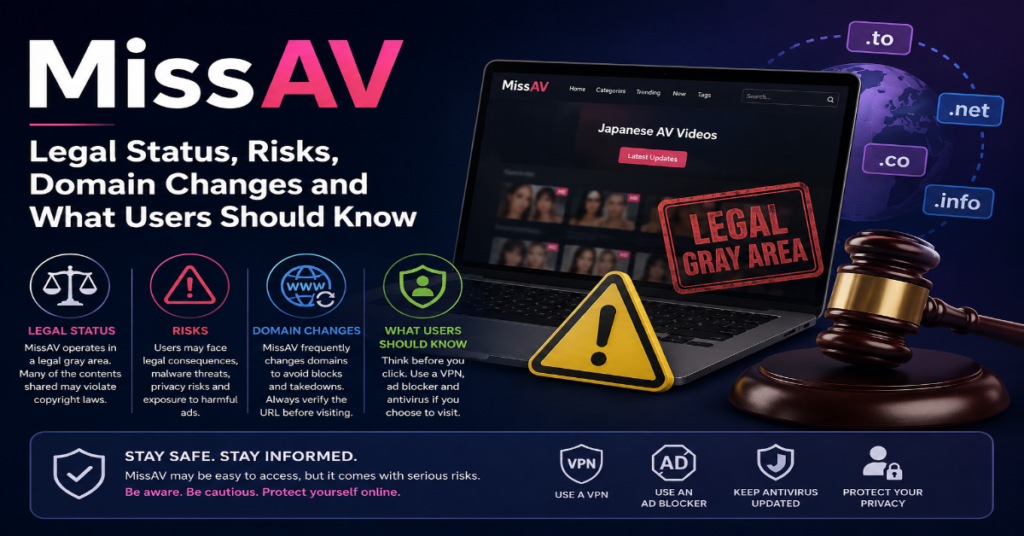
MissAV is an online adult streaming platform known for Japanese AV content, multilingual navigation and free access. The search interest around it is not only about viewing content. Readers also want to know whether the site is legal, why its domains keep changing, what happened to the original .com domain and whether using mirror sites or VPNs creates extra risk.
The short answer is that MissAV sits in a legally sensitive area. Public court records show that Will Co. Ltd., a Japanese adult entertainment company, pursued litigation in the Western District of Washington against operators linked to ThisAV and related websites. In January 2025, the court granted default judgment and discussed claims involving copyright infringement, trademark issues and unfair competition.
That does not mean every user understands what the ruling means. A domain seizure affects web addresses and registrars. It does not always remove every copy, mirror or successor domain from the internet. That is why users may still see references to alternate addresses after legal action.
This article explains MissAV as a platform, the domain dispute, the role of Will Co. Ltd., the risks of VPN-based access, the Hong Kong hosting angle and the broader implications for adult streaming in 2026 and 2027.
What Is MissAV?
MissAV is commonly described as a free adult streaming site focused on Japanese adult video content. The uploaded brief describes the platform as hosting a very large catalog of Japanese AV videos, with access that is free and optional registration.
The key distinction is that popularity does not equal legitimacy. A site can be heavily visited while still facing serious copyright allegations. In the MissAV case, the central issue is not whether users can find the site. The issue is whether the platform had authorization to distribute the works it made available.
Public reporting and court records connect the dispute to Will Co. Ltd., which alleged that defendants unlawfully displayed its copyrighted works across multiple websites. The court order states that Will Co. alleged at least 300 separate instances of infringement involving 50 works.
MissAV.com vs Later Domains
The biggest confusion around MissAV comes from domain movement. Many users search for the “real” site after seeing unavailable pages, seizure notices or mirror domains.
| Domain type | What it usually means | Practical concern |
| Original .com domain | The better-known address before seizure action | May no longer be controlled by the original operators |
| Alternate domains | Replacement addresses used after disruption | Harder for users to verify authenticity |
| Mirror or clone domains | Copies or lookalikes that may imitate the brand | Higher phishing, malware and privacy risk |
| Region-blocked access | Access restricted by ISP, court order or local policy | Users may face local legal or terms-of-service issues |
TorrentFreak reported in January 2025 that several domains, including MissAV.com and ThisAV.com, were redirected to seizure banners after a U.S. court order. The same report said the judgment awarded $4.5 million in damages and granted injunctive relief affecting domain control.
The practical lesson is simple. A familiar-looking domain is not automatically safe, official or legally stable.
The January 2025 Court Order
The strongest verified legal context comes from Will Co Ltd v. Lee et al., filed in the U.S. District Court for the Western District of Washington. On January 7, 2025, Judge Benjamin H. Settle granted Will Co. Ltd.’s motion for default judgment.
The order says Will Co. alleged copyright infringement, inducement of infringement, contributory infringement, vicarious infringement, trademark-related violations and unfair competition. It also says the defendants did not answer after the Second Amended Complaint.
A key detail is the damages calculation. Will Co. sought statutory damages under the U.S. Copyright Act. Reporting on the order states that the court awarded $4.5 million, rather than the $45 million requested.
This matters because it shows the case was not merely a takedown complaint. It became a formal judgment with financial damages and domain-control consequences.
Who Is Will Co. Ltd.?
Will Co. Ltd. is described in court materials as a Japan-based entertainment company with a library of adult entertainment movies.
One point needs care. Search results can confuse Will Co. Ltd. with other Japanese companies using similar English names. Bloomberg, for example, lists a “Will Co Ltd/Tokyo” company involved in electronics distribution, which does not appear to be the same adult entertainment rights holder in the MissAV litigation.
That distinction matters for accuracy. When discussing MissAV, the relevant entity is the Will Co. Ltd. named in the court case, not every company with a similar name.
Why VPN Access Is Not a Simple Fix
Users often search for VPN advice when adult sites are blocked in their region. Technically, a VPN can route traffic through a server in another country, which may make a blocked site appear accessible from a different location. But that technical fact does not remove legal, privacy or safety concerns.
There are four major issues:
| Issue | Why it matters |
| Local law | Adult content rules, obscenity law and copyright enforcement differ by country |
| Platform authenticity | Mirror domains may be fake, malicious or short-lived |
| Payment and tracking | Free adult sites may still collect analytics, fingerprints or ad-tech data |
| Copyright exposure | Viewing or distributing pirated content may create legal risk depending on jurisdiction |
The safer framing is not “how to bypass blocking.” It is whether the user should access a blocked or disputed platform at all. In many cases, licensed services, official studio platforms or region-compliant distributors are safer choices.
Hong Kong Hosting and Adult Content Regulation
The uploaded brief mentions Hong Kong hosting as part of the platform’s background. Hong Kong is often discussed in relation to adult platforms because of hosting infrastructure, cross-border audiences and a different legal environment from Japan or the United States.
However, Hong Kong is not a “no rules” environment. The Control of Obscene and Indecent Articles Ordinance, Cap. 390, regulates obscene and indecent materials. Hong Kong’s Office for Film, Newspaper and Article Administration says the ordinance covers publication and display of obscene or indecent articles and is intended to prevent young people from accessing indecent materials.
The Hong Kong government also stated in 2024 that complaints involving online videos suspected of being Class III obscene articles had been referred for follow-up, including one case involving a locally operated internet platform.
For adult content platforms, hosting location does not erase liability. It changes the enforcement path.
Japan’s Adult Video Law Context
MissAV also sits inside a larger Japanese AV debate involving performer rights, consent and content distribution. Japan enacted the Act on the Prevention and the Remedy of Harm Associated with Performing in Sexually Explicit Videos in June 2022. The Cabinet Office describes the law as focused on performance contracts, prevention of harm and remedies for performers.
That law is important because the adult video debate is not only about copyright owners. It also involves performers, consent, contract terms, takedown rights and downstream distribution. Unauthorized streaming can affect studios, rights holders and performers whose work circulates outside intended channels.
Academic work has also examined coercion, consent and labor conditions within Japan’s adult video industry. The University of Kansas highlighted Akiko Takeyama’s research on “involuntary consent” and the legal structures surrounding Japan’s sex entertainment industries.
Strategic Implications for Users
MissAV’s legal history creates three practical implications.
First, users should not assume that a free streaming catalog is licensed. Court records show that copyright claims against related operators were serious enough to produce a default judgment.
Second, domain-switching increases security risk. When a site moves from one address to another, imitators can exploit search demand by launching clones. These clones may use misleading branding, aggressive pop-ups or credential-harvesting pages.
Third, VPN use can hide traffic from some networks but cannot make a questionable platform trustworthy. It may also violate a service’s terms or local access rules.
Strategic Implications for Rights Holders
For rights holders, the MissAV case shows both the power and weakness of civil enforcement.
The power is clear. A U.S. court order can affect domains registered through infrastructure connected to U.S. jurisdiction. TorrentFreak reported that the injunctive relief allowed Will Co. to take control of domain names through VeriSign.
The weakness is also clear. Domain seizure does not automatically remove the underlying audience, files, operators or mirror ecosystem. A platform can attempt to reappear under another top-level domain, especially if infrastructure and operators are outside the enforcing jurisdiction.
That creates a whack-a-mole problem. Rights holders can win formal legal victories while still facing ongoing distribution through new domains.
Structured Insight Table
| Area | Verified context | Reader takeaway |
| Copyright | Will Co. obtained default judgment in January 2025 | The legal risk is documented, not speculative |
| Domains | Multiple domains were affected by seizure action | Search results may lead to unstable or imitation sites |
| Hosting | Hong Kong has adult content regulation under COIAO | Offshore hosting does not mean risk-free hosting |
| VPN use | VPNs can alter apparent location | Technical access is not the same as lawful or safe access |
| Performer rights | Japan passed a performer-protection law in 2022 | Adult content distribution has labor and consent implications |
The Future of MissAV in 2027
By 2027, platforms like MissAV will likely face more pressure from three directions.
The first is rights-holder enforcement. The January 2025 judgment shows that copyright owners can use civil litigation to target domains and seek damages when jurisdictional hooks exist.
The second is regional blocking. Governments and rights holders are increasingly using ISP-level filtering, domain actions and registrar pressure. These tools do not always eliminate access, but they make discovery less stable.
The third is platform trust. Users are becoming more aware that adult sites can carry privacy, malware and identity risks. A clone domain that looks familiar may still be unsafe.
The uncertain part is enforcement durability. Domain seizures can disrupt brand recognition, but they rarely solve the full infrastructure problem unless operators, hosting providers, payment channels and distribution networks are also addressed. That makes 2027 likely to bring more fragmentation rather than a clean ending.
Key Takeaways
- MissAV should be understood as a disputed adult streaming platform, not just a search term.
- The January 2025 Will Co. Ltd. judgment is the most important verified legal milestone.
- Domain changes make authenticity harder to verify and increase user risk.
- VPN access may bypass some blocks, but it does not resolve copyright, privacy or legal concerns.
- Hong Kong hosting does not remove regulatory exposure.
- Japan’s adult video debate includes performer protection and consent, not only piracy.
- Safer viewing depends on licensed platforms, transparent ownership and lawful access.
Conclusion
MissAV’s continued search popularity reflects a wider reality of adult streaming: users often encounter platforms through search engines, mirror links and social referrals before they understand the legal or security context. The verified record shows that MissAV-related domains have been tied to serious copyright litigation, including a U.S. default judgment and domain-control remedies.
For users, the safest approach is caution. Free access, HD playback and large catalogs do not prove that a platform is licensed or safe. For rights holders, the case shows that court action can produce real remedies, but domain seizures alone may not end redistribution. For publishers covering the topic, accuracy matters most. The responsible angle is not promotion. It is legal context, safety awareness and clear explanation.
FAQ
What is MissAV?
MissAV is commonly known as an adult streaming platform focused on Japanese AV content. The uploaded brief describes it as free to use, with optional registration and a large catalog.
Is MissAV legal?
Its legality depends on jurisdiction, content licensing and how users access it. Public court records show that Will Co. Ltd. won default judgment in a copyright case involving related domains and alleged infringement.
What happened to MissAV.com?
In January 2025, reporting stated that MissAV.com and related domains were affected by seizure action following a U.S. court order.
Are MissAV mirror domains safe?
Not necessarily. Mirror domains can be unstable, fake or malicious. Users should treat clones and replacement addresses as higher-risk because ownership and security are difficult to verify.
Can a VPN access MissAV if it is blocked?
A VPN can route traffic through another country, but that does not make access legal or safe. Users should follow local law and avoid platforms with unclear licensing.
Why is Will Co. Ltd. important in this case?
Will Co. Ltd. is the Japanese company that brought the U.S. copyright action tied to ThisAV, MissAV and related websites. The January 2025 order granted default judgment in its favor.
Methodology
This article was prepared from the uploaded production brief and checked against public sources including U.S. court records, copyright reporting, Hong Kong regulatory material and Japan’s Cabinet Office information on adult video performer protection. The analysis avoids direct promotion of adult content and does not provide operational instructions for bypassing blocks. Known limitations: mirror-domain status can change quickly, some platform ownership details are hard to verify and adult-site traffic claims often depend on third-party estimates.
References
Gender Equality Bureau Cabinet Office. (2022). Act on the Prevention and the Remedy of Harm Associated with Performing in Sexually Explicit Videos.
Hong Kong Office for Film, Newspaper and Article Administration. (2026). Enforcement of the Control of Obscene and Indecent Articles Ordinance.
Hong Kong Government. (2024). LCQ14: Obscene and indecent videos published on the Internet.
Justia. (2025). Will Co Ltd v. Lee et al, No. 3:2020cv05802, Document 64.
Stanford Copyright and Fair Use Center. (2023). WILL CO., LTD. v. KA LEE.
TorrentFreak. (2025). Court Orders Pirate Site MissAV to Pay $4.5m in Damages, Domains Seized.
