
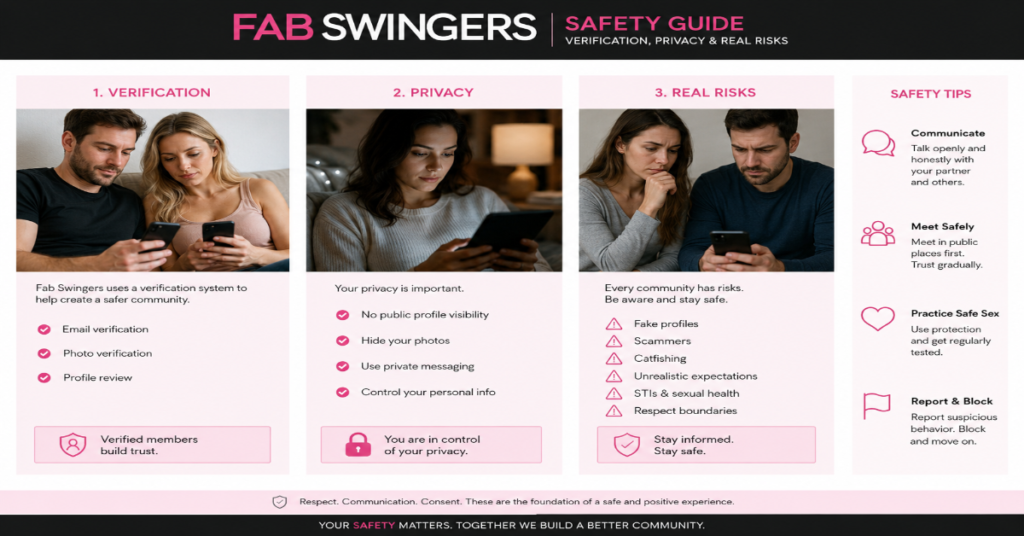
Fab Swingers is a search phrase usually pointing to Fab Swingers, a UK-associated adult social networking platform for swingers, couples and adults seeking casual connections. The platform launched in 2006 and is commonly described as having a companion site, Fab Guys, for gay and bisexual men. This article follows the supplied production brief, which frames the topic around site safety, verification, subscription costs, profile creation and the differences between the two platforms.
The safety question matters because adult dating platforms carry more risk than ordinary social apps. Users often share intimate preferences, private images, location clues and relationship status details. That creates a larger privacy surface. A dating profile can expose someone to ordinary spam, but it can also expose them to blackmail, stalking, reputational harm or coercive contact.
Fab Swingers is not unusual in facing those risks. The FTC says romance scammers create fake profiles on dating sites, apps and social media to build trust before asking for money. In 2025, nearly 60 percent of people who reported losing money to a romance scam said it started on social media, showing how quickly trust-based fraud can move across platforms.
This article is not an endorsement of FabSwingers or Fab Guys. It is a safety and trust guide for adults who want to understand how the platform is described, where its safeguards may help and where users still need to protect themselves.
What Fab Swingers is ?
FabSwingers is described as a social networking website for swingers and adults seeking casual connections. Publicly available summaries say it allows profiles for individuals or couples and includes filters around location, venues and interests. It also has a companion site, Fab Guys, aimed at gay and bisexual men.
The platform’s reputation is mixed. It is known for longevity, a large niche community and practical search features, but its interface has also been criticised as dated. That matters because a dated interface is not automatically unsafe, but it can make privacy controls, reporting tools and account settings harder for less technical users to understand.
| Area | Fab Swingers | Fab Guys |
| Primary audience | Swingers, couples and adults seeking casual connections | Gay and bisexual men |
| Profile model | Individuals and couples | Primarily individual male users |
| Core use case | Adult social networking, events, messaging and discovery | Adult social networking for men |
| Safety concern | Privacy exposure, couple authenticity, offline meeting risk | Privacy exposure, harassment, identity misuse |
| Best user mindset | Treat verification as helpful but incomplete | Treat profile signals as partial evidence only |
The important point is simple: FabSwingers may offer community-specific tools, but it should still be treated like any high-risk adult social platform.
How account verification appears to work
Public summaries describe FabSwingers verification as an authenticity check where a user submits a photograph of themselves with their username written down. That kind of process is meant to reduce fake accounts and make impersonation harder.
That said, verification should not be confused with a full identity guarantee. A verified profile can still misrepresent intentions, relationship status, boundaries, availability or offline behaviour. Verification answers one narrow question: does this account appear connected to a real person or couple? It does not answer whether the user is safe, honest or respectful.
| Safety signal | What it can help with | What it cannot prove |
| Photo verification | Reduces obvious fake or bot profiles | Does not prove character, consent or intent |
| Active profile history | Shows platform participation | Does not prove reliability |
| Community feedback | May reveal patterns | Can be incomplete or biased |
| Messaging consistency | Helps detect contradictions | Can still be manipulated |
| Willingness to video verify | Adds confidence before meeting | Does not remove offline risk |
Original insight: on adult social platforms, verification creates a “trust shortcut.” That shortcut can help users avoid obvious fake profiles, but it can also make people lower their guard too early. The safer interpretation is to treat verification as the beginning of screening, not the end.
Safety features users should look for
Any adult social networking site should give users clear control over identity, visibility, blocking, reporting and data handling. For Fab Swingers, the most important safety questions are not only whether features exist, but whether they are easy to find and use.
Practical safety features to check:
• Profile visibility controls
• Blocking and reporting tools
• Photo privacy settings
• Message controls
• Account deletion options
• Verification status indicators
• Clear rules for harassment and abuse
• Guidance for meeting safely offline
The ICO advises people to take precautions online to protect themselves from identity fraud, misuse of information and unwanted privacy exposure. That advice is especially relevant for adult dating profiles because personal images, usernames, locations and private preferences can be combined to identify someone.
A useful privacy test is this: could a stranger connect your Fab Swingers profile to your real name, workplace, family account or ordinary social media? If the answer is yes, the profile is too exposed.
Subscription costs and the freemium model
Fab Swingers is publicly described as operating on a freemium model. Commonly cited paid features include ad removal, viewing higher-resolution photos and seeing users who viewed the logged-in profile.
The practical implication is that payment does not appear to be the main barrier to basic participation. That can be good for accessibility, but it also means safety depends heavily on moderation, verification and user behaviour rather than payment friction.
Original insight: low-cost or free adult platforms often have a safety trade-off. They attract more users, which improves discovery, but they may also attract more casual, low-investment accounts. A paid tier can improve convenience, yet it should not be treated as a safety certification.
Creating a safer profile
A safer profile should be specific enough to communicate boundaries but limited enough to avoid exposing real-world identity.
Good profile practice:
• Use a unique username not used elsewhere
• Avoid face photos in public galleries if privacy is a concern
• Remove workplace, neighbour hood and routine-location clues
• Keep conversations on platform until trust is established
• Do not share financial information
• Do not send documents, workplace photos or family details
• Use separate email credentials and strong authentication where available
The FTC warns that romance scammers build trust through repeated conversation before asking for money or steering people toward fake financial opportunities. That pattern applies beyond conventional romance apps because adult social platforms also create fast emotional or intimate trust.
A strong rule is to separate attraction from verification. Someone may be appealing, active and verified, but money requests, secrecy pressure, urgent travel stories or investment advice should still be treated as red flags.
Offline meeting risks
The most serious safety risk is not always the website itself. It is the moment online trust becomes an offline meeting.
A widely reported 2018 case involved Naomi Hersi, a transgender woman who was murdered after an encounter arranged through Fab Swingers. The case is an extreme example, but it shows why adult platforms must be discussed with offline safety in mind.
Safer meeting practices include meeting first in a public place, telling a trusted person where you are going, arranging your own transport, avoiding intoxication during first meetings and leaving if boundaries shift. For couples, both people should agree privately before meeting anyone else. For solo users, a check-in plan is essential.
Original insight: adult platform safety is usually framed as “avoid fake profiles,” but the higher-stakes issue is boundary drift. A profile can look real, a chat can feel respectful and the offline situation can still become unsafe if the location, timing, substance use or expectations change.
Market, cultural and privacy impact
Fab Swingers sits inside a wider shift in adult social networking. Adults increasingly use niche platforms to find communities that mainstream dating apps do not serve well. This has cultural value because it can reduce isolation for people with non-traditional relationship structures.
At the same time, niche adult platforms produce concentrated privacy risk. A breach, screenshot, reused photo or careless username can reveal not just that someone uses a dating site, but details about relationship structure, sexual identity, location and private preferences.
Internal link opportunities for Perplexity AI Magazine should be used only where relevant. The site has related published pieces on adult-content cybersecurity, adult platform risk and digital intimacy that could support this article’s reader journey, including coverage of Erome cybersecurity risks, BaddiesOnly cultural platform risks and Candy AI digital relationship platforms.
The future of Fab Swingers in 2027
By 2027, the biggest pressure on adult social platforms is likely to be stronger age assurance, clearer privacy controls and more visible trust signals.
In the UK, Ofcom said that from 25 July 2025, sites and apps allowing pornography needed strong age checks to prevent children accessing that content. The UK government’s Online Safety Act materials also state that platforms are required to use highly effective age assurance to prevent children from accessing pornography or other harmful content.
That regulatory direction creates a difficult balance. Stronger age checks may reduce underage access, but they can also increase privacy concerns if users are asked for IDs, biometric checks or third-party verification. Of com and the ICO’s 2026 joint statement describes age assurance policy as risk-based, flexible, technology-neutral and intended to work alongside data protection law.
For Fab Swingers and similar platforms, the future is likely to depend on three things: whether verification becomes more privacy-preserving, whether reporting tools become easier to use and whether users trust the platform with sensitive identity data.
Takeaways
• Fab Swingers is best understood as a search term for Fab Swingers, not a generic dating category.
• Verification can reduce obvious fake accounts, but it cannot prove consent, honesty or offline safety.
• Adult social profiles should reveal preferences without exposing real-world identity.
• Scam risk is real even when a site is niche, community-based or verification-oriented.
• Offline safety planning matters as much as digital privacy settings.
• Age assurance rules are likely to shape adult platforms more heavily by 2027.
• Users should treat paid features as convenience features, not safety guarantees.
Conclusion
Fab Swingers has survived for years because it serves a niche audience that mainstream dating apps often ignore. That longevity gives it cultural relevance, but it does not remove the risks that come with adult social networking. The safest way to approach the platform is with layered caution: protect identity, verify slowly, keep financial boundaries absolute and treat offline meetings as separate safety decisions.
The main mistake is assuming that a verified profile means a safe person. Verification can help reduce impersonation, but it is only one signal. Real safety comes from privacy discipline, clear consent, careful screening, platform reporting tools and a willingness to walk away when something feels wrong.
For readers researching Fab Swingers, the best conclusion is balanced. The platform may be useful for adults seeking niche connections, but it should be used with realistic expectations and strong personal safeguards.
FAQ
What is Fab Swingers?
Fab Swingers usually refers to Fab Swingers, an adult social networking site for swingers, couples and adults seeking casual connections. It launched in 2006 and has a companion site called Fab Guys for gay and bisexual men.
Is Fab Swingers safe?
It may include verification and community tools, but no adult dating site is risk-free. Users should still protect identity, avoid money requests, control photo visibility and plan offline meetings carefully.
How does Fab Swingers verify users?
Public descriptions say users can verify authenticity by submitting a photo of themselves with their username written down. This can reduce obvious fake profiles but does not prove someone’s intentions.
Is Fab Swingers free?
Fab Swingers is commonly described as freemium. Basic use is associated with free access, while paid features may include ad removal, higher-resolution photos and profile-viewer visibility.
What is the difference between Fab Swingers and Fab Guys?
Fab Swingers serves swingers, couples and adults seeking casual connections. Fab Guys is described as a companion website aimed at gay and bisexual men.
What are the biggest privacy risks?
The biggest risks are reused usernames, identifiable photos, location clues, screenshots, harassment and data exposure. Adult platforms carry higher privacy stakes because profile details can reveal intimate personal information.
Should users meet someone from Fab Swingers offline?
Only with caution. First meetings should be public, independently arranged and shared with a trusted contact. Verification and messaging history should never replace offline safety planning.
Methodology
This article was drafted from the supplied production brief, public platform descriptions and current safety guidance from consumer protection, privacy and online safety sources. No live account was created, no private platform areas were accessed and no firsthand product test was conducted. Platform-specific claims should be checked manually against Fab Swingers current help pages, terms and account screens before publication. Regulatory context was checked against Of com, UK government and ICO-linked material. Scam guidance was checked against FTC consumer advice and recent FTC reporting.
References
Federal Trade Commission. (2024, February 13). Love stinks when a scammer is involved. FTC Business Blog.
Federal Trade Commission. (2026, April 27). New FTC data show people have lost billions to social media scams.
Information Commissioner’s Office. (n.d.). Online safety.
Ofcom. (2025, June 26). Age checks for online safety, what you need to know as a user.
Ofcom and Information Commissioner’s Office. (2026, March 25). Joint statement on age assurance.
UK Government. (2025, July 24). Online Safety Act collection.
Wikipedia contributors. (2025, October 6). FabSwingers. Wikipedia.
