
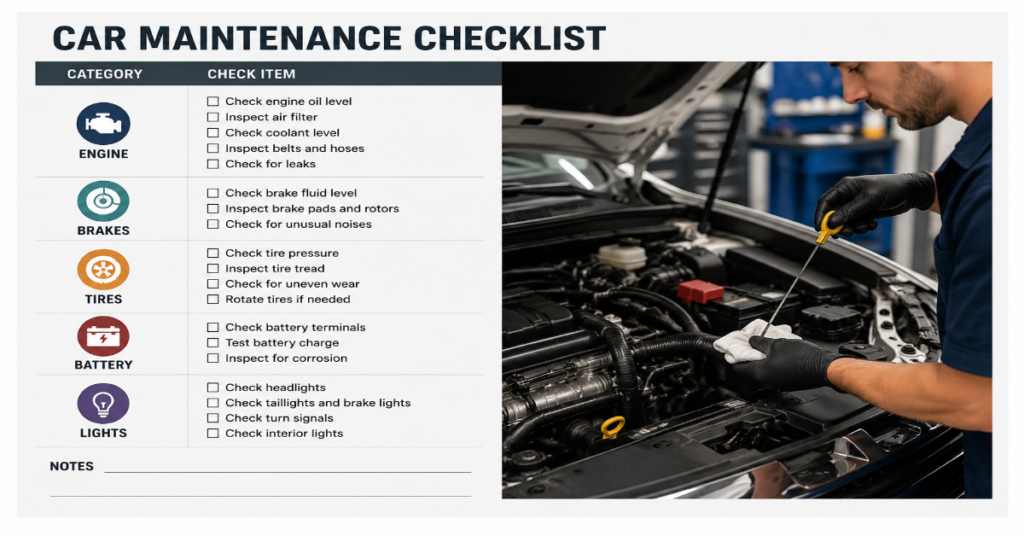
A car maintenance checklist is a simple way to turn vehicle care into a repeatable routine instead of a series of expensive surprises. The goal is not to replace a trained mechanic or ignore the owner’s manual. The goal is to know what to check monthly, what to service every few thousand miles and what to plan for as the vehicle passes 60,000, 100,000 and 150,000 miles.
That matters more in 2026 because drivers are keeping vehicles longer. S&P Global Mobility reported that the average age of cars and light trucks in the United States reached a record 12.6 years in 2024, a sign that maintenance is no longer optional for many households. Older vehicles can remain dependable, but only when wear items are inspected before they fail.
The best checklist starts with basic safety: tire pressure, tread condition, fluid levels, lights, wipers and battery terminals. NHTSA’s TireWise guidance tells drivers to conduct monthly tire inspections focused on inflation pressure, treadwear and damage. That aligns with Consumer Reports’ 2026 maintenance guidance, which lists recurring items such as oil changes, coolant service, brake pads and tire rotation.
This guide uses those sources, Capital One’s mileage-based maintenance checklist and practical service logic to build a schedule that ordinary drivers can follow without over-servicing the vehicle.
Why Car Maintenance Works as a System
Vehicle maintenance is not a list of isolated chores. It is a system of small checks that protect larger systems.
Tire pressure affects handling, braking feel, tread life and fuel use. Engine oil protects moving parts under heat and load. Coolant manages temperature. Brake fluid transfers pedal force through the hydraulic system. Filters protect airflow and cabin quality. Belts, hoses and suspension parts quietly age until a small crack becomes a roadside failure.
A good car maintenance checklist therefore separates tasks into three layers:
| Maintenance Layer | What It Catches | Why It Matters |
| Monthly checks | Low tire pressure, low fluids, bad lights, weak wipers, visible battery corrosion | Prevents basic safety and reliability problems |
| Mileage-based service | Oil degradation, uneven tire wear, dirty filters, brake wear | Keeps wear items from damaging larger systems |
| Long-interval service | Spark plugs, coolant, transmission fluid, belts, differential fluids | Protects expensive drivetrain and cooling components |
This structure avoids two common mistakes. The first is waiting for a warning light. Many maintenance needs do not trigger one until the problem is already serious. The second is treating oil changes as the whole maintenance plan. Oil matters, but brakes, tires, coolant, filters and belts are just as important to long-term reliability.
Monthly or Before Long Trips
Monthly checks should be quick, visible and easy to repeat. The best time is when the vehicle is cold, parked on level ground and not under time pressure.
| Monthly Task | What to Check | Action Point |
| Tire pressure and condition | PSI on all tires, including spare if equipped | Inflate to the driver-side door placard, not the tire sidewall maximum |
| Tread and sidewall | Uneven wear, cuts, bulges, cracks, embedded objects | Schedule inspection if wear is uneven or damage is visible |
| Engine oil | Level and appearance on dipstick, if accessible | Top off only with the correct grade |
| Coolant | Reservoir level when engine is cool | Do not open a hot radiator cap |
| Brake fluid | Reservoir level and fluid condition | Low level may indicate brake wear or a leak |
| Power steering fluid | Level where applicable | Some modern cars use electric steering and have no fluid |
| Lights | Headlights, brake lights, turn signals, reverse lights | Replace failed bulbs promptly |
| Wipers and washer fluid | Streaking, skipping, cracked rubber, empty washer tank | Replace blades if visibility is poor |
| Battery terminals | White or bluish corrosion, loose clamps | Clean carefully or have it tested |
Tire pressure deserves special attention. The U.S. Department of Energy’s fuel economy guidance says underinflated tires can lower gas mileage by about 0.2 percent for every 1 psi drop in the average pressure of all four tires, while proper inflation improves safety and tire life.
This is a useful practical insight: a $10 tire gauge can prevent both fuel waste and premature tire replacement. It also gives drivers a baseline. If the same tire loses air every month, the problem may be a slow leak, damaged valve stem or rim issue.
Every 5,000 to 7,500 Miles
This is the interval most drivers associate with routine service. It usually includes an oil change, tire rotation and a multi-point inspection.
Consumer Reports lists oil changes and tire rotation among recurring maintenance items, while many modern vehicles use oil-life monitoring systems that adjust service timing based on driving conditions. Capital One’s checklist also groups oil changes, tire rotations and multi-point inspections into scheduled service intervals.
| Service Item | Typical Interval | Practical Note |
| Oil and oil filter | 5,000 to 7,500 miles for many vehicles, or per oil-life monitor | Severe use may shorten the interval |
| Tire rotation | Often aligned with oil service | Helps even out front-to-rear tire wear |
| Multi-point inspection | At each routine service | Ask for photos or measurements, not vague warnings |
| Belts and hoses | Visual inspection | Look for cracking, swelling, glazing or leaks |
| Suspension components | Visual inspection | Uneven tire wear can indicate alignment or suspension issues |
The original insight here is that the multi-point inspection is only useful if it produces usable information. A checklist that says “brakes checked” is less valuable than one that records pad thickness in millimeters, tire tread depth in 32nds of an inch and visible fluid leaks. Drivers should ask shops to document measurements because that turns maintenance from guesswork into trend tracking.
Every 15,000 to 30,000 Miles
The 15,000 to 30,000 mile range is where overlooked comfort and safety items begin to matter.
Engine air filters affect airflow into the engine. Cabin air filters affect air quality inside the vehicle and HVAC performance. Brake inspections become more important because pad wear depends heavily on city driving, hills, vehicle weight and driving style.
| Component | Why It Matters | Typical Maintenance Logic |
| Engine air filter | Restricts dirt before air enters the engine | Replace when dirty or at the manual’s interval |
| Cabin air filter | Protects cabin air and HVAC airflow | Replace sooner in dusty or polluted areas |
| Brake pads and rotors | Direct safety system | Inspect pad thickness, rotor condition and brake fluid |
| Brake fluid | Absorbs moisture over time | Replace based on manual or test results |
Capital One’s checklist separates cabin air filter replacement, engine air filter replacement and longer service milestones, while Consumer Reports includes brake pads and other common maintenance items in its guide.
A practical trade-off: do not replace filters blindly if they are clean, but do not stretch them forever either. A cabin filter in a dusty city, wildfire region or heavy pollen area may clog faster than the mileage schedule suggests. A vehicle used mostly on clean highways may not need the same frequency.
Every 60,000 to 100,000 Miles
This is where maintenance becomes more expensive but also more important. Spark plugs, coolant, transmission fluid, accessory belts and drivetrain fluids can affect engine performance, temperature control and long-term durability.
| Long-Interval Item | What Can Go Wrong If Ignored | Best Practice |
| Spark plugs | Misfires, rough idle, poor acceleration, reduced efficiency | Replace at the manufacturer interval |
| Coolant | Corrosion, overheating, heater issues | Use the correct coolant type |
| Transmission fluid | Harsh shifting, overheating, internal wear | Follow the manual, especially for towing or severe use |
| Serpentine belt | Loss of alternator, water pump or accessory function depending on design | Inspect for cracks, glazing and dry rot |
| Differential or transfer case fluid | Gear wear, noise, heat buildup | More important for AWD, 4WD and towing use |
Capital One’s schedule points to spark plugs and accessory drive belt inspection around higher mileage intervals, with some fluids scheduled much later depending on the vehicle.
The hidden limitation is that “lifetime fluid” does not always mean lifetime under real-world use. It often means the expected service life under defined operating conditions. Towing, heat, short trips, heavy traffic and mountainous driving can move a vehicle into severe-service territory. The owner’s manual usually explains this, but drivers often read only the normal-service chart.
Comparison: DIY Checks vs Professional Service
Some tasks are ideal for owners. Others need tools, training or a lift.
| Task | DIY-Friendly? | When to Use a Mechanic |
| Tire pressure | Yes | If one tire repeatedly loses air |
| Light check | Yes | If electrical faults recur |
| Wiper replacement | Yes | If wiper arms are damaged |
| Washer fluid | Yes | Rarely needed |
| Oil change | Sometimes | If access is difficult or warranty records matter |
| Brake inspection | Partial | For pad measurement, rotor inspection or fluid service |
| Battery test | Partial | If starting is slow or corrosion returns |
| Transmission fluid | Usually no | Because fluid type, temperature and procedure matter |
| Coolant flush | Usually no | If air bleeding or special coolant is required |
| Suspension inspection | No | If there is clunking, pulling or uneven tire wear |
This split matters because a strong car maintenance checklist should save money without creating false confidence. Checking tire pressure is simple. Diagnosing brake pulsation, coolant leaks or transmission behavior is not.
Cost and Real-World Impact
Maintenance costs are rising, but neglect is usually more expensive than prevention. AAA’s 2025 Your Driving Costs analysis estimated the average annual cost to own and operate a new vehicle at $11,577, including categories such as fuel, insurance, depreciation, finance costs, maintenance, repair and tires.
That figure is not a repair bill for every driver. It is a total ownership estimate. Still, it shows why maintenance planning matters. A driver who budgets only for fuel and insurance may be surprised by tires, brakes, batteries, filters and fluids.
There is also a resale impact. A folder of dated receipts, tire records, brake measurements and fluid services is evidence that the vehicle was maintained. For a private sale, that record can reduce buyer uncertainty. For the owner, it prevents duplicate work because the next shop can see what was already done.
Risks and Trade-Offs
Maintenance has its own risks when it is done poorly.
Over-servicing wastes money. Under-servicing raises failure risk. Using the wrong fluid can damage components. Cheap parts may wear faster. Ignoring recalls while doing routine maintenance can miss safety defects. Relying only on quick-lube recommendations can create conflicts because not every upsell is required at that moment.
The practical answer is simple: use the owner’s manual as the baseline, use trusted third-party guidance for context and ask for measurements before approving repairs. Consumer Reports’ maintenance guidance is useful because it frames common maintenance items and intervals, but the exact requirement still depends on the vehicle.
The Future of Car Maintenance in 2027
By 2027, car maintenance will become more software-aware, but not fully software-driven. Tires, brakes, wipers, fluids, filters and batteries will still wear in the physical world.
Three trends are likely to shape maintenance:
| 2027 Trend | What It Means for Drivers | Constraint |
| Older vehicle fleet | More out-of-warranty vehicles need preventive care | Repair costs may rise with labor and parts prices |
| More EVs and hybrids | Less engine maintenance for EVs, but more focus on tires, brakes, battery cooling and software | EVs still need inspections and tire service |
| Connected diagnostics | More vehicles can report faults earlier | Data access may depend on manufacturer systems |
The aging fleet trend is already documented by S&P Global Mobility’s 2024 vehicle age data. The EV and hybrid shift will change the checklist, but it will not eliminate it. Nationwide notes that EVs skip oil changes, engine air filters and fuel filter checks, but still need tire rotation, brake fluid checks, cabin filters, software updates, suspension inspections and cooling system attention.
The uncertain part is data access. If automakers keep more diagnostic information inside proprietary apps or dealer systems, independent shops and owners may need better right-to-repair support to maintain vehicles affordably.
Takeaways
- The best maintenance schedule combines monthly checks, mileage-based service and long-interval planning.
- Tire pressure is one of the easiest high-value checks because it affects safety, tread wear and fuel economy.
- Oil changes matter, but they should not crowd out brakes, filters, coolant, belts and battery checks.
- A multi-point inspection should include measurements, photos or written notes to be useful.
- Severe-service driving can shorten intervals, especially for fluids, brakes and tires.
- EVs reduce some maintenance needs, but they do not remove the need for inspections.
- A documented maintenance history protects reliability and can support resale value.
Conclusion
A car maintenance checklist works because it makes vehicle care visible. Instead of waiting for a warning light, noise or breakdown, the driver follows a rhythm: monthly checks, routine service and long-range planning. The highest-value items are not complicated. Tires, fluids, lights, wipers, brakes, filters and batteries account for much of everyday safety and reliability.
The owner’s manual should remain the final source for exact intervals because every engine, transmission, cooling system and drivetrain has its own requirements. Still, third-party guidance from Consumer Reports, Capital One, NHTSA, AAA and fuel economy authorities helps drivers understand why those intervals matter.
The strongest approach is practical rather than obsessive. Check what you can see, document what a shop measures and treat maintenance as risk control. A well-kept vehicle is not just cleaner or smoother. It is safer, more predictable and usually cheaper to own over time.
Structured FAQ
What should be included in a car maintenance checklist?
A complete checklist should include tire pressure, tread condition, oil level, coolant, brake fluid, power steering fluid where applicable, lights, wipers, washer fluid, battery terminals, oil changes, tire rotation, brake inspection, air filters, spark plugs, belts and major fluids.
How often should I check my car before a long trip?
Check tires, fluids, lights, wipers and battery condition before any long trip. NHTSA recommends monthly tire inspections, and long trips are a good time to repeat that check because heat, speed and load can expose weak tires.
Is oil change timing the same for every vehicle?
No. Oil change timing depends on engine design, oil type, driving conditions and the vehicle’s oil-life monitoring system. Many vehicles fall near 5,000 to 7,500 miles, but the owner’s manual is the final authority.
When should brake pads be inspected?
Brake pads should be inspected during routine service and any time you hear squealing, grinding, feel vibration or notice longer stopping distance. City driving, towing, hills and aggressive braking can wear pads faster.
Do electric cars need a car maintenance checklist?
Yes. EVs do not need engine oil changes, spark plugs or engine air filters, but they still need tire rotation, brake fluid checks, cabin filters, suspension inspections, battery cooling system attention and software updates.
What is the most overlooked maintenance item?
Tire pressure is often overlooked because tires can look normal while underinflated. Proper inflation supports safety, tread life and fuel economy, while underinflation can reduce gas mileage.
Should I follow normal or severe-service intervals?
Use severe-service intervals if your driving includes frequent short trips, heavy traffic, towing, dusty roads, extreme heat, mountain driving or repeated stop-and-go use. These conditions increase stress on fluids, brakes, tires and cooling systems.
Methodology
This article was built from the provided production brief, then cross-checked against current and authoritative public sources. The maintenance structure was validated with Consumer Reports’ 2026 maintenance guide, Capital One’s mileage-based checklist, NHTSA TireWise tire safety guidance, U.S. Department of Energy fuel economy information, AAA ownership-cost data and reporting on average vehicle age from S&P Global Mobility through Reuters and AP.
References
American Automobile Association. (2025). Your Driving Costs 2025.
Capital One. (2026). Car Maintenance Checklist: The Ultimate Guide.
Consumer Reports. (2026, April 18). Your Car Maintenance Checklist.
FuelEconomy.gov. (n.d.). Tire Pressure and Fuel Economy. U.S. Department of Energy.
National Highway Traffic Safety Administration. (n.d.). Tire Safety Ratings and Awareness: TireWise.
Reuters. (2024, May 22). Americans keep vehicles for record 12.6 years on average despite easing supplies, S&P says.
The Associated Press. (2024, May 22). Average US vehicle age hits record 12.6 years as high prices force people to keep them longer.
