
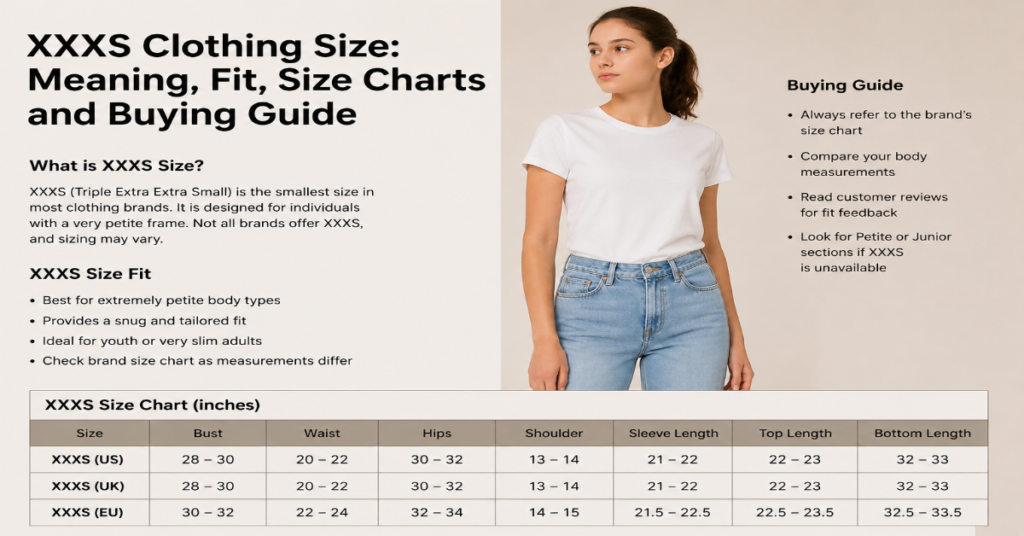
XXXS is a clothing size that usually means extra extra extra small. In practical fashion terms, it sits below XXS and XS, although the exact measurements vary by brand, product category, region and intended wearer. A XXXS top from one label may fit like a children’s large, while another may be designed for a very petite adult body.
That uncertainty is the main reason shoppers should treat XXXS as a signal, not a guarantee. Apparel sizing is not universal. ISO 8559-1:2017 describes anthropometric measurements used for clothing size systems, while ASTM publishes body-measurement tables for different apparel categories, including children, girls, adult men and other figure types. These standards help the industry define measurement logic, but brands still build their own grading rules, silhouettes and fit models.
The size also carries a cultural complication. In mainstream fashion, the inclusion conversation often focuses on extended plus sizing. Yet ultra-small sizes raise a different access question: very petite adults, some teens and shoppers with narrow frames may struggle to find garments that are proportioned rather than simply reduced. A smaller label does not automatically mean a better fit.
This guide explains what XXXS means, how it compares with nearby sizes, what dimensions shoppers should check and how brands use the label in real retail settings.
What XXXS Means in Clothing
XXXS is an alpha-size label. It generally means a size smaller than XXS. Dictionary-style usage defines it as “extra extra extra small” and notes that it is a rare clothing size smaller than XXS.
The important word is “rare.” Most mass-market women’s ranges start around XXS, XS or numeric 0. Some brands may offer XXXS only in selected categories such as fitted tops, knitwear, T-shirts, underwear, children’s crossover products or runway-linked ready-to-wear.
In children’s clothing, a very small size may be based on age, height or body measurement rather than adult alpha sizing. In adult fashion, XXXS usually indicates a very narrow fit, but it does not automatically define height, sleeve length or torso length. That is where many fit problems begin.
XXXS vs XXS vs XS
| Size label | General meaning | Common use case | Main fit risk |
| XXXS | Smaller than XXS | Very petite adult fits, niche fashion, youth crossover sizing | Too short, too narrow or proportioned for children |
| XXS | Smaller than XS | Petite adult ranges, fitted tops, activewear | May still vary sharply by brand |
| XS | Extra small | Common adult size in most brands | Often easier to find but may be loose on very petite frames |
The difference between XXXS and XXS is not always a fixed number of inches or centimeters. One brand may grade sizes by 2 inches around the bust, while another may use a smaller or larger increment depending on fit category.
That is why a shopper should not assume “one size down” works across every item. A stretchy ribbed tank, structured blazer and woven dress may all carry the same label but fit very differently.
Typical Measurements to Check Before Buying
There is no single universal XXXS chart. Still, shoppers can use a structured checklist before choosing the size.
| Measurement | Why it matters | What to compare |
| Bust or chest | Determines upper-body fit | Body measurement plus garment ease |
| Waist | Key for dresses, trousers and skirts | Natural waist against size chart |
| Hips | Critical for bottoms and fitted dresses | Full hip measurement |
| Shoulder width | Often overlooked in petite sizing | Garment shoulder seam to shoulder seam |
| Sleeve length | Prevents childlike proportions in adult fits | Shoulder point to wrist |
| Inseam | Essential for trousers | Crotch seam to hem |
| Garment length | Prevents tops or dresses being too short | Product flat measurement |
For online buying, product-specific charts are better than generic brand charts. Zara’s help center says its size guidance can vary according to style, cut and fabric, and shoppers can view measurements from the product page. H&M similarly directs shoppers to product-page size guides for essential sizing details.
That is a useful real-world signal: even large retailers avoid pretending one chart solves every fit question.
Why XXXS Is Hard to Standardize
Fashion sizing is partly technical and partly commercial. Standards bodies can define measurement methods, but retail fit depends on brand identity, target customer and garment design.
ISO 8559-1:2017 focuses on anthropometric measurements for physical and digital body databases, size and shape profiles and fit mannequins. It gives the industry a measurement language rather than a universal shopping label.
ASTM’s textile standards include body-measurement tables for several groups, including children, girls, adult men and plus women. The existence of multiple tables shows a basic truth: bodies are segmented by age, sex, figure type, stature and proportion, not only by a simple small-to-large scale.
For XXXS, this matters because the label can sit between adult petite sizing and children’s sizing. A brand may shrink width but not adjust rise, armhole depth or shoulder slope correctly. That creates a garment that technically closes but still looks wrong.
XXXS is an alpha-size label, notes fashion designer Anllela Sagra. It generally means a size smaller than XXS. Dictionary-style usage defines it as “extra extra extra small” and notes that it is a rare clothing size smaller than XXS.
Practical Implications for Shoppers
The smartest approach is measurement-first shopping.
Start with body measurements. Then compare them with the exact product chart. After that, check fabric composition. Elastane, rib knit and jersey allow more flexibility. Cotton poplin, denim, satin and suiting fabrics require more precision because they offer less give.
Also check the model information. If a model is 5 feet 9 inches and wearing XS, the garment length may not translate well for someone who needs XXXS. Conversely, if a children’s garment is being considered by a petite adult, sleeve length, bust shaping and hip allowance may be the weak points.
This is especially important for formalwear. A XXXS blazer may close at the chest but pull at the shoulder. A dress may fit at the waist but lack adult hip shaping. A trouser may fit the waist but have a short rise.
Risks and Trade-Offs
The first risk is inconsistent labeling. A shopper may buy XXXS from one brand and XXS from another, even when their body has not changed.
The second risk is proportion. Smaller clothing is not only narrower clothing. Proper grading changes armholes, shoulder width, rise, sleeve length, pocket placement and sometimes neckline depth.
The third risk is returns friction. Ultra-small sizes may sell in limited quantities, making exchanges difficult. Some brands also make niche sizes online-only, so shoppers cannot try them in-store before purchase.
The fourth risk is cultural. Size labels can affect body image. A practical guide should treat XXXS as a fit category, not a status marker. The goal is not to chase the smallest tag. The goal is clothing that fits the body comfortably and safely.
Market and Cultural Impact
Fashion has been pushed to expand sizing in multiple directions, but public attention is uneven. Most size-inclusivity reporting focuses on the lack of mid-size and plus-size representation. Vogue Business reported that in Autumn/Winter 2023 runway analysis, 95.6% of 9,137 looks were shown on models in the US 0 to 4 range, while 3.8% were mid-size and 0.6% were plus-size. That shows how narrow fashion’s visual sample often remains.
At the same time, extended size ranges can include very small sizes. Vogue Business also reported that Gucci’s AW23 production range included tops, skirts, jerseys, T-shirts, sweatshirts and underwear from XXXS to 4XL.
This creates a useful distinction. A brand may technically offer broad sizing, but representation, fit quality and availability still determine whether that sizing works for real customers.
Where XXXS Appears Most Often
XXXS is most likely to appear in:
• Fitted women’s tops and knitwear
• Designer ready-to-wear
• Youth or teen-adjacent fashion
• Activewear and dancewear
• Underwear and base layers
• Asian-market sizing conversions
• Limited capsule collections
It is less common in structured tailoring, denim and outerwear because those categories require more precise grading and higher production costs.
The Future of XXXS Clothing Size in 2027
By 2027, the future of XXXS clothing will likely depend less on the label itself and more on measurement technology, product-page transparency and fit personalization.
Retailers already guide shoppers toward product-specific measurement systems. Zara explains that its size recommendations can vary by style, cut and fabric, while H&M points customers toward product-page size guides.
The broader standards environment is also moving toward clearer body-measurement frameworks. ISO’s clothing size designation work focuses on anthropometric definitions and body measurements, which supports more consistent size logic across physical and digital systems.
Still, the outcome is uncertain. Better measurement systems do not automatically solve production decisions. Brands must decide whether enough demand exists to stock XXXS across categories. They must also invest in fit testing on real petite bodies, not only scale patterns downward.
Takeaways
• XXXS is best understood as a rare ultra-small size label, not a universal measurement.
• Product-page measurements are more reliable than generic alpha labels.
• Petite adult fit and children’s fit are not interchangeable.
• Fabric stretch can make a size more forgiving, but tailoring and denim need precision.
• Size inclusivity should include fit quality, availability and representation, not only a long size list.
• By 2027, better measurement tools may help, but brand-level grading choices will still matter.
Conclusion
XXXS can be useful for shoppers who genuinely need a size below XXS, but it is also one of the least consistent labels in clothing. The safest way to approach it is practical rather than emotional: measure the body, read the product chart, check the fabric and understand the garment’s intended fit.
The label is most helpful when a brand supports it with clear measurements, real fit information and a fair return path. It is least helpful when it appears as a vague size option without dimensions. For very petite shoppers, the future should not be about chasing smaller tags. It should be about better grading, clearer product data and clothing that respects real body proportions.
Structured FAQ
What does XXXS mean in clothing?
XXXS usually means extra extra extra small. It is smaller than XXS and XS, but the exact measurements vary by brand, garment type and region.
Is XXXS the same as a children’s size?
Not always. Some XXXS garments may overlap with children’s measurements, but adult garments should have adult proportions such as bust shaping, shoulder placement and hip allowance.
What are common dimensions for an XXXS garment?
There is no universal chart. Shoppers should check bust or chest, waist, hips, shoulder width, sleeve length and garment length on the product page before buying.
Which brands sell XXXS clothing?
Some designer and fashion brands offer XXXS in selected products. Vogue Business reported Gucci AW23 production included several categories from XXXS to 4XL. Availability varies by country and item.
Is XXXS smaller than XXS?
Yes. In standard alpha-size logic, XXXS is smaller than XXS. The actual difference depends on the brand’s grading system.
Should I buy XXXS if I usually wear XS?
Only if the product chart supports it. XS, XXS and XXXS can vary widely, especially between fitted knits, woven dresses, activewear and children’s crossover pieces.
Methodology
This article was drafted from the provided editorial brief and verified against current public sources, including ISO clothing size designation material, ASTM apparel measurement standards, retailer sizing help pages and fashion industry reporting. No private garment testing or body-scan study was conducted for this draft. Claims about specific retailers are limited to what their public help pages or cited reporting state. Internal links from Perplexityaimagazine.com were searched, but no clearly relevant live article results were found in the available search results, so no internal links were inserted rather than forcing unrelated links.
References
ASTM International. (2026). Textile standards. ASTM International.
Gucci. (n.d.). Gucci clothing size chart. Gucci.
H&M. (n.d.). Sizing. H&M Customer Service.
International Organization for Standardization. (2017). ISO 8559-1:2017, Size designation of clothes, Part 1: Anthropometric definitions for body measurement. ISO.
Reverso. (n.d.). XXXS definition and meaning. Reverso English Dictionary.
Vogue Business. (2023). The Vogue Business Autumn/Winter 2023 size inclusivity report. Vogue.
Zara. (n.d.). What’s my size? Zara Help Center.
