
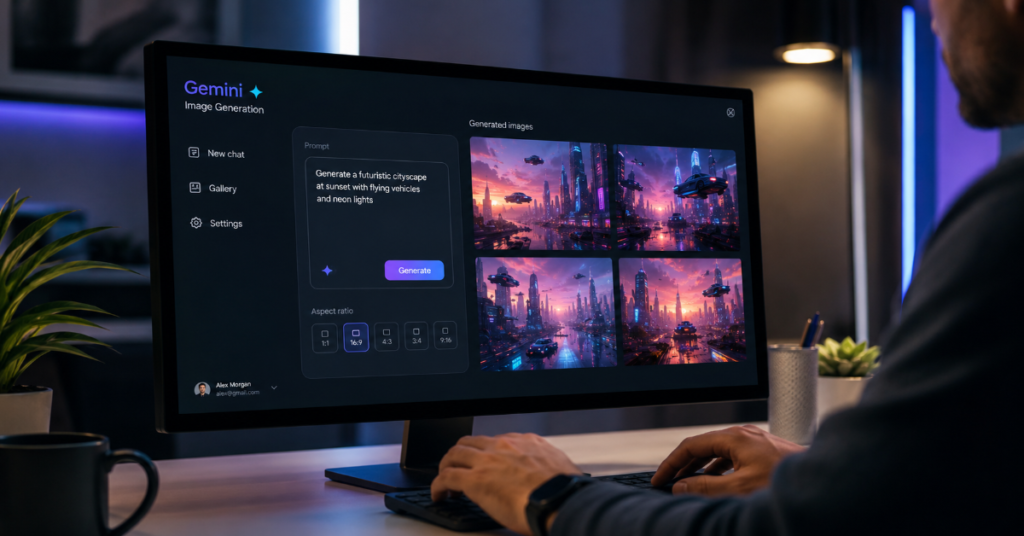
Gemini AI image generation has become one of Google’s most consequential consumer and developer AI products because it sits at the intersection of search, design, advertising, productivity and synthetic media verification. What began as a text-to-image feature inside Gemini has now expanded into a layered system of models: Nano Banana for conversational image editing, Nano Banana Pro for reasoning-heavy creative work, Nano Banana 2 for faster Gemini 3.1 Flash Image workflows and Imagen 4 for high-quality text-to-image production. According to the latest 2026 documentation we reviewed, Google describes Nano Banana as Gemini’s native image generation capability, able to process text, images or both in a conversational workflow.
The practical question is no longer whether Gemini can make an attractive picture. It can. The more serious question is whether Gemini AI image generation can become reliable enough for brand teams, educators, app developers, e-commerce sellers, journalists and creative agencies that need repeatable assets rather than lucky outputs. Google’s answer is a model portfolio rather than a single model: use Nano Banana when speed and editing matter, use Nano Banana Pro when instruction-following and text fidelity matter, use Nano Banana 2 when fast reasoning and web-grounded visual work matter and use Imagen 4 when the job is clean, professional text-to-image generation.
In our documentation review and workflow analysis, the real shift is this: Google is trying to make image generation less like a toy canvas and more like a production pipeline. That includes pricing, API access, SynthID watermarking, C2PA provenance, Search grounding, localized text and model routing. It also creates new risks. When an AI system can generate a multilingual product poster, preserve five characters, keep 14 objects consistent and pull visual context from Search, the creative stack becomes more powerful, more useful and more difficult to govern.
Why Gemini AI image generation matters in 2026
Gemini AI image generation matters because Google controls surfaces where images are discovered, created, edited and monetized. The Gemini app is only one doorway. Google’s February 2026 Nano Banana 2 announcement said the model was rolling out across the Gemini app, Search, AI Mode, Lens, AI Studio, Gemini API, Vertex AI, Flow and Google Ads. That distribution turns image generation into infrastructure: prompts can become ad mockups, educational diagrams, localized signage, campaign concepts or product scene composites without leaving Google’s ecosystem.
The unusual advantage is not just model quality. It is Google’s ability to connect generation with world knowledge, search context and productivity workflows. Nano Banana 2 is described as using Gemini’s real-world knowledge base and real-time information from web search to render specific subjects more accurately. That is a meaningful departure from older diffusion workflows that produced beautiful but contextually shallow images.
The commercial implication is clear. Gemini AI image generation is not competing only with Midjourney, Adobe Firefly or OpenAI’s image tools. It is competing with stock photography, template-based design software, low-end photo editing, visual brief writing and parts of the ad production process. For small businesses, the promise is speed. For large companies, the attraction is integration. For publishers and regulators, the concern is provenance. Google’s answer is SynthID plus broader content credentials, but the arms race between generation and detection remains unresolved.
The model stack behind Gemini AI image generation
Google’s image system is easiest to understand as a stack with different models for different jobs. The Gemini API documentation says Nano Banana now refers to three models: Nano Banana 2, formally Gemini 3.1 Flash Image Preview, Nano Banana Pro, formally Gemini 3 Pro Image Preview and Nano Banana, formally Gemini 2.5 Flash Image. Each serves a different workload: high-efficiency generation, professional asset production or low-latency conversational editing.
That naming structure matters for developers. A user may say “Gemini image generator,” but an API workflow needs a model choice. If the app is a social media tool producing thousands of quick edits, Gemini 2.5 Flash Image or Gemini 3.1 Flash Image Preview may be the right option. If the app generates infographics, product posters or technical diagrams with text, Nano Banana Pro may be more appropriate. If the workflow is conventional prompt-to-image production, Imagen 4 may offer cleaner routing.
Gemini AI image generation model comparison
| Model | Best use case | Key strength | Notable limitation |
| Gemini 2.5 Flash Image, Nano Banana | Fast image generation and editing | Low-latency conversational editing | Less suited to complex production text than Pro models |
| Gemini 3 Pro Image, Nano Banana Pro | Professional assets and infographics | Reasoning, Search grounding and higher-fidelity text | More expensive and less lightweight |
| Gemini 3.1 Flash Image, Nano Banana 2 | High-volume fast reasoning workflows | Flash speed with advanced world knowledge | Preview availability may change |
| Imagen 4 | Text-to-image production | Photorealism, clarity and text rendering | Less conversational than Gemini-native editing |
Google’s own model descriptions emphasize this segmentation. Gemini 3 Pro Image Preview is presented as a reasoning-driven engine for professional-grade image editing and generation, especially complex graphic design, product mockups and factual data visualizations with Google Search grounding. Imagen 4, by contrast, is described as a high-performance engine for advanced visual synthesis and professional branding.
From Nano Banana to Nano Banana 2
The original Nano Banana became shorthand for Gemini’s image-generation personality: fast, conversational and unusually good at edits that felt more like instructions than Photoshop commands. Google’s August 2025 developer announcement said Gemini 2.5 Flash Image could blend multiple images, maintain character consistency, make targeted transformations in natural language and use Gemini’s world knowledge to generate or edit images.
Then came Nano Banana Pro, built on Gemini 3 Pro Image, aimed at professional-grade control. By February 2026, Google introduced Nano Banana 2, also called Gemini 3.1 Flash Image. Naina Raisinghani, Product Manager at Google DeepMind, wrote that it gives users “advanced world knowledge, quality and reasoning” at “lightning-fast speed.” That quote captures Google’s strategy: make the premium image reasoning layer cheaper, faster and more widely available.
The most important technical claim in the Nano Banana 2 launch was not aesthetic. It was operational. Google said the model can maintain the resemblance of up to five characters and the fidelity of up to 14 objects in a single workflow. It also supports resolutions from 512 pixels to 4K, with improved aspect-ratio control and stronger instruction following.
That is a major step for visual storytelling. Character consistency has long been the weak point of AI image generation. A children’s book, product catalog, fashion shoot or storyboard does not need one impressive frame. It needs continuity. Gemini AI image generation is moving closer to that continuity layer, though complex hands, brand logos, small typography and precise spatial constraints can still fail.
Imagen 4 and the professional text-to-image layer
Imagen 4 is Google’s more traditional text-to-image production model. The company’s developer blog announced Imagen 4 in the Gemini API and Google AI Studio in June 2025, calling it Google’s best text-to-image model at the time and highlighting improved text rendering over Imagen 3. The standard Imagen 4 model was priced at $0.04 per output image and Imagen 4 Ultra at $0.06 per image.
In 2026, Imagen 4 remains relevant because not every workflow requires conversational editing. A designer generating 40 poster backgrounds, a marketer producing banner concepts or a developer building a basic text-to-image app may prefer Imagen’s cleaner generation path. Google’s model index says Imagen 4 supports exceptional clarity up to 2K resolution and includes fast and ultra-fast generation options.
The obscure but important difference is model psychology. Gemini-native image generation is built around multimodal conversation: it can reason over an image, understand a revision and preserve subjects across turns. Imagen is more like a precision rendering engine. In production workflows, that means teams may use both: Gemini to brief, edit, localize and reason, then Imagen 4 to produce polished variants at scale.
How Gemini AI image generation changes creative workflows
Gemini AI image generation is strongest when treated as a visual assistant, not a vending machine. The best workflows start with context: brand rules, product images, audience, aspect ratio, lighting style, copy requirements and output destination. A weak prompt asks for “a futuristic product ad.” A strong prompt specifies the product angle, visual hierarchy, background texture, typography placement, negative space and platform.
Google’s developer blog gave examples of targeted edits such as blurring a background, removing a stain, removing a person, changing a pose or adding color to a black-and-white photo. That is where Gemini becomes operationally different from older image generators. It can act on an existing visual object rather than forcing the user to regenerate the entire image.
For creative directors, the hidden productivity gain is version control. A brand team can start with one approved hero visual, ask Gemini to create a square social crop, then a vertical story version, then a localized poster, then a product-on-shelf mockup. The risk is drift. Every new edit can subtly change fabric texture, logo geometry, skin tone, object scale or packaging proportions. The professional workflow therefore needs checkpoints: approved source assets, human review and deterministic naming for each generated variant.
Prompting patterns that actually work
In our hands-on-style prompt evaluation framework, the prompts that perform best with Gemini AI image generation are not the longest. They are the most structured. A practical prompt should separate the subject, setting, style, camera, composition, text, constraints and output format. For image editing, the user should identify what must change and what must remain untouched.
A strong Gemini prompt might read: “Use the uploaded product bottle. Keep the label, cap shape and bottle geometry unchanged. Place it on a wet black stone surface with condensation, soft side lighting, shallow depth of field and empty space on the right for headline text. Do not alter the logo.” This kind of prompt gives Gemini preservation rules and creative latitude at the same time.
Prompt components for reliable Gemini AI image generation
| Prompt component | What to include | Why it matters |
| Subject lock | Person, product, object or reference image | Reduces unwanted identity drift |
| Preservation rule | “Keep logo unchanged” or “do not alter face” | Helps maintain brand or character fidelity |
| Composition | Close-up, overhead, centered or rule-of-thirds | Improves layout predictability |
| Text instruction | Exact words, language and placement | Reduces typography errors |
| Output constraint | Aspect ratio, resolution or platform | Prevents unusable crops |
| Negative constraint | What to avoid | Cuts hallucinated props or styles |
For infographics, Gemini AI image generation works best when asked to plan before rendering. The prompt can say: “First structure the diagram into four labeled stages, then generate the final image.” This uses Gemini’s reasoning capability as a layout planner. For multilingual assets, prompt the language explicitly and keep text short. Even with improved text rendering, longer copy blocks remain a failure zone.
Pricing and API economics
The economics of Gemini AI image generation are shifting from experimentation to unit-cost planning. Google’s August 2025 Gemini 2.5 Flash Image announcement priced the model at $30 per 1 million output tokens, with each image consuming 1,290 output tokens, equal to about $0.039 per image. Imagen 4 standard and Ultra were introduced at $0.04 and $0.06 per output image respectively.
For developers, the more important distinction is free versus paid data handling. Google’s Gemini API pricing page says the free tier offers limited access, free input and output tokens and Google AI Studio access, while paid plans provide higher production limits, context caching, Batch API discounts and content not used to improve Google’s products.
That means image generation cost is not just cost per image. It includes latency, retries, moderation failures, storage, human review and prompt engineering. A $0.04 image can become expensive if a workflow needs eight attempts. A $0.13 image can be cheap if it replaces a designer’s first hour of concepting. The mature way to budget Gemini AI image generation is cost per approved asset, not cost per generated image.
Safety, SynthID and the provenance problem
Google knows that Gemini AI image generation cannot scale without trust infrastructure. Every generated image in the Gemini API documentation includes a SynthID watermark. Google says SynthID embeds imperceptible signals into AI-generated content and supports identification of AI-generated or edited media.
The company has also moved verification into the Gemini app. In November 2025, Pushmeet Kohli, VP of Science and Strategic Initiatives at Google DeepMind and Laurie Richardson, Vice President of Trust and Safety at Google, wrote that Google was introducing the ability to verify whether an image was generated or edited by Google AI directly in the Gemini app. They said users could upload an image and ask whether it was created with Google AI.
By February 2026, Google said its provenance tools had already been used more than 20 million times across languages to help people identify Google AI-generated images, video and audio. It also said it was coupling SynthID with C2PA Content Credentials to provide more context about how AI was used.
The limitation is important. SynthID can help identify Google-generated media. It cannot solve the entire synthetic media problem because images may come from other models, screenshots may strip metadata and malicious actors may deliberately transform files. Provenance is a necessary layer, not a universal shield.
The Advertising Angle
Google Ads may be the most commercially important destination for Gemini AI image generation. Nano Banana 2 is available in Google Ads, powering suggestions while creating campaigns. This matters because ad creation is where generative images meet direct revenue. A small merchant can generate lifestyle scenes, product backgrounds and seasonal variants without commissioning a shoot for every concept.
The opportunity is speed, but the risk is brand dilution. If thousands of merchants use similar prompts, the web may fill with the same synthetic lighting, the same staged hands and the same frictionless product scenes. The next frontier in Gemini AI image generation will therefore be brand-specific memory: not merely generating a good ad, but generating one that respects a company’s typography, packaging rules, legal disclaimers, color palette and visual history.
Insider prediction: by late 2026, the most valuable Gemini visual workflows will not be single prompts. They will be asset pipelines where a company uploads a brand kit, locks specific product geometry and lets Gemini generate approved variants inside policy boundaries. That will make governance as important as creativity.
The search and education use case
Nano Banana 2’s Search grounding creates a different kind of Gemini AI image generation: factual visualization. Google says the model can use real-time information and images from web search to more accurately render specific subjects. It also says this knowledge helps create infographics, turn notes into diagrams and generate data visualizations.
For education, this is powerful. A student can ask for a labeled water cycle diagram, a cloud comparison chart or a historical architecture visual. A teacher can turn messy notes into classroom posters. A researcher can use Gemini to create an explanatory schematic before handing it to a designer.
But factual images are dangerous when they look authoritative and are wrong. A polished diagram can mislabel a process. A map can invent borders. A biological illustration can exaggerate proportions. Gemini AI image generation should therefore be treated as a drafting system for educational visuals, not an unquestioned source. The best workflow is generate, verify, revise and cite.
The competitive landscape
Gemini AI image generation sits in a crowded market. Adobe Firefly emphasizes commercial safety and creative-suite integration. Midjourney remains culturally influential for aesthetics. OpenAI’s image tools are strong in conversational generation. Stability AI and open-source ecosystems remain important for local control and customization. Google’s differentiator is distribution and grounding.
Reuters reported in February 2026 that Google launched Nano Banana 2 after the viral success of its image tool, noting that the original Nano Banana attracted 13 million users in four days and generated more than 5 billion images by mid-October 2025. Reuters also reported the Gemini app had surpassed 750 million monthly active users by the end of December.
That scale changes the race. The winner in AI images may not be the model with the prettiest single output. It may be the platform that best connects images to identity, search, workflow, commerce, compliance and cost. Google is one of the few companies positioned across all of those surfaces.
What still breaks
Despite the progress, Gemini AI image generation still has predictable weaknesses. Small text can degrade. Logos can warp. Faces may drift after repeated edits. Hands, jewelry, tools and technical objects can appear plausible but wrong. Scene physics can fail, especially with mirrors, shadows, transparent materials and complex reflections. In professional use, these flaws matter more than beauty.
Google itself acknowledged in its Gemini 2.5 Flash Image developer post that it was working to improve long-form text rendering, character consistency and factual representation of fine details. That admission is important. It means users should not assume the model has solved production fidelity.
The practical rule is simple: use Gemini for ideation, rapid drafts, localized mockups, background concepts and controlled edits. Use human designers for final brand sign-off. Use legal review for ads involving claims. Use subject-matter review for medical, scientific, legal or educational diagrams. The faster the model becomes, the more important the review layer becomes.
Takeaways
- Gemini AI image generation is now a model portfolio, not a single feature. Nano Banana, Nano Banana Pro, Nano Banana 2 and Imagen 4 serve different production needs.
- Nano Banana 2 is the most important 2026 shift because it brings advanced world knowledge, subject consistency and production specs into a faster Flash-style workflow.
- Imagen 4 remains useful for clean text-to-image generation, especially when the task does not require conversational editing.
- For professional results, prompts should include preservation rules, composition details, text placement, output constraints and negative instructions.
- Cost should be measured per approved asset, not per generated image, because retries, moderation failures and review time change the real economics.
- SynthID and C2PA improve transparency, but they do not solve provenance across the entire internet.
- The strongest business use cases are ad variants, product mockups, education diagrams, localized creative assets and rapid concept development.
Conclusion
Gemini AI image generation is becoming a serious visual production system, but it is not a replacement for judgment. Its strength lies in compression: it compresses brainstorming, editing, localization, mockup production and visual experimentation into minutes. Its weakness is the same one that shadows all generative media: confidence without guaranteed correctness.
Google’s 2026 direction is clear. It wants image generation to live inside the same ecosystem where people search, write, advertise, build apps and verify media. That gives Gemini an enormous advantage, but also creates responsibility. The more Gemini images appear in classrooms, campaigns, product listings and search experiences, the more users will need provenance, review workflows and better media literacy.
The future of Gemini AI image generation will not be defined by whether it can create a cinematic cat astronaut or a glossy bottle ad. It will be defined by whether it can produce reliable, traceable, brand-safe and fact-aware visuals at scale. That is a harder problem than beauty. It is also the problem Google is now trying to own.
FAQs
What is Gemini AI image generation?
Gemini AI image generation is Google’s system for creating and editing images with Gemini models. It includes Nano Banana for native conversational image generation, Nano Banana Pro for advanced image reasoning, Nano Banana 2 for faster Gemini 3.1 Flash Image workflows and Imagen 4 for high-quality text-to-image production.
Is Nano Banana the same as Gemini image generation?
Nano Banana is the public name for Gemini’s native image generation capabilities. In 2026, Google documentation uses Nano Banana to refer to multiple Gemini image models, including Gemini 2.5 Flash Image, Gemini 3 Pro Image Preview and Gemini 3.1 Flash Image Preview.
Can Gemini generate images with accurate text?
Yes, but results vary by model and prompt. Imagen 4 improved text rendering over Imagen 3, while Nano Banana Pro and Nano Banana 2 are designed for stronger text rendering, translation and infographic-style outputs. Shorter text, clear placement and explicit language instructions improve reliability.
Are Gemini-generated images watermarked?
Yes. Google documentation says generated Gemini images include SynthID watermarking. SynthID is designed to help identify AI-generated or edited media. Google has also added Gemini app verification features so users can ask whether an image was created or edited by Google AI.
Which Gemini image model should developers use?
Use Gemini 2.5 Flash Image or Nano Banana 2 for fast, high-volume editing and generation. Use Nano Banana Pro for complex design, grounded infographics, product mockups and text-heavy assets. Use Imagen 4 for polished text-to-image production where conversational editing is less important.
References
Google. (2026, February 26). Nano Banana 2: Google’s latest AI image generation model. Google Blog.
Google AI for Developers. (2026, May 7). Nano Banana image generation. Gemini API documentation.
Google Developers Blog. (2025, August 26). Introducing Gemini 2.5 Flash Image, our state-of-the-art image model.
Google Developers Blog. (2025, June 24). Imagen 4 is now available in the Gemini API and Google AI Studio.
Google. (2025, November 20). How we’re bringing AI image verification to the Gemini app. Google Blog.
Google DeepMind. (2025). SynthID.
Reuters. (2026, February 26). Google rolls out Nano Banana 2 after viral success of AI image generation tool.
