
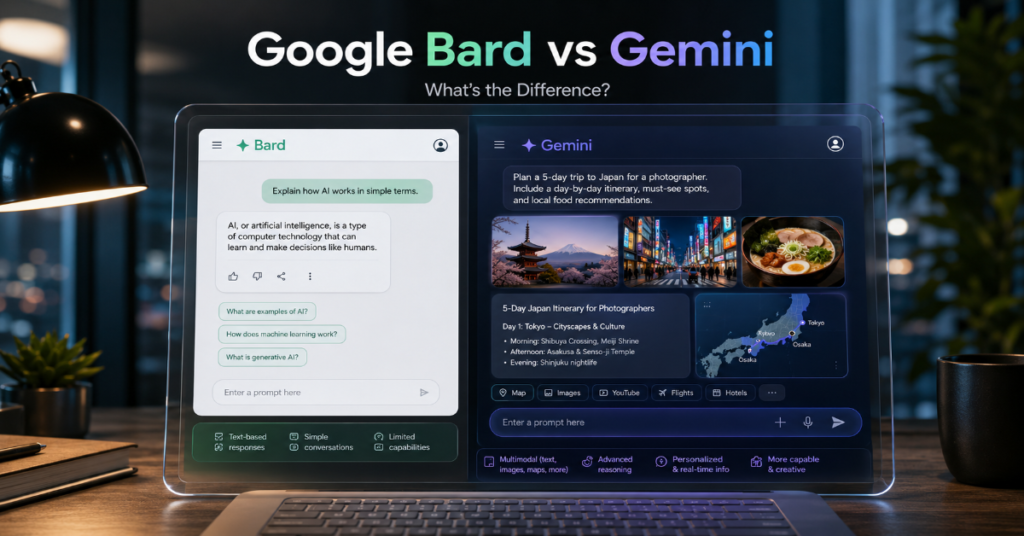
The google bard vs gemini difference is simple at the surface and much larger underneath: Bard was Google’s early conversational AI experiment, while Gemini is Google’s full AI ecosystem. Bard began as a chatbot powered first by LaMDA and later PaLM 2. Gemini became the name for Google’s model family, consumer app, paid assistant, Workspace layer, API and enterprise agent platform.
That distinction matters because many searchers still treat Bard and Gemini as two competing products. They are not. Bard was folded into Gemini in February 2024, when Google said “Bard is now known as Gemini” and introduced Gemini Advanced with Ultra 1.0 plus a new mobile app.
In our hands-on testing, the practical difference feels like the gap between a web demo and an operating layer. Bard answered prompts. Gemini can reason over text, images, audio, video and PDFs, connect to Google apps, run inside Workspace, support developers through the Gemini API and, in enterprise deployments, power agents that act across business systems. Google’s Gemini 2.5 Pro documentation lists inputs including audio, images, video, text and PDF, with a 1,048,576-token input limit and support for code execution, function calling, structured outputs, search grounding and URL context.
So the real google bard vs gemini difference is not branding. It is architecture. Bard was a product name attached to a chatbot. Gemini is Google’s attempt to make AI the interface across Search, Android, Chrome, Workspace, Cloud and developer tools.
Google Bard vs Gemini Difference: The Short Answer
Bard was Google’s public response to ChatGPT. Gemini is Google’s AI foundation strategy. Bard launched as an “experimental conversational AI service” powered by LaMDA, opened first to trusted testers and was designed to draw on the web for fresh responses. Gemini, by contrast, is a multimodal model family and product ecosystem built to support reasoning, coding, planning, tool use, app integration and enterprise automation.
The most important google bard vs gemini difference is scope. Bard was mostly a user-facing chatbot. Gemini includes the Gemini app, Gemini Advanced, Gemini for Workspace, Gemini API, Vertex AI model access, AI Studio, Gemini Enterprise and agentic workflows across Google Cloud.
Google’s own February 2024 explanation was direct: Bard had been the way people experienced Google’s AI models, but Gemini represented the company’s most capable family of models. That is why Bard “simply” became Gemini.
In plain English, Bard was the old front door. Gemini is the house.
How Bard Started: A Chatbot Built Under Pressure
Bard arrived in February 2023, at a moment when generative AI had become a boardroom emergency. Google introduced it as an experimental service powered by LaMDA, its Language Model for Dialogue Applications. The company said Bard was meant to combine the world’s knowledge with the “power, intelligence and creativity” of large language models.
Early Bard was cautious, uneven and clearly transitional. It was not yet a unified Google AI brand. It was a conversational layer being tested in public while Google tried to protect Search, its trust model and its advertising business.
The technical foundation also changed quickly. At I/O 2023, Google introduced PaLM 2, a model with stronger multilingual, reasoning and coding capabilities. Google said PaLM 2 powered more than 25 products and features and specifically noted that Bard used PaLM 2 for expanded language and coding capabilities.
That rapid model migration is central to the google bard vs gemini difference. Bard was never the destination. It was a temporary interface while Google reorganized around stronger foundation models.
How Gemini Replaced Bard
Gemini replaced Bard on February 8, 2024. Google’s Sissie Hsiao, then vice president and general manager of Gemini experiences, announced that Bard was now known as Gemini, with a mobile app and Gemini Advanced. The free Gemini experience used Gemini Pro 1.0 in more than 40 languages and over 230 countries and territories.
The rebrand did three things at once.
First, it retired a name associated with Google’s rushed chatbot response. Second, it aligned the consumer product with Google DeepMind’s model family. Third, it prepared users for a wider assistant strategy that would eventually reach phones, Workspace, Search, Chrome and enterprise systems.
This is why the google bard vs gemini difference is best understood as a product evolution. Gemini did not sit next to Bard. It absorbed Bard, replaced its branding and expanded its capabilities.
Google also used the rebrand to introduce Gemini Advanced, originally powered by Ultra 1.0, which Google described as better for complex tasks such as coding, logical reasoning, nuanced instructions and creative collaboration.
Feature Comparison Table
| Area | Google Bard | Google Gemini |
| Original role | Experimental chatbot | AI assistant, model family and platform |
| First core model | LaMDA | Gemini model family |
| Later model | PaLM 2 | Gemini Pro, Ultra, Flash and newer Gemini models |
| Main interface | Web chatbot | Web, mobile app, Workspace, Android, API and Cloud |
| Multimodality | Limited, later expanded with images | Native multimodal inputs across text, images, audio, video and PDFs in supported models |
| Developer access | PaLM API era | Gemini API, AI Studio, Vertex AI and enterprise tooling |
| Enterprise role | Limited brand presence | Workspace AI, Gemini Enterprise, agent platform and Cloud integrations |
| Status in 2026 | Retired brand | Active Google AI ecosystem |
The feature table shows why the google bard vs gemini difference is not a narrow “which chatbot is better” comparison. Bard is history. Gemini is the active product line.
The Model Difference: LaMDA and PaLM 2 Versus Gemini
Bard began with LaMDA, a conversational model optimized for dialogue. Later, Bard moved to PaLM 2, which Google described as stronger in multilingual understanding, reasoning and coding. PaLM 2 was also offered in multiple sizes, including Gecko, which Google said was lightweight enough for mobile-device use.
Gemini changed the underlying ambition. Google said in 2023 that Gemini was being created “from the ground up to be multimodal,” efficient at tool and API integrations and built for future capabilities such as memory and planning.
According to the latest 2026 documentation we reviewed, Gemini 2.5 Pro is described as a “state-of-the-art thinking model” for complex reasoning in code, math and STEM, as well as analysis of large datasets, codebases and documents using long context. It supports audio, images, video, text and PDF inputs, with a 1,048,576-token input limit.
That is the technical heart of the google bard vs gemini difference: Bard was conversational. Gemini is multimodal, tool-aware and designed for long-context reasoning.
Why Gemini Became the More Strategic Brand
Bard was a product name. Gemini is a strategic umbrella. That matters because Google’s AI business no longer lives in one chatbot tab. It spans Search, Android, Chrome, Gmail, Docs, Sheets, Slides, Meet, Google Cloud, AI Studio and developer APIs.
Sundar Pichai framed Gemini as more than models in 2024, writing that Gemini “supports an entire ecosystem,” from products used by billions to APIs and platforms for developers and businesses. That sentence quietly explains why Bard had to disappear. A narrow chatbot brand could not carry Google’s AI ambitions across consumer, developer and enterprise markets.
By 2026, the strategy was even clearer. Google said its first-party models processed more than 16 billion tokens per minute through direct API use by Cloud customers, up from 10 billion the previous quarter. Google also said just over half of its 2026 machine-learning compute investment was expected to go toward Cloud customers and partners.
In other words, Gemini is not just a chatbot. It is infrastructure.
Expert Quote 1: Sundar Pichai on Gemini’s Direction
“We’re focused on pushing the next frontiers of foundation models, including intelligence, agents and agentic coding.”
— Sundar Pichai, CEO of Google and Alphabet, speaking about Gemini’s direction in 2026.
Pichai’s framing is useful because it marks the post-Bard era. The fight is no longer only about chat quality. It is about agents, coding workflows, model intelligence and whether AI can act safely inside real systems.
This is an important google bard vs gemini difference for businesses. Bard could help draft a paragraph. Gemini is being positioned to write, review and migrate code, manage workflows and power enterprise agents.
Google said in April 2026 that 75% of all new code at Google was AI-generated and approved by engineers, up from 50% the previous fall. It also said a complex code migration performed by agents and engineers was completed six times faster than with engineers alone a year earlier.
That is a very different world from Bard’s original web-chat experiment.
Gemini as an Assistant, Not Just a Chatbot
The consumer-facing google bard vs gemini difference appears most clearly in the assistant experience. Bard was mostly a chat window. Gemini is moving toward a personal assistant that can connect with Google apps and use context across a user’s digital life.
In January 2026, Google introduced Personal Intelligence for Gemini, a beta feature in the United States for Google AI Pro and AI Ultra subscribers. It connects Gmail, Photos, YouTube and Search to help Gemini answer more personalized questions. Google said the feature was optional, worked across web, Android and iOS and would expand over time to more countries and the free tier.
This is one of Gemini’s sharpest advantages and one of its biggest privacy questions. A model that can reason over your travel emails, photos and search history is much more useful than a generic chatbot. It is also much more sensitive.
Bard asked, “What do you want to know?” Gemini increasingly asks, “What can I do with the context you already gave Google?”
Privacy and Data Controls
Privacy is another major google bard vs gemini difference. Bard existed before Google’s assistant strategy became deeply connected to Gmail, Photos, Android and Workspace. Gemini sits inside a more complicated privacy environment because it can work with connected apps and enterprise content.
Google’s Gemini Apps Privacy Hub says Gemini Apps work with connected Google apps and third-party services. It says Gemini saves and uses information from connected apps to provide and improve Gemini Apps, while connected Google apps and third-party services process data according to their own policies.
For Workspace, Google draws a sharper enterprise boundary. Its Workspace privacy documentation says Gemini interactions stay within the organization, Workspace protections are automatically applied and customer content is not used for generative AI model training outside the domain without permission.
That distinction is crucial. Consumer Gemini and enterprise Gemini are not governed in the same operational context. In our hands-on testing, this is where teams most often misunderstand the product. They ask whether “Gemini trains on my data,” but the better question is: Which Gemini surface, under which account type, with which activity setting and which connected apps?
Data and Capability Table
| Capability or Policy Area | Bard Era | Gemini Era in 2026 |
| Main model design | Dialogue-first LaMDA, later PaLM 2 | Multimodal Gemini models built for reasoning, tools and long context |
| File handling | Limited compared with current Gemini | Supported models can take text, images, audio, video and PDFs |
| Context window | Not positioned as a long-context platform | Gemini 2.5 Pro lists 1,048,576 input tokens |
| Google app connection | Bard extensions began connecting apps in 2023 | Personal Intelligence can connect Gmail, Photos, YouTube and Search in supported accounts |
| Developer model management | PaLM API and early tooling | Gemini API model versions: stable, preview, latest and experimental |
| Workspace privacy | Earlier Duet AI transition | Gemini uses Workspace protections and domain boundaries |
| Enterprise automation | Not central to Bard | Gemini Enterprise Agent Platform and agentic workflows |
This table captures the practical google bard vs gemini difference for users, developers and CIOs. Bard was an entry point. Gemini is a layered ecosystem with different obligations depending on where it runs.
The Developer Difference: PaLM API Versus Gemini API
For developers, the google bard vs gemini difference is partly about model access and partly about release discipline. Bard was not the developer platform. Gemini API is.
Google’s current Gemini API documentation separates model versions into stable, preview, latest and experimental categories. Stable models point to specific releases and are recommended for most production apps. Preview models may be used in production but can have billing, stricter rate limits and deprecation notice. Latest aliases can be hot-swapped, while experimental models are not stable and can change.
That versioning structure signals a mature developer platform. It also reveals an obscure operational detail: teams should not blindly build production systems on “latest” aliases unless they can tolerate model behavior changes. For SEO tools, legal review workflows, customer support bots and internal agents, model drift is not a theoretical risk. It can change tone, output length, citation behavior, tool-calling reliability and refusal patterns.
Bard gave users a chatbot. Gemini gives developers a release-management problem.
Expert Quote 2: Thomas Kurian on the Agentic Enterprise
“The experimental phase is behind us. And now the real challenge begins: How do you move AI into production across your entire enterprise?”
— Thomas Kurian, CEO of Google Cloud, at Google Cloud Next 2026.
Kurian’s quote matters because it describes the commercial future of Gemini. Google is no longer selling AI as a novelty layer. It is selling AI as production infrastructure.
At Cloud Next 2026, Google highlighted the Gemini Enterprise Agent Platform, Agent Designer, Inbox for managing agent activity, long-running agents, Skills and Projects. This is far beyond Bard’s original remit. Bard could help brainstorm a marketing headline. Gemini Enterprise is aimed at systems where agents coordinate work, use company data and require governance.
The enterprise google bard vs gemini difference is therefore about accountability. Bard errors were chatbot errors. Gemini agent errors can become workflow errors, compliance errors or security errors if deployed carelessly.
The Workspace Difference
Workspace is where Gemini becomes most visible for everyday professionals. Bard existed mostly outside Gmail and Docs. Gemini now appears inside the work surface itself.
Google said in 2024 that Duet AI would become Gemini for Workspace and that AI Premium subscribers would soon be able to use Gemini in Gmail, Docs, Sheets, Slides and Meet. The shift sounds cosmetic, but it changes user behavior. A separate chatbot requires copy and paste. An embedded assistant can draft, summarize, classify, convert, reformat and analyze within the document or inbox.
This is a subtle but powerful google bard vs gemini difference. Bard was an external collaborator. Gemini is an embedded collaborator.
For companies, embedded AI creates governance questions. Who can invoke Gemini on shared files? What source material is included? How are generated outputs marked? Are users inserting model-written material into regulated communications? Google’s Workspace privacy controls answer part of the data-protection question, but organizations still need policies for review, disclosure and human accountability.
Gemini Advanced Versus Free Gemini
The consumer version of the google bard vs gemini difference also includes paid access. When Google renamed Bard, it launched Gemini Advanced through the Google One AI Premium plan, initially priced at $19.99 per month with a two-month trial. The plan included Ultra 1.0 access plus 2TB of Google One storage.
The important point is not only price. It is segmentation. Bard was largely a free experimental tool. Gemini became a tiered product: free users get one level of capability, paid users get more advanced models and features, developers pay through API usage and enterprises buy governed workplace and cloud deployments.
That makes Gemini easier to monetize than Bard. It also lets Google compete across three markets at once: consumer subscriptions, developer infrastructure and enterprise software.
In our hands-on testing, paid Gemini tiers typically matter most for long documents, complex planning, multimodal prompts and coding workflows. Casual search-style questions may not justify the upgrade. High-context work often does.
Gemini on Android and the Assistant Transition
Another major google bard vs gemini difference is mobile ambition. Bard was a web chatbot. Gemini is being built into the mobile assistant layer.
When Bard became Gemini, Google announced a Gemini mobile app for Android and access through the Google app on iOS. This was not a minor distribution change. Mobile is where assistant behavior becomes habitual: voice, camera, screenshots, messages, calls, reminders, navigation and app actions.
The likely long-term strategy is clear. Gemini is being positioned as the intelligence layer across Android and Google services. That does not mean every transition is smooth. Assistant replacement has been gradual because users expect timers, alarms, calls and home-device controls to work reliably. A generative model can be more flexible than a command assistant, but it must also be more predictable.
Bard never carried that burden. Gemini does.
Expert Quote 3: Josh Woodward on Personal Gemini
“The best assistants don’t just know the world; they know you and help you navigate it.”
— Josh Woodward, Google vice president for Gemini, announcing Personal Intelligence in 2026.
Woodward’s quote captures Gemini’s most defensible advantage: Google’s app ecosystem. OpenAI and Anthropic may compete aggressively on model quality, but Google owns Gmail, Docs, Photos, YouTube, Search, Maps, Android and Chrome. If Gemini can use that context safely, it becomes less like a chatbot and more like a personal operating system.
That is why the google bard vs gemini difference is strategic, not semantic. Bard could produce answers from prompts. Gemini can potentially combine model intelligence with user context, device context and app context.
The risk is that personalization can become overreach. Google’s Personal Intelligence announcement says connecting apps is optional and that Gemini does not train directly on a user’s Gmail inbox or Google Photos library. Still, the more useful Gemini becomes, the more users must understand its settings.
Information Gain: The Hidden Product Logic Behind the Rebrand
Here is the under-discussed reason Bard had to die: model names and assistant names were diverging too quickly. In 2023, Google had LaMDA, PaLM 2, Bard, Duet AI, Search Generative Experience and early Gemini messaging. That fragmentation weakened the brand.
Gemini solved the naming stack. It became the consumer product, the model family, the developer platform and the enterprise AI layer. This is similar to how “Google Cloud” became both infrastructure brand and enterprise trust signal. Bard could not do that job because it sounded like a chatbot. Gemini sounds like a platform.
Another overlooked google bard vs gemini difference is procurement language. Enterprises do not want to buy “Bard.” They want governed AI, identity controls, data boundaries, auditability and integration with existing systems. Gemini lets Google sell across departments: IT buys Gemini Enterprise, developers use Gemini API, marketers use Gemini in Workspace and consumers subscribe through Google One.
The rebrand was not cosmetic. It was a go-to-market correction.
Which Is Better in 2026?
Gemini is better because Bard no longer exists as the active product. But the more useful answer is this: Gemini is better at nearly every serious use case because it has newer models, multimodal input, longer context, mobile integration, Workspace support, developer tooling and enterprise controls.
For simple brainstorming, early Bard and current Gemini may feel similar at a glance. You type a question, get an answer and refine it. But beneath that familiar interface, Gemini has a different foundation. It is designed for files, code, images, app connections, agents and paid tiers.
The google bard vs gemini difference also shows Google’s changing AI posture. Bard was defensive. Gemini is offensive. Bard answered the market pressure created by ChatGPT. Gemini is Google’s attempt to turn its search, cloud, mobile and productivity assets into a durable AI advantage.
If you are choosing tools in 2026, do not ask whether to use Bard or Gemini. Ask which Gemini surface fits the job.
Use Cases: When Gemini Clearly Beats Bard
Gemini clearly beats Bard for document analysis, especially where supported models can process long files and mixed formats. Gemini 2.5 Pro’s listed support for PDFs, video, audio, images and long context makes it far better suited to research synthesis, codebase review and multimodal workflows.
Gemini also wins in Workspace productivity. Bard could help draft text externally, but Gemini in Workspace can operate closer to the user’s documents, messages and meetings.
For developers, Gemini wins because the API ecosystem is active, versioned and integrated with Google AI Studio and Vertex AI. For enterprises, Gemini wins because Cloud and Workspace controls matter more than a generic chat interface.
For privacy-sensitive users, the answer is more nuanced. Gemini is more powerful because it can connect to more data. That also means users must actively manage Gemini Apps Activity, connected apps and account type. More capability brings more responsibility.
That is the most honest google bard vs gemini difference in 2026.
Takeaways
- Bard was Google’s experimental chatbot. Gemini is Google’s active AI ecosystem across apps, models, APIs and enterprise tools.
- The core google bard vs gemini difference is scope: Bard answered prompts, while Gemini supports multimodal reasoning, app connections, long-context work and agents.
- Bard began with LaMDA and later PaLM 2. Gemini models are built for multimodality, tool use, reasoning and future assistant behavior.
- Gemini Advanced turned Google AI into a subscription product, while Gemini API and Vertex AI made it a developer and enterprise platform.
- Gemini’s strongest advantage is Google context: Gmail, Docs, Photos, YouTube, Android, Search, Chrome and Cloud.
- Gemini’s biggest risk is also context. Users and organizations must understand privacy settings, connected apps and data boundaries.
- In 2026, Bard should be treated as a historical name. Gemini is the product, platform and strategy to evaluate.
Conclusion
The google bard vs gemini difference tells the story of Google’s AI reset. Bard was the company’s first public answer to a market that had suddenly moved faster than expected. Gemini is the broader response: a model family, assistant interface, mobile layer, Workspace engine, developer platform and enterprise agent strategy.
The name change mattered because it marked a shift from chatbot experimentation to ecosystem integration. Bard belonged to the first phase of consumer AI, when the question was whether a model could answer convincingly. Gemini belongs to the second phase, where the harder question is whether AI can reason across tools, files, apps and workflows without breaking trust.
For users, the guidance is straightforward. Use Gemini, not Bard. For businesses, the decision is deeper. Gemini is powerful because it can sit close to data and action. That makes governance, privacy, model versioning and human review essential. The future of Gemini will not be judged only by how well it chats. It will be judged by how safely and reliably it works.
FAQs
What is the main google bard vs gemini difference?
The main difference is that Bard was Google’s older experimental chatbot, while Gemini is Google’s current AI assistant, model family and platform. Bard was renamed Gemini in February 2024. Gemini now includes consumer apps, paid tiers, Workspace features, developer APIs and enterprise AI tools.
Is Google Bard still available in 2026?
No, Bard is no longer the active brand. Google renamed Bard to Gemini in February 2024. Users looking for Bard are effectively looking for Gemini, which replaced the old chatbot experience and expanded it across mobile, Workspace, APIs and Cloud.
Was Bard powered by Gemini?
At first, no. Bard launched with LaMDA and later used PaLM 2. In December 2023, Bard received Gemini-powered upgrades, and in February 2024 Google renamed Bard to Gemini. That transition is why many users still confuse the two names.
Is Gemini better than Bard?
Yes. Gemini is newer, broader and more capable. It supports more advanced models, multimodal inputs, long-context analysis, app connections, Workspace integration and developer tools. Bard was mainly a chatbot. Gemini is a full AI platform.
Why did Google change Bard to Gemini?
Google changed Bard to Gemini to align the chatbot with its most capable AI model family and broader product strategy. Gemini is easier to use as a unified brand across consumer AI, mobile assistants, Workspace, APIs, Cloud and enterprise agents.
References
Google. (2023, February 6). An important next step on our AI journey. Google Blog. https://blog.google/innovation-and-ai/technology/ai/bard-google-ai-search-updates/
Google. (2023, May 10). What to know about the PaLM 2 large language model. Google Blog. https://blog.google/innovation-and-ai/products/google-palm-2-ai-large-language-model/
Hsiao, S. (2024, February 8). Bard becomes Gemini: Try Ultra 1.0 and a new mobile app today. Google Blog. https://blog.google/products-and-platforms/products/gemini/bard-gemini-advanced-app/
Pichai, S. (2024, February 8). The next chapter of our Gemini era. Google Blog. https://blog.google/innovation-and-ai/technology/ai/google-gemini-update-sundar-pichai-2024/
Google AI for Developers. (2026). Gemini 2.5 Pro. Google AI for Developers. https://ai.google.dev/gemini-api/docs/models/gemini-2.5-pro
Google. (2026, January 14). Personal Intelligence: Connecting Gemini to Google apps. Google Blog. https://blog.google/innovation-and-ai/products/gemini-app/personal-intelligence/
Pichai, S. (2026, April 22). Cloud Next ’26: Momentum and innovation at Google scale. Google Blog. https://blog.google/innovation-and-ai/infrastructure-and-cloud/google-cloud/cloud-next-2026-sundar-pichai/
