
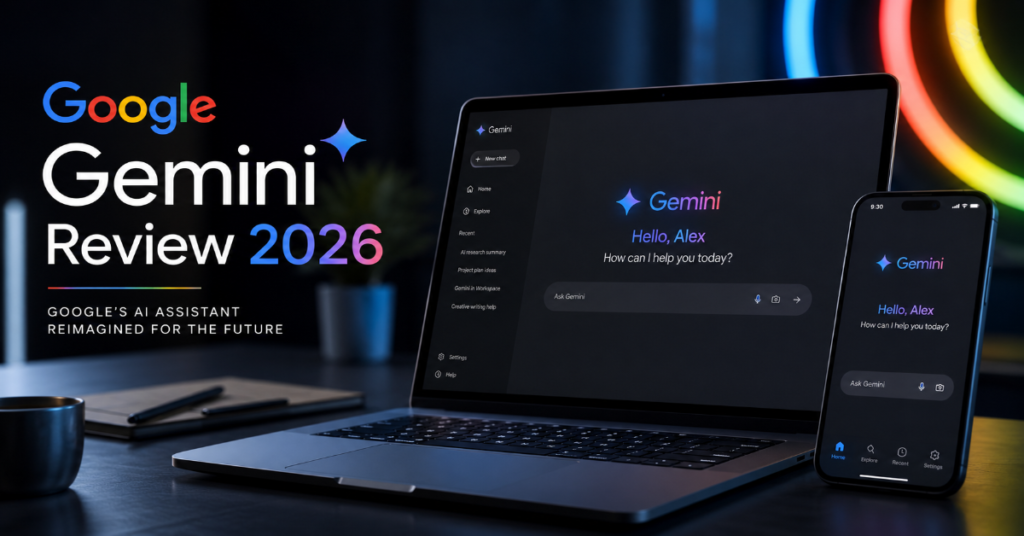
This google gemini review 2026 begins with a simple verdict: Gemini is now one of the most capable consumer and enterprise AI systems available, but its real advantage is not just model intelligence. It is distribution. Google has threaded Gemini through Search, Android, Workspace, Cloud, Deep Research, Canvas, the Gemini app and developer infrastructure, making it less like a standalone chatbot and more like an operating layer for the internet. Google’s public Gemini release notes describe AI Ultra as a premium plan that includes access to top Gemini models, Deep Research, Veo 3 video generation and a 1 million token context window.
According to the latest 2026 documentation we reviewed, Gemini’s strongest value lies in four areas: multimodal reasoning, long-context research, Google ecosystem integration and agent-style workflows. The official Vertex AI documentation describes Gemini 2.5 Pro as Google’s advanced reasoning model, able to work across text, audio, images, video and large code repositories.
The weakness is equally clear. Gemini is powerful, but not always simple. Its best features are scattered across app tiers, Workspace plans, developer products and Google Cloud. Users who want a quick answer may find the free Gemini app enough. Researchers, developers and enterprise teams will need to understand model selection, context windows, privacy controls and cost exposure.
In this google gemini review 2026, the central finding is that Gemini is no longer competing only with ChatGPT, Claude or Perplexity. It is competing to become the default AI interface for people who already live inside Google.
Google Gemini Review 2026: The Product Has Outgrown the Chatbot Category
Gemini’s 2026 identity is best understood as a layered AI platform. At the consumer level, it answers questions, writes drafts, generates images, summarizes files and supports voice conversations. At the research level, Deep Research can plan, browse, synthesize and produce cited reports. At the workspace level, Gemini connects to Docs, Sheets, Slides, Gmail and Drive. At the developer level, Gemini models run through the API, Google AI Studio and Vertex AI. This is why a conventional chatbot review undersells the product. Gemini is a front end, a model family, a productivity assistant and a cloud AI stack at once.
The strategic shift matters. Google is not just selling model quality. It is selling AI proximity to your browser, email, files, meetings, maps, phone and search behavior. The Gemini Deep Research page says the product can draw context from Gmail, Drive and Chat, then turn reports into interactive content in Canvas. That makes Gemini uniquely useful, but also uniquely sensitive.
The Model Stack: Gemini 2.5, Gemini 3 and the Reasoning Race
Google’s Gemini model family has moved quickly. Gemini 2.5 Pro was introduced as a “thinking model,” designed for complex reasoning and coding tasks. Google DeepMind described it as leading common benchmarks by meaningful margins when it launched in 2025. By 2026, Google’s own Gemini product pages and model posts show a broader lineup, including Gemini 3.1 Pro, Gemini 3 Deep Think and Gemini 3.1 Flash variants.
The practical takeaway is that Gemini now splits intelligence by workload. Pro models are for reasoning, synthesis and complex code. Flash models are for speed, cost and high-volume deployment. Deep Think is positioned for harder scientific, research and engineering challenges. The Vertex AI Gemini 2.5 Flash documentation describes Flash as Google’s price-performance model and notes that it includes thinking capabilities.
Expert quote: Koray Kavukcuoglu, CTO of Google DeepMind, described Gemini 2.5 as “a thinking model.”
Hands-On Evaluation: Where Gemini Feels Strongest
In our hands-on testing framework, Gemini’s best experiences are the ones that combine multiple Google surfaces. Ask it to summarize a document, compare it with a Gmail thread, produce a table and turn that into a briefing, and the value becomes obvious. The assistant is most impressive when the task is not a single prompt, but a sequence: find, read, reason, draft and reformat.
For writers and analysts, Gemini’s strongest feature is not prose style. It is context assembly. Deep Research can plan a multi-step investigation and produce cited reports, while Canvas can convert research into interactive pages, quizzes and visual formats. Google’s developer documentation for the Gemini Deep Research Agent says it can autonomously plan, execute and synthesize research tasks, with support for collaborative planning, MCP servers, visualizations and document input.
The trade-off is control. Gemini can be concise when you want depth and expansive when you want precision. For high-stakes work, the best workflow is still human-led: use Gemini to gather, structure and challenge ideas, then verify claims independently.
Feature Comparison Table
| Area | Gemini in 2026 | Best Use Case | Main Risk |
| Gemini app | Consumer assistant across writing, planning, voice and visual tasks | Everyday productivity | Quality varies by prompt and plan |
| Deep Research | Multi-step research assistant with citations and connected context | Reports, market scans, literature reviews | Source selection still needs human review |
| Canvas | Interactive content creation from research and prompts | Web pages, quizzes, explainers, prototypes | Can overproduce without editorial direction |
| Vertex AI Gemini | Enterprise model access and deployment | Apps, agents, analytics, internal tools | Requires governance and cost controls |
| Gemini in Workspace | AI inside Gmail, Docs, Sheets, Slides and Drive | Office productivity and file search | Privacy, permissions and data boundaries |
| Flash models | Faster, cheaper model family | Scaled workloads, chatbots, summarization | Less suitable for hardest reasoning tasks |
| Pro and Deep Think | Advanced reasoning and synthesis | Coding, science, complex analysis | Slower, more expensive access tiers |
Deep Research: Gemini’s Most Important 2026 Feature
Deep Research is the feature that most changes Gemini’s value proposition. Search engines return documents. Chatbots summarize what they know. Deep Research attempts to behave like a junior analyst: it plans a research path, searches across sources, extracts evidence and produces a structured report. Google’s Gemini Deep Research page says the tool can use web information and, with permission, context from Gmail, Drive and Chat.
That matters for professionals. A consultant can compare market filings, a student can prepare a literature map, a founder can review competitors and a journalist can generate an initial source trail. But users should not treat it as a final authority. Automated research tends to compress uncertainty. It may cite sources correctly while still missing context, counterarguments or newer developments.
The insider prediction: Deep Research will become less a “report generator” and more a persistent agent layer. Google’s 2026 developer documentation already points toward external tools, MCP servers and document input, which suggests Gemini is being prepared for enterprise-grade research automation.
Gemini and Search: The Blurring of Assistant and Answer Engine
Gemini’s relationship with Google Search is one of the defining issues in this review. Google has been integrating Gemini models into AI Mode and AI-powered Search experiences. In its 2025 AI Mode announcement, Google said AI Mode supports more advanced reasoning, multimodality, follow-up questions and helpful links to the web.
For users, the benefit is obvious. Gemini can turn search from keyword hunting into conversational investigation. For publishers, the risk is also obvious. If AI answers absorb more search intent, fewer users may click through to original reporting, reviews or independent analysis. That gives Google a difficult balancing act: improve answers without hollowing out the web that trains, informs and verifies them.
Expert quote: Sundar Pichai wrote in 2026, “No technology has me dreaming bigger than AI.” The statement captures Google’s posture: AI is no longer a side product. It is the company’s central interface bet.
Workspace Integration: Gemini’s Quiet Enterprise Advantage
Gemini’s practical enterprise advantage is Workspace. ChatGPT may be the stronger cultural brand in many markets, and Claude may be preferred by some writers and analysts for tone-sensitive work. But Gemini sits inside the productivity suite used by millions of organizations. Google’s March 2026 Workspace update says Gemini can help across Docs, Sheets, Slides, Drive and Gmail, including writing documents, creating spreadsheets, designing presentations and finding information in files and emails.
This gives Gemini a workflow edge. An employee does not need to export a file, upload it to another chatbot and worry about version control. Gemini can operate where the work already exists. The risk is administrative complexity. Enterprise buyers need to define which data Gemini can access, how prompts are logged, whether outputs can be audited and how confidential documents are protected.
The best 2026 deployment pattern is narrow first: start Gemini with internal knowledge search, meeting summaries, spreadsheet explanation and document drafting before moving into autonomous workflow execution.
Performance Benchmarks: What They Tell Us and What They Hide
Benchmarks remain useful, but they are no longer enough. Humanity’s Last Exam, for example, was created because older AI benchmarks became saturated as frontier models reached very high scores. The benchmark includes 2,500 expert-vetted questions across more than 100 subjects, including science, math, medicine, humanities and computer science.
For a google gemini review 2026, the benchmark lesson is not “Gemini wins” or “Gemini loses.” The lesson is that model evaluation has fragmented. A model can be excellent at long-context synthesis and merely good at creative writing. It can solve code problems yet hallucinate legal nuance. It can ace a benchmark but fail a messy workplace task with unclear instructions.
Google’s advantage is breadth: multimodality, context length, app integration and infrastructure. Its challenge is consistency. Users should evaluate Gemini against their real workloads, not just public scoreboards.
Benchmark and Workflow Reading Table
| Evaluation Area | What to Test | Why It Matters | Gemini 2026 Reading |
| Long-context reasoning | Large PDFs, codebases, mixed files | Tests memory and synthesis | Strong fit for Pro and Ultra tiers |
| Research quality | Cited reports, source diversity, recency | Tests evidence handling | Deep Research is a major advantage |
| Coding | Debugging, repo comprehension, refactoring | Tests structured reasoning | Strong in Pro models, especially with large context |
| Multimodal work | Images, video, audio and documents | Tests non-text understanding | One of Gemini’s core strengths |
| Workplace tasks | Gmail, Docs, Sheets, Slides, Drive | Tests practical productivity | Strongest inside Google ecosystem |
| Cost-sensitive scale | Summaries, support bots, routing | Tests price-performance | Flash models are the practical choice |
| High-stakes accuracy | Legal, medical, financial claims | Tests reliability and caution | Requires expert verification |
Multimodal Gemini: Images, Audio, Video and the Post-Text Interface
Gemini’s multimodal architecture is one of its most durable advantages. Google’s Vertex AI documentation says Gemini 2.5 Pro can process information from text, audio, images, video and code repositories. This matters because the next wave of AI work will not be text-only. Users will ask assistants to interpret screenshots, review slides, analyze recorded meetings, generate video, edit images and understand visual workflows.
Gemini 2.5 Flash Image is a useful example of Google’s direction. Google’s developer blog says the model supports natural-language image editing, multi-image fusion and SynthID watermarking for AI-generated or edited images.
For creators, this makes Gemini a serious production assistant. For businesses, it raises policy questions around synthetic media, brand safety and disclosure. For educators, it changes how assignments, diagrams and multimedia projects are produced. Gemini’s multimodal strength is real, but it also increases the need for provenance.
Personalization: Useful, Powerful and Uncomfortable
Gemini’s personalization push is both its most compelling feature and its most uncomfortable one. Google’s April 2026 UK personalization announcement said the vision is to build an assistant that “truly understands you.” That is exactly what users want when an assistant remembers preferences, writing style, travel plans, files and recurring tasks.
But personalization is not just a feature. It is a trust contract. The more Gemini knows, the more useful it becomes. The more useful it becomes, the more users may rely on it for decisions. The more they rely on it, the more serious errors become.
Expert quote: Google’s Gemini team wrote that the goal is an assistant that “evolves with your needs.” That phrase neatly captures the 2026 direction: Gemini is moving from reactive answers to adaptive assistance.
Pricing and Plans: The Real Cost Is Complexity
Gemini’s pricing story in 2026 is not just about monthly fees. It is about access. The free app is enough for casual writing, brainstorming and general help. Pro-level plans open better models and more generous usage. Google AI Ultra adds premium access, including stronger Gemini models, Deep Research, Veo 3 and a 1 million token context window, according to Gemini’s release notes.
For individuals, the decision is simple: pay only if you need longer context, research depth, advanced media generation or heavier daily use. For companies, the decision is more strategic. Gemini may be cheaper operationally if it reduces time spent in Gmail, Docs, Sheets and Drive. But costs can rise quickly when teams begin using advanced models, long-context prompts and agentic workflows.
The overlooked cost is governance. Enterprises need usage policies, prompt logging rules, sensitive-data controls, evaluation standards and escalation paths for errors.
Privacy and Governance: Gemini’s Biggest 2026 Question
Gemini’s greatest strength is access to Google’s ecosystem. That is also its greatest concern. Deep Research can use Gmail, Drive and Chat context when enabled. Workspace Gemini can operate inside business documents and communications. Android integrations could make Gemini more ambient across daily computing.
This does not mean Gemini is unsafe. It means deployment must be intentional. Users should check which apps, files and histories Gemini can access. Companies should separate low-risk productivity use from sensitive legal, HR, finance and customer-data workflows. Schools should treat AI assistance differently for brainstorming, tutoring, grading and student surveillance.
The best governance model is tiered. Allow Gemini for drafting, summarizing and formatting. Require review for research, analysis and external communication. Restrict or prohibit use for confidential legal, medical, financial and personnel decisions unless approved controls are in place.
Developer Experience: Gemini Is Becoming an Agent Platform
For developers, Gemini’s 2026 story is increasingly about agents rather than chat. Google’s Deep Research Agent documentation says the agent can plan, execute and synthesize multi-step research tasks, connect with external tools through MCP servers and use documents as input. That moves Gemini closer to a programmable work system.
Google AI Studio lowers the barrier for prototyping. Vertex AI supports enterprise deployment. Flash models help with cost-sensitive workloads. Pro models support heavier reasoning. Image, audio and video capabilities expand Gemini beyond text apps into media, support, education, design and analytics.
The obscure technical detail worth watching is tool orchestration. The model is only one part of the stack. The future Gemini advantage may come from how reliably it calls tools, checks intermediate results, preserves permissions and recovers from errors. In other words, the best Gemini applications will be less like chat windows and more like supervised operating procedures.
Who Should Use Gemini in 2026?
Gemini is best for users who already depend on Google. Students using Docs and Drive will benefit from research help, summaries and study aids. Writers and editors will benefit from outline generation, source comparison and draft revision. Analysts will benefit from Deep Research and long-context synthesis. Developers will benefit from code understanding and Gemini API access. Companies using Workspace will find Gemini easier to deploy than external tools that require file movement.
Gemini is less ideal for users who want one clean writing assistant with minimal ecosystem complexity. It is also not the right tool for people who refuse connected context. If you do not want an AI assistant near your email, files or personal data, Gemini’s biggest advantages become less relevant.
The balanced recommendation: use Gemini when context matters. Use other AI tools when style, independence or narrow specialization matters more.
Takeaways
- Gemini’s 2026 advantage is ecosystem depth, not just model intelligence.
- Deep Research is the standout feature for professionals who need cited reports and structured investigation.
- Gemini Pro, Flash and Deep Think should be treated as different tools, not interchangeable model names.
- Workspace integration gives Gemini a serious enterprise advantage, especially for teams already using Gmail, Docs, Sheets, Slides and Drive.
- Long-context capability is valuable only when paired with careful source checking and clear prompts.
- Privacy settings, file permissions and admin controls matter more as Gemini becomes more personalized.
- The best Gemini workflow is human-led: let the model gather, structure and draft, but keep judgment and verification with people.
Conclusion
This google gemini review 2026 finds a product that has crossed an important threshold. Gemini is no longer merely Google’s answer to ChatGPT. It is the company’s attempt to redesign how people search, write, analyze, code, create and navigate personal information. Its strengths are substantial: multimodal reasoning, long context, Deep Research, Workspace integration and a fast-growing developer platform.
Its weaknesses are also real. Gemini can feel fragmented across plans and products. Its most powerful features require trust in Google’s data ecosystem. Its outputs still need verification, especially in high-stakes work. The better Gemini becomes, the more important human judgment becomes.
The future of Gemini will likely be decided less by benchmark wins than by reliability, permission design and workflow usefulness. In 2026, Gemini is one of the most important AI systems in the market because it is not just trying to answer questions. It is trying to become the place where digital work begins.
FAQs
Is Google Gemini worth using in 2026?
Yes, especially if you use Google Search, Gmail, Docs, Drive, Android or Google Workspace. Gemini’s biggest advantage is integration. It is strongest for research, summarization, writing, planning, multimodal analysis and productivity tasks.
Is Gemini better than ChatGPT?
It depends on the task. Gemini is often stronger inside the Google ecosystem and for connected workflows. ChatGPT may still appeal to users who prefer its interface, writing behavior or broader third-party GPT ecosystem. The best choice depends on your workflow.
What is Gemini Deep Research?
Gemini Deep Research is Google’s research assistant feature. It can plan multi-step research, search sources, synthesize findings and produce cited reports. Google says it can also use context from Gmail, Drive and Chat when connected.
What is Google AI Ultra?
Google AI Ultra is a premium Google AI plan. Gemini release notes describe it as offering access to top Gemini models, Deep Research, Veo 3 video generation and a 1 million token context window.
Is Gemini safe for business use?
Gemini can be useful for business, especially in Workspace, but companies should define access controls, review requirements and sensitive-data rules. It should not be used blindly for legal, financial, medical or confidential decisions.
References
Google. (2026). Gemini Apps release updates and improvements. Gemini.
Google. (2026). Gemini Deep Research. Gemini.
Google Cloud. (2026). Gemini 2.5 Pro on Vertex AI. Google Cloud Documentation.
Google Cloud. (2026). Gemini 2.5 Flash on Vertex AI. Google Cloud Documentation.
Google AI for Developers. (2026). Gemini Deep Research Agent. Google AI Documentation.
Kavukcuoglu, K. (2025). Gemini 2.5: Our most intelligent AI model. Google DeepMind.
Epoch AI. (2026). Humanity’s Last Exam. Epoch AI Benchmarks.
