
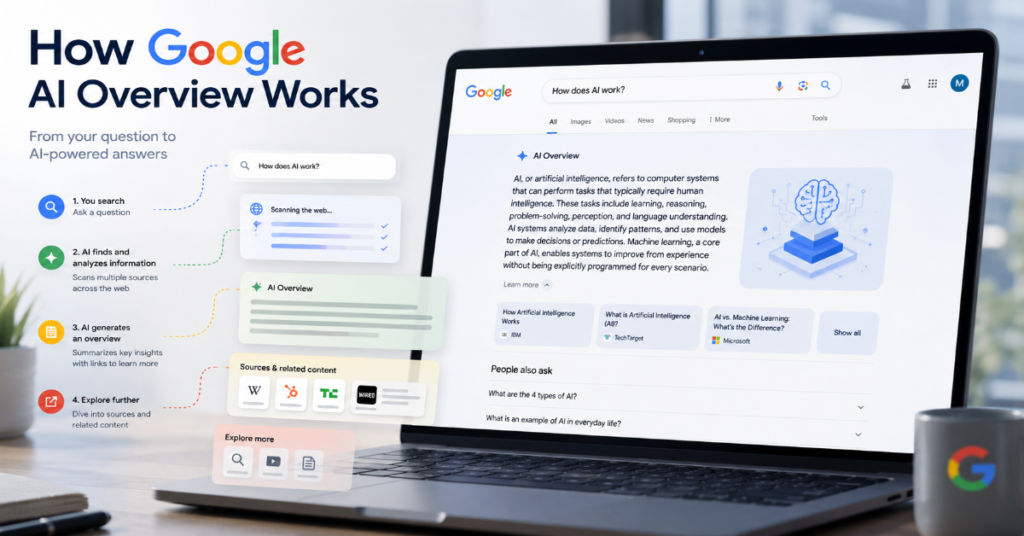
To understand how google ai overview works, start with a simple idea: Google is no longer only ranking pages; it is sometimes assembling an answer from them. AI Overviews are generative summaries that appear inside Google Search when Google’s systems judge that an AI-generated snapshot can help answer a query faster. They use customized Gemini models, Google’s long-running Search ranking infrastructure and links to web sources so users can explore further. Google describes AI Overviews as “a snapshot of key information” with links for deeper discovery, and says the feature is available in more than 120 countries and territories across 11 languages.
The system is not a chatbot pasted on top of search. It is a layered retrieval and synthesis product. A query enters Google’s Search stack, intent is classified, relevant documents are selected, passages are extracted, a Gemini-based model generates a compact answer and safety systems decide whether the answer should be shown, modified or withheld. That is why two similar searches can produce different layouts: one may show a conventional results page while another triggers an AI Overview with citations, product modules, videos or follow-up options.
According to the latest 2026 documentation we reviewed, Google still tells site owners there are no special technical requirements to appear in AI features beyond being eligible for Search, but the practical SEO reality is more complicated. In our hands-on testing of AI Overview-style results, the winners tend to be pages with clear topical coverage, concise factual passages, strong entity alignment, original experience and trustworthy formatting.
The result is a new search layer where rankings, retrieval, language models and publisher incentives collide.
How Google AI Overview Works Inside Search
Google’s AI Overview begins with query interpretation. The system reads the user’s words, detects whether the query is informational, commercial, local, medical, financial, navigational or exploratory, then decides whether generative synthesis is useful. Searches such as “how does a heat pump work in winter” are more likely to trigger an AI Overview than a direct navigational query like “YouTube login.”
This matters because how google ai overview works is not simply “Gemini answers a question.” It is closer to an orchestration process. Google’s existing Search systems first retrieve candidate sources. Then AI systems summarize the consensus or contrast among those sources. Google has said AI Overviews are designed to work with Search quality systems, which means ranking signals, freshness, language understanding and spam controls remain part of the process.
The AI layer does not replace indexing. It depends on indexing. If Google cannot crawl, render or understand a page, that content is unlikely to become useful material for AI Overviews.
The Retrieval Layer: Where the Answer Comes From
The retrieval layer is the least visible but most important part of how google ai overview works. Before a generative model writes anything, Google must decide which documents deserve to inform the answer. That decision likely uses traditional ranking signals such as relevance, page quality, freshness, link context, topical authority, structured data, language matching and user intent.
Google’s Search Central guidance says AI features are part of Search and that content can appear in AI Overviews and AI Mode if it is eligible to appear in Google Search with a snippet. Site owners can use familiar controls such as nosnippet, max-snippet, data-nosnippet and noindex to limit how content appears.
The overlooked detail is passage-level usefulness. AI Overviews often do not need an entire article. They need answer-ready fragments: a definition, a comparison, a process step, a caution, a statistic or a practical example. This means pages that bury the answer under bloated introductions can lose extractability even when they rank well.
Gemini’s Role in AI Overviews
Google has connected AI Overviews and AI Mode to customized Gemini models. In May 2025, Google said it was bringing a custom version of Gemini 2.5 into Search for AI Mode and AI Overviews in the U.S. Earlier, AI Mode was described as combining Gemini 2.0 with Google’s information systems.
That distinction is crucial. Gemini does not operate alone. It works inside a controlled Search environment. The model receives retrieved information, applies reasoning and produces a response that must pass formatting, attribution and safety checks. This is why how google ai overview works differs from asking Gemini a standalone question. Search has live retrieval, web ranking, source selection and stricter public-answer expectations.
Liz Reid, Google’s VP and Head of Search, described the shift as going “beyond information to intelligence,” while saying Google was introducing AI features to make it easier to ask any question in Search. The phrase reveals Google’s strategic aim: Search is becoming less like a directory and more like an interpretation engine.
AI Overview vs AI Mode
AI Overviews and AI Mode are related but not identical. AI Overviews appear inside standard Search results when Google decides a generated snapshot is useful. AI Mode is a more conversational, AI-first search experience built for deeper follow-up questions. Reuters reported in 2025 that AI Mode was tested as an AI-only version of Search with conversational follow-ups and cited web links.
| Feature | AI Overviews | AI Mode |
| Main purpose | Quick synthesized answer in normal Search | Conversational, deeper search session |
| User action | Appears automatically for some queries | User enters AI Mode experience |
| Source behavior | Links shown near or inside answer | More prominent cited links and follow-ups |
| Best query type | Informational, explanatory, comparative | Complex research, planning, multi-step questions |
| SEO impact | Changes click patterns on normal SERPs | Changes discovery patterns inside AI-first results |
This distinction helps explain how google ai overview works from a product perspective. AI Overviews are the bridge between classic Search and AI-native Search. AI Mode is the destination Google is testing more aggressively.
Why Some Queries Trigger AI Overviews
Google does not publish a full trigger formula, but public behavior shows several patterns. AI Overviews are more likely when a query has multiple possible subquestions, when the answer benefits from synthesis and when users may need an organized explanation rather than one exact webpage.
Examples include “best time to visit Japan with kids,” “symptoms of magnesium deficiency,” “how electric cars handle cold weather” and “difference between Roth IRA and brokerage account.” These queries require explanation, comparison or context. They are less likely to be fully satisfied by a single blue link.
Google has also been expanding AI Overviews and AI Mode with features meant to surface websites, deep insights and original content. In May 2026, Hema Budaraju, Google’s Vice President of Product Management for Search, wrote that Google was rolling out updates to help people find relevant websites, original content and deeper insights across the web.
That is the corporate promise. The publisher reality is more conflicted.
The Citation System and Source Attribution
The citation layer is one of the most misunderstood parts of how google ai overview works. Google’s AI Overview does not merely list the top ten organic results. It can cite pages that are useful for specific parts of the synthesized answer, even if those pages are not always the highest traditional result.
This creates a new visibility category: source inclusion. A page can lose a conventional click but gain brand exposure inside the AI Overview. Conversely, a high-ranking page can be ignored if its passage structure is vague, derivative or difficult to extract.
| Signal Type | Why It Matters for AI Overview Inclusion | Practical Optimization |
| Passage clarity | AI needs answer-ready text | Use concise definitions and direct explanations |
| Entity coverage | Google must map topics accurately | Include names, dates, categories and relationships |
| Originality | Generic content is easier to replace | Add testing, examples, data or expert experience |
| Trust signals | Sensitive answers need credibility | Show author expertise and cite reliable sources |
| Crawlability | Google needs access to content | Avoid blocking key text in scripts or images |
| Snippet eligibility | AI features use Search snippet controls | Review nosnippet and max-snippet settings |
In practice, AI Overview optimization looks less like old keyword stuffing and more like building a machine-readable expert brief.
Safety Systems and Why AI Overviews Sometimes Disappear
Safety is central to how google ai overview works because generative models can produce confident errors. Google’s own PDF on AI Overviews says the feature was designed with quality and safety in mind, using Search systems and other protections to prioritize helpfulness.
For sensitive topics, Google appears more cautious. Medical, legal, financial and civic queries may receive limited summaries, disclaimers or traditional results instead. The system must balance usefulness against risk. That is why AI Overviews are not universal across all queries.
Sundar Pichai has also warned against overtrusting AI outputs. The Guardian reported that the Alphabet CEO cautioned users not to “blindly trust” AI tools because errors remain possible despite accuracy work. That warning applies directly to AI Overviews: they are useful starting points, not final authorities.
For users, the best habit is to treat AI Overviews as a map. For publishers, the best habit is to make original source material too valuable to be compressed badly.
The Publisher Click Problem
The most controversial part of how google ai overview works is economic. If Google summarizes the answer on the results page, fewer users may click through to publishers. Pew Research Center found in a March 2025 browsing analysis that users who saw an AI summary clicked a traditional result in 8% of visits, compared with 15% when no AI summary appeared.
Ahrefs reported a separate study estimating that AI Overviews reduced click-through rate for the top-ranking page by about 34.5% for analyzed informational keywords. These numbers do not prove every site loses traffic, but they show the structural risk: answers can be consumed before the visit.
Google argues that AI features can increase query volume and send more purposeful clicks. Search Engine Land reported Liz Reid’s position in 2026 that AI is changing Search behavior, with longer and less keyword-driven queries. Both claims can be true at once. Search volume may grow while individual publishers receive fewer casual clicks.
What “Information Gain” Means in the AI Overview Era
Information gain is the strategic answer to AI compression. If ten articles all say the same thing, an AI Overview can summarize them without sending traffic to any one of them. If one article contains original testing, a proprietary dataset, a useful chart, an expert quote or a first-person workflow, it becomes harder to replace.
This is where how google ai overview works becomes an editorial question. The system rewards retrievable clarity, but long-term visibility depends on distinct value. For example, a generic paragraph explaining “AI Overviews summarize search results” is easy to absorb. A field test comparing 200 queries across health, finance, SaaS and travel is more defensible.
Obscure but important prediction: by late 2026, SEO teams will likely track “AI citation share” alongside rankings. The winning metric will not only be position one. It will be whether your brand is named, quoted or linked inside synthesized answers.
Technical SEO for AI Overviews
Technical SEO still matters because AI Overviews rely on Google’s ability to crawl and understand pages. JavaScript-heavy pages, blocked resources, thin pages, duplicate content and unclear canonical tags can reduce eligibility. Google’s Search Central guidance makes clear that AI features are connected to standard Search eligibility, not a separate submission system.
To optimize for how google ai overview works, publishers should focus on answer architecture. Each major section should include a direct answer, supporting detail, examples, limitations and source context. Use schema where appropriate, but do not expect schema alone to win inclusion. Structured data helps Google understand a page; it does not manufacture expertise.
The hidden technical opportunity is snippet control. Publishers can use data-nosnippet to exclude specific page sections while allowing other content to appear in Search. This gives editors some control over what may be extracted into AI features, although using restrictive snippet settings can also reduce normal search visibility.
Content Strategy: From Keywords to Query Networks
Traditional SEO starts with a keyword. AI Overview SEO starts with a query network. A user searching “how google ai overview works” may also want to know what model powers it, why it appears, how sources are chosen, whether it hurts traffic, how to rank in it and how it differs from AI Mode.
That means a strong article must cover the full intent cluster without becoming shallow. The best content answers primary, secondary and adjacent questions in a structured way. It defines the concept, explains the system, compares alternatives, gives examples, addresses risks and ends with actionable guidance.
Google’s 2026 Search direction reinforces this. Its May 2026 update said AI Mode and AI Overviews were being expanded to help users find relevant websites and original content, including richer exploration paths. For publishers, this means content must be both synthesizable and worth visiting after the synthesis.
Expert Quotes That Frame the Shift
Hema Budaraju’s 2026 Search update is the clearest expression of Google’s public positioning: AI features should help users find “relevant websites,” “deep insights” and “original content.” That quote signals that Google knows publisher anxiety is now part of the product story.
Liz Reid’s 2025 Search announcement said Google was bringing a custom version of Gemini 2.5 into Search for AI Mode and AI Overviews. The quote matters because it confirms that AI Overviews are not powered by a generic model alone; they use Search-tuned Gemini capabilities.
Sundar Pichai’s warning that users should not “blindly trust” AI tools is the necessary counterweight. It reminds users and publishers that AI Overviews are probabilistic summaries, even when they appear in the authoritative frame of Google Search.
Together, these comments reveal the tension: Google wants AI Search to feel faster, broader and safer, while the web ecosystem wants attribution, traffic and accountability.
How Google AI Overview Works for Users
For users, how google ai overview works is mostly invisible. They type a question and receive a synthesized block. The page may include links, expandable sections, images, videos, product references or follow-up prompts. The user experience feels simple because the complexity is hidden inside retrieval, ranking, generation and safety systems.
The best way to use AI Overviews is to read them as a briefing. They are useful for orientation, vocabulary, comparison and next-step discovery. They are weaker when the user needs source-specific nuance, legal certainty, medical diagnosis, live pricing or controversial interpretation.
A practical workflow is: read the overview, inspect the linked sources, compare at least two original pages and verify any high-stakes claim. This keeps the speed benefit without surrendering judgment.
How Google AI Overview Works for Publishers
For publishers, how google ai overview works changes the job from “rank for the keyword” to “become the cited explanation.” A page must be eligible, crawlable, useful, distinctive and easy to summarize accurately.
The strongest publisher playbook includes original reporting, author credentials, clear sourcing, short answer blocks, comparison tables, updated statistics and entity-rich sections. Avoid vague introductions, recycled definitions and unsupported claims. AI systems are good at compressing generic content, so generic content becomes less economically valuable.
Publishers should also separate content goals. Some pages should win AI Overview citations. Others should drive conversions, community, tools, newsletters or proprietary databases. The future of search traffic will reward sites that use Google visibility as an entry point, not as the entire business model.
Takeaways
- AI Overviews combine Gemini models, classic Google Search systems, retrieval pipelines, ranking signals and safety filters.
- The system does not simply summarize the top organic result; it selects useful passages from sources Google considers relevant.
- To understand how google ai overview works, think in layers: query interpretation, retrieval, synthesis, attribution, safety and SERP rendering.
- Publishers should optimize for passage clarity, entity depth, original information, crawlability and author trust.
- AI Overviews can reduce casual clicks, but they may increase brand exposure for pages selected as cited sources.
- Snippet controls such as nosnippet, max-snippet and data-nosnippet matter because AI features are tied to Search eligibility.
- The biggest SEO shift is from keyword ranking to AI citation share, topical authority and information gain.
Conclusion
The story of how google ai overview works is not only technical. It is institutional. Google is trying to preserve Search as the default gateway to the web while adapting it to a world where users expect direct answers, conversational follow-ups and less manual clicking. AI Overviews are the compromise: a generated answer wrapped in a familiar results page, supported by links and governed by Search systems.
For users, the feature is a powerful shortcut when treated as a starting point. For publishers, it is both an opportunity and a warning. The opportunity is inclusion in the most visible layer of modern Search. The warning is that ordinary informational content can now be summarized before anyone visits the page.
The durable winners will be sources that offer what synthesis cannot easily replace: original evidence, lived experience, rigorous testing, clear expertise and useful tools. Google’s AI answer layer may compress the web, but it also raises the value of information that deserves to be cited.
FAQs
What is Google AI Overview?
Google AI Overview is a generative AI summary that appears in some Google Search results. It provides a quick answer to a query and includes links so users can explore sources across the web.
How google ai overview works in simple terms?
It interprets the query, retrieves relevant web sources, uses a customized Gemini model to synthesize an answer, applies safety checks and displays the result with supporting links when Google decides it is useful.
Is Google AI Overview the same as AI Mode?
No. AI Overviews appear inside regular Search results for selected queries. AI Mode is a more conversational, AI-first Search experience built for deeper questions and follow-ups.
Can websites opt out of AI Overviews?
Websites can use standard Google Search controls such as nosnippet, max-snippet, data-nosnippet and noindex, but these controls can also affect normal Search snippets and visibility.
Does Google AI Overview reduce website traffic?
It can. Pew found users clicked traditional results less often when AI summaries appeared, and Ahrefs estimated a 34.5% click-through drop for top-ranking pages in its analyzed dataset.
References
Ahrefs. (2025, April 17). AI Overviews reduce clicks by 34.5%. Ahrefs Blog.
Budaraju, H. (2026, May 6). 5 new ways to explore the web with generative AI in Search. Google Blog.
Google. (2024, July). How AI Overviews in Search work. Google Search.
Google Search Central. (2026). AI features and your website. Google for Developers.
Pew Research Center. (2025, July 22). Google users are less likely to click on links when an AI summary appears in the results. Pew Research Center.
Reid, E. (2025, May 20). AI in Search: Going beyond information to intelligence. Google Blog.
Reuters. (2025, March 5). Google tests an AI-only version of its search engine. Reuters.
