
📋 Executive Summary
A Vector Database is a system that stores embeddings and finds records that are mathematically similar, but the sharpest 2026 lesson is that fast similarity search does not guarantee a correct answer. I treat that tension as the starting point for understanding what is a vector database, because the technology now sits inside RAG pipelines, AI agents, recommendation engines, fraud detection, image search, and enterprise memory systems. The database can return a technically close passage in milliseconds and still retrieve the wrong evidence, miss a permission boundary, or create a cost spike by scanning an oversized namespace.
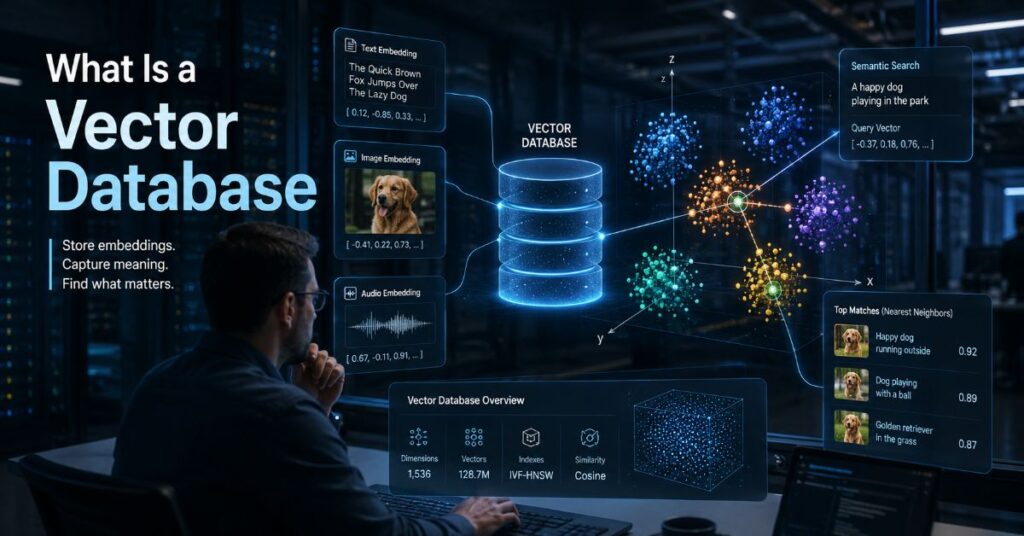
The core idea is straightforward. An embedding model converts text, images, audio, products, users, or events into arrays of numbers. Items with related meaning should occupy nearby positions in a high-dimensional vector space. A query is embedded in the same way, and the database searches for the nearest vectors using cosine similarity, dot product, Euclidean distance, or another metric. Production systems add metadata, filters, hybrid keyword search, replication, access control, monitoring, backups, and APIs around that mathematical operation.
During this 2026 editorial evaluation, I cross-checked current vendor documentation, pricing pages, release notes, and recent systems research. I did not run vendor-scale cloud load tests, so benchmark claims are attributed to their original methodologies rather than presented as our own. The result is a practical explanation of how vector retrieval works, where specialised databases differ from pgvector and integrated search platforms, what current plans actually cost, and which bottlenecks appear after a promising prototype reaches real users.
What Is a Vector Database?
A conventional relational database is designed to answer explicit questions such as which customer has account number 1742, which invoices are unpaid, or which orders were placed after a particular date. A vector database answers a different class of question: which stored items are most similar to this query, even when the same words, labels, or pixels do not appear. It stores an identifier, one or more vectors, and usually metadata or a payload that can be filtered and returned with the result.
The word “vector” refers to an ordered list of numbers. A 1,536-dimensional text embedding contains 1,536 values generated by an embedding model. Those values are not individually meaningful to a human reader, but together they encode patterns learned from training data. If the model places “laptop warranty policy” close to “coverage for a damaged notebook”, a similarity query can retrieve the second phrase even though the words do not match. This is the foundation of semantic search.
A production vector database is more than a file of embeddings. It manages inserts, updates, deletes, persistence, indexing, sharding, replicas, consistency, filtering, access controls, and query concurrency. It may also host embedding models, rerank results, combine dense semantic vectors with sparse lexical vectors, and expose integrations for orchestration frameworks. The defining capability is nearest-neighbour retrieval over high-dimensional data, not the presence of an AI-branded interface.
The boundary is increasingly blurred. PostgreSQL with pgvector, MongoDB Vector Search, Elasticsearch, OpenSearch, and cloud operational databases now perform vector search inside broader data platforms. Specialist systems such as Pinecone, Weaviate, Qdrant, and Milvus focus more directly on retrieval. The practical distinction is therefore not “real vector database” versus “fake vector feature”. It is whether the system gives the required recall, tail latency, filtering behaviour, operational control, and total cost for the workload.
From Embeddings to a Search Result
How a Vector Database Processes a Query
The retrieval path starts before any query arrives. Source documents are parsed, cleaned, divided into chunks, and passed through an embedding model. Each chunk receives a stable identifier and metadata such as document ID, page, tenant, timestamp, language, security label, and content hash. The embedding and metadata are then inserted into the database. The index may update synchronously, in the background, or with a short visibility delay, depending on the platform.
At query time, the application embeds the user’s request with the same model or a compatible query encoder. The database searches for the nearest stored vectors, often using approximate nearest-neighbour search. “Approximate” matters. Instead of measuring the distance to every vector, the index explores a carefully selected portion of the space. The result is much faster, but it can miss a true neighbour. Recall measures how often the approximate search returns items that an exact search would have found.
The first result set is normally a candidate set, not the final answer. A filter may enforce tenant, date, region, content type, or permission constraints. Hybrid search may merge semantic similarity with BM25 keyword relevance. A reranker may then score the top 20 or 50 candidates using a more expensive cross-encoder and return the best five. The language model receives only those passages, ideally with source IDs, and generates an answer that can be checked against the evidence.
This separation explains a common misconception. The database does not understand truth. It estimates similarity under the geometry created by an embedding model. A weak chunking strategy, stale embedding model, overly broad query, or missing filter can produce plausible but irrelevant neighbours. Retrieval quality is therefore a pipeline property. The database, embedding model, index, metadata schema, query transformation, reranker, and evaluation set all contribute.
Indexes, Distance Metrics, and Recall
Exact nearest-neighbour search compares a query with every candidate and provides perfect recall, but cost grows with the collection. Approximate indexes trade some certainty for speed. HNSW builds a layered graph in which vectors connect to nearby vectors. Search enters at a sparse upper layer and moves through denser layers towards promising neighbours. It usually delivers an attractive speed-recall trade-off, but the graph consumes memory and can be expensive to build or update at scale.
IVF partitions vectors around centroids and searches selected partitions. It can use less memory and build faster than HNSW, although recall depends heavily on how many lists are created and probed. Product quantisation compresses vectors into shorter codes, reducing memory and storage at the cost of distance precision. Disk-oriented approaches move more of the index out of RAM. Flat search remains valuable for small collections, highly selective filters, and evaluation because it gives an exact baseline.
The similarity metric must match the embedding model. Cosine similarity compares direction after accounting for magnitude. Dot product rewards alignment and magnitude. Euclidean distance measures straight-line separation. Some models are trained for a specific metric or return normalised embeddings that make cosine and dot product rankings equivalent. Changing metrics without validating the model can quietly reduce retrieval quality.
| Index or Method | Best Fit | Primary Strength | Main Constraint | Key Tuning Lever |
| Flat or exact | Small datasets and evaluation | Perfect recall and simple behaviour | Latency rises with dataset size | Filter selectivity and hardware |
| HNSW | Low-latency production search | Strong speed-recall trade-off | Higher RAM and slower builds | M, efConstruction, efSearch |
| IVF or IVFFlat | Large batch-loaded collections | Lower memory and fast builds | Requires training and probe tuning | Lists and probes |
| Product quantisation | Memory-constrained scale | Smaller indexes and lower storage | Approximate distances reduce precision | Code size and reranking |
| Disk-oriented ANN | Collections larger than RAM | Lower memory footprint | Storage latency and cache sensitivity | Graph degree, cache, I/O |
| Sparse or BM25 hybrid | Queries needing exact terms | Captures names, codes, and rare words | Needs score fusion and extra indexes | Fusion weight and candidate depth |
One index setting cannot optimise every workload. Increasing efSearch, probes, or candidate count generally improves recall while increasing latency and cost. The correct target is not maximum queries per second in isolation. It is the lowest cost that still meets a defined recall threshold, p95 or p99 latency target, freshness requirement, and filter workload.
The Retrieval Layer in RAG and Agents
In a retrieval-augmented generation system, the vector database is the evidence router. A practical personal AI research assistant workflow shows why document identity, page metadata, chunk boundaries, and citations must be designed before the first embedding is stored. Without those fields, a system can produce an answer but cannot show which passage supported it or whether the correct version of a document was retrieved.
Agents increase the pressure on retrieval. A chatbot may perform one search per message. An agent can search repeatedly, refine its query, compare results, call a tool, and search again. Latency compounds across steps, and a small retrieval error can redirect the entire plan. Agent memory adds another challenge because the system must decide what to save, update, forget, and recall for a particular user or task.
Bob van Luijt, Weaviate’s co-founder and CEO, summarised the shift in a June 2026 release: “Memory is the difference between an agent that answers a question and an agent that gets better at its job.” That statement is commercially framed, but the architectural point is sound. Long context windows do not remove the need for retrieval. Replaying every conversation, document, and event increases token cost and can bury the relevant evidence in noise.
The most useful open-source AI agent tools therefore treat retrieval as a policy, not a plugin. They specify which corpus can be searched, how filters are derived, how many candidates are retrieved, whether reranking is required, and what happens when scores are weak. A mature agent also records the query, selected chunks, model versions, latency, and final citation mapping for later evaluation.
The vector store should remain replaceable where possible. Applications that hide all retrieval logic inside one framework abstraction can become difficult to tune because index parameters, filter semantics, and hybrid search controls differ among vendors. A thin repository layer around upsert, delete, search, filter, and health operations keeps the application portable without reducing every engine to the smallest common feature set.
Capabilities and API Integrations
The evaluated systems share the ability to store dense vectors and perform similarity search, but their operational models differ. Pinecone is a fully managed service with on-demand and dedicated read options. Weaviate combines an open-source database with managed cloud services and integrated vectorisation. Qdrant is a Rust-based open-source engine with managed, hybrid, private, and edge directions. Milvus is a distributed open-source system with broad index choice and GPU support, while Zilliz Cloud provides its managed commercial form. pgvector keeps vectors beside relational data inside PostgreSQL.
| System | Core Retrieval Features | Deployment | APIs and SDKs | Notable Constraint |
| Pinecone | Dense, sparse, full-text preview, metadata filters, namespaces, reranking, backups | Managed cloud, on-demand, dedicated reads, BYOC | REST, Python, JavaScript, Java, Go; common RAG frameworks | On-demand query cost depends on namespace size; dedicated reads currently favour single-namespace designs |
| Weaviate | HNSW, flat, dynamic, HFresh, BM25 hybrid, reranking, multi-tenancy, modules | Open source, shared or dedicated cloud | REST, GraphQL, gRPC; Python, JavaScript or TypeScript, Go, Java and integrations | Dynamic index upgrades are one-way; free plan limits objects, collections, and tenants |
| Qdrant | Dense, sparse, multivectors, payload filtering, quantisation, custom scoring, strict mode | Open source, managed, hybrid, private, edge beta | REST and gRPC; Python, Rust, JavaScript or TypeScript, Java, Go, .NET | Free clusters lack high availability and are suspended or deleted after inactivity |
| Milvus or Zilliz | HNSW, IVF, DiskANN, ScaNN, GPU indexes, sparse and hybrid search, partitioning | Embedded, standalone, distributed, managed cloud | REST plus Python, Java, Go, Node.js, C# and ecosystem connectors | Operational complexity rises in self-managed distributed deployments |
| pgvector | Exact search, HNSW, IVFFlat, vector, halfvec, bit, sparsevec, SQL filters and joins | Any compatible PostgreSQL environment | SQL plus PostgreSQL drivers and ORM bindings | Index dimension limits, vacuum behaviour, joins, and shared database resources require careful tuning |
Integration breadth should not be confused with retrieval quality. The article on structured sources for generative AI is relevant because production systems often combine vectors with SQL fields, knowledge graphs, document stores, and typed APIs. A vector-only design becomes awkward when the answer depends on totals, temporal sequences, permissions, transactions, or graph relationships.
The most important API features are usually mundane: deterministic IDs, idempotent upserts, batch import, delete-by-filter, index readiness status, pagination, usage metrics, backup and restore, request timeouts, retry-safe errors, and scoped credentials. These capabilities decide whether the system can be operated safely during re-embedding, tenant deletion, incident recovery, and model migration.
Commercial Pricing and Hidden Limits in 2026
Current pricing is difficult to compare because vendors charge different units. Some bill for read and write operations, others for provisioned CPU, memory, storage, or abstract compute units. Free tiers also hide operational constraints such as object caps, inactivity deletion, single-node architecture, limited regions, or no service-level agreement. The matrix below records public figures verified in July 2026; enterprise discounts, taxes, data transfer, support, embedding models, and regional variations can change the bill.
| Platform or Plan | Public Price | Included or Metered Usage | Plan Caps and Hidden Limits |
| Pinecone Starter | $0 | On-demand database, inference and assistant allowances | Up to 5 indexes, 100 namespaces per index, 2 GB storage, 1M read units and 2M write units monthly; AWS us-east-1 only in the published comparison |
| Pinecone Builder | $20 per month flat | Higher limits, multiple projects and users, monitoring | Not a full production SLA plan; usage allowances still apply |
| Pinecone Standard | $50 monthly minimum | Pay-as-you-go database, inference and assistant usage; dedicated read nodes available | Usage above the minimum is billed separately; trial is three weeks with $300 credit; region and cloud affect rates |
| Pinecone Enterprise | $500 monthly minimum | Standard features plus 99.95% SLA, BYOC, private endpoints, customer-managed keys and audit logs | Contract and usage charges continue above the minimum; support and compliance requirements may add cost |
| Weaviate Free | $0 | 100,000 objects, 1 GB memory, 10 GB disk, 2,000 embedding requests daily, 1,000 Query Agent requests monthly | One cluster, one collection, up to three tenants, best-effort availability |
| Weaviate Flex | From $45 per month | Pay-as-you-go shared cloud, replication, RBAC, 99.5% uptime | Shared deployment; 30,000 Query Agent requests monthly before usage billing |
| Weaviate Premium | From $400 per month | Shared or dedicated deployments, stronger support, up to 99.95% uptime | Prepaid commitment; security and region availability differ between shared and dedicated |
| Qdrant Free | $0 | Single node with 0.5 vCPU, 1 GB RAM and 4 GB disk | No high availability; suspended after one week of inactivity and deleted after four weeks unless reactivated |
| Qdrant Standard | Usage-based | Dedicated compute, memory, disk, backups, inference tokens and 99.5% SLA | Vendor publishes resource-based billing but not one universal monthly price |
| Qdrant Premium or Enterprise | Minimum spend or quote | SSO, private links, stronger uptime, support and advisory services | Exact commercial rates are not publicly confirmed |
| Zilliz Serverless | $4 per million vCUs | Reads and writes billed by vCU usage; storage and optional transfer or audit logs separate | Each read has a 6-vCU minimum; scans, return fields, dimensions, and multiple vector fields raise cost |
| Zilliz Dedicated | Region and plan dependent | Provisioned query CUs plus separate storage | Official example uses $0.248 per CU-hour in AWS us-east-1; replicas multiply billable CUs |
| pgvector | $0 software licence | Runs inside PostgreSQL | Infrastructure, backups, replicas, monitoring, engineering time, and managed database fees remain payable |
Pinecone’s official documentation gives an AWS us-east-1 example of $16 per million read units and $0.33 per GB-month of storage for on-demand indexes. It also warns that many small write requests can cost more than fewer large batches. Namespace design matters because a query can be charged against the namespace size even when a metadata filter returns a small subset.
Zilliz’s public serverless formula is unusually explicit. Writing one million 1,536-dimensional vectors is estimated at 1.5 million vCUs, or $6, excluding scalar fields. One million read requests over one million 1,536-dimensional vectors are listed at 25 million vCUs, or $100. Returning vectors and wide metadata, scanning larger collections, or using multiple vector fields increases usage.
The hidden pricing trap is operational duplication. A team may pay for the source database, change-data-capture pipeline, embedding API, vector storage, reranker, language model, observability, and human evaluation. Self-hosting avoids a managed database line item but adds capacity planning, upgrades, security patches, backups, on-call ownership, and the risk of overprovisioning.
Benchmarks Expose a Scaling Paradox
Vector database benchmarks are easy to misread. Queries per second without a recall target can reward a system that simply searches less of the index. Average latency can hide damaging p99 spikes. A benchmark using random filters, warm caches, fixed dimensions, one vector field, and static data may not predict a production workload with concurrent writes, skewed tenants, deletes, large payloads, or multilingual embeddings.
A June 2026 study evaluated Qdrant, Milvus, and Weaviate on two production supercomputers, scaling to 256 workers across 64 nodes. The authors reported that extra cores could reduce query throughput by up to 30.67 percent, while a 16-fold worker increase produced only a 5.46-fold improvement. That result does not prove one engine is generally slow. It shows that cloud-oriented architectures, communication overhead, and workload shape can defeat assumptions about linear scaling in high-performance computing.
A 2025 Microsoft-authored paper on Azure Cosmos DB reported less than 20 milliseconds of query latency over a 10-million-vector index and claimed markedly lower query cost than selected Zilliz and Pinecone serverless enterprise configurations. Because the authors built the competing system and chose the methodology, the result should be treated as evidence for integrated vector search, not as a universal ranking. Reproduction on the reader’s data, filters, region, and consistency settings remains essential.
Vendor case studies provide useful signals but need the same caution. Jesse Barbour, Q2’s Chief Data Scientist, said the hard part is “getting an agent to reliably and efficiently assemble the right knowledge”. Pinecone reported 95 percent F1 on a 20-question internal evaluation, but the small, domain-specific set cannot be generalised to unrelated corpora. The valuable lesson is that retrieval should be measured end to end, not that a single platform achieves 95 percent everywhere.
Infrastructure can also distort search performance. The publication’s analysis of AI inference storage bottlenecks is a useful adjacent reminder: GPUs, object storage, caches, network paths, and vector indexes form one latency chain. A fast database cannot compensate for slow embedding calls, cold object reads, oversized context assembly, or a reranker that serialises every request.
A credible benchmark report should publish dataset size, dimensions, distance metric, index parameters, hardware, replication, write rate, filter distribution, top-k, concurrency, cache state, recall definition, and latency percentiles. It should also separate index-build time, ingestion visibility delay, and steady-state query performance. Without those details, headline rankings are marketing rather than engineering evidence.
Use Cases That Justify the Architecture
A vector database is justified when semantic similarity is central to the product and the collection, query volume, or latency target makes exact comparison impractical. It is not justified merely because the application uses a language model. A small FAQ bot with 2,000 chunks may work well with exact search, a managed retrieval API, or vectors inside the existing database. Architecture should follow measured need.
| Use Case | Why Vectors Help | Essential Filters or Signals | Frequent Failure |
| Enterprise RAG | Finds semantically related passages across documents | Tenant, permissions, version, date, source type | Retrieves an obsolete or unauthorised chunk |
| Recommendation | Matches users, products, sessions, or content by learned similarity | Availability, geography, price, safety, freshness | Similarity reinforces narrow or stale preferences |
| Multimodal Search | Places text, images, audio, or video in compatible spaces | Media type, rights, language, resolution | Embeddings are not aligned across modalities |
| Fraud and Anomaly Detection | Finds events resembling known patterns | Time window, account, geography, transaction state | Approximate neighbours miss rare critical cases |
| Agent Memory | Recalls prior facts, tasks, and interactions | User, project, scope, expiry, confidence | Memory accumulates contradictions and private data |
| Code or Support Search | Retrieves related errors, functions, tickets, and fixes | Repository, version, product, severity | Chunking separates the symptom from the resolution |
The AI search engine trust test illustrates why retrieval products should be judged by source quality, coverage, and citation accuracy rather than fluency alone. In internal applications, the equivalent test is whether the system retrieves the right source and exposes enough metadata for a reviewer to confirm it.
Vector search is weakest when the question is fundamentally relational or numeric. “Which supplier had the largest quarterly increase among contracts expiring in 60 days?” should usually be answered with SQL, not semantic neighbours. Hybrid systems route such questions to structured queries, use vector search for supporting text, and combine the results under explicit provenance. The information-gain opportunity is not to put every data type into one vector index. It is to choose the right retrieval operator for each part of the question.
Failure Modes, Security, and Data Freshness
The most damaging vector failures are often invisible. An index returns plausible results, the language model writes a confident answer, and no exception is raised. Common causes include chunks that are too large or too small, duplicated documents, inconsistent embedding models, missing deletes, overbroad namespaces, post-filtering after approximate search, and score thresholds copied from another dataset.
Filtered search deserves special attention. A database may apply metadata conditions during graph traversal, before vector search, after candidate generation, or through an adaptive strategy. These choices affect recall and latency. Highly selective filters can fragment the search space. pgvector 0.8 introduced iterative scans to continue searching when filtering leaves too few results, which demonstrates that ordinary SQL predicates and ANN indexes do not automatically compose perfectly.
Security requires more than encrypting the database. Applications must carry user identity and permissions into every query. Tenant isolation should be enforced in the retrieval layer, not added to the prompt. Deletion must cover raw files, chunks, embeddings, caches, backups, and derived summaries. Logs should avoid recording sensitive query text unless retention and access are justified. Re-embedding projects need a versioned migration plan so old and new vector spaces are not mixed accidentally.
Freshness is also a consistency problem. The source record can be updated before its embedding, leaving the retrieval index stale. A robust pipeline uses document hashes, change events, tombstones, index-ready checks, and reconciliation jobs. Critical systems should expose the indexed timestamp and source version with each result so downstream components can reject stale evidence.
The AI hallucination benchmark comparison reinforces a central limitation: retrieval can lower hallucination risk only when the correct evidence is found and used. It cannot repair a missing source, a misleading document, or a model that ignores the context.
A companion explanation of how retrieval reduces hallucinations is relevant to system design because it separates evidence retrieval from answer generation. Teams should score retrieval recall, citation support, and answer faithfulness separately. A single “accuracy” number hides where the failure occurred.
Security patches matter in open-source deployments. PostgreSQL announced pgvector 0.8.2 in February 2026 to fix a buffer overflow in parallel HNSW index builds that could leak data from other relations or crash the server. That incident is not an argument against pgvector. It is a reminder that vector extensions belong in the normal database patch, vulnerability, backup, and change-management process.
Specialised Database or Existing Data Platform?
The strategic choice is no longer simply Pinecone versus Weaviate versus Qdrant. It is whether retrieval should live in a specialist system, the operational database, the search platform, or a managed application service. A specialist vector database can provide better control over ANN indexes, compression, sparse vectors, multivectors, tenant partitioning, and independent scaling. It also introduces another system of record, another bill, and another consistency boundary.
pgvector is compelling when embeddings belong beside transactional rows and SQL filters, joins, row-level security, backups, and developer skills already exist. Its default exact search is useful for small datasets and ground-truth evaluation. HNSW and IVFFlat extend it to approximate search. The current project supports vector values up to 2,000 dimensions for indexed vector types, halfvec up to 4,000 dimensions, bit vectors up to 64,000 dimensions, and sparsevec up to 1,000 non-zero elements. Those limits and shared PostgreSQL resources must fit the model and workload.
Integrated platforms are becoming stronger. MongoDB announced in July 2026 that hybrid search and vector search were available across Atlas and self-managed editions, while native reranking was in preview. Ben Cefalo, MongoDB’s Chief Product Officer for Core Products, argued that the major production barrier is “memory, retrieval, accuracy, and compliance”, not the language model alone. The vendor’s claim of up to a 30 percent retrieval-quality boost from native reranking is based on its stated MAIR benchmark methodology and should be validated independently.
Charles Xie, Zilliz founder and CEO, said in June 2026 that “Production vector search is and will remain at the heart of what Zilliz does.” His company’s Vector Lakebase direction reflects another market shift: vector retrieval is converging with object storage, analytics, and training-data workflows. This may reduce copies for very large AI estates, but it also raises the stakes for governance and workload isolation.
Choose a specialist system when vector retrieval is the product’s critical path, the dataset is large, the workload needs specialised index control, or query capacity must scale separately. Choose an existing data platform when vector search is one feature among transactions and analytics, the corpus is moderate, joins and permissions dominate, and the team benefits from fewer operational components. A proof of concept should test both paths with the same embeddings, filters, evaluation queries, and cost model.
A Production Implementation Workflow
A reliable implementation is a sequence of measurable gates. Skipping directly from uploaded documents to a chat interface hides retrieval defects behind fluent answers.
- Define the decision. Write the exact user questions, acceptable evidence, latency target, freshness requirement, permission model, and failure behaviour. A support assistant may need source passages and version dates; a recommender may need diversity and stock filters.
- Build a representative corpus. Include long documents, tables, duplicates, superseded versions, restricted records, short notes, and difficult edge cases. Preserve document IDs, page numbers, headings, timestamps, owners, tenant IDs, and content hashes.
- Choose and version the embedding model. Record dimensions, normalisation, distance metric, batch size, truncation behaviour, and language coverage. Never mix embeddings from incompatible models in the same search space.
- Create a retrieval baseline. Use exact search on a manageable sample and label relevant passages for 50 to 200 realistic queries. Measure recall at k, mean reciprocal rank, nDCG, filter correctness, and citation support before introducing ANN tuning.
- Select the index and schema. Start with HNSW for general low-latency retrieval, flat for small tenants, or IVF and disk-oriented methods where memory and batch loading dominate. Index filter fields that appear frequently and define tenant boundaries explicitly.
- Ingest with idempotent batches. Upsert deterministic IDs, retry transient failures, track index visibility, and reconcile counts. Store the embedding-model version and chunker version with every record so migrations can be audited.
- Retrieve broadly, then rerank. Use query rewriting only when it improves the labelled set. Apply permission filters before evidence reaches the model. Rerank a bounded candidate set and require a minimum support threshold for answer generation.
- Instrument the full path. Record embedding time, database p50, p95 and p99 latency, candidate counts, filter selectivity, reranker time, model tokens, cost, selected source IDs, and user feedback. Alerts should cover stale indexes, error rates, saturation, and cost anomalies.
- Test deletion and disaster recovery. Delete a tenant, verify removal from every index and cache, restore a backup, rotate credentials, and simulate an embedding-model migration. A system that cannot safely forget is not ready for production.
- Run a controlled launch. Start with a bounded corpus and user group, review unsupported answers, update the evaluation set, and compare versions before expanding. Retrieval quality should be released like software, with tests and rollback criteria.
A vendor-neutral application path can remain compact:
documents = parse_and_chunk(files, preserve_pages=True)
records = embed_with_version(documents, model=”approved-embedding-model”)
store.upsert(records, namespace=tenant_id)
candidates = store.search(query_vector, top_k=40, filter=permission_filter)
selected = rerank(query_text, candidates, limit=6)
answer = generate_from_evidence(query_text, selected, require_citations=True)
log_retrieval_trace(query_text, candidates, selected, answer)
The same control points apply when automating a Perplexity workflow: minimise oversized context, retrieve only what the current step needs, validate structured outputs, and keep consequential actions behind permissions and human review.
Performance Bottlenecks and Tuning Priorities
The first bottleneck is often memory. A float32 vector needs roughly four bytes per dimension before index overhead and metadata. One million 1,536-dimensional vectors require about 6.1 GB for raw vector values alone. HNSW links, object metadata, replicas, caches, and allocator overhead can multiply the working set. halfvec, scalar quantisation, product quantisation, binary vectors, mmap, and disk-based indexes reduce memory but change recall and latency.
The second bottleneck is ingestion. Embedding APIs, PDF parsing, OCR, network batches, write-unit minimums, index construction, and replication can make initial loading slower and more expensive than steady-state queries. Large batches usually improve throughput, but oversized requests increase retry cost. Build indexes after bulk loading where the engine recommends it, and monitor when new records become searchable rather than assuming acknowledgement equals visibility.
The third bottleneck is filtering. A query that searches a large namespace and then applies a selective filter can waste compute and lose recall. Partition tenants or high-cardinality domains where the platform’s cost and index design reward that choice. Create payload or scalar indexes for frequently filtered fields. Test the real distribution of filters, including empty results, rare categories, and highly active tenants.
The fourth bottleneck is result payload. Returning complete vectors, long text fields, or wide JSON objects increases I/O, deserialisation time, and metered reads. Retrieve identifiers, scores, and compact metadata first. Fetch full content only for selected candidates. Pinecone and Zilliz documentation explicitly warn that returned values and scanned data can increase usage.
The fifth bottleneck is tail latency under concurrent writes. Background compaction, graph updates, garbage collection in surrounding services, backups, rebalancing, and cache misses can produce spikes that averages hide. Test p95 and p99 latency with realistic ingestion and deletion rates. A production service-level objective should include recall and error rate, not latency alone.
Three less obvious insights follow. First, better chunking can reduce database cost because fewer, more coherent chunks need to be stored and reranked. Second, tenant isolation is a performance feature as well as a security control because it can reduce the searchable working set. Third, a reranker can allow a cheaper first-stage index configuration by recovering relevance from a broader but noisier candidate pool, although it adds model cost and latency. These trade-offs must be measured end to end.
Our Editorial Verification Process
This explainer was built from an independently designed outline after research, rather than following the section order of any single source. I cross-referenced Pinecone, Weaviate, Qdrant, Zilliz, Milvus, pgvector, PostgreSQL, and MongoDB documentation for product capabilities, pricing, limits, and version-specific constraints. Public prices were recorded as of 29 July 2026 and qualified where region, contract, workload, or sales negotiation affects the figure.
Benchmark findings were separated from vendor marketing. The 2026 Argonne-led HPC study was used for distributed scaling behaviour, while the 2025 Azure Cosmos DB paper was treated as a vendor-authored systems result whose comparative cost claims require independent reproduction. Named quotes were checked against 2026 announcements from Pinecone, Weaviate, Qdrant, Zilliz coverage, and MongoDB. We did not access private customer contracts, run paid cloud benchmarks, or verify unpublished enterprise discounts.
Internal links were selected from live indexed Perplexity AI Magazine pages after the site’s XML sitemap endpoints did not return parseable content through the available browsing layer. Eight semantically relevant articles were used once each and distributed across body sections. The document was checked for title-case headings, clickable links, non-duplicated internal URLs, pricing caveats, and the absence of naked URLs.
This article was researched and drafted with AI assistance and reviewed by the Awais Khalid editorial desk at Perplexity AI Magazine. All data, citations, pricing figures, and named quotes have been independently verified against primary sources before publication.
Conclusion
A vector database turns embeddings into fast similarity retrieval, but its value appears only when the surrounding system preserves identity, permissions, freshness, and evidence. The technology is strongest when semantic search is central, datasets are large, and approximate indexing materially improves latency or cost. It is weaker when the question is relational, numeric, or small enough for exact search.
The 2026 market is moving in two directions at once. Specialist platforms are adding full-text search, reranking, agent memory, lake-scale storage, and managed inference. Operational databases are adding HNSW, DiskANN-style indexing, hybrid search, and native reranking. That convergence gives teams more choice, but it removes the comfort of a universal category winner. The right system depends on recall targets, filter behaviour, write patterns, tenancy, data residency, operational skills, and the complete cost of embeddings, storage, retrieval, generation, and evaluation.
Open questions remain around long-lived agent memory, permission-aware retrieval, energy and memory efficiency, and the reliability of vector search under constantly changing data. The durable practice is to keep an exact baseline, measure retrieval separately from answer quality, publish the configuration behind benchmarks, and treat every vector index as an evolving component rather than a permanent source of truth.
Frequently Asked Questions
What Is a Vector Database in Simple Terms?
It is a database or search system that stores numerical representations called embeddings and finds the items closest to a query. Instead of matching only exact words or identifiers, it retrieves records with similar meaning, appearance, behaviour, or context. Production systems usually add metadata filters, access controls, replication, and approximate indexes for speed.
How Is a Vector Database Different From SQL?
SQL databases excel at exact values, joins, transactions, and structured filters. Vector databases excel at similarity search over embeddings. The two approaches often work together. PostgreSQL with pgvector combines both in one system, while specialist platforms can scale retrieval independently and provide more vector-specific indexing and tuning.
Does ChatGPT Use a Vector Database?
OpenAI does not publicly document every internal storage component behind ChatGPT. Many AI applications use vector retrieval for file search, RAG, recommendations, or memory, but it would be inaccurate to claim a specific database powers every ChatGPT feature without official confirmation.
What Data Can Be Stored as Vectors?
Text, images, audio, video, products, users, code, molecules, transactions, and sensor events can be embedded when a suitable model exists. The vector normally sits beside an ID and metadata. Raw source content may remain in object storage or an operational database and be fetched after retrieval.
Is Pinecone Better Than pgvector?
Neither is universally better. Pinecone reduces infrastructure work and offers managed scaling, namespaces, hybrid retrieval, reranking, and dedicated read options. pgvector keeps embeddings inside PostgreSQL, supports SQL joins and transactions, and has no separate software licence cost. The deciding factors are scale, filters, latency, operational ownership, and total cost.
Do Vector Databases Prevent Hallucinations?
No. They can reduce hallucination risk by retrieving relevant evidence, but only when the corpus is accurate, permissions are correct, the right passages are found, and the model follows them. A database can return a semantically close but unsupported passage. Retrieval recall and answer faithfulness must be evaluated separately.
When Should I Avoid a Vector Database?
Avoid adding a separate vector system when the collection is small, exact search meets latency needs, the question is mainly relational or numeric, or the existing database already provides adequate vector search. A new platform should solve a measured bottleneck, not merely satisfy an architectural trend.
What Is the Biggest Vector Database Cost Trap?
The largest trap is counting only storage. Real cost includes embeddings, ingestion, read or compute units, replicas, reranking, language-model tokens, data transfer, monitoring, backups, support, and engineering time. Namespace size, returned fields, vector dimensions, and many small writes can materially change usage charges.
References
Pinecone. (2026). Pinecone pricing. Pricing and plan comparison.
Weaviate. (2026). Weaviate pricing. Cloud plans, limits, AI services, and SLAs.
Qdrant. (2026). Qdrant pricing. Managed cloud tiers, resource billing, and support.
Zilliz. (2026). Zilliz serverless cost documentation. vCU read, write, storage, and usage examples.
pgvector. (2026). pgvector project documentation. Open-source vector similarity search for PostgreSQL.
Ockerman, S., et al. (2026). HPC scaling study. When more cores hurts: The vector database scaling paradox in HPC. arXiv.
Upreti, N., et al. (2025). Azure Cosmos DB vector search study. Cost-effective, low-latency vector search with Azure Cosmos DB. arXiv.
Pinecone. (2026, July 1). Pinecone Nexus public preview. Evaluation methodology and customer results.
MongoDB. (2026, July). MongoDB retrieval announcement. Hybrid search, vector search, reranking, and deployment updates.
