
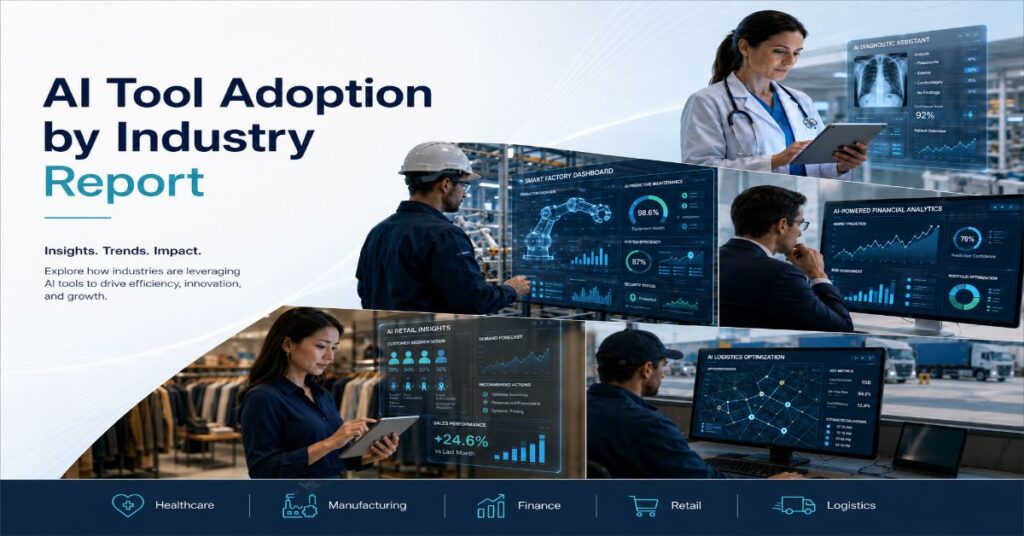
- ◆ 88% of respondents in McKinsey’s 2025 global survey reported organisational AI use in at least one business function, but only about one-third said their organisations had begun scaling AI programmes.
- ▣ U.S. Census BTOS data from December 2025 to May 2026 showed business AI use hovering between 17% and 20%, with Information at 39.7% and Finance and Insurance at 33.9%.
- ! AI tool adoption by industry report findings point to an intensity gap: the ECB survey cited by Reuters found more than 70% of euro zone firms used AI, but only 7% used it intensely.
- $ Pricing has become a governance issue, not an IT footnote, because Copilot seats, API tokens, MCP tool calls, agent conversations, storage caps, and data residency premiums turn pilots into variable operating costs.
- ↗ Technology, media, financial services, healthcare, retail, and professional services are moving fastest, while manufacturing, construction, agriculture, and parts of the public sector still face data, integration, skills, and safety bottlenecks.
- ✓ Leaders should choose three narrow workflows first, assign measurable value owners, model usage costs before rollout, and treat governance as a launch requirement rather than a post-pilot clean-up.
I read the latest AI tool adoption by industry report data as a paradox: 88% of organisations in McKinsey’s 2025 global survey now use AI in at least one business function, yet U.S. business surveys still show only about 17% to 20% of firms using AI across recent reporting windows. That gap is the central story. AI is no longer a curiosity, but adoption still changes shape depending on whether the unit is a person, a firm, a large employer, a department, a sector, or a workflow that is genuinely redesigned around machine assistance.
This report answers the search query directly. Technology, media, telecommunications, insurance, financial services, healthcare, and professional services are moving fastest. Retail and e-commerce are already using AI heavily for personalisation, inventory, recommendations, customer service, and creative production. Manufacturing, construction, agriculture, and some government functions are adopting more slowly because the benefits depend on cleaner operational data, sensor integration, safety assurance, procurement discipline, and frontline change management.
I have treated adoption as a business operating question rather than a headline number. The useful measure is not simply whether a firm has licensed ChatGPT, Microsoft 365 Copilot, Gemini Enterprise, Claude, Perplexity Enterprise, Zapier, Make, or Salesforce Agentforce. The useful measure is whether a team uses AI repeatedly in a production process, whether the output changes cycle time, cost, quality, or revenue, and whether leaders can prove it without hiding the labour needed to validate the machine. For readers comparing sectors, the report gives an industry snapshot, use-case map, pricing and limits matrix, barriers, implementation workflow, and risk framework for 2026.
AI Tool Adoption by Industry Report: What the 2026 Data Shows
The first thing this AI tool adoption by industry report needs to clarify is measurement. McKinsey’s 2025 global survey says 88% of respondents report regular organisational AI use in at least one business function, but the same research notes that only about one-third of organisations have begun scaling AI programmes. That means adoption is broad, but scaled deployment is still scarce. For a practical market overview, AI tools for business should therefore be read through a workflow lens, not a shopping-list lens.
The Stanford Digital Economy Lab’s Adoption Monitor adds another useful distinction. Individual generative AI adoption for work or personal use reached 58% at the beginning of 2026, and nearly 90% of users reported weekly use. Daily use, however, was only about a quarter of users. That spread matters because weekly use can signal curiosity or light productivity support, while daily use suggests habit formation and integration into normal work.
U.S. firm-level data is more conservative. The Census Bureau’s Business Trends and Outlook Survey reported that AI usage hovered between 17% and 20% from December 2025 to May 2026, with 20% to 23% expecting to use AI in the following six months. The Federal Reserve’s April 2026 note explains why adoption estimates vary so widely: question wording, respondent type, employment weighting, and the difference between firm counts and worker exposure all change the answer.
The most defensible reading is that large employers expose far more workers to AI than small-firm counts imply. A five-person construction subcontractor and a 250,000-person bank each count as one firm in a simple firm survey. Employment-weighted surveys therefore show higher exposure, while firm-weighted surveys show how far diffusion still has to travel through smaller businesses.
Why This AI Tool Adoption by Industry Report Measures Intensity
Intensity is the bridge between adoption and value. Reuters reported on 24 June 2026 that an ECB survey of more than 5,000 euro zone companies found over 70% using AI, but only 7% using it intensely. The authors’ warning was blunt: “intensive use that drives transformation” remains rare. That is why this report separates tool access, weekly use, production use, and scaled workflow redesign.
Industry Adoption Snapshot by Sector
The sector pattern is clear even where exact rates differ by survey. Information, technology, media, telecommunications, financial services, insurance, healthcare, professional services, and large digital retailers are the leaders. Traditional asset-heavy industries are not absent, but their adoption is often project-based, plant-specific, or limited to analytics and maintenance rather than broad workforce use.
Census data provides one of the cleanest public sector cuts for the United States. In the reporting period ending 3 May 2026, Information firms reported 39.7% current AI use and Finance and Insurance reported 33.9%, both above the 19.8% national rate. Retail Trade was lower, around 14% current use and 17% expected use. These figures do not capture every embedded AI feature, but they are useful because the questions are nationally representative and recent.
Table 1. Adoption Snapshot by Industry, 2026 Planning View
| Industry | Adoption Position | Indicative Public Signal | Top Use Cases | Main Constraint |
| Technology, Media, Telecoms | Very high | McKinsey reports technology above 90% AI use and agent use most reported in technology, media, and telecommunications | Software engineering, support, search, product features, security triage | Cost control and governance at scale |
| Finance and Insurance | High | U.S. Census reported 33.9% current AI use in the sector as of 3 May 2026 | Fraud detection, risk scoring, underwriting, research, developer productivity | Regulatory scrutiny and model validation |
| Healthcare and Life Sciences | High but controlled | McKinsey identified healthcare as one of the sectors where agent use is most widely reported | Imaging support, documentation, triage, drug discovery, claims workflows | Privacy, safety, clinical validation |
| Retail and E-Commerce | Moderate to high | U.S. Census showed Retail Trade below national average in firm-level use, despite mature recommendation and merchandising AI | Personalisation, demand forecasting, support automation, product content | Margin pressure and fragmented data |
| Manufacturing | Mixed | McKinsey reported cost benefits in manufacturing activities, but many plants remain early-stage | Predictive maintenance, quality inspection, process optimisation, digital twins | Legacy systems and OT integration |
| Construction and Real Estate | Lower to moderate | Public data shows slower small-firm adoption and Reuters reported industrial or construction users still struggle to convert use into gains | Scheduling, estimating, document review, safety monitoring | Project fragmentation and low data standardisation |
| Agriculture and Food Systems | Lower but rising | Adoption is strongest where remote sensing, weather, robotics, and supply-chain data are available | Crop monitoring, yield forecasting, disease detection, logistics | Connectivity and capex barriers |
| Government and Education | Accelerating selectively | Public-sector examples show planning, administrative, and learning workflows entering production | Citizen service, procurement, adaptive learning, case summarisation | Policy, procurement, and public trust |
This snapshot should not be read as a league table where every firm in a high-adoption sector is advanced. It is possible to find a bank with careful AI governance and poor frontline adoption, or a farm using computer vision more effectively than a corporate back office uses copilots. The correct comparison is between workflows, data readiness, and operating models.
Technology, Media, and Financial Services Lead the Pack
Technology, media, telecommunications, and financial services lead because they already have three advantages: digital work, large datasets, and teams used to software iteration. They can connect AI to code repositories, knowledge bases, customer logs, market feeds, security telemetry, and internal productivity tools. That does not guarantee ROI, but it reduces the time between experiment and measurable workflow change.
The enterprise search pattern is especially important. When teams use AI to interrogate documents, tickets, repositories, research files, meeting transcripts, or customer histories, the product becomes infrastructure rather than a novelty. Perplexity AI Magazine’s enterprise search analysis makes the same strategic point from the research side: citation-first search tools are gaining relevance because knowledge workers need verifiable answers, not just fluent text.
Finance shows the clearest value chain. AI helps banks and insurers detect fraud, extract contract data, analyse markets, assist developers, summarise research, monitor compliance, and speed internal technology work. Reuters reported on 18 June 2026 that Deutsche Bank CIO Denis Roux said work that once took two years was now being done in three to six months. He also described the new discipline: usage patterns are monitored because the bank wants returns, not unrestricted token spending.
That quote captures the 2026 financial-services mood. Banks are not simply buying AI subscriptions for everyone and hoping for magic. They are building quotas, model-selection rules, evidence requirements, and value-sharing systems. They know an analyst can burn through tokens quickly with little value if prompts are broad, outputs are unverified, or the model is used where a cheaper deterministic process would work.
Technology firms face a different challenge. Their employees are heavy users, and their products increasingly ship with AI embedded by default. That creates saturation, but also a governance problem. The faster AI enters development, support, marketing, and product analytics, the more important it becomes to classify data, monitor outputs, and decide which agents can take actions across tools.
Healthcare, Retail, and Professional Services Move from Pilots to Workflows
Healthcare, retail, and professional services are in the messy middle: adoption is already significant, but value depends on validation and operating redesign. In healthcare, the most mature applications include imaging support, documentation assistance, claims and prior authorisation workflows, clinical summarisation, discovery research, and operational scheduling. The constraint is not interest. The constraint is proving safety, reliability, privacy, and clinical relevance inside regulated environments.
Retail and e-commerce have used machine learning for years in recommendations, pricing, promotions, demand forecasting, inventory planning, and churn prediction. The newer wave of generative AI adds product descriptions, campaign variants, customer support agents, visual merchandising, synthetic content, and shopping assistants. The paradox is that some mature retail AI is invisible in surveys because it is embedded in systems, while generative AI adoption among smaller retailers may remain low because teams lack clean product data and integration capacity.
Professional services, including consulting, accounting, tax, legal, risk, and advisory, are moving quickly because the work is text-heavy and document-heavy. Thomson Reuters’ 2026 professional services report found that the early adoption phase had passed, but ROI tracking remains weak. The report noted that only 18% of professionals say their organisations track AI ROI, while 40% do not know whether ROI is measured.
The most meaningful professional-services deployments are not generic drafting. They are structured review workflows: contract comparison, tax research, evidence summarisation, risk memo generation, audit sampling, regulatory change monitoring, and client-service triage. In these uses, AI output can be checked against source documents and quality rubrics. That reduces hallucination risk and creates a measurable path to cycle-time improvement.
The lesson for this AI tool adoption by industry report is that adoption becomes durable when it is attached to a reviewable object. A model that drafts a memo is helpful. A model that drafts a memo, cites the clause, flags uncertainty, routes high-risk findings to a professional, and logs acceptance rates is operational infrastructure.
Manufacturing, Construction, Agriculture, and Public Sector Remain Uneven
Manufacturing is both advanced and lagging, depending on which plant, process, and data layer is being measured. Leading manufacturers use AI for predictive maintenance, defect inspection, demand planning, energy optimisation, robotics, additive manufacturing, and digital twins. Yet many factories still rely on older operational technology systems, inconsistent sensor data, and fragmented enterprise resource planning. The bottleneck is not the model. It is the data pipe between physical operations and decision systems.
Construction remains a slower adopter because work is project-based, subcontractor-heavy, and often less digitised. AI can help with estimating, bid analysis, site progress monitoring, safety observations, schedule risk, contract review, and procurement forecasting. But construction data is distributed across drawings, PDFs, spreadsheets, project management platforms, site photos, and emails. Without standardised capture, the model spends too much time interpreting messy context and too little time improving decisions.
Agriculture is similar. High-value farms and agribusinesses can benefit from remote sensing, drones, crop disease detection, yield forecasting, irrigation optimisation, robotics, livestock monitoring, and weather-risk analytics. Smaller producers may face connectivity, hardware cost, local-language support, data ownership concerns, and limited technical support. Adoption rises where AI is bundled into existing equipment, farm management platforms, insurance products, and supply-chain systems.
Public sector and education are accelerating, but procurement and trust slow them down. AI can summarise case files, triage citizen requests, assist planning decisions, support teachers, localise content, and detect fraud. The risk is that public institutions deploy black-box tools before they have appeal processes, audit trails, accessibility reviews, and human accountability. In public services, efficiency cannot be the only metric. Fairness, transparency, security, and explainability matter more than speed alone.
The common theme is that lagging sectors often need system integration before agent deployment. Buying a chatbot is easy. Connecting it safely to maintenance history, BIM files, land records, patient data, sensor streams, or citizen casework is the hard work that determines whether adoption becomes transformation.
Enterprise Use Cases and Tool Categories by Industry
Across industries, the top use cases cluster into five tool families: copilots, search and research tools, automation platforms, domain analytics, and agentic workflow systems. A buyer comparing the best AI productivity tools should begin by classifying work rather than products. The most basic question is whether the task is text creation, information retrieval, prediction, classification, decision support, workflow execution, or physical-world sensing.
Table 2. Use-Case Matrix by Sector and Tool Type
| Sector | Copilot and Text Work | Search and Knowledge | Prediction and Optimisation | Agentic Automation |
| Technology | Code generation, documentation, incident drafts | Repository search, product knowledge, support logs | Bug risk, capacity planning, fraud and abuse detection | DevOps ticket routing, testing, release workflows |
| Finance | Research memos, client summaries, policy drafts | Market research, compliance knowledge, portfolio exposure | Fraud, credit risk, liquidity and trading signals | Onboarding, KYC review, exception handling |
| Healthcare | Clinical note drafts, payer letters, patient instructions | Policy search, medical literature, chart summarisation | Imaging, triage, scheduling, supply demand | Claims routing, prior authorisation support |
| Retail | Product copy, campaign variants, support responses | Product and customer history search | Demand forecasting, pricing, recommendation engines | Returns handling, inventory alerts, merchandising workflows |
| Manufacturing | Standard operating procedure drafts, training content | Maintenance history, engineering documentation | Predictive maintenance, defect detection, energy use | Work-order creation, procurement triggers |
| Public Sector | Case summaries, citizen letters, policy drafts | Records search, legislative research, procurement history | Fraud flags, resource allocation, service demand | Form processing, triage, escalation workflows |
The strongest cross-industry pattern is that AI becomes valuable when it removes handoffs. That is why the practical question is how to automate work with AI without giving the system unlimited authority. The safest early workflows are structured, frequent, reversible, and measurable. Examples include meeting summaries sent to task systems, customer emails drafted but not sent, invoice anomalies routed for review, and maintenance alerts converted into draft work orders.
Research tools also matter because adoption does not stop at back-office automation. Knowledge workers are increasingly comparing ChatGPT, Claude, Gemini, Copilot, Perplexity, and vertical assistants for source-grounded answers. In that market, Perplexity user growth benchmarks are useful because they show demand for citation-first answer engines alongside general-purpose chatbots.
This report does not claim a single tool wins across industries. A law firm handling client documents has different requirements from a retailer creating product images, a bank monitoring model risk, or a manufacturer connecting machine telemetry to maintenance tickets. The right selection principle is fit between use case, data sensitivity, integration needs, auditability, and cost model.
Pricing, Plan Limits, and API Cost Signals
Pricing is now part of AI governance. Seat subscriptions looked simple in 2023 and 2024. By 2026, costs include per-seat plans, annual commitments, usage quotas, token charges, web search calls, code-execution time, MCP tool calls, storage and indexing caps, agent actions, conversations, regional processing premiums, and data-residency requirements. Procurement teams need to model these costs before a pilot becomes a department-wide rollout.
The table below summarises public pricing and constraints that matter for enterprise AI adoption. Rates are listed only where public vendor pages or help pages confirmed them during this research pass. Where vendors require contact with sales, the table says so rather than estimating.
Table 3. Commercial Pricing and Limits Matrix, Publicly Verified
| Product or Platform | Public Price or Cost Signal | Adoption-Relevant Features | Known Limits or Caveats | Source |
| ChatGPT Business | Paid per user per month; Business starts at 2 users; Enterprise requires sales contact | Instant and Thinking model picker, GPTs, data analysis, search, image generation, canvas, deep research, document and file inputs | OpenAI help lists 128K context for Instant and Thinking, 272K for Pro, 3,000 Thinking requests per week, and 15 Pro requests per month for Business | ChatGPT pricing |
| OpenAI API | GPT-5.5 listed at $5 per 1M input tokens, $0.50 cached input, and $30 per 1M output tokens | Text, multimodal, realtime, image, web search, containers, batch processing, data residency options | Batch processing is discounted; data residency adds a premium; output-token variability can make budgets uncertain | OpenAI API pricing |
| Microsoft 365 Copilot Business | $21 per user per month list, with $18 annual promotional rate shown on the pricing page for eligible customers | Work IQ, Copilot in Teams, Outlook, Word, PowerPoint, Excel, agents, security and analytics | Separate qualifying Microsoft 365 license required; up to 300 users; agents can be metered | Microsoft 365 Copilot pricing |
| Google Gemini Enterprise | Business edition starts at $21 per seat per month; Standard or Plus starts at $30 per seat per month | Connectors to Microsoft 365, Google Workspace, HubSpot, Jira and more; no-code Agent Designer; NotebookLM Enterprise; security controls | Business supports 1 to 300 seats and 25 GiB pooled storage and indexing per seat; Standard and Plus offer higher quota and enterprise controls | Google Gemini Enterprise pricing |
| Claude by Anthropic | Claude API rates include Opus 4.8 at $5 input and $25 output per MTok; Sonnet 4.6 at $3 input and $15 output per MTok | Claude Code, Claude Cowork, connectors, enterprise search, SSO, SCIM, audit logs, compliance API, usage analytics | Enterprise pricing is sales-led; US-only inference adds 1.1x pricing; fast mode for Opus is 2x standard pricing | Claude pricing |
| Perplexity Enterprise | Enterprise pricing page showed $34 per seat per month, while help documentation listed Enterprise Pro at $40 monthly or $400 yearly per seat | Enterprise search, proprietary data sources, collaboration, organisation repositories, internal knowledge search | Published pages conflicted during research; API usage is not included with Enterprise seats | Perplexity Enterprise pricing |
| Zapier | MCP is available to all accounts; each MCP tool call uses two tasks from the plan quota | 9,000 integrations, Zaps, MCP, SDK, AI steps, agents, tables and forms | Task consumption can exceed expectations when agents call tools repeatedly | Zapier pricing |
| Make | Free, Core, Pro, Teams, and Enterprise plans; Enterprise is custom pricing | No-code scenario builder, 350+ AI apps, MCP server, AI agents, AI web search, code app | Code execution consumes credits; beta AI features and enterprise pricing require careful validation | Make pricing |
| Salesforce Agentforce | Foundations $0; Flex Credits at $500 per 100,000 credits; Conversations at $2 per conversation | Agentforce Builder, Prompt Builder, customer-facing agents, employee-facing agents, Agentforce Voice, digital wallet | Regional currencies vary; consumption model requires action and conversation forecasting | Salesforce Agentforce pricing |
For operations teams, the hidden cost is not always the subscription. It is the multiplication effect. The Zapier AI automation guide is useful here because it frames task consumption as a production planning problem. A workflow that runs 10,000 times a month and calls three tools per run has a very different cost profile from a weekly reporting automation.
Make has a similar lesson. A visual workflow that looks clean in a demo can become expensive if it polls frequently, processes large files, or routes every exception through a high-cost model. Teams comparing agent platforms should read a practical Make.com AI automation tutorial before turning prototypes into live operational dependencies.
Drivers, Barriers, and Regional Adoption Gaps
The strongest drivers are efficiency, competitive pressure, customer experience, and faster decision cycles. McKinsey found that high performers are more likely to pursue growth and innovation, not just cost reduction. Reuters reported that Google Cloud’s Maureen Costello described the UK market as being at a “tipping point” where organisations move from experimentation into production and begin to see returns. She also warned that technology is only half the answer because leaders need hands-on understanding.
Region matters. Microsoft’s AI Economy Institute estimated global generative AI adoption at 16.3% of the world population in the second half of 2025, with the Global North at 24.7% and the Global South at 14.1%. That divide explains why a global AI tool adoption by industry report should not assume that SaaS access, cloud infrastructure, payment methods, or local-language support are equally available. Perplexity AI Magazine’s coverage of the fastest AI adoption countries adds the strategic country-level layer behind these market differences.
Firm size is another dividing line. The Census Bureau found that 37% of firms with at least 250 employees reported using AI in operations, and 32% of firms with 100 to 249 employees reported use in the period ending 3 May 2026. Less than 20% of firms with four or fewer employees reported use. This is not simply a matter of enthusiasm. Larger firms can absorb compliance costs, build training programmes, negotiate enterprise terms, and connect AI to internal data systems.
Barriers are remarkably consistent across industries: skill shortages, uncertain ROI, poor data quality, privacy and security risks, legacy systems, integration complexity, procurement friction, regulatory uncertainty, and employee resistance. The OECD’s 2025 report on AI adoption in firms highlighted specialised talent scarcity and the need for programmes that help enterprises identify and use the right AI skills. IBM’s 2026 adoption challenges analysis also emphasised governance, accountability, audit trails, and the risk of autonomous systems acting across sensitive workflows without enough oversight.
A 2026 WRITER survey illustrates the cultural problem. It reported that 79% of organisations face challenges adopting AI, 67% of executives believe their company has suffered a leak or breach from unapproved AI tools, and only 29% see significant ROI from generative AI. Vendor surveys should be read cautiously, but the pattern is consistent with more neutral research: deployment is easier than redesign.
Implementation Workflow for Industry Leaders
Industry leaders should not begin with a model leaderboard. They should begin with a workflow register. Each candidate workflow should have an owner, input data, output format, risk category, review step, baseline cycle time, expected business metric, tool options, cost model, and stop condition. Without those elements, a pilot can produce impressive anecdotes but no investment case.
During our 2026 evaluation of public documentation, pricing pages, and implementation case signals, the most repeatable pattern was narrow scope. Successful teams avoid asking AI to transform a whole department in one leap. They pick a workflow that is frequent, painful, data-rich, reversible, and measurable. Examples include support-ticket classification, sales-call summarisation, claims triage, product-description generation, incident analysis, maintenance alerting, and invoice exception routing.
Table 4. Step-by-Step Implementation Workflow
| Step | Decision | Evidence to Collect | Pass Criteria | Common Bottleneck |
| 1. Map the Workflow | Choose one process, not a department | Volume, cycle time, error rate, labour hours, escalation rate | Baseline is measurable before AI is added | The process is too vague or spans too many systems |
| 2. Classify the Risk | Decide whether the output affects customers, money, safety, legal rights, or regulated data | Data sensitivity, approval rules, compliance obligations | Human review is matched to risk level | Teams treat all AI tasks as low risk |
| 3. Select the Tool Category | Choose copilot, search, prediction, automation, or agent workflow | Integration needs, source grounding, model capabilities, audit features | The tool fits the task and data boundary | A general chatbot is forced into a workflow role |
| 4. Model the Cost | Calculate seats, tokens, actions, storage, calls, and regional premiums | Expected usage per user or transaction | Budget owner agrees to scaling assumptions | Token and action volume is ignored |
| 5. Run a Controlled Pilot | Test with real but bounded data | Acceptance rate, correction rate, hallucination rate, latency, cost | Outcome beats baseline by a defined margin | Pilot outputs are judged subjectively |
| 6. Build Governance | Add logs, permissions, review queues, rollback, and escalation | Audit events, role permissions, training records | System can be paused and investigated | Shadow AI spreads outside approved paths |
| 7. Scale Selectively | Expand only after the value case is proven | ROI, quality, user adoption, incident count, customer impact | A value owner signs off on expansion | Leaders scale because the demo impressed them |
The key implementation detail is the value owner. IT can manage access and security, but the business unit must define success. A finance workflow needs finance ownership. A retail workflow needs merchandising or operations ownership. A clinical documentation workflow needs clinical and compliance oversight. Without the right owner, AI becomes another software layer that staff use inconsistently and leaders cannot evaluate.
Known bottlenecks include latency during peak periods, context-window limits, file-size caps, retrieval errors, poor permissions mapping, inconsistent source citations, output-token unpredictability, unclear ownership of prompt libraries, and insufficient logging. The most expensive bottleneck is validation labour. If every AI output requires full human rework, the tool has not automated the workflow. It has merely moved effort to a new location.
Risk, Governance, and ROI Measurement
Governance should start before procurement, not after deployment. The risk inventory should include personal data, trade secrets, regulated records, source attribution, bias, model accuracy, vendor training policies, residency requirements, logs, deletion controls, audit access, and the ability to pause agents. For regulated industries, leaders should also document why a model is appropriate and what a human must review.
The 2026 risk question is not whether AI makes mistakes. It does. The question is whether an organisation has designed a system where mistakes are caught before they matter. A customer-facing agent that can update an account, issue a refund, or make a service promise needs stricter guardrails than a drafting assistant. A medical or legal assistant needs source trails, review standards, and professional accountability. A coding assistant needs repository rules, test gates, and security scanning.
ROI measurement should mix hard and soft metrics. Hard metrics include time saved, first-contact resolution, coding cycle time, defect rate, conversion lift, claim turnaround, invoice exceptions cleared, downtime avoided, support cost per ticket, and revenue per employee. Soft metrics include employee satisfaction, customer satisfaction, quality of documentation, and reduced backlog. The mistake is relying on login counts. Logins measure exposure. They do not prove value.
Reuters reported that Bpifrance found 77% of surveyed French mid-sized company leaders used generative AI, but only 17% of users reported time savings. Regular users were more likely to see benefits than occasional users. That is the adoption lesson in miniature: value follows routine, workflow fit, and intensity. It does not automatically follow access.
A mature governance model therefore has four layers: policy, architecture, workflow controls, and measurement. Policy defines allowed uses. Architecture controls data access and model pathways. Workflow controls keep humans in the loop where risk requires it. Measurement proves whether the system is worth scaling. Remove any one layer and adoption becomes fragile.
Takeaways
- Treat this AI tool adoption by industry report as an intensity map, not a simple adoption ranking.
- Use firm-level data and employment-weighted data together, because they answer different questions about diffusion and worker exposure.
- Prioritise technology, finance, healthcare, retail, professional services, and manufacturing workflows where data is already digitised and reviewable.
- Avoid scaling broad chatbot access until cost models include seats, tokens, web searches, storage, MCP calls, agent actions, and regional requirements.
- Require each pilot to name a value owner, baseline metric, review process, and stop condition before procurement begins.
- Use source-grounded retrieval for knowledge work and high-risk research tasks, especially where citations, files, and auditability matter.
- Treat governance as a launch feature, including permissions, logs, escalation, model restrictions, and deletion rules.
- Scale only when a workflow beats its baseline in measurable time, quality, cost, risk, or revenue terms.
Our Editorial Verification Process
This report was built by cross-referencing current 2025-2026 public sources, including McKinsey’s State of AI survey, Stanford Digital Economy Lab’s Adoption Monitor, Microsoft AI Economy Institute diffusion data, U.S. Census BTOS firm data, the Federal Reserve’s monitoring note, OECD evidence on firm adoption, Reuters reporting, and official pricing or product pages from OpenAI, Microsoft, Google Cloud, Anthropic, Perplexity, Zapier, Make, and Salesforce. Pricing claims were limited to figures visible on official vendor pages during research, and conflicting public data was flagged rather than harmonised by assumption. The evaluation framework used four metrics relevant to an industry adoption report: adoption breadth, adoption intensity, workflow integration, and cost-governance exposure. No proprietary enterprise quotes, hidden discounts, or unpublished plan caps were inferred.
Conclusion
The 2026 AI adoption story is not that every industry has crossed the same threshold. It is that every industry now faces the same management question: how to turn accessible AI tools into measurable workflow value without losing control of data, cost, quality, or accountability. Technology, media, finance, healthcare, retail, and professional services are moving fastest because their work is already digital and their use cases are easier to connect to measurable outputs. Manufacturing, construction, agriculture, education, and public services are not behind because they lack imagination. They often need harder integration, safer validation, and better data foundations before AI can act reliably.
The open question is whether 2026 becomes the year of durable productivity gains or another year of impressive pilots. The evidence points both ways. Adoption is high, but intense use is rare. Tool capabilities are improving, but governance and ROI measurement remain uneven. The winners will not be the firms that buy the most AI. They will be the firms that redesign work carefully enough for people, software, and agents to share responsibility without confusing speed for progress.
FAQs
Which Industry Has the Highest AI Tool Adoption in 2026?
Technology, media, telecommunications, insurance, finance, healthcare, and professional services show the strongest adoption signals across recent surveys. U.S. Census data places Information and Finance and Insurance above the national average, while McKinsey reports technology above 90% organisational AI use and agent use most reported in technology, media and telecommunications, and healthcare.
What Is the Main Finding of This AI Tool Adoption by Industry Report?
The main finding is that adoption is broad, but intensity and scaled workflow redesign remain limited. Many employees and firms use AI weekly or experimentally, yet only a smaller group uses it daily, deeply, and measurably in production workflows.
Why Do AI Adoption Rates Differ So Much Across Sources?
Surveys measure different things. Some ask individuals about generative AI. Others ask executives about firm adoption. Some count firms equally, while others weight by employment. Question wording, sample size, timing, and whether embedded AI is counted can all shift the reported rate.
Which AI Use Cases Are Most Common Across Industries?
The most common use cases are text generation, customer support, knowledge search, software engineering, predictive analytics, document review, fraud detection, recommendations, demand forecasting, and workflow automation. The highest-value use cases usually have clean inputs, reviewable outputs, and a measurable baseline.
Why Do SMEs Lag Large Enterprises in AI Adoption?
SMEs often face higher relative costs, fewer technical staff, weaker data infrastructure, and less procurement leverage. Cloud AI and SaaS tools lower barriers, but smaller firms still need training, integration support, and clear use cases before adoption becomes routine.
How Should Leaders Start an AI Adoption Programme?
Start with one narrow workflow that is frequent, reversible, and measurable. Define the baseline, owner, data boundary, human review step, expected value, and cost model. Expand only after the workflow beats the baseline and governance controls are proven.
What Are the Biggest AI Adoption Barriers in 2026?
The biggest barriers are skills shortages, weak data quality, integration complexity, privacy and regulatory concerns, unclear ROI, legacy systems, and employee trust. Usage-based pricing and agentic workflows also make cost control and governance more important than in earlier AI pilots.
Do AI Tools Replace Workers or Redesign Work?
Both outcomes are possible, but the stronger evidence points to workflow redesign first. AI can reduce manual effort, change job tasks, and shift headcount needs, but most organisations still require human review, governance, domain judgement, and accountability for high-risk decisions.
References
Allen, J. S. (2026, April 3). Monitoring AI adoption in the US economy. Board of Governors of the Federal Reserve System. https://www.federalreserve.gov/econres/notes/feds-notes/monitoring-ai-adoption-in-the-u-s-economy-20260403.html
Google Cloud. (2026). Gemini Enterprise app: Best of Google AI for business. https://cloud.google.com/gemini-enterprise
McKinsey & Company. (2025, November 5). The state of AI: Global survey 2025. https://www.mckinsey.com/capabilities/quantumblack/our-insights/the-state-of-ai
Microsoft AI Economy Institute. (2026, January 8). Global AI adoption in 2025. https://www.microsoft.com/en-us/corporate-responsibility/topics/ai-economy-institute/reports/global-ai-adoption-2025/
OECD, BCG, & INSEAD. (2025). The adoption of artificial intelligence in firms: New evidence for policymaking. OECD Publishing. https://doi.org/10.1787/f9ef33c3-en
OpenAI. (2026). ChatGPT pricing. https://openai.com/business/chatgpt-pricing/
Reuters. (2026, June 17). AI use in UK hits tipping point as companies scale up, Google exec says. https://www.reuters.com/world/uk/ai-use-uk-hits-tipping-point-companies-scale-up-google-exec-says-2026-06-17/
Stanford Digital Economy Lab. (2026, June 10). Adoption Monitor. https://digitaleconomy.stanford.edu/project/indicators/adoptionmonitor/ U.S. Census Bureau. (2026, May 26). AI use at U.S. businesses. https://www.census.gov/library/stories/2026/05/ai-use-businesses.html
