
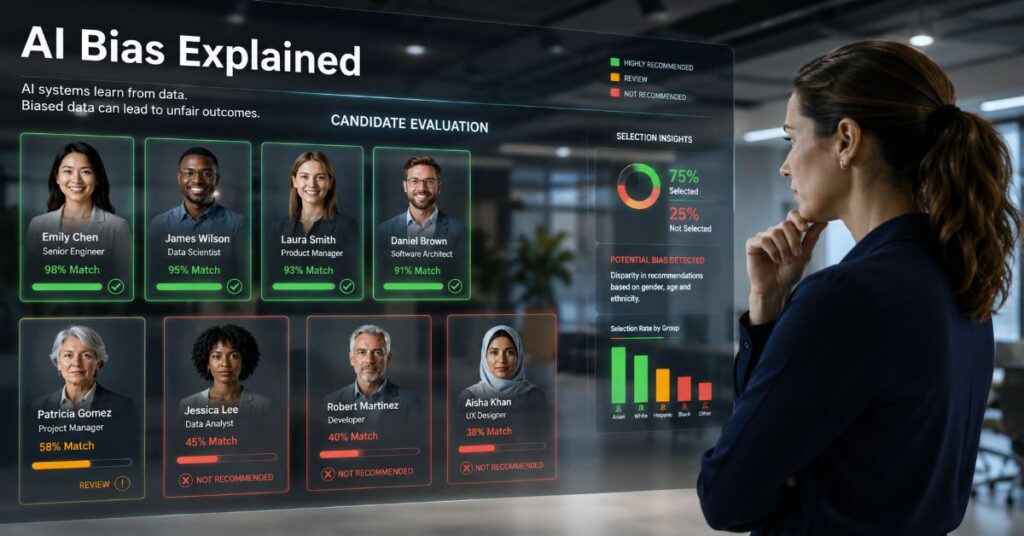
- ✓ AI bias explained: unfair outcomes can enter through data, objectives, labels, interfaces or human use.
- ✓ Accuracy averages can hide severe error gaps between demographic and intersectional groups.
- ✓ A credible audit tests data, model, thresholds, deployment context, overrides and post-release drift.
- ✓ Open-source tools reduce licence cost, while cloud platforms charge for compute, storage and governance usage.
- ✓ Regulation increasingly demands documentation, independent testing, transparency, monitoring and meaningful human review.
An AI system can be impressively accurate and still fail the people who most need it to work. I use AI bias explained here in the practical sense: a system produces unfair, prejudiced or systematically erroneous outcomes because its data, model design, labels, thresholds, interface or human operators favour some groups over others. This article shows where that failure enters, how to measure it, which audit tools can expose it, what current regulation expects and how an organisation can build a repeatable mitigation workflow.
The simplest chain is biased data, biased model, unfair decision, but that shorthand misses two crucial facts. First, representative data does not guarantee a fair objective. A lender can train on a balanced dataset and still optimise solely for short-term default reduction in a way that excludes applicants with thin credit histories. Second, a statistically balanced model can become discriminatory after deployment when staff override recommendations unevenly, a threshold changes, or the population shifts.
During my 2026 documentation-led evaluation, I compared official fairness frameworks, current cloud tooling, open-source libraries, regulatory guidance and reported incidents. I also rebuilt a small reproducible threshold test to examine how overall accuracy can conceal group-level harm. The result is a working definition rather than a slogan: AI bias is a lifecycle property, not a single defect in training data. It must therefore be governed as an engineering, legal and operational risk from problem definition through retirement.
For London and European organisations, that distinction is now commercially material. Recruitment, lending, healthcare, insurance and public services increasingly face audit, transparency and monitoring expectations. The central conclusion is direct: fairness cannot be proven by one score, one dataset or one pre-launch review. It requires explicit harm hypotheses, subgroup testing, documented trade-offs, independent challenge and monitoring that follows the system into real decisions.
AI Bias Explained: The Core Mechanism
AI bias begins when a system’s assumptions are misaligned with the people, context or decision it is meant to serve. The model does not need malicious code. It only needs a pattern that is statistically convenient but socially misleading. A postcode may predict repayment, for example, while also acting as a proxy for deprivation or ethnicity. A language model may associate leadership with men because those patterns are over-represented in its corpus. A computer vision system may perform well in aggregate because the majority group dominates the test set.
NIST’s bias guidance separates three overlapping categories: systemic bias embedded in institutions, statistical and computational bias produced by data or algorithms, and human cognitive bias introduced through design and use. That framing matters because it prevents teams from treating a technical rebalancing step as a complete solution. Reweighting a dataset can reduce one statistical disparity while leaving the institutional rule, such as a historically exclusionary hiring criterion, untouched.
A useful mental model has five linked layers. The target defines what success means. The data represents the world the model sees. The algorithm determines which patterns it rewards. The interface shapes how people interpret the output. The operating process decides who can challenge, override or appeal. Bias may originate in any layer and propagate through the rest. In agentic systems, the chain is longer because a model can select tools, retrieve external data and take actions across several services. Current coverage of the wider agentic AI landscape helps explain why each tool call and hand-off also needs its own fairness control.
This is why an audit should ask more than whether protected characteristics were removed. Their influence can remain through correlated features, and removing them may even prevent teams from measuring unequal outcomes. The better question is whether the system’s purpose, features, errors and remedies are justified for each affected group. Fairness is therefore a claim that must be supported by evidence, not a property a vendor can switch on.
A practical definition for decision systems
For operational use, define AI bias as a persistent and unjustified difference in model behaviour, allocation or error burden between relevant groups or contexts. The words persistent and unjustified do important work. A random fluctuation in a tiny sample is not enough, and not every difference is unlawful or harmful. The organisation must test statistical significance, sample adequacy, business necessity, less discriminatory alternatives and the severity of consequences.
The Seven Main Types of AI Bias
The categories below overlap, but separating them gives audit teams a practical diagnostic map. A single incident often contains several forms at once. A hiring model can inherit historical bias, amplify it through selection bias, and then add measurement bias because performance labels reflect subjective manager ratings.
| Type | What it is | Illustrative example | Primary audit evidence |
| Data or selection bias | Training data does not represent the population or decision context. | A facial analysis dataset contains mostly lighter-skinned subjects. | Coverage ratios, subgroup counts, missingness and out-of-distribution tests. |
| Algorithmic bias | Model structure, objective or constraints favour particular signals or groups. | A ranker rewards career continuity and penalises caring-related gaps. | Feature influence, counterfactual tests, threshold sensitivity and objective review. |
| Sampling bias | Collection methods over-sample accessible or already engaged populations. | An online survey misses people with limited digital access. | Sampling frame review, response propensity and reweighting diagnostics. |
| Measurement bias | Labels, proxies or instruments do not measure the intended concept consistently. | Past promotion is used as a label for merit despite unequal opportunity. | Label agreement, construct validity, proxy analysis and error by annotator. |
| Historical bias | Data faithfully reflects past inequality that should not be reproduced. | Historic lending approvals encode redlining and wealth gaps. | Outcome history, policy review and comparison with normative targets. |
| Confirmation bias | Designers tune or interpret results to support expected patterns. | A team accepts favourable slices and dismisses adverse tests as anomalies. | Pre-registered tests, independent review and blind error analysis. |
| Stereotyping bias | Outputs reproduce harmful social associations or role expectations. | Translation links nurse with women and doctor with men. | Prompt suites, association tests, qualitative review and affected-user testing. |
Selection and sampling bias are often confused. Selection bias concerns which records enter a dataset relative to the target population. Sampling bias is the mechanism that creates the skew, such as recruiting only from one platform or measuring only approved borrowers. The distinction changes the remedy. Reweighting may correct a known sampling imbalance, but it cannot create behaviours that were never observed.
Measurement bias is particularly dangerous because it can survive every conventional data-quality check. The field may be complete, correctly formatted and statistically stable while measuring the wrong construct. Attendance, for instance, may be a poor proxy for productivity where disabled employees use flexible arrangements. The data looks clean, but the label is normatively contaminated.
Historical bias exposes another limit of representation. A dataset can perfectly represent history and still be unsuitable for future decisions. Fairness work must therefore distinguish descriptive accuracy from legitimate policy. The model should not be rewarded simply for predicting which group a biased institution previously favoured.
Where Bias Enters the AI Lifecycle
Bias rarely appears at one identifiable moment. It accumulates through problem framing, collection, labelling, feature engineering, optimisation, validation, deployment and human use. The first control is therefore a lifecycle map that identifies the decision owner, affected people, data sources, model version, threshold, interface, downstream action and appeal path.
At problem definition, teams can choose a target that is easy to predict but weakly related to the intended social outcome. Predicting past employee retention may favour workers who could afford inflexible schedules. At collection, missing groups or contexts create blind spots. At labelling, annotators bring cultural assumptions, while historical administrative decisions can be mistaken for objective truth. At training, the loss function usually rewards average performance, so minority errors contribute less to optimisation. At validation, a random split can leak the same institutions, customers or time periods into training and test data, creating false confidence.
Deployment adds a second system around the model. A score becomes a recommendation, a queue position, a price or a denial. Staff may interpret the same probability differently across cases. Interfaces can display a precise-looking number without uncertainty. Automated workflows can transmit a flawed label into several systems before anyone sees it. Guides to AI tools for HR professionals are useful here because recruitment products often combine sourcing, ranking, screening and interview analysis, creating several distinct bias surfaces rather than one model.
The final stage is feedback. Decisions affect who appears in future data. A fraud model that blocks more transactions from one group generates fewer successful examples for that group, reinforcing the original pattern. This is performative prediction: the system helps create the world it later treats as evidence. A robust governance plan must therefore monitor both predictive performance and allocation effects after release.
The first information-gain insight: fairness debt
A recurring operational failure is fairness debt. Teams postpone protected-group logging, model versioning or override capture until an audit is requested. By then, they cannot reconstruct which threshold, features or human action produced a decision. The missing evidence becomes a liability much like undocumented technical debt. The remedy is an immutable audit record created at decision time, with access controls and lawful data governance, rather than a retrospective spreadsheet assembled after complaints arise.
Why Accuracy Can Hide Discrimination
Aggregate accuracy answers a narrow question: how often was the model correct across all evaluated cases? It does not show who absorbed the mistakes, whether false positives and false negatives had different costs, or whether the test set represented deployment. A model can therefore improve average accuracy while worsening outcomes for a smaller group.
In my reproducible threshold example, Group A contained 80 cases and Group B contained 20. The model correctly classified 72 Group A cases but only 12 Group B cases. Overall accuracy was 84 per cent, a respectable headline, yet the group accuracies were 90 and 60 per cent, a 30 percentage-point gap. If Group B represents a protected or vulnerable population, the average conceals the central risk. The calculation is deliberately simple so any audit team can recreate it in a notebook or spreadsheet.
The peer-reviewed Gender Shades study demonstrated the same structural problem at a larger scale. Across three commercial gender-classification systems, darker-skinned women had error rates as high as 34.7 per cent, while the maximum error rate for lighter-skinned men was 0.8 per cent. The study also found that two widely used benchmark datasets were overwhelmingly lighter-skinned. The lesson is not that one demographic metric solves facial analysis. It is that intersectional slices can reveal failures hidden by both aggregate and single-axis reporting.
UC Berkeley computer scientist Emma Pierson described the scaling risk plainly in a January 2026 profile.
“If an algorithm is unfair, it can also reproduce unfairness on a much vaster scale than any single human decision maker.”
Emma Pierson, Zhang Family Endowed Professor and UC Berkeley assistant professor of computer science, Berkeley News, 20 January 2026.
Accuracy also fails when labels encode unequal access. A healthcare model trained on spending may appear accurate at predicting past cost while underestimating need among groups that historically received less care. Audit teams should therefore report calibration, error rates, selection rates and utility by group, then examine whether the label itself is a defensible measure of the intended outcome.
Real-World Consequences in Hiring, Finance and Public Services
AI bias is not an abstract model-quality issue. It can change who receives an interview, who is investigated, whose identity is accepted, how much someone pays, and whether a person can challenge a public decision. The harm includes direct discrimination, wrongful denial, reputational damage, legal exposure and a quieter loss of trust that reduces adoption even when a system works well for most users.
Recruitment is a high-risk setting because historical labels often reflect organisational preferences rather than job capability. A model trained on previous successful hires can learn gendered career patterns, prestigious institutions or uninterrupted employment as shortcuts. Automated screening also creates scale: a defective rule can reject thousands of applicants before a complaint exposes it. The UK Information Commissioner’s Office audited recruitment AI providers and issued nearly 300 recommendations covering fairness, transparency and data protection. Its findings included tools that enabled filtering by protected characteristics or inferred gender and ethnicity from names.
Facial recognition illustrates the consequences of uneven error rates. False matches can lead to intrusive stops or wrongful arrests, while false non-matches can deny access to services. The risk is magnified when operators treat a similarity score as identification rather than an investigative lead. Documentation should state the intended use, operating threshold, image-quality limits, demographic performance and required corroboration.
Finance adds a proxy problem. Models can infer protected characteristics from postcode, device, shopping patterns or employment history even when those fields are absent. A lender may also validate only on approved borrowers, creating selective-label bias because repayment outcomes for rejected applicants are unknown. The model then optimises within a dataset created by previous decisions.
Australia’s Human Rights Commissioner Lorraine Finlay captured the policy concern in 2025.
“Algorithmic bias means that bias and unfairness is built into the tools that we’re using.”
Lorraine Finlay, Australian Human Rights Commissioner, quoted by The Guardian, 13 August 2025.
The strongest mitigation is proportional to impact. A low-stakes content recommendation may justify lightweight testing and a feedback mechanism. A hiring, credit, health or policing system needs independent validation, legal review, documented human authority, an appeal route and post-deployment outcome monitoring. The same metric threshold should not govern every use case.
How Organisations Audit AI Models for Algorithmic Bias
A credible bias audit is a structured investigation, not a dashboard screenshot. It begins with the decision and affected people, then traces evidence through data, model, workflow and outcomes. The steps below can be scaled for a small internal model or a regulated enterprise platform.
- Define the decision, benefit, harm and accountable owner. Record what the model predicts, what action follows, who can be affected and who can stop deployment.
- Map groups and intersections. Identify legally protected characteristics, locally relevant vulnerability factors and context slices such as language, disability access, geography, device or shift pattern.
- Create an audit dataset. Freeze a time-bounded, representative sample with ground truth, prediction, score, threshold, model version and outcome. Separate training, validation and post-release evidence.
- Test data quality and construct validity. Measure coverage, missingness, label agreement, proxy relationships, sampling frame and whether the target reflects the intended concept.
- Compute group metrics with confidence intervals. Report selection, false-positive, false-negative, precision, recall, calibration and utility. Avoid declaring success from a single ratio.
- Run counterfactual and threshold tests. Change protected or proxy attributes where conceptually valid, inspect rank stability, and model the effect of alternative thresholds on each group.
- Audit the operating process. Review explanations, human overrides, queues, fallback rules, notices, accessibility, appeals and vendor dependencies.
- Document mitigation and residual risk. Compare less discriminatory alternatives, retrain or recalibrate, repeat tests, obtain independent challenge and set monitoring triggers.
For teams building the evidence in Python or a business intelligence stack, the practical methods in using AI to analyse data can accelerate exploration, but the audit logic must remain reviewable. Automated summaries should never replace the underlying confusion matrices, sample counts and code or formulae that produced them.
Evidence that must survive challenge
The minimum audit pack should include the system card, intended-use statement, data sheet, feature list, label rationale, subgroup definitions, code or query version, model artefact hash, threshold, metric results with uncertainty, mitigation log, reviewer names and deployment decision. Where protected-characteristic processing is restricted, teams should seek legal advice and use proportionate privacy controls rather than assume fairness cannot be measured.
Fairness Metrics and the Trade-Offs Between Them
Fairness metrics formalise different moral and operational questions. They are not interchangeable, and several cannot generally be satisfied at once when groups have different base rates. The audit’s job is therefore to connect each metric to the harm being controlled, not to search for a universal score.
Demographic parity asks whether groups receive positive outcomes at similar rates. It can reveal allocation gaps, but it ignores qualification or true outcome and may be unsuitable where base rates reflect legitimate need. Equal opportunity compares true-positive rates and is often relevant where the main harm is denying a deserved benefit. Equalised odds adds false-positive parity, balancing both kinds of error. Predictive parity compares precision, while calibration asks whether the same score means the same observed probability across groups.
The table shows why a metric should be chosen before results are seen. Post-hoc metric shopping creates confirmation bias. Teams should pre-register the primary fairness question, secondary diagnostics, acceptable uncertainty and escalation rule. Broader comparisons of AI systems for data analysis are helpful for selecting the computational environment, but no general analytics tool determines which fairness concept is legitimate for a particular decision.
| Metric | Question answered | Useful for | Main limitation |
| Demographic parity | Are positive decisions allocated at similar rates? | Disparate impact and access barriers. | Can force parity despite legitimate need or qualification differences. |
| Equal opportunity | Do qualified members of each group receive the benefit equally? | False-negative harm, such as missed diagnosis or rejected qualified applicants. | Ignores false-positive disparities. |
| Equalised odds | Are both true-positive and false-positive rates similar? | High-impact classification where both error types matter. | May reduce accuracy or require group-aware thresholds. |
| Predictive parity | Does a positive prediction have similar precision across groups? | When downstream teams rely on positive flags. | Often conflicts with equalised odds when base rates differ. |
| Calibration | Does the same risk score imply the same observed rate? | Risk scoring and prioritisation. | A calibrated model can still produce unequal selection or error burdens. |
| Individual or counterfactual fairness | Would similar people or the same person in a counterfactual receive similar treatment? | Testing sensitivity to protected attributes and proxies. | Requires contested assumptions about similarity and causal structure. |
A second information-gain insight is denominator drift. A selection-rate ratio can improve because the applicant pool changed, not because the model became fairer. At the same time, the false-negative gap may worsen. Monitoring should therefore preserve numerator and denominator counts, base rates and outcome delays, not only a percentage or ratio.
Small subgroups create another bottleneck. Intersectional analysis is essential, yet slicing by several characteristics rapidly reduces sample size. Use confidence intervals, hierarchical or Bayesian estimates where appropriate, minimum evidence thresholds and qualitative testing with affected users. Never treat the absence of statistical significance in a tiny group as proof of fairness.
Bias Audit Tools, Features, APIs and 2026 Pricing
The current tool market divides into open-source metric libraries, cloud-native explainability services, governance platforms and general observability frameworks. Pricing below was checked against official vendor pages on 17 June 2026. Where a vendor does not publish a fixed commercial price, the table states that limitation rather than estimating it. Feature lists are scoped to bias auditing, model evaluation and related governance, because each platform also contains unrelated services.
| Tool | Relevant features and integrations | Current pricing | Hidden limits and constraints |
| Fairlearn | MetricFrame group metrics; parity and equalised-odds measures; ExponentiatedGradient, GridSearch, ThresholdOptimizer and CorrelationRemover; scikit-learn-compatible Python APIs. | MIT open source; no licence fee. | Requires valid sensitive-feature labels, adequate slices and user-funded compute and review. |
| AI Fairness 360 | Dataset and model metrics; preprocessing, in-processing and post-processing algorithms; Python, R and scikit-learn-style APIs; optional TensorFlow dependencies. | Apache 2.0 open source; no licence fee. | Method support varies by data type; some mitigations require protected attributes during training or inference. |
| Amazon SageMaker Clarify | Pre-training and post-training metrics; SHAP and partial dependence; attribution and bias drift; S3 reports; Pipelines, Model Monitor, endpoints and processing-job APIs. | No separate Clarify fee; pay for processing, endpoints, storage, transfer and related AWS services. | Region-aligned S3 inputs; VPC and subnet limits for shadow endpoints; parallel jobs increase cost and load. |
| Azure Responsible AI dashboard | Error analysis, explanations, counterfactuals, causal analysis and scorecards through Python, YAML, registry and studio components. | No Azure ML surcharge; compute, storage, Key Vault, registry and monitoring services are billed. | Requires registered, pickleable MLflow models with scikit-learn flavour and MLTable data; no-code scorecards remain preview. |
| IBM watsonx.governance | Inventories, factsheets, approvals, fairness, drift and explainability monitoring; generative AI quality, PII and abuse checks; OpenPages, APIs and third-party models. | Lite: free, 200 resource units, 3 use cases, 1 inventory. Essentials: USD 0.60 per unit. AWS SaaS: USD 38,160 yearly. | Lite evaluations cap at 1,000 records; Essentials caps predictive evaluations at 50,000 and foundation-model evaluations at 3,000 records. |
| Evidently | Evaluation and observability for predictive ML, LLMs, RAG and agents; 100+ metrics, custom tests, drift, tracing, datasets, synthetic data and safety checks. | Apache 2.0 open source. Public fixed cloud pricing was not verifiable; current commercial terms require sales contact. | Not a legal fairness certificate; teams must design group segments, fairness metrics and governance controls. |
Tools compute metrics and preserve evidence, but they cannot decide whether a disparity is justified. Organisations still need accountable owners, statistical expertise, legal interpretation and affected-user input.
The decisive constraints are operational: Azure narrows model packaging, SageMaker explanation jobs can increase endpoint load and cost, IBM Lite is capped for evaluation, and Evidently leaves fairness design to the user. Procurement tests should expose these limits before integration.
Diversifying Training Data Without Creating New Errors
Diversification is not simply adding more records from under-represented groups. The aim is coverage of the people, environments and edge cases that determine performance. A dataset can be demographically balanced but still miss low-light images, regional accents, assistive technologies, uncommon devices or changing economic conditions. Collection plans should therefore combine demographic, behavioural, environmental and temporal dimensions.
Start with a coverage matrix that compares the target population with available data across relevant slices. Record counts, missingness, label quality and time period. Then decide whether the gap can be closed through new collection, partnership data, stratified sampling, reweighting, augmentation or synthetic data. Each method has a different risk. Oversampling can duplicate noise. Reweighting can increase variance. Synthetic records can preserve stereotypes or fail to capture causal relationships. Augmentation may alter superficial features while leaving the underlying representation unchanged.
Measurement deserves equal attention. Teams should write a label specification, train annotators, measure inter-rater agreement and examine disagreement by group. Subjective tasks need culturally and professionally diverse annotators plus an escalation route for ambiguous cases. A practical AI in Excel workflow can help operational teams profile missingness and subgroup counts, but protected data should be minimised, access-controlled and handled under an appropriate lawful basis.
Australian senator and physician Michelle Ananda-Rajah argued in 2025 that training data must cover a broad population or AI will amplify existing bias.
“AI must be trained on as much data as possible from as wide a population as possible.”
Michelle Ananda-Rajah, Australian senator and physician, quoted by The Guardian, 13 August 2025.
A third information-gain insight is proxy latency. Proxy relationships are not fixed. A feature that weakly correlates with ethnicity or disability today can become a stronger proxy after a housing shift, benefits reform or product redesign. Organisations should scan proxy relationships on a schedule and after major market changes, rather than treat the feature review as a one-off exercise.
Dataset documentation should end with an explicit residual-gap statement: which groups or conditions remain under-represented, what performance uncertainty follows, and what deployment restriction compensates for it. A model that lacks evidence for a population should be limited or routed to human assessment, not silently generalised.
Production Monitoring and Human Oversight
Pre-launch testing is only a baseline. Data distributions change, policies shift, users adapt and model updates alter behaviour. NIST’s March 2026 post-deployment monitoring report organises monitoring into six categories: functionality, operational performance, human factors, security, compliance and large-scale impacts. That breadth is useful because a fairness failure may appear first as a complaint pattern, an override spike or a queue delay rather than a metric alert.
A production fairness dashboard should track subgroup counts, base rates, score distributions, selection rates, errors when ground truth arrives, calibration, appeals, complaints, override direction, processing time and missingness. Alert thresholds should include absolute harms and changes from baseline. Teams also need delayed-outcome logic, because repayment, retention or health outcomes may take months to mature.
Human oversight must be designed, trained and measured. A nominal reviewer who approves 99.9 per cent of recommendations in seconds is not meaningful control. Operators need authority, relevant information, time, alternative actions and protection from automation bias. The interface should display uncertainty, known limitations and the reason an alert was raised without inviting users to over-trust a simplified explanation.
Workflow automation can help route alerts and preserve evidence. A carefully governed Zapier AI automation may notify owners, open a ticket and attach a monitoring snapshot, but it should not automatically suppress a fairness alert or retrain a high-impact model without approval. Every automated step needs an owner, access control, retry behaviour and audit log.
The fourth information-gain insight: override telemetry
Monitor human overrides as their own model. Record who overrode, in which direction, the reason code, time spent and eventual outcome. Overrides can correct a biased model, reintroduce prejudice, or concentrate burden on particular teams. Comparing model-only, human-only and combined outcomes often reveals whether the operating system is fairer than the algorithm in isolation.
“The opacity of generative AI development and deployment is deeply problematic.”
Julie Inman Grant, Australia’s eSafety Commissioner, quoted by The Guardian, 13 August 2025.
Regulatory Frameworks Addressing AI Fairness in 2026
AI fairness is governed through a mixture of AI-specific rules, equality law, data protection, consumer protection and sector regulation. The obligations depend on jurisdiction and use case, but the direction is consistent: organisations must understand their systems, assess risk, provide information, enable oversight and monitor outcomes.
The EU AI Act uses a risk-based structure. Employment, worker management and access to essential services can fall within high-risk categories. The 2026 simplification agreement adjusted parts of the implementation timetable: certain Annex III high-risk obligations are scheduled for 2 December 2027, while high-risk systems embedded in regulated products are scheduled for 2 August 2028. Transparency duties under Article 50 remain scheduled from 2 August 2026. Organisations should verify the final legal text, guidance and national enforcement position for their system rather than rely on older timeline graphics.
In the UK, existing data protection and equality duties remain central. ICO audits of recruitment technology emphasised lawful processing, fairness, transparency, data minimisation and meaningful information for candidates. Sector regulators may add model-risk, consumer-duty or clinical-safety expectations. For workforce planning, the changing European AI jobs landscape also matters because organisations need people who can bridge data science, law, risk and operational governance.
In New York City, Local Law 144 requires certain automated employment decision tools to undergo a recent bias audit, publish a summary and provide notices. The law illustrates a broader shift towards independent evidence and public accountability, although its definitions and metrics do not settle every fairness question.
| Framework | Coverage | Core fairness-related expectations | 2026 limitation or timing note |
| EU AI Act | High-risk AI, including specified employment and essential-service uses; transparency for certain AI interactions and synthetic content. | Risk management, data governance, technical documentation, logging, human oversight, accuracy and post-market monitoring. | Article 50 transparency from 2 Aug 2026; revised high-risk dates extend into 2027 and 2028. |
| UK data protection and equality law | Personal-data processing, automated decisions and discriminatory effects across sectors. | Lawfulness, fairness, transparency, minimisation, impact assessment, security, rights handling and non-discrimination. | No single UK fairness metric. Duties depend on context and existing statutes. |
| NYC Local Law 144 | Specified automated employment decision tools used for hiring or promotion. | Independent bias audit within one year, public summary and candidate or employee notices. | Coverage depends on tool and use definitions; audit ratios do not prove broader fairness. |
| NIST AI RMF | Voluntary risk framework used across sectors and procurement. | Govern, Map, Measure and Manage functions, including documented fairness and bias evaluation. | Not a legal safe harbour; must be adapted to use case and regulation. |
Regulatory compliance is a floor, not a full ethical verdict. A system may satisfy a prescribed ratio and still impose inaccessible appeals, poor explanations or concentrated harm on an unmeasured intersectional group. Governance should connect legal requirements with product quality, human rights and operational resilience.
A Technical Implementation Blueprint for Fairer AI
The following blueprint turns fairness principles into an engineering workflow. It is designed for predictive models but can be extended to generative and agentic systems by treating prompts, retrieval, tool selection and actions as additional logged components.
Phase 1: Define and instrument
Write the decision contract: purpose, users, affected people, prohibited uses, benefit, foreseeable harms, accountable executive and appeal route. Define protected and context groups with legal advice. Add model version, feature version, score, threshold, decision, operator, override and reason fields to the event schema. Create retention and access rules before collecting sensitive attributes.
Build an immutable audit-shadow dataset. This is a protected copy of the exact inputs, outputs and decision metadata needed to reproduce an audit without exposing operational tables to ad hoc changes. Hash model artefacts and configuration. Store data lineage and transformation code. This shadow record is the foundation for defensible monitoring and incident reconstruction.
Phase 2: Test and challenge
Run data coverage, label, proxy and leakage tests. Compute pre-registered performance and fairness metrics with uncertainty. Stress thresholds, missing values, rare categories and distribution shifts. Use counterfactual examples only where the causal interpretation is defensible. Invite independent reviewers to challenge the target, not just the code.
For workflow orchestration, a controlled Make.com automation can collect approvals, trigger scheduled evaluation jobs and archive reports. Keep credentials in managed secrets, make retries idempotent, separate test and production environments, and require human approval before model promotion or threshold changes.
Phase 3: Mitigate and release
Choose mitigation at the source where possible. Improve collection or labels before adding algorithmic constraints. Compare reweighting, representation learning, constrained optimisation, recalibration and threshold changes against utility and harm. Document why the selected trade-off is justified and what residual disparity remains. Use a staged release with shadow or limited traffic, rollback criteria and a named incident owner.
Performance bottlenecks usually arise from repeated inference for explanation, high-dimensional subgroup slicing, delayed labels and costly joins across decision systems. Cache stable explanations where appropriate, parallelise batch evaluation within endpoint limits, pre-aggregate monitoring data, and prioritise high-impact slices. Do not reduce audit depth by silently dropping small groups; record the evidence limit and add qualitative review.
Phase 4: Monitor, respond and retire
Schedule metric, proxy and control reviews based on harm and change frequency. Trigger reassessment after data-source changes, retraining, threshold updates, vendor releases, policy shifts or complaint clusters. Investigate alerts with both statistical and case-level evidence. Record remediation, user communication and regulator notification where required.
Retirement is part of fairness. Remove integrations, revoke credentials, preserve required evidence, notify users, migrate open cases and test the replacement. A model that is no longer monitored should not remain quietly active because its endpoint still responds.
“Bias isn’t just an ethical flaw in AI – it’s a cost center hiding in plain sight.”
Alicia Skubick, Chief Customer Officer at Trustpilot, writing in TechRadar, 2026.
The commercial implication is that fairness belongs in reliability engineering. Rework, complaints, manual review, abandoned transactions and regulatory investigation all consume budget. Treating bias controls as performance infrastructure makes costs visible and gives engineering teams measurable service objectives rather than a vague ethics checklist.
Takeaways
- Define the harm and affected groups before choosing any fairness metric.
- Report subgroup counts and uncertainty alongside every disparity ratio.
- Audit labels, objectives, thresholds, interfaces and human overrides, not only training data.
- Create an immutable decision-time audit record to avoid fairness debt.
- Use open-source metrics for analysis and a governed evidence store for accountability.
- Monitor denominator drift, proxy changes, complaints and overrides after deployment.
- Limit or route decisions when evidence is weak for a population or context.
- Treat regulation as a baseline and justify residual risk in operational terms.
Conclusion
AI bias is best understood as a system-level failure that can enter through data, labels, objectives, algorithms, interfaces, people and institutions. The familiar chain of biased data leading to unfair decisions is real, but incomplete. Representative data cannot rescue a harmful target, and a balanced model cannot guarantee fair operation when thresholds, overrides or feedback loops change the outcome.
The practical response is disciplined evidence. Organisations need to define harms, preserve decision-time records, test intersectional groups, select metrics tied to consequences, document trade-offs and monitor the complete human-machine workflow. Tools such as Fairlearn, AIF360, SageMaker Clarify, Azure’s Responsible AI dashboard and watsonx.governance can accelerate parts of that work, but none can decide what fairness requires in context.
Open questions will remain. Societies disagree about which differences are legitimate, protected-characteristic data can be both necessary for auditing and sensitive to collect, and fairness criteria can conflict mathematically. Generative and agentic systems add new uncertainty because behaviour emerges across prompts, retrieval and tools. Even so, uncertainty is not a reason to postpone control. It is a reason to make assumptions explicit, test them against real outcomes and keep human authority meaningful throughout the system’s life.
Frequently Asked Questions
What is AI bias in simple terms?
AI bias is a consistent and unjustified pattern of unequal or erroneous outcomes. It can come from unrepresentative data, flawed labels, model objectives, proxy variables, deployment rules or human use. The simple chain is biased evidence or assumptions, biased model behaviour, and unfair decisions.
What is an example of bias in artificial intelligence?
A hiring model trained on previous successful employees may learn that uninterrupted careers or male-coded language predict success. It can then rank men more highly even when gender is removed, because other features act as proxies for historical hiring patterns.
How do you detect algorithmic bias?
Define relevant groups and harms, then compare selection rates, error rates, calibration and utility by group with confidence intervals. Review data coverage, labels, proxies, thresholds, explanations, human overrides and outcomes after deployment. One metric is not enough.
Can AI ever be completely unbiased?
No practical system can prove universal freedom from bias across all people, contexts and future conditions. Organisations can reduce unjustified disparities, document assumptions, restrict unsupported uses and monitor change. Fairness is an ongoing risk-management claim, not a permanent certificate.
What is the difference between data bias and algorithmic bias?
Data bias concerns what was collected, omitted, sampled or labelled. Algorithmic bias concerns how the model’s objective, architecture, constraints or threshold turns those inputs into outputs. A system can have either form independently, and many real incidents contain both.
Which fairness metric is best for machine learning?
There is no universal best metric. Equal opportunity suits false-negative harm, equalised odds considers both major error types, demographic parity examines allocation, and calibration examines score meaning. The right metric follows the decision’s harm, legal context and operational use.
How often should an AI bias audit be performed?
Audit before launch, after material model or data changes, and on a risk-based schedule in production. High-impact systems may need continuous monitoring plus periodic independent review. Complaints, drift, threshold changes, vendor updates or new populations should trigger reassessment.
Does removing protected characteristics prevent AI discrimination?
Not necessarily. Postcode, education, language, device and employment history can act as proxies. Removing protected attributes can also make disparities harder to measure. The safer approach is lawful, controlled auditing of outcomes and proxy influence, supported by data protection and legal review.
References
Buolamwini, J., & Gebru, T. (2018). Gender shades: Intersectional accuracy disparities in commercial gender classification. Proceedings of Machine Learning Research, 81, 77-91. https://proceedings.mlr.press/v81/buolamwini18a.html
European Commission. (2026, May 7). Commission welcomes political agreement to simplify implementation of the AI Act. https://digital-strategy.ec.europa.eu/en/news/commission-welcomes-political-agreement-simplify-implementation-ai-act
Information Commissioner’s Office. (2024). Outcomes report: AI tools in recruitment. https://ico.org.uk/media2/migrated/4031620/ai-tools-in-recruitment-outcomes-report.pdf
Manke, K. (2026, January 20). AI has a bias problem. Can we build something smarter? Berkeley News. https://news.berkeley.edu/2026/01/20/ai-has-a-bias-problem-can-we-build-something-smarter/
Microsoft. (2026, March 19). Generate Responsible AI insights with YAML and Python. Microsoft Learn. https://learn.microsoft.com/en-us/azure/machine-learning/how-to-responsible-ai-insights-sdk-cli?view=azureml-api-2
National Institute of Standards and Technology. (2023). Artificial Intelligence Risk Management Framework (AI RMF 1.0) (NIST AI 100-1). https://doi.org/10.6028/NIST.AI.100-1
National Institute of Standards and Technology. (2026). Post-deployment monitoring of artificial intelligence systems: A literature review and industry workshop report. https://nvlpubs.nist.gov/nistpubs/ai/NIST.AI.800-4.pdf
Skubick, A. (2026). Bias is eating your AI budget. TechRadar. https://www.techradar.com/pro/bias-is-eating-your-ai-budget
Taylor, J. (2025, August 13). Use of AI could worsen racism and sexism in Australia, human rights commissioner warns. The Guardian. https://www.theguardian.com/technology/2025/aug/13/ai-artificial-intelligence-racism-sexism-australia-human-rights-commissioner
