
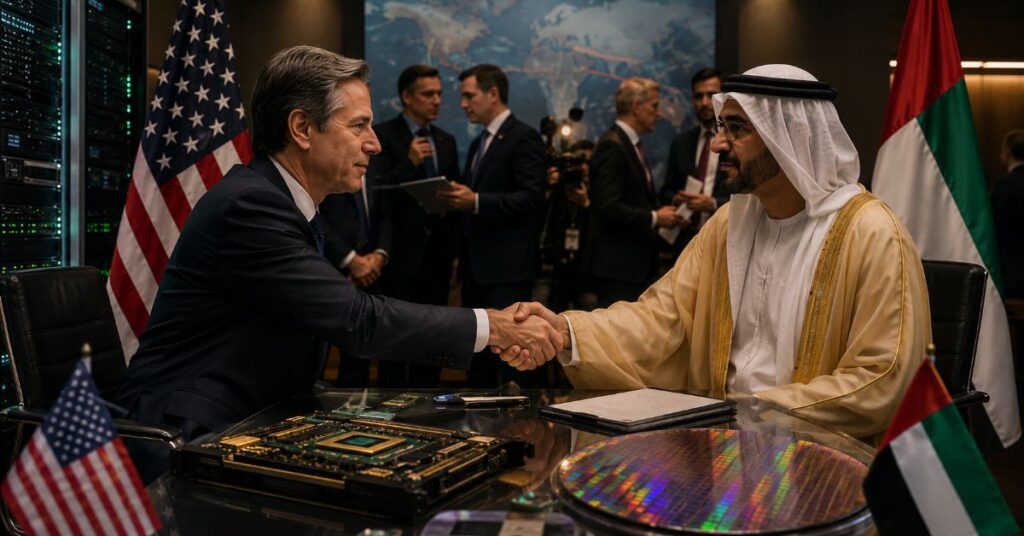
For more than two years, the question of whether the United Arab Emirates could buy America’s most advanced AI chips without a government licence sat unresolved, caught between the strategic value of a Gulf alliance and the national security concern that Emirati technology companies’ existing ties to China made every chip transfer a potential diversion risk. On July 10, 2026, the Trump administration resolved it by moving the UAE into the highest tier of preferred US technology export partners.
A notice published in the Federal Register by the Commerce Department’s Bureau of Industry and Security removes the UAE from Country Groups D:3 and D:4 — categories associated with national security and regional stability restrictions — and places it in Country Group A:5, which covers US allies and close partners receiving the most favourable treatment under US export control law. The practical effect is immediate: UAE entities including G42, its subsidiary Core42, and Abu Dhabi fund MGX can now purchase cutting-edge AI chips from Nvidia, AMD, and Cerebras without applying for individual US government licences.
KEY DEVELOPMENTS
- The US Commerce Department published a Federal Register notice on July 10, 2026, removing the UAE from export control Country Groups D:3 and D:4 and adding it to Country Group A:5, the most favourable tier for US technology exports.
- UAE entities G42 and Core42, plus Abu Dhabi fund MGX, are now cleared for licence-free purchases of advanced AI chips from Nvidia, AMD, and Cerebras. Eight US companies and their UAE subsidiaries — Amazon, Google, Apple, Meta, Microsoft, OpenAI, Oracle, and SpaceX’s xAI — also gain licence-free access for AI processors within the UAE.
- The Commerce Department cited two rationales: UAE steps to safeguard sensitive American technology, and UAE geopolitical support for the US in its war against Iran.
- Democratic Senator Elizabeth Warren immediately criticised the decision, citing unreported UAE royal stakes in the Trump crypto company World Liberty Financial and continued concerns about potential technology diversion to China.
What the Rule Change Does
The scope of the notice, which Reuters reported and Bloomberg confirmed, extends beyond AI chips into military equipment, commercial satellites, spacecraft, and dual-use technologies eligible under the Strategic Trade Authorisation programme. G42 and Core42 gain the most commercially significant benefit: direct access to Nvidia’s advanced GPU infrastructure without the case-by-case licence review process that has slowed and complicated previous chip transactions. Eight US-headquartered companies and their UAE subsidiaries are simultaneously granted licence-free AI processor access for operations in the UAE: Amazon, Alphabet’s Google, Apple, Meta, Microsoft, OpenAI, Oracle, and SpaceX’s xAI. MGX, the Abu Dhabi fund backed by G42, was separately approved for favourable treatment, a designation that had previously been withheld pending review of the fund’s ownership structure and investment activity.
The notice was signed by Jeffrey Kessler, director of the Bureau of Industry and Security. It cited UAE foreign direct investment into the United States valued at more than $1 trillion across AI, metals, aviation, and energy as evidence of the depth of the bilateral commercial relationship, alongside the UAE’s operational support for US policy toward Iran.
The G42 Question: What Changed
Why G42 Licences Were Contentious
G42 is the UAE’s state-backed technology conglomerate, operating AI infrastructure at a scale that places it among the largest computing deployments outside the US and China. It is the primary vehicle through which Abu Dhabi’s AI ambitions — backed by sovereign wealth fund wealth measured in hundreds of billions — are being executed. But G42 attracted US government scrutiny for a specific reason: its historical business relationships with Chinese technology companies, including Huawei, which raised concerns that advanced chips shipped to G42 could find their way into Chinese AI or surveillance applications through opaque business channels. Those concerns were significant enough that previous licence approvals for G42 generated internal debate within the Trump administration even when they were ultimately granted. The episode is analogous in its security logic to the concerns that drove the US to apply export controls to Anthropic’s frontier models in June 2026, as covered in our reporting on how those controls were imposed and lifted: in both cases, the underlying question is the same — can advanced AI capabilities be secured in their destination environment against diversion to actors the US does not want to have them?
What the UAE Did to Qualify
The Commerce Department’s notice cited “steps taken by the UAE to safeguard sensitive American technology” as the core justification for the country group elevation. Those steps are not specified in detail in the public notice, but reporting from Reuters and Bloomberg indicates they include G42’s earlier decision to divest its Chinese business operations, personnel changes designed to reduce Chinese nationals in sensitive roles, and commitments to US government oversight of chip deployments and usage monitoring. A former Commerce Department official told Reuters the new regime removes the administrative ambiguity that made previous G42 licences contested within the government: under A:5 treatment, the baseline eligibility is established, and individual transactions no longer require the same level of interagency review.
The Political Controversy
Senator Elizabeth Warren’s statement on the day of the announcement was the sharpest public pushback. Warren, ranking member of the Senate Banking Committee, cited reporting that the UAE royal linked to G42 and MGX had secretly acquired a 49 percent stake in World Liberty Financial, a cryptocurrency company associated with the Trump family. In Warren’s framing, the decision to grant G42 and MGX licence-free access to advanced AI chips in the same period as that reported stake acquisition raises serious conflict-of-interest questions, separate from the underlying technology security evaluation. The Commerce Department did not immediately respond to requests for comment on Warren’s statement.
The critique sits alongside a separate legislative thread: US lawmakers are currently weighing a series of bills aimed at tightening AI export controls more broadly, following the June 2026 restrictions on Anthropic’s Fable 5 and Mythos 5 models and subsequent debates about how to set threshold rules for frontier AI technology exports. The UAE decision moves in the opposite direction to those legislative proposals, loosening existing controls at the same moment Congress is debating tightening the framework.
Backstory: A Deal Promised a Year Ago
The UAE’s chip access ambitions did not emerge in 2026. The broader framework — a US-UAE AI cooperation agreement under which Nvidia, AMD, and Cerebras were expected to supply G42 with advanced AI computing infrastructure — was negotiated more than a year earlier. What has been missing is the regulatory clearance to execute it at scale and without case-by-case licence review. The July 10 Federal Register notice resolves that gap. The geopolitical context has evolved alongside it: the UAE’s active support for US policy in the Iran conflict, cited explicitly in the notice, has provided the Trump administration with a security rationale that strengthens the bilateral relationship beyond its commercial dimensions. As covered in our earlier reporting on Nvidia’s South Korea AI deals across SK Hynix, telecom, and Naver, US chip suppliers have been building a network of preferred-partner AI infrastructure deals across allied countries throughout 2025 and 2026. The UAE announcement extends that network into the Gulf for the first time at A:5-equivalent access levels, creating a template for how Gulf sovereign AI ambitions can be accommodated within the US export control framework.
What Happens Next
The immediate effect will be the acceleration of AI infrastructure procurement in the UAE that has been proceeding more slowly than Abu Dhabi’s timeline required. G42 has been building out data centre capacity at scale — Core42 operates one of the largest GPU cluster deployments in the region — but the licence-by-licence process for accessing top-tier Nvidia hardware has created procurement friction. Under the new framework, G42 and Core42 can move at the pace their capital and construction capacity allows, rather than the pace of US government licence reviews. The eight named US tech companies operating in the UAE gain symmetric benefit: Amazon Web Services, Google Cloud, Microsoft Azure, Oracle, and OpenAI all have active or planned UAE data centre operations that were constrained by the same review process. Licence-free access streamlines their UAE expansion substantially.
The diversion risk question does not disappear with the country group reclassification. The UAE’s ongoing business and investment relationships with Chinese entities continue to be a subject of US government monitoring, and the A:5 designation includes end-user and end-use commitments that are subject to enforcement if chip flows are found to circumvent the export control framework. Senator Warren’s intervention signals that Congressional oversight of the decision will be sustained, and any credible evidence of chip diversion would create significant political pressure to revisit the reclassification.
Why It Matters
The UAE chip export ruling is a meaningful data point in the larger story of how the US is managing AI technology transfer in a world where semiconductor access is geopolitical leverage. By elevating the UAE to A:5 status, the Trump administration has signalled that geopolitical alignment and demonstrated safeguards can purchase preferred access to the US technology stack, even for a country whose technology sector has historically maintained significant Chinese business ties. That is a workable framework for the US-UAE relationship, but it also sets a precedent that other Gulf states, and other countries seeking similar treatment, will reference in their own negotiations with Washington.
Sources
Reuters, July 10, 2026 (Karen Freifeld). Bloomberg, July 10, 2026. US Federal Register, Bureau of Industry and Security notice, July 10, 2026. Senator Elizabeth Warren statement, July 10, 2026.
