
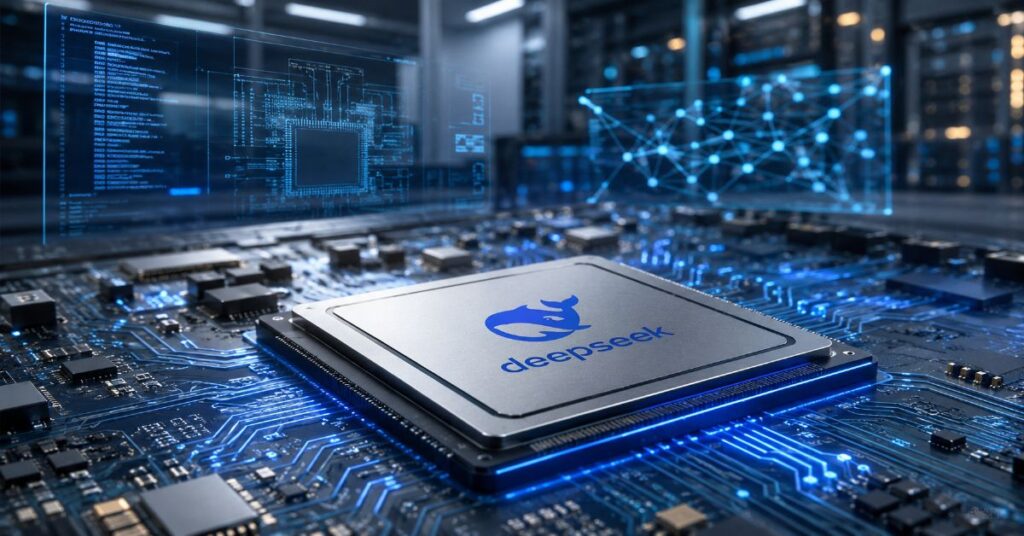
DeepSeek made its name by showing the AI world how much could be achieved with less. Fewer chips than Nvidia wanted to sell. More efficient architectures than its rivals deployed. A cost per token that made Silicon Valley executives call emergency meetings. Now, according to Reuters, the Hangzhou startup is pursuing the logical next step: building its own semiconductor so it doesn’t have to depend on anyone else’s hardware at all.
Three people with direct knowledge of the matter told Reuters on July 7, 2026, that DeepSeek is developing a proprietary AI chip focused on inference — the computational stage where a trained model generates live responses for users — rather than on training new models from scratch. The effort is approximately a year old, remains at an early stage, and has not been publicly confirmed by the company. DeepSeek did not respond to a request for comment. The implications, even in unconfirmed form, were enough to move Nvidia’s stock: shares slipped roughly 1.6 percent in premarket trading on the report.
KEY DEVELOPMENTS
- Reuters reported July 7, 2026, citing three people with direct knowledge, that DeepSeek is developing a proprietary AI chip focused on inference, not training. DeepSeek did not respond to requests for comment.
- The effort began roughly a year ago. DeepSeek has been quietly hiring chip-design engineers without public job postings and has held discussions with chip-design, foundry, and memory companies.
- The chip push coincides with DeepSeek’s first-ever acceptance of outside capital: a $7 billion maiden funding round at a valuation of $52–$59 billion, reported by Reuters in June 2026.
- Nvidia shares slipped roughly 1.6% in premarket trading on the news. Analyst Richard Windsor of Radio Free Mobile said the development does not affect Nvidia’s position, as “Nvidia is at zero in China and staying there.”
What the Report Says
The Reuters exclusive, which Bloomberg subsequently confirmed, describes a DeepSeek chip programme that is still in early-stage discussions rather than final production planning. DeepSeek has been approaching external partners in chip design, foundry, and memory, according to the three sources. It has hired chip-design engineers, but through private channels rather than public job postings on standard hiring platforms. No named foundry partner, no prototype, and no benchmark have been disclosed. The effort is focused on inference rather than training for a technically deliberate reason: inference and training require fundamentally different hardware profiles. Training demands raw throughput and massive memory bandwidth over extended periods. Inference demands low latency, high utilisation under live traffic, and low cost per token generated. A chip tuned specifically to DeepSeek’s own model architecture and serving software could deliver better economics on inference than any general-purpose GPU, including the Nvidia and Huawei chips the company currently relies on.
The timing coincides with a broader capital structure change at DeepSeek. The company, which famously rejected outside investment for years while its models gained global users, was reported by Reuters in June 2026 to be raising approximately $7 billion in a maiden funding round at a valuation of $52 to $59 billion. Designing a competitive AI chip typically takes years and significant capital. The fundraise suggests DeepSeek now has both the ambition and the runway to pursue hardware in parallel with model development.
The Strategic Logic: Why Inference, and Why Now
The Von Neumann Problem at Scale
AI inference is the fastest-growing segment of AI compute. As applications spread from research into production — customer service, code generation, search, document analysis, drug discovery — more of the industry’s computing burden shifts from training new models, which happens once, to running them, which happens billions of times per day. General-purpose GPUs, including Nvidia’s most advanced hardware, were designed with training workloads in mind. They are expensive, power-hungry, and often underutilised during inference because their raw throughput is overkill for the latency-and-cost profile that serving live users requires. A chip purpose-built for inference — one that can sustain high utilisation, tight latency, and low cost per token under real production traffic — is structurally cheaper to operate than a repurposed training accelerator.
The Export Control Dimension
For DeepSeek, the case for building its own chip carries an extra dimension that US-based AI labs do not face. US export controls bar Chinese companies from purchasing Nvidia’s most advanced GPUs. Huawei has filled part of that gap, supplying roughly half of China’s estimated $50 billion domestic AI chip market, largely because Washington’s restrictions on US exports to China handed Huawei captive demand it could not have won on pure merit. DeepSeek has used both Nvidia and Huawei hardware, but that dependency creates supply chain risk in both directions: Nvidia supply is constrained by export controls, and Huawei’s chips still lag Nvidia’s most advanced products by a meaningful margin. As detailed in our earlier coverage of how US export controls shaped Anthropic’s market access restrictions, the export control framework has become a structural variable in how every frontier AI company, on both sides of the Pacific, plans its hardware roadmap. For DeepSeek, the logical response is not to optimise around whatever hardware remains available but to build hardware it fully controls.
What the Competition Is Doing
DeepSeek would not be the first AI lab to pursue custom silicon. OpenAI unveiled Jalapeno, its first custom inference chip built with Broadcom, in June 2026. Anthropic has been in preliminary discussions with Samsung to manufacture a custom AI accelerator using Samsung’s 2nm process, as reported by The Information. Google has operated its own Tensor Processing Units since 2015. The pattern is clear: once an AI lab reaches sufficient scale of inference demand, the unit economics of custom silicon — lower cost per token, higher utilisation, better alignment between chip architecture and model structure — become compelling enough to justify the years of engineering and capital required to build it. DeepSeek’s situation is unusual in that it operates under tighter supply constraints than any of those labs, which makes the custom silicon case even stronger. The Nvidia–SK Hynix partnership and the South Korea AI infrastructure build-out illustrates how deeply the global AI infrastructure stack is being reconfigured around a small number of dominant hardware suppliers — a reconfiguration that every large AI developer, including DeepSeek, must either accommodate or work around.
The Manufacturing Problem
China’s chip programme faces a constraint that model efficiency alone cannot solve: manufacturing. The most capable semiconductor foundries — TSMC in Taiwan, Samsung in South Korea, Intel Foundry in the US — are inaccessible to Chinese chip designers under current US export controls. China’s domestic foundry, SMIC, can manufacture chips at the 7nm node using techniques that have drawn scrutiny from US export enforcement, but is not currently capable of the 3nm or below process nodes that the most efficient inference chips would require. DeepSeek will almost certainly need to target a process node that is achievable within China’s domestic manufacturing constraints, which means trading some performance density for supply chain security. That trade-off is workable for inference — where efficiency and cost matter more than peak throughput — in a way it would not be for a training chip competing directly with Nvidia’s H100 or Blackwell series.
Radio Free Mobile analyst Richard Windsor captured the ceiling on Nvidia’s competitive concern succinctly: “Nvidia is at zero in China and staying there. DeepSeek has almost no chance of selling silicon outside of China unless it gets access to leading-edge manufacturing.” A DeepSeek inference chip, even if technically competitive for its process node, would not be an export threat to Nvidia’s global business. It would be a domestic alternative that reduces DeepSeek’s cost structure inside China, potentially pressuring Huawei’s grip on the domestic AI chip market and reshaping the economics of Chinese AI inference.
What Happens Next
The programme is early enough that the next meaningful signal will be a confirmed foundry partner or a named memory supplier — neither of which has been disclosed. DeepSeek’s chip will require high-bandwidth memory to function effectively in inference applications, and the US has separately restricted Chinese companies’ access to the most advanced HBM components, creating a second supply constraint alongside the foundry problem. The energy and resource footprint of AI inference at scale is precisely the problem that a purpose-built inference chip is designed to address: lower power consumption per token generated translates directly into lower operating costs and a smaller infrastructure footprint. If DeepSeek can produce a chip that runs its own models at meaningfully lower energy cost than current hardware, the economics of its inference business improve regardless of the chip’s benchmarks against Nvidia’s latest generation.
Why It Matters
DeepSeek’s move into chip design matters for three separate reasons, not one. It matters for Huawei, which currently holds dominant position in China’s AI chip market and would face a new domestic rival if DeepSeek’s programme succeeds. It matters for the US export control framework, which was designed partly to slow China’s AI development by restricting hardware access, and which may instead be accelerating Chinese AI labs’ motivation to build domestic alternatives. And it matters as a signal about where the frontier of AI competition is heading: not the model layer, where capabilities are increasingly competitive, but the infrastructure layer, where control of silicon means control of cost, supply, and ultimately the economics of who can afford to run the largest models at the lowest price per user.
Sources
Reuters, July 7, 2026 (three-source exclusive, confirmed by Bloomberg). Taipei Times, July 8, 2026. Technology.org, July 8, 2026. AI Weekly analysis, July 7, 2026.
