
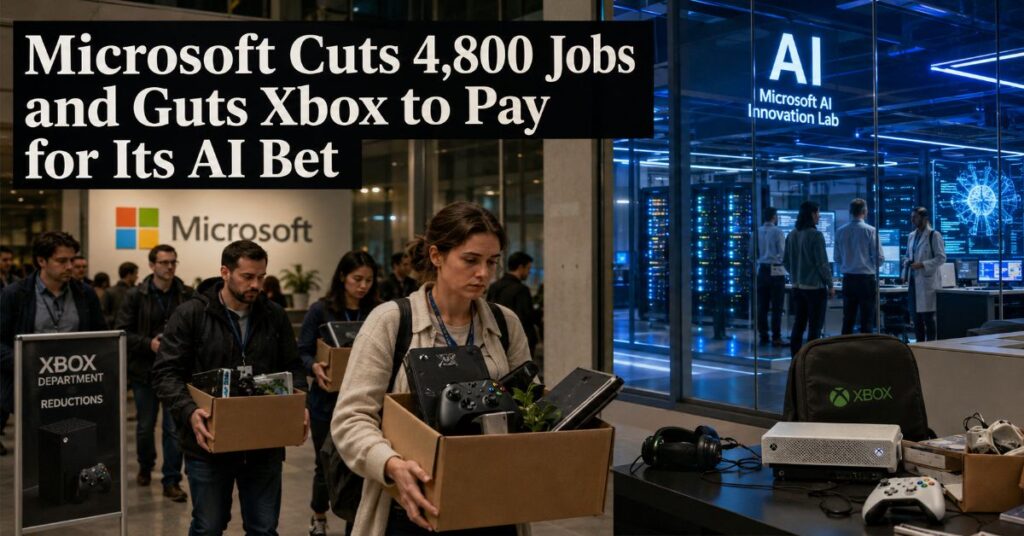
Sixty-four cents lost for every dollar invested. That is the number Asha Sharma, the new head of Xbox, put in her memo to employees on July 6, 2026, as she announced the gaming division would shed roughly 3,200 roles — about one in five of the people who worked there — across this fiscal year. It is an unusually honest piece of data to put in a layoff memo. It is also the clearest signal yet of what Microsoft is actually doing: dismantling the parts of its business that are losing money to bankroll the ones where it has decided to bet everything.
The 4,800 cuts announced Monday represent 2.1 percent of Microsoft’s global workforce. Combined with a voluntary retirement programme that saw more than 30 percent of the 8,750 eligible US employees accept exit packages, the restructuring is the company’s most significant workforce action since it cut over 15,000 jobs in two rounds last year. The backdrop is stark: Microsoft has the worst stock performance of any megacap tech company in 2026, down nearly 23 percent as investors wait for the company’s colossal AI spending to produce returns.
KEY DEVELOPMENTS
- Microsoft announced 4,800 job cuts on July 6, 2026, representing 2.1% of its global workforce, with 1,600 roles eliminated immediately and the remainder phased through FY2027.
- Xbox bears the heaviest blow: CEO Asha Sharma announced a total reduction of roughly 3,200 gaming roles throughout FY2027, about 20% of the global Xbox workforce, alongside the closure or spin-off of four studios.
- Microsoft plans to spend $190 billion on AI infrastructure and data centers in 2026 alone. Its stock has fallen nearly 23% this year, the worst performance among megacap tech peers.
- Amy Coleman, Microsoft’s chief people officer, said AI is “changing how work gets done” but explicitly stated the layoffs are not direct AI replacements — the cuts target commercial and gaming units, not technical roles being automated away.
What Happened
Microsoft’s chief people officer Amy Coleman outlined the cuts in a company-wide memo that CNBC and CNN both obtained. “The way technology is built, deployed, and used is transforming faster than at any point in my time here,” Coleman wrote, framing the cuts as a restructuring of Microsoft’s commercial and gaming divisions rather than a response to AI replacing roles. The 4,800 figure breaks down into roughly 1,600 Xbox cuts effective immediately, with another 1,600 Xbox roles exiting over the course of FY2027, and approximately 1,600 cuts spread across Microsoft’s commercial sales and consulting business.
Four Xbox studios are leaving the brand: Compulsion Games and Double Fine Productions are becoming independent studios; Ninja Theory and Undead Labs have entered agreements to join new ownership. Xbox CEO Asha Sharma’s memo to the gaming division was titled “Resetting Xbox” and posted publicly on the Xbox Wire blog. Sharma said the business “is currently not healthy,” pointing to Game Pass growth that fell short of projections, a multi-platform content strategy that has not yet delivered at scale, and a hardware business facing what she called the most severe console component cost crisis in Xbox’s history. Sony’s PlayStation competes directly for the same premium gaming market. Nintendo’s Switch 2 momentum has applied additional pressure.
The Trade-Off at the Centre of This Announcement
$190 Billion Out, 4,800 People Out
Microsoft announced during its last earnings call a $190 billion plan for AI infrastructure and data centre spending in 2026. The scale of that commitment is the key context for Monday’s cuts. Free cash flow tightened as capital expenditure surged, and Wall Street has grown impatient with operating costs that do not obviously contribute to the AI-driven growth thesis. As covered in our reporting on Microsoft’s Copilot revenue and M365 seat growth, the company hit $37 billion in annual recurring revenue from AI-adjacent services, but its flagship Copilot product has not achieved the broad enterprise adoption its pricing implied. The layoffs in the commercial division are in part a reorganisation around the Microsoft Frontier Company — the $2.5 billion embedded engineering unit launched last week — which requires a different kind of customer-facing talent than the sales and consulting headcount it is replacing.
Xbox as Collateral
The gaming cuts represent something distinct from the commercial reorganisation. Xbox is not being reshaped for AI. It is being reduced because its economics have not worked. Microsoft spent over $20 billion on content, platform, and hardware subsidies over five years, excluding Activision Blizzard King, and annual revenue fell by nearly half a billion dollars over that same period. Sharma acknowledged all of it. The division’s profit margin has declined to 3 percent, against the 10 to 30 percent margins typical for platform businesses like Apple’s App Store or PlayStation’s digital storefront. That gap, sustained over years, is what makes the Xbox restructuring the inevitable outcome it now appears to be.
Backstory: A Pattern Across Big Tech
Microsoft’s move is the most dramatic single example of a pattern that has been building across large technology companies throughout 2025 and 2026: aggressive reduction of legacy or underperforming business units to fund AI infrastructure investment. The trade-off is explicit in Microsoft’s case in a way it rarely is elsewhere. Its $190 billion AI spending projection sits directly alongside a 23 percent stock decline, a voluntary retirement programme, and now the largest gaming workforce reduction in Xbox history. For investors, the question is not whether Microsoft is spending on the right thing — most analysts agree AI infrastructure is strategically necessary — but whether the current pace of spending, and the current pace of return, can sustain the company’s valuation at anything close to its 2025 peak. The Microsoft Maia 200 inference chip represents one lever Microsoft is pulling to reduce its inference cost per customer — bringing the unit economics of AI delivery closer to what its enterprise pricing requires. If Maia 200 delivers on its promise of lower-cost inference at scale, the capital being freed by these workforce reductions would find a more efficient home. If not, the cuts buy time without fixing the underlying margin problem.
Reactions
Coleman was careful not to attribute the cuts to AI automation directly. “Jobs are not being replaced by AI,” she wrote, though she immediately followed that statement by noting AI is “changing how work gets done” through task automation. The distinction — between AI changing workflows and AI replacing workers — is one technology executives have deployed carefully throughout the current layoff wave, and it is genuinely difficult to disentangle in practice. If a sales team of 10 can now accomplish what previously required 14 because AI handles research, scheduling, and first-draft proposals, those four roles are not replaced by an AI; they simply ceased to be created.
The gaming community’s reaction has focused on the studio closures and the specific teams affected. The Elder Scrolls Online team, whose community manager posted publicly about the cuts, appears to have lost a significant portion of its staff, with the game’s published roadmaps now described as “shifting.” Four studios are leaving the Xbox brand entirely. The human cost of restructuring a gaming business is measured differently than a sales reorganisation: years of project development, institutional knowledge of specific game franchises, and communities built around games that may now see reduced development are all consequences that quarterly earnings statements do not capture.
What Happens Next
The voluntary retirement programme Microsoft offered to 8,750 US employees at the senior director level and below will likely become a recurring feature rather than a one-time event. Amy Coleman indicated in interviews that Microsoft is “exploring approaches similar” to the programme on an ongoing basis — a signal that further workforce shaping through attrition is part of the company’s operating model rather than a crisis response. The Frontier Company launch alongside these cuts creates an immediate question: does the 6,000-person embedded engineering unit draw from the commercial talent being let go, or does it require net new hires with different skill profiles? Microsoft has not clarified this, and the answer matters to the unit economics of the Frontier Company’s $2.5 billion budget.
Why It Matters
This restructuring is significant less for its scale than for what it makes explicit. Microsoft is not cost-cutting in a recession; it is cost-cutting in a period of record AI investment, at a company whose AI revenue is growing. The inference is that even $37 billion in AI-adjacent recurring revenue is not yet sufficient to justify the operational costs of a gaming division losing money and a commercial sales organisation built for a pre-AI enterprise relationship model. As explored in our analysis of why most CEOs are seeing zero ROI from AI investments, the pressure Microsoft is responding to is the same pressure its customers face: AI investment is obligatory, returns are not yet guaranteed, and the gap between the two is being closed by cutting what can be cut. Microsoft just cut more visibly than most.
Sources
CNBC, July 6, 2026. CNN Business, July 6, 2026. Xbox Wire (“Resetting Xbox”, Asha Sharma), July 6, 2026. GeekWire, July 6, 2026. NBC News, July 6, 2026.
