
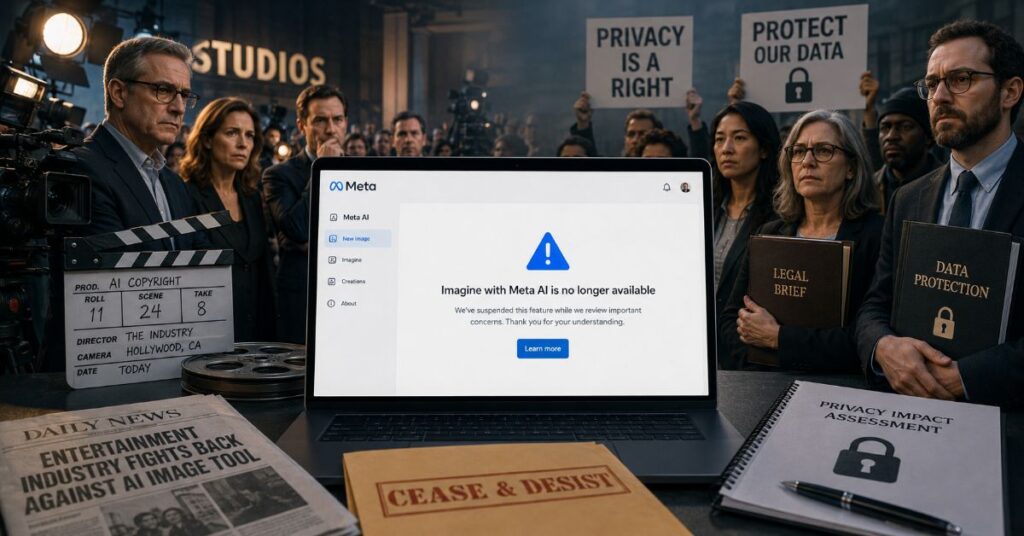
Two days. That is how long Meta’s newest AI image feature survived before the company pulled it. Muse Image, announced Tuesday and gone by Friday, is the fastest public reversal Meta has made on an AI feature to date, and it follows a pattern the industry keeps repeating: launch first, discover the consent problem after, and apologise before the legislative attention arrives.
On July 10, 2026, Meta removed a specific functionality from its newly launched Muse Image tool that had allowed users to @-mention any public Instagram account in order to use that account’s publicly visible images as reference material for AI-generated content. The feature was enabled by default for all public Instagram accounts, required active opt-out rather than opt-in consent, and did not notify account owners when their images were used. SAG-AFTRA, CAA, privacy researchers, and large numbers of individual creators responded within hours of the launch. Meta pulled the feature before the weekend.
KEY DEVELOPMENTS
- Meta launched Muse Image on Tuesday, July 8, 2026, as the first image-generation model from Meta Superintelligence Labs, integrated into Meta AI across Instagram.
- A specific feature allowed users to @-mention any public Instagram account to use that account’s publicly visible images as reference material for AI image generation, without notifying the account owner or requiring opt-in consent.
- Backlash came immediately from SAG-AFTRA, the Creative Artists Agency (CAA), privacy advocates, and users. SAG-AFTRA urged its 160,000 members to opt out immediately. CAA called the feature an infringement of creators’ rights.
- Meta pulled the @-mention reference feature on Friday, July 10, 2026, stating the feature “missed the mark.” The broader Muse Image tool remains available; only the public-account-tagging functionality was removed.
What Muse Image Was
Muse Image was introduced on July 8, 2026, as the first consumer-facing output from Meta Superintelligence Labs, the AI research unit Meta assembled earlier this year from a wave of high-profile hires documented in our reporting on the 2026 AI talent exodus from DeepMind and Meta research labs. Integrated into Meta AI across Instagram, the tool allowed users to generate AI images using photos as inputs and edit AI-created images through sketches and modifications — both relatively standard generative AI capabilities. The controversial element was a specific feature built on top of those capabilities: the ability to @-mention a public Instagram account within the image generation prompt, causing the Muse model to use that account’s publicly shared photos as stylistic or content reference material.
The mechanics of the opt-out structure were the core of the complaint. Meta designed the feature with universal default activation for public accounts, on the grounds that content shared publicly on Instagram is by definition visible to the public. Account owners received no notification if their images were referenced. The only way to prevent your public Instagram content from being used was to actively find and toggle an opt-out control in Meta AI’s settings — a process that required knowing the feature existed in the first place.
Why That Consent Mechanism Failed
Opt-Out vs Opt-In in AI Training and Generation
The opt-out consent structure for AI-generated content that references a person’s likeness, work, or publicly shared images is a distinct and contested question from the opt-out structures that govern, say, targeted advertising. The key difference is harm asymmetry. An irrelevant ad shown to someone who did not want to see it is annoying. An AI image generated using a professional photographer’s distinctive style, or a public figure’s recognisable face, or a working actor’s appearance, and then used for commercial purposes, promotional content, satire, or worse, is a harm of a different order. The person whose work or likeness is used may face reputational damage, loss of commercial opportunities, or targeted harassment from the generated content. That asymmetry is what makes opt-in consent the standard professional creative communities expect.
The SAG-AFTRA and CAA Response
SAG-AFTRA, the union representing approximately 160,000 media professionals including actors, broadcast journalists, and recording artists, issued an immediate directive urging all members to opt out. The union’s spokesperson framed the decision as consistent with its position on non-consensual digital replicas: “With the dangers of nonconsensual digital replicas well known to all, a feature that encouraged that behaviour is unwise.” The Creative Artists Agency, whose roster includes some of the most commercially prominent performers in entertainment, went further, releasing a public statement commending Meta’s decision to remove the feature after the reversal, describing individual consent and rights as “essential to building responsible technology.” The speed of both responses — issued within the first news cycle after the launch — reflects how closely Hollywood representation firms now monitor AI feature launches from major platforms.
Meta’s Statement and What It Acknowledged
Meta’s official statement, issued Friday on its blog, was carefully worded. “Earlier this week, we announced that one way for people to generate images in Meta AI is by @-mentioning public Instagram accounts that they want to reference. Our intent was to provide a useful creative tool and to give people control over whether their public content could be referenced in this way. We’ve heard the feedback that this feature missed the mark, so it’s no longer available.” The statement does not use the word “consent.” It does not acknowledge that the opt-out structure was problematic rather than simply unpopular. It frames the removal as a response to feedback about “missing the mark” rather than a concession that the feature’s design was legally or ethically questionable. The broader Muse Image tool — the image generation and editing capabilities that do not depend on other users’ public account data — remains available.
The Pattern This Fits
The Muse Image withdrawal echoes a pattern that has repeated throughout the current AI product cycle. OpenAI launched Sora in late 2024 with limited IP protections, generated a wave of infringing content featuring recognisable celebrities and fictional characters, and backed away within days before eventually discontinuing Sora as a standalone product. The pattern — launch, viral backlash over consent and IP, rapid partial or full reversal — reflects a recurring gap between the speed at which AI image and video generation products can be developed and deployed, and the pace at which their implications for consent, likeness rights, and existing IP frameworks can be evaluated. That evaluation gap has been the subject of ongoing litigation, including the lawsuit patterns documented in our coverage of OpenAI’s ChatGPT product liability cases. TikTok has separately been shutting down accounts that used AI-generated Black female influencer personas to funnel users toward paid explicit content, while separate research documented TikTok videos featuring AI-generated images of minors in sexualised contexts accumulating millions of views. Muse Image, in this context, is a relatively contained episode — the backlash came fast, Meta responded fast, and the feature is gone. But it is one data point in a much larger pattern of AI image capabilities outpacing the legal and consent frameworks designed to govern them.
The Regulatory Context
The timing of Meta’s Muse Image episode is not incidental to the regulatory environment. The EU AI Act’s general-purpose AI model requirements take effect on August 2, 2026, less than a month away. Those requirements include transparency obligations around AI-generated content and specific provisions for AI systems capable of producing synthetic images of identifiable individuals. The California AI Transparency Act, which has been in effect since 2025, requires disclosure when AI-generated content depicts a real person without consent in a misleading way. The EU’s proposed AI Liability Directive adds a civil liability layer. None of these frameworks was invoked in the public response to Muse Image — the backlash was a reputational and stakeholder response, not a regulatory enforcement action — but the overlap between the feature’s design and multiple pending legal frameworks is clear enough that Meta’s legal team would have flagged it as a risk the moment SAG-AFTRA issued its directive.
What Happens Next
Meta has not indicated whether the @-mention reference feature will return in a modified form with opt-in consent architecture, or whether it has been shelved entirely. The broader Muse Image tool — with its base image generation and editing capabilities — continues to operate. Meta Superintelligence Labs, which built Muse, remains one of the most heavily resourced AI research units in the industry following its 2025-2026 talent buildout. The creative tools ambition behind Muse Image is not going away; what changes is the consent model required to deploy it. Whether Meta rebuilds the @-mention feature with opt-in architecture or pivots to a different reference mechanism will be the first signal of whether the company has absorbed the lesson this episode was offering about where the line sits between publicly accessible content and licensable creative material.
Why It Matters
The Muse Image withdrawal matters less for the feature itself — which was removed before causing documented, quantifiable harm at scale — than for what the episode reveals about the current state of AI image product development at the major platforms. The two-day turnaround from launch to withdrawal suggests that the consent problem was either not caught internally before launch or was caught and dismissed as manageable until external pressure made it untenable. Either reading is concerning. If internal review missed the opt-out problem, that is a product governance failure. If it was identified and launched anyway, that is a strategic miscalculation about how quickly creator communities and their industry representation would respond. The AI image generation category is now mature enough that neither explanation is as forgivable as it might have been two years ago.
Sources
Meta official blog statement, July 10, 2026. TechCrunch, July 10, 2026. The Hollywood Reporter, July 10, 2026. SAG-AFTRA statement, July 10, 2026. CAA statement, July 10, 2026.
