
There is a particular kind of political speech that announces a framework without legislating one, commits to action without specifying the mechanism, and generates headlines without producing law. Australia’s Prime Minister Anthony Albanese delivered a different kind of speech on July 15, 2026. Standing at the University of Sydney, he named specific obligations, named a specific target, and named a specific adversary by implication — landing all three with a clarity that most AI policy announcements deliberately avoid.
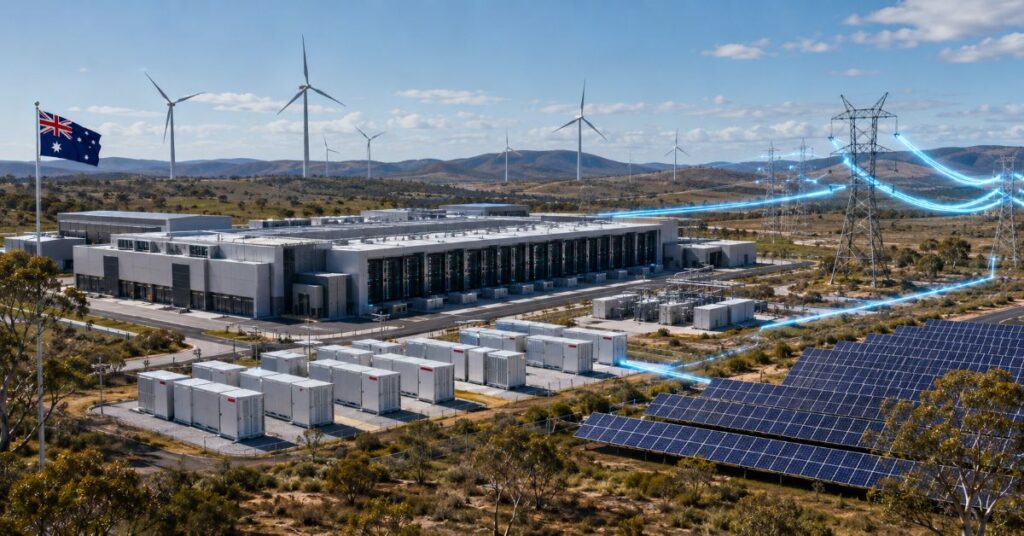
Australia will legislate national standards for artificial intelligence. Large data centers will be required to put more power into the electricity grid than they take out. They will minimise water usage. They will not compete with housing for land. And no company — Albanese used the word ‘no company’ — will be permitted to use Australian books, music, art or news to build or train AI without the artist’s control over both the use and the price of that work. Anything less, he said, is theft. The laws will be introduced in 2027.
Key Developments
- Australian Prime Minister Anthony Albanese announced on July 15, 2026, that Australia will legislate national AI standards covering both data center resource use and copyright protections for creative work.
- Large AI data centers will face legal obligations to feed more electricity into the national grid than they consume, minimise water usage, and avoid competing with housing for land.
- Albanese stated that no company may use Australian books, music, art or news to build or train AI without the artist’s control, calling anything less “theft,” in direct response to lobbying by Anthropic for copyright law changes.
- A dedicated Office of Artificial Intelligence will be established within the Prime Minister’s department. Laws will be introduced in 2027 following a consultation with state and territory leaders next month.
What Albanese Announced
The speech, delivered at the University of Sydney and titled ‘AI in Australia’s Interests,’ was the most comprehensive statement of Australian AI policy since the current government took office. As Bloomberg reported, Albanese outlined plans to embrace AI while shaping its development in Australia’s national interest, framing the choice between action and inaction in stark terms. ‘If we hang back and stand still this will just run right over the top of us,’ he told the audience. ‘Our great country can be much more than a data warehouse for AI products made overseas.’ The speech confirmed that Albanese will meet Australia’s state and territory leaders next month to discuss the proposed laws before they are introduced to parliament in 2027. A dedicated Office of Artificial Intelligence will be established within the Prime Minister’s own department to coordinate AI policy and oversee compliance.
The legislation, when introduced, will set clear legal obligations for large AI data centers operating in Australia. Those obligations will require data centers to put more power into the national electricity grid than they take out, a standard designed to prevent the kind of local power price inflation that has accompanied data center buildouts in parts of the United States and Europe. Water usage minimisation obligations and requirements that data centers not displace housing developments from suitable land reflect the same logic applied to two other critical infrastructure pressure points.
The Copyright Dimension
Why Albanese Named It Theft
The copyright section of the speech was the most politically charged, and its timing was not accidental. It emerged this week that Anthropic had lobbied Australian officials to change the country’s copyright laws to permit AI training on copyrighted material without consent or compensation — a policy position Anthropic had advanced as a precondition for investing in Australian data centres. Musicians, writers, publishers and news organisations had responded with forceful public opposition, urging the government to resist the lobbying. Albanese’s speech was, in part, a direct answer to that pressure. ‘No company should use Australian books, music, art or news to build or train AI without the artist’s control,’ he said. ‘That includes the artist’s control of the price and value of their work. Anything less is theft.’ The phrasing is unambiguous by the standards of political speech. The word ‘theft’ does not invite negotiation. It is worth reading in the context of our earlier reporting on the US export controls imposed on Anthropic’s AI models, which documented how Anthropic’s commercial expansion into allied markets is generating increasingly direct friction with those governments’ regulatory instincts. Australia is not the first country where Anthropic’s data and copyright lobbying has generated a regulatory counter-response, and it is unlikely to be the last.
What Control Actually Means
Albanese’s formulation — ‘the artist’s control of the price and value of their work’ — implies a licensing framework rather than a blanket prohibition. If Australian law ultimately gives rights holders the ability to set terms for AI training use, rather than either prohibiting training outright or permitting it freely, the outcome would resemble the approach being discussed in the European Union’s ongoing AI Act implementation for GPAI model providers, where content licensing negotiations between model developers and rights holders are expected to become a standard part of frontier model development. Australia entering that conversation with explicit government backing for rights-holder leverage changes the negotiating dynamics meaningfully. Anthropic and other companies seeking to train on Australian creative content would face a regulated market for that content rather than an ambiguous legal status.
The Backstory: Data Center Investment and its Discontents
Australia has been experiencing a surge in AI data center investment. Government data cited in Albanese’s speech showed that data center investment was the largest single contributor to Australia’s economic growth in the three months to March 2026. That growth, however, came with the complication that most of the equipment was imported rather than domestically manufactured, limiting the spillover economic benefits, and that power and water pressures from data center buildouts were already generating community complaints in urban and peri-urban areas where sites were being developed. The speech’s energy and water obligations are direct responses to those complaints, and they reflect a calculation that Australia can capture the investment benefits of the AI data center boom while insisting on infrastructure standards that prevent that boom from becoming a local cost burden. The broader challenge — the energy and water footprint of AI infrastructure at scale — is one that every country hosting large AI data center buildouts is now navigating, and Australia’s legislative approach, requiring net-positive energy contribution rather than simply limiting consumption, is among the most prescriptive national standards announced to date.
The Sovereignty Argument
Albanese framed the entire policy in terms of national sovereignty, and that framing was pointed in specific directions. ‘Letting others write the AI rules would mean subcontracting our national sovereignty and security to the control of foreign monopolies,’ he said. That sentence was not aimed at China. It was aimed at the US technology companies — Anthropic, Google, Microsoft, Meta, Amazon — whose AI infrastructure investments Australia is simultaneously courting and whose lobbying on copyright law Australia is simultaneously resisting. The tension is structural: Australia needs the economic activity and technological capacity these companies bring, but it also needs to set the terms under which they operate domestically. Albanese’s speech is an attempt to establish that Australia can do both simultaneously, accepting the investment while refusing the legislative concessions that the investors are requesting.
How This Fits the Global AI Regulation Landscape
Australia’s announcement arrives within weeks of the EU AI Act’s August 2 enforcement date for general-purpose AI model requirements, the UN Global Dialogue on AI Governance in Geneva, and the United States’ approach to AI governance through voluntary commitments and export controls rather than domestic legislation. Among major Western economies, Australia is now among the most specific about the content of planned AI legislation: data centers will face energy, water and land obligations; creative content training will require rights-holder consent and compensation. The detailed legislative proposals coming from US state capitals, tracked in our coverage of state AI bills across the US in 2026, show how quickly the regulatory landscape is fragmenting at the national and sub-national level. Australia joining with detailed planned legislation adds another significant jurisdiction to the list of governments that have decided they will set terms rather than accept the default frameworks that technology companies prefer.
Reactions
Albanese explicitly invoked Australia’s social media age restriction law — the world’s most stringent, banning children under 16 from social media platforms — as evidence that Australia was willing to act where other governments waited. ‘Australia had led other countries in imposing limits on social media use for children,’ he said, ‘but the challenge to shape AI in Australia’s interest was greater and demanded action now.’ Creative industry bodies responded positively, noting that the copyright protections Albanese outlined were consistent with what the arts and media sectors had been demanding. No specific response from Anthropic, Google, or Meta was published by the time of the speech, though the implication of the lobbying revelation — that Anthropic had sought changes that Albanese just explicitly ruled out — creates a direct and public confrontation.
What Happens Next
Albanese will meet Australia’s eight state and territory premiers and chief ministers next month to discuss the proposed laws. That consultation step is both procedurally necessary — AI data centers and energy networks span jurisdictional boundaries — and politically useful, allowing Albanese to show that the legislation has national support rather than federal imposition behind it. The laws are then expected to be introduced to parliament in 2027, leaving a development and consultation window that the technology industry will use intensively to shape the specific mechanisms, particularly the copyright licensing framework. The question of what ‘artist’s control of the price and value of their work’ means in practice — whether it creates a mandatory licensing scheme, a right of refusal, or a right to set prices that AI companies are obligated to accept — will be the central legislative design question. The data center energy spike driven by AI infrastructure will continue to put pressure on the government to move quickly on the energy obligations, since every month of delay is another month of data center buildouts proceeding without the framework Albanese has now publicly committed to.
Why It Matters
Australia’s AI policy announcement matters beyond its domestic legislative implications for two reasons. First, it demonstrates that a government that wants foreign AI investment can simultaneously set binding conditions on that investment, including conditions the investors are actively lobbying against. That combination has been theoretically possible but practically rare; Australia’s combination of the social media precedent and Albanese’s explicit copyright-as-theft framing gives it more political credibility than a purely aspirational policy statement would have. Second, the energy obligation framework — requiring net-positive grid contribution rather than simply capping consumption — introduces a standard that no other major AI-hosting nation has yet legislated, and that the global AI infrastructure industry will have to respond to when deciding how to structure Australian data center investment proposals.
Sources
Bloomberg, July 15, 2026. Agence France-Presse (AFP) via multiple outlets, July 15, 2026. Australian PM’s office speech excerpts. The Jakarta Post and France24 AFP reporting, July 15, 2026.
