
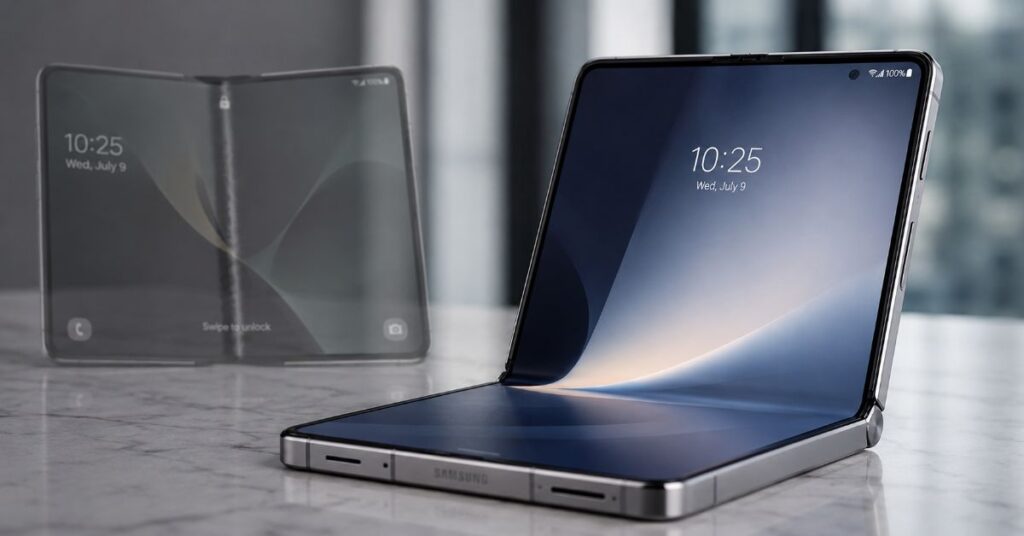
When Samsung launched the first Galaxy Fold in 2019, it simultaneously created the foldable smartphone market and introduced a problem it has spent seven generations trying to fix. The crease — the visible indentation down the centre of the inner display where the device bends — has been the category’s defining liability, the single biggest reason first-time buyers hesitate and returning buyers qualify their enthusiasm. On July 15, 2026, Samsung announced that it has found a structural solution.
Flex Titanium is a redesigned foldable display architecture that replaces the polymer film used in every previous Galaxy foldable with two titanium-based components working in tandem. The result, according to Samsung and the handful of journalists who have seen the new display firsthand, is a fold line that is dramatically less visible than anything Samsung has shipped before — and a display structure that is simultaneously thinner, stiffer, and more shock-resistant than its predecessor.
Key Developments
- Samsung unveiled Flex Titanium on July 15, 2026, a redesigned foldable display architecture combining a titanium-alloy film and a titanium plate to reduce crease visibility and improve durability for the Galaxy Z Fold 8 series and Z Flip 8.
- The titanium-alloy film sits directly beneath the OLED panel, delivering 20 times the mechanical stiffness of the polymer film it replaces while measuring roughly one-third the thickness of a human hair.
- The titanium plate beneath the display module features micro-patterned precision holes that allow the hinge area to flex repeatedly while closing air gaps between the plate and adhesive layers that previously worsened crease visibility.
- The first devices featuring Flex Titanium — Galaxy Z Fold 8, Galaxy Z Fold 8 Ultra, and Galaxy Z Flip 8 — will be officially unveiled at Samsung Galaxy Unpacked on July 22, 2026, in London.
What Samsung Announced
Samsung published the Flex Titanium announcement on its global newsroom on July 15, 2026, ahead of the Galaxy Unpacked event scheduled for July 22 in London. The announcement confirmed that Flex Titanium will debut in the Galaxy Z Fold 8, Galaxy Z Fold 8 Ultra, and Galaxy Z Flip 8 — all three members of Samsung’s next-generation foldable lineup. Sunghoon Moon, Executive Vice President and Senior Executive of Samsung’s Mobile R&D Office, described Flex Titanium as the product of seven generations of consumer feedback synthesis: ‘Samsung’s strength in the foldable category comes from connecting user needs with our technologies that deliver tangible benefits in everyday life.’ Kyung-Jin Yoo, EVP and Head of Mobile Display Product Development at Samsung Display, explained the specific engineering approach: ‘By introducing sophisticated micro-patterned holes to the folding section of the titanium plate, we have successfully secured flexibility with robust durability.’
How Flex Titanium Works
Layer 1 — The Titanium-Alloy Film
Every foldable OLED display requires a support layer beneath the flexible panel to give the panel structural integrity across the opening and closing cycle. Previous Samsung foldables used a polymer film for this purpose — a material that is inherently flexible but relatively soft, which means it deforms over time under repeated mechanical stress and contributes to crease formation. Samsung has replaced this polymer layer with an ultra-thin titanium-alloy film that sits directly beneath the OLED panel. The titanium-alloy film delivers approximately 20 times the mechanical stiffness of the polymer film it replaces. Despite this dramatic increase in rigidity, it is thinner than its predecessor: Samsung has engineered the film to measure roughly one-third the thickness of a human hair using a precision rolling process that was not previously possible with titanium at this form factor. Greater stiffness at thinner cross-section is the combination that makes the display sit flatter across the hinge area, which is directly where crease visibility is determined.
Layer 2 — The Titanium Plate
The second component in the Flex Titanium system is a redesigned titanium plate that sits beneath the display module and provides structural support for the entire display assembly. Previous foldable designs used plates with air gaps between the plate and its adhesive bonding to the module, gaps that accumulated and worsened crease formation over time. Samsung’s redesigned titanium plate incorporates thousands of micro-patterned precision holes across the folding section — a technique Yoo described as a lattice structure processed with a laser hole system to increase structural integrity. These holes have a dual function: they allow the inherently stiff titanium to flex at the fold point as required for repeated opening and closing, and they eliminate the air gaps between plate and adhesive by allowing the adhesive to bond more completely to the plate surface. Removing those air gaps is what produces the noticeably flatter appearance at the fold line that Tom’s Guide — one of five publications that viewed the new display at Samsung Display’s headquarters in South Korea ahead of Unpacked — described as ‘nearly crease-free.’
The Display and Efficiency Improvements
Beyond the structural changes, Samsung has combined Flex Titanium with next-generation OLED materials and a new high-resolution display architecture. The company says these changes deliver higher display resolution and lower power consumption simultaneously — a combination that historically has involved trade-offs, since higher pixel density typically increases power draw. Samsung has not specified the resolution or power efficiency figures with precise numbers ahead of Unpacked on July 22, but the direction is consistent with its prior roadmap for OLED advancement: higher ppi, more vibrant colour at lower energy cost, achieved through the continuous improvement of organic light-emitting materials and pixel circuit architecture.
Why the Crease Problem Matters
Seven Years of Consumer Resistance
The crease on Samsung’s inner display has been the single most consistent source of consumer hesitation about foldables since the Galaxy Fold launched in 2019. In internal Samsung surveys referenced indirectly in Yoo’s comments, crease visibility and overall durability have consistently ranked as the top two improvements consumers request. The foldable category has grown steadily — Samsung topped the global smartphone market in Q2 2026 with a 24 percent share, driven in part by the Galaxy S26 Ultra — but foldable devices remain a premium niche rather than a mass-market category. Industry analysts have consistently pointed to the crease and concerns about long-term durability as the primary barriers preventing broader adoption among the consumers who buy the category but still default to conventional slabs.
The Competitive Stakes
Samsung’s timing is pointed. Apple has been extensively reported to be preparing a foldable iPhone — referred to in leaks as the iPhone Ultra or iPhone Fold — for a 2026 launch, with iOS 27 code containing foldable-specific API work that has been independently confirmed as covered in our earlier reporting on the foldable iPhone and iOS 27 development. Samsung’s strategy for facing Apple’s entry into the category is to compete on seven years of accumulated engineering refinement — continuous iteration across a customer base measured in millions of real-world users who bent, dropped, and stress-tested devices — that Apple, launching for the first time, cannot match from day one. Flex Titanium is the clearest expression of that accumulated advantage. It is exactly the kind of incremental but structurally significant improvement that only becomes possible after processing feedback from millions of users across multiple product generations. Kyung-Jin Yoo put the competitive position bluntly in a comment to Tom’s Guide: ‘When Samsung first came up with the foldable in 2019, of course this was a big innovation, but we needed continuous improvement.’ Samsung doesn’t seem worried about Apple entering the space. ‘We love other companies joining this market,’ Yang said, on the Samsung team. ‘The market will expand and the awareness will increase.’
The Context: AI-Enabled Smartphones and the Foldable Form Factor
The timing of the Flex Titanium announcement is also relevant to Samsung’s broader AI strategy. The Galaxy foldable line has become the premium showcase for Samsung’s on-device AI capabilities — Galaxy AI features, including the generative editing tools, translation, and note-summarisation functions Samsung has developed with Google and its own models — are positioned as flagship experiences that are best experienced on the larger display that only a foldable or ultra-thin form factor can provide. As agentic AI on smartphones has become an increasingly central value proposition for premium handsets, the screen real estate advantage of foldables becomes more rather than less significant. A foldable that eliminates the crease concern — the last major aesthetic and functional objection to the category — at the same moment that AI features become the primary reason to buy a premium smartphone may be better timed than it first appears.
Durability: The Open Question
One notable absence from Samsung’s Flex Titanium announcement is a fold cycle rating. The Galaxy Z Fold 7, like its predecessors, carried a rated 500,000 fold cycles using polymer parts. Samsung has not yet announced the fold cycle durability rating for the Flex Titanium-equipped Fold 8 series, which is the single data point that will most directly answer whether the structural redesign has improved durability across the device’s operational lifetime or simply improved immediate crease appearance. During testing at Samsung Display’s South Korean facility, journalists witnessed robotic arms stress-testing displays at 24 hours per day across multiple units, folding and unfolding continuously — but Samsung has not yet converted those tests into a public durability specification. That number will likely be disclosed at Galaxy Unpacked on July 22.
What Happens Next
Galaxy Unpacked is scheduled for July 22, 2026, in London — the event at which Samsung will officially reveal the Galaxy Z Fold 8, Galaxy Z Fold 8 Ultra, and Galaxy Z Flip 8 with all their specifications, pricing, and availability details. Pre-registrations are already open, with Samsung offering a $30 credit for reservations made before the launch, alongside up to $1,230 in savings through trade-in. Leaked specifications suggest the Fold 8 will also include a larger battery than the Fold 7, faster 45W wired charging, and 20W wireless charging. The inclusion of Flex Titanium across all three foldable devices rather than exclusively in the premium Ultra model is significant: it suggests Samsung views this as a category-level improvement rather than a premium differentiator, extending the crease reduction and durability benefits to the full foldable range.
Why It Matters
Samsung’s Flex Titanium announcement matters for the foldable category more broadly, not just for the Galaxy Z Fold 8’s commercial prospects. Seven years into the foldable era, the category has established itself commercially but has not yet crossed into mainstream adoption. The crease has been a symbolic and practical barrier — symbolic because it marked every foldable as visibly different from a conventional smartphone in a way that signalled compromise, and practical because it raised questions about long-term durability that conventional smartphones do not face. Flex Titanium is the most credible structural response to both objections that Samsung has produced. If it performs in consumers’ hands as it has in limited press demonstrations, it removes the last major specific objection to foldable smartphones — and does so at the moment Apple is preparing to enter the market that Samsung has developed, at considerable cost and over considerable time, essentially alone.
Sources
Samsung Electronics Global Newsroom (news.samsung.com), July 15, 2026. Samsung Mobile Press (samsungmobilepress.com), July 15, 2026. Tom’s Guide, July 14, 2026. 9to5Google, July 14, 2026. SammyFans, July 14, 2026. Gizmochina, July 15, 2026.
