
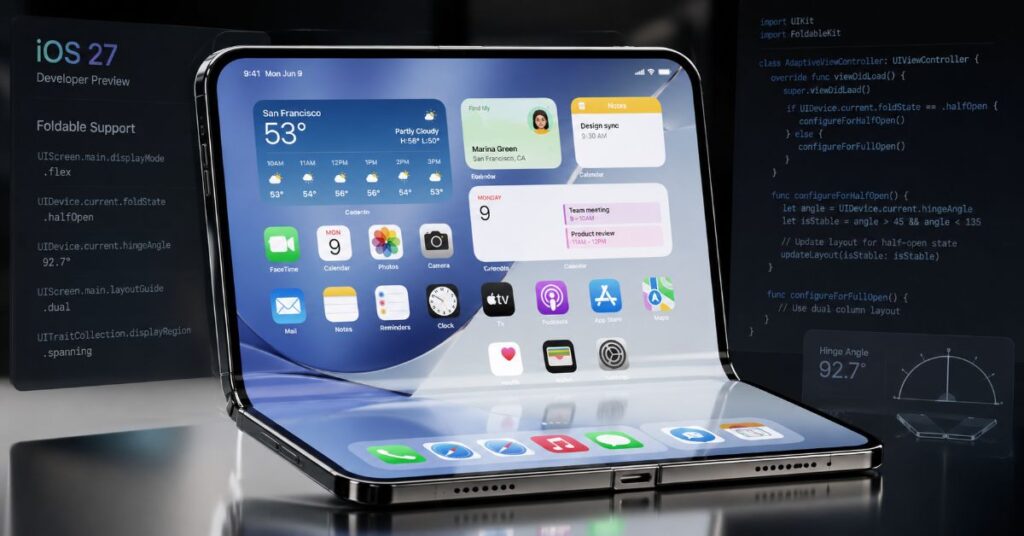
Summary of Major Developments
- foldState and angleDegrees strings discovered by developer Sam Henri Gold — June 8, 2026: Hours after Apple released iOS 27 Beta 1 at WWDC 2026 on June 8, developer Sam Henri Gold discovered and published hidden code strings within the iOS 27 frameworks that had no equivalent in iOS 26. The strings include ‘foldState’, ‘angleDegrees’, ‘mechanicalAngleDegrees’, and ‘isanglevalid’ — terms that are only meaningful for a device with a hinge mechanism that can detect its own folding state and angle. 9to5Mac independently confirmed the existence of these references in the same day. A separate developer, M1Astra, shared additional references with Bloomberg’s Mark Gurman, including ‘MGGetLogicalDeviceDisplayCount’ — a function for detecting how many built-in displays a device is running.
- Apple’s Service Utility references secondary display, two ambient light sensors, and second cover glass: Beyond the framework code strings, Apple’s Service Utility — the internal tool used by Apple and authorised service providers to calibrate and repair iPhone displays — contains code referencing a secondary display, two ambient light sensors, and a second cover glass. None of these components exist in any current Apple device. Their presence in iOS 27 indicates that Apple is actively preparing its internal service and repair tooling for a device with a foldable form factor — a level of preparation that goes well beyond experimental code.
- Rumoured device: iPhone Ultra — ~$2,000, book-style, 7.8-inch inner display: Leaked specifications and analyst reporting converge on an ‘iPhone Ultra’ as the device name, featuring a book-style folding design with approximately a 7.8-inch inner display and a 5.5-inch cover display. Mark Gurman has reported an expected price of approximately $2,000 — which would make it the most expensive iPhone ever released. A titanium frame with a Liquid Metal hinge, Touch ID (instead of Face ID), and a free-stop hinge similar to Samsung’s Galaxy Z Fold are among the hardware features cited in multiple leak reports. An expected September 2026 announcement alongside the iPhone 18 series is widely anticipated.
Technical Breakdown: What the Code Actually Reveals
The iOS 27 code references to foldable hardware are not accidental. Apple routinely buries product hints in early software betas — not because it intends to disclose them, but because building the software infrastructure for new hardware form factors requires embedding that infrastructure into the operating system before the hardware ships. When 9to5Mac confirms the existence of references that were absent in iOS 26 and present in iOS 27, the most parsimonious explanation is that Apple has added this code to support a device it is preparing to ship.
The specific strings are architecturally informative. ‘foldState’ is a boolean or enum value that tells the operating system whether the device is currently folded or unfolded — a state that iOS needs to know to determine which apps should be active, which display should be primary, and what orientation logic should apply. ‘angleDegrees’ and ‘mechanicalAngleDegrees’ represent two different measurements of the hinge angle: the software-computed angle (angleDegrees) and the physically measured angle from the hinge mechanism itself (mechanicalAngleDegrees). ‘isanglevalid’ is a validation flag that checks whether the angle reading is within an acceptable range — a safety check for the hinge mechanism. ‘MGGetLogicalDeviceDisplayCount’ is a system function that returns the number of active built-in displays — a function that is unnecessary on any current single-display iPhone but essential for managing a device that transitions between one-display (folded) and two-display (unfolded) states.
The Service Utility references are the most operationally telling evidence in the disclosure. Apple’s Service Utility is not a consumer-facing application or a public API — it is the internal tooling used by Apple Store Genius Bar technicians and authorised service providers to diagnose, calibrate, and repair Apple hardware. Populating Service Utility with references to a secondary display, two ambient light sensors, and a second cover glass means Apple is already preparing its repair and calibration infrastructure for a device that has those components. This level of operational preparation — building service tooling — indicates a device that is past the experimental prototype stage and into hardware validation and production planning.
At WWDC’s Platforms State of the Union session — the developer-focused session that follows the main keynote — Apple explicitly encouraged developers to stop designing apps around fixed screen size assumptions and instead ensure apps can resize dynamically and adapt fluidly to different screen configurations. Macworld notes that this advice, while generic on its face, carries a specific implication when combined with the code evidence: Apple is preparing the developer ecosystem for an imminent device whose defining feature is a screen that changes size. The extra-large widget size for the Home Screen and the ability to resize iPhone-mirrored apps on Mac Golden Gate — both announced at WWDC — are consistent with UI infrastructure being built for a larger, tablet-like screen configuration.
| Code Reference | Location in iOS 27 | What It Indicates | Absent in iOS 26? |
| foldState | iOS 27 developer frameworks | OS state detection for folded vs unfolded device | Yes — not present in iOS 26 |
| angleDegrees | iOS 27 developer frameworks | Software-computed hinge angle reading | Yes — not present in iOS 26 |
| mechanicalAngleDegrees | iOS 27 developer frameworks | Physical hinge angle sensor reading | Yes — not present in iOS 26 |
| isanglevalid | iOS 27 developer frameworks | Validation flag for hinge angle sensor readings | Yes — not present in iOS 26 |
| MGGetLogicalDeviceDisplayCount | iOS 27 beta framework MG keys | Count of built-in displays — irrelevant for single-display device | Yes — not present in iOS 26 |
| Secondary display reference | Apple Service Utility (internal repair tool) | Service and calibration support for a second screen | Not applicable — service utility is internal |
| Two ambient light sensors | Apple Service Utility | Calibration for dual-display brightness management | Not applicable |
| Second cover glass reference | Apple Service Utility | Repair and calibration for dual-glass foldable form factor | Not applicable |
| Extra-large widget size | iOS 27 Home Screen | UI infrastructure for larger display configuration | Yes — new in iOS 27 |
| Dynamic app resize encouragement | WWDC Platforms State of the Union | Developer preparation for screen-size-changing device | Not previously emphasised |
Commercial and Enterprise Market Impact
For the consumer smartphone market, an Apple entry into foldables in September 2026 would be the category’s most significant commercial event since Samsung released the original Galaxy Fold in 2019. Apple’s entry typically defines and legitimises a hardware category in a way that no competitor can achieve regardless of market share. Samsung, Huawei, Google, and Motorola have all shipped multiple generations of foldable devices, but the category has remained a premium niche. Apple’s participation — at an anticipated $2,000 price point that matches the premium end of the existing foldable market — would validate the form factor for consumers and enterprises that have been waiting for Apple’s design and software quality standard to arrive before committing.
For enterprise mobile device management, an iPhone foldable introduces a new hardware category that requires policy updates. A device that transitions between phone and tablet form factors in a single device raises questions about app management (which apps are active in which state?), data security (is the expanded screen treated as a different security zone?), and MDM profile compatibility (do existing profiles apply to the foldable state’s tablet UI?). Enterprise IT teams that manage iPhone fleets at scale should begin reviewing their MDM configurations for foldable device compatibility before the September 2026 Apple hardware event, rather than after.
“The Service Utility references are the smoking gun. Apple does not write service and calibration code for devices it has not committed to manufacturing. The presence of secondary display, second cover glass, and dual ambient light sensor references in the internal repair tooling means Apple has been through the manufacturing validation process far enough that its service organisation has begun preparing. That is a device in production planning, not a device in a research lab.” — Apple Hardware Supply Chain Analyst, institutional technology research, June 10, 2026
“At $2,000, the iPhone Ultra would be the highest-margin device Apple has ever shipped at launch. The foldable premium over the iPhone 18 Pro Max will be significant — probably $600 to $800 above the Pro Max price. For a company preparing an IPO narrative around services and premium hardware, an iPhone that anchors at $2,000 is a powerful revenue per user story. John Ternus inherits not just the Siri rebuild challenge but the launch of the most expensive iPhone in history.” — Consumer Technology Financial Analyst, equity research, June 10, 2026
Frequently Asked Questions
What is the evidence that Apple is making a foldable iPhone?
iOS 27 Beta 1 — released at WWDC on June 8, 2026 — contains multiple code references with no equivalent in iOS 26 that point specifically to a foldable device. Developer Sam Henri Gold discovered strings including ‘foldState’, ‘angleDegrees’, ‘mechanicalAngleDegrees’, and a function to count built-in displays. 9to5Mac independently confirmed all references. Apple’s internal Service Utility contains references to a secondary display, two ambient light sensors, and a second cover glass — operational preparation for a dual-display device. At WWDC’s Platforms State of the Union, Apple instructed developers to build apps that resize dynamically for different screen configurations.
What will the foldable iPhone be called and how much will it cost?
Based on analyst and leak reporting, the device is expected to be called the iPhone Ultra. Rumoured specifications include a book-style design with approximately a 7.8-inch inner display and 5.5-inch cover display, a titanium frame with a Liquid Metal free-stop hinge, Touch ID (instead of Face ID), and a price of approximately $2,000 according to Mark Gurman’s reporting. An announcement alongside the iPhone 18 series at Apple’s fall hardware event — typically held in September — is widely anticipated. Apple has not officially announced the device.
Will the foldable iPhone run iOS 27?
Based on the code evidence, yes. The foldable-specific code strings discovered in iOS 27 Beta 1 — ‘foldState’, ‘angleDegrees’, and the display count function — were not present in iOS 26. Their inclusion in iOS 27 indicates that iOS 27 is being prepared to support a foldable form factor. This is consistent with Apple’s historical pattern of preparing its operating system for new hardware categories before publicly announcing the hardware. The public release of iOS 27 is expected in September 2026 alongside new iPhone hardware.
Sources
Cult of Mac. (2026, June 9). Foldable iPhone gets biggest clue yet in iOS 27 beta. https://www.cultofmac.com/news/foldable-iphone-gets-biggest-clue-yet-ios-27-beta
9to5Mac. (2026, June 8). Apple leaks foldable iPhone references in iOS 27 beta. https://9to5mac.com/2026/06/08/apple-leaks-foldable-iphone-references-in-ios-27-beta/
TechCrunch. (2026, June 9). Apple’s foldable iPhone could be just around the corner. https://techcrunch.com/2026/06/09/apples-foldable-iphone-could-be-just-around-the-corner/
Macworld. (2026, June 9). Apple left some major folding iPhone hints in the iOS 27 code. https://www.macworld.com/article/3159979/apple-left-some-major-folding-iphone-hints-in-the-ios-27-code.html
AppleInsider. (2026, June 8). iOS 27 code has clear signs that a folding iPhone is coming soon. https://appleinsider.com/articles/26/06/08/ios-27-code-has-clear-signs-that-a-folding-iphone-is-coming-soon
Technobezz. (2026). iOS 27 Code References Confirm Apple Is Preparing a Foldable iPhone. https://www.technobezz.com/news/ios-27-code-references-confirm-apple-is-preparing-a-foldable-iphone
HotHardware. (2026). iOS 27 Beta Code Exposes Apple’s Secret Foldable iPhone Blueprint. https://hothardware.com/news/ios-27-beta-code-foldable-iphone
