
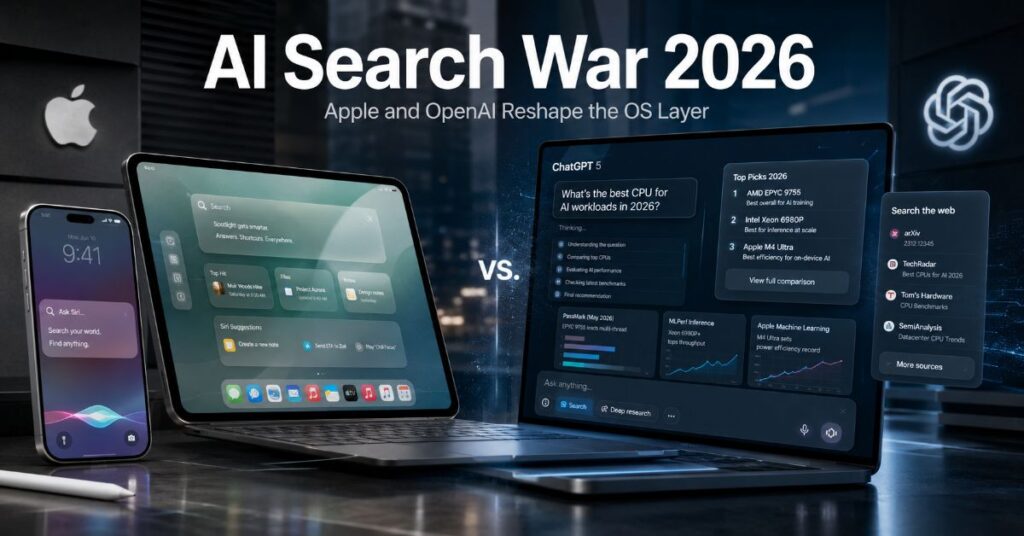
Two announcements made within 24 hours on June 8, 2026, individually look like a product launch and a financial filing. Together, they mark a structural inflection point in the AI search ecosystem that every company competing for the AI query layer needs to understand.
Apple announced that Siri AI — rebuilt on Google Gemini — can now answer discovery questions by reaching out to the web, while simultaneously understanding your personal context across every app on your device. OpenAI filed a confidential S-1 targeting a $1 trillion public valuation, one week after Anthropic made the same move. What connects these two events is not coincidence. Both are moves in the same battle: the fight to own the layer of the computing stack where users get answers.
This is the battle for the OS layer. Its outcome will determine which AI companies survive the next consolidation wave, which search engines retain their traffic, and whether alternative answer engines like Perplexity have a path to scale or face structural distribution barriers they cannot overcome.
What the OS Layer Is and Why It Matters Now
The OS layer is the interface through which users interact with their devices before they choose a specific application. Until 2024, it was a routing mechanism. Apple’s Siri heard questions and sent users to Safari or Google to get answers. The query left the OS and entered a search engine.
Siri AI is categorically different. It answers questions — by searching your personal context on-device and by querying the web for world knowledge. For discovery queries that would previously have opened Safari, Siri AI now provides an answer within the iOS interface. The user never opens a browser. The query never reaches a search engine.
This is not an incremental improvement to a voice assistant. It is the operating system reclaiming queries that it previously handed off to third parties. The implications for every company whose business model depends on receiving those queries — Google, Bing, and Perplexity AI — are structural, not marginal.
Apple’s Dual-Layer Moat: Personal Context Plus World Knowledge
The most strategically significant design decision in Siri AI is the explicit architecture that separates personal context (on-device) from world knowledge (cloud via Gemini). This is not just a privacy architecture — it is a competitive moat construction.
Personal context is the data no external AI company can access: your messages, emails, photos, files, and calendar. No Perplexity search, no ChatGPT query, no Google AI Overview can know what was in your friend’s text from last Tuesday unless you explicitly share it. Apple owns this data by virtue of operating the device. Siri AI uses it to provide answers that are not just generally correct but specifically correct for you — answers that no search engine can match.
World knowledge is the data every AI company competes to provide best. By integrating Gemini for world knowledge, Apple solved its frontier AI capability gap without building a frontier model — outsourcing the commodity intelligence layer to the world’s most capable provider while retaining exclusive ownership of the personal context layer that makes answers uniquely valuable.
The combination creates a moat that is structurally difficult to attack. Perplexity can build a better web search engine. Google can build a better knowledge graph. Neither can access the on-device personal context layer that makes Siri AI’s answers relevant to each individual user. That moat deepens with every message sent, every email received, every photo taken on an Apple device.
The Threat to Perplexity: Distribution Risk at the OS Level
For Perplexity AI, the Siri AI announcement is the clearest statement yet of the structural challenge it faces. Perplexity has built a genuinely superior web answer engine — cited, real-time, conversational answers that outperform traditional search for many query types. Its 169,000 monthly sessions and 181 AI-cited pages on perplexityaimagazine.com illustrate how AI-native publications are building meaningful Perplexity-driven traffic.
But Perplexity’s distribution depends on users actively choosing it. It requires opening a browser, navigating to the app, or making a deliberate choice. In a world where Siri AI answers discovery queries before the user opens Safari, a meaningful percentage of the queries that would previously have become Perplexity visits will now be answered within iOS. Perplexity never sees them.
The countervailing opportunity is the iOS 27 model toggle. Users can set ChatGPT or Claude as their Siri AI model. Apple has a historical precedent of allowing alternative search engines as Safari defaults. If the architecture allows third-party answer engines to serve the world knowledge tier, Perplexity could position itself as the default for users who prefer citation-rich, source-attributed answers over Gemini’s synthesis. Apple’s $1 billion per year Gemini licence almost certainly includes exclusivity provisions that prevent this during the licence term — but those terms have end dates. The strategic question for Perplexity is whether it can build the user demand signal that makes a Perplexity-Apple partnership commercially attractive when that window opens.
What OpenAI’s IPO Means for the Search Ecosystem
A public OpenAI is a financially constrained OpenAI. Public companies face quarterly reporting obligations and shareholder pressure to maximise near-term revenue metrics. The product rationalisation that OpenAI has already executed — closing Sora, concentrating on Codex and enterprise AI — previews the decision-making discipline that public markets will enforce at scale.
For AI search, this means ChatGPT’s search capabilities will either be monetised aggressively as a standalone product or deprioritised in favour of higher-ARR enterprise lines. Public investors will not accept a search product that competes at significant infrastructure cost without a clear revenue model. As OpenAI moves toward IPO, it may be less willing to subsidise ChatGPT’s free web search capabilities — opening space for Perplexity to occupy the premium web answer engine position for users who want search-quality answers with citations rather than LLM synthesis without attribution.
Anthropic’s parallel IPO preparation creates the same dynamic for Claude. As Anthropic’s institutional investors from the $65 billion Series H demand returns, Anthropic will concentrate on its highest-margin enterprise streams rather than subsidising consumer AI search features. The IPO pressure hitting both major AI platforms simultaneously may be Perplexity’s best distribution opportunity since its launch.
The Competitive Map: Who Controls What
| Layer | Current Control | Perplexity Position | Strategic Assessment |
| Personal context (messages, email, photos, files, calendar) | Apple — exclusive on-device | None — structural exclusion by design | Permanent moat — cannot be competed away |
| OS-level query interception (Siri AI default) | Apple — captures queries pre-search | Indirect — depends on Apple partnership | High threat to casual search volume |
| World knowledge / web synthesis (Siri AI cloud) | Google Gemini (exclusive licence ~$1B/yr) | Excluded during licence term | Medium-term threat — potentially addressable at contract renewal |
| Consumer AI answer engine (direct access) | Perplexity’s core position | Full ownership — active user base | Home turf — defensible with quality and citation differentiation |
| AI-cited content in LLM answers | All frontier models cite web content including PAM | 181 cited pages — active GEO channel | Active opportunity — GEO is a growing distribution path |
| ChatGPT free web search | OpenAI — shrinking under IPO pressure | Growing opportunity as free tier narrows | Medium-term opportunity as OpenAI monetises search |
| Enterprise AI search | OpenAI + Anthropic dominant | Limited focus — consumer/prosumer target | Low competition risk — different segment |
The Path Forward for Perplexity and AI-Native Publishers
The WWDC 2026 Siri AI announcement and OpenAI’s S-1, taken together, clarify the competitive landscape for the next 18 months. Apple is building a personal context moat that no external AI can penetrate. Google is paying $1 billion per year to be the world knowledge layer of the OS. OpenAI and Anthropic are moving toward public markets, which will impose financial discipline on their consumer AI subsidies.
Within this landscape, Perplexity’s most defensible position is the one it already occupies: the premium AI answer engine for users who actively choose it. The addressable market for this position is real, growing, and underserved by OS-layer alternatives. A user who needs cited, verifiable, source-attributed answers — journalist, researcher, analyst, student, professional — will not be satisfied by a Siri AI answer that synthesises without citation. Perplexity’s model of showing sources, ranking by recency and credibility, and linking directly to primary materials is not something a consumer OS assistant will replicate at scale.
The second path is the GEO opportunity. As frontier AI models — including Siri AI’s world knowledge tier, ChatGPT, Claude, and Gemini — cite web content in their answers, publishers who optimise for AI citation generate traffic and brand reach through LLM surfaces that bypass traditional search entirely. Perplexity AI Magazine’s own data — 169,000 monthly sessions, 181 AI-cited pages, 87% US traffic — demonstrates that GEO is not theoretical. It is a measurable, growing distribution channel that operates in parallel with and partially independently of the OS-layer query competition.
The OS layer battle is real. The structural threats to AI search distribution are genuine. But the battle is being fought on territory that Perplexity does not need to win to build a durable business. It needs to win the users who choose it — and the IPO pressure compressing every major AI platform’s consumer subsidy budgets means there are more of those users available every quarter.
“Apple has built the most sophisticated personal context moat in the history of consumer technology. Fourteen years of messages, emails, photos, and calendar data on a locked device that can be queried privately — nobody else has that. Perplexity cannot compete on that dimension. What it can compete on is the quality and credibility of its web answers. And on that dimension, it can win.” — AI Search Ecosystem Analyst, enterprise digital research, June 9, 2026
“The OpenAI IPO changes the AI search dynamic in a way most people are missing. A public OpenAI cannot subsidise free ChatGPT web search indefinitely under quarterly earnings pressure. As the free tier shrinks, Perplexity’s premium answer engine position becomes more differentiated, not less. The IPO is both a validation of the AI search market and a clearing of the field for Perplexity in the consumer segment.” — AI Market Strategy Analyst, technology equity research, June 9, 2026
Frequently Asked Questions
Does Siri AI in iOS 27 directly compete with Perplexity AI?
Partially. Siri AI’s world knowledge capability — powered by Gemini — can answer discovery queries that would previously have become Perplexity searches. For users whose default is to ask Siri, some queries that might have reached Perplexity will now be answered within iOS. However, Siri AI does not replicate Perplexity’s citation-rich, source-attributed answer format. Users who specifically value cited, verifiable answers with direct links to primary sources will not be satisfied by Siri AI’s synthesised responses. Perplexity’s addressable market is users who actively choose it — and Siri AI’s default interception primarily affects users who were not Perplexity’s core base.
Could Perplexity become a selectable answer engine within Siri AI?
Potentially, but the commercial dynamics are restrictive in the near term. Apple reportedly pays Google approximately $1 billion per year for the Gemini world knowledge licence, which almost certainly includes exclusivity provisions preventing a competing answer engine from serving that tier during the licence term. However, iOS 27 introduces a model toggle for ChatGPT and Claude. Apple has a historical precedent of allowing alternative search defaults in Safari. If and when the Gemini exclusivity window expires, a Perplexity-Apple partnership for the AI answer engine position is commercially conceivable — but requires Apple to see measurable user demand for citation-rich answers over Gemini synthesis.
How does the OpenAI IPO affect Perplexity’s competitive position?
The OpenAI IPO creates a mixed but net-positive competitive signal for Perplexity. A public OpenAI facing quarterly earnings pressure is likely to monetise ChatGPT’s web search features more aggressively or deprioritise them in favour of higher-margin enterprise revenue. As the free tier of ChatGPT’s search capabilities shrinks under public market discipline, Perplexity’s premium answer engine position becomes more differentiated. Additionally, as OpenAI concentrates on Codex enterprise revenue, it will likely reduce the consumer AI subsidies that have kept ChatGPT’s free tier competitive with Perplexity for casual queries. The IPO validates the AI search TAM and simultaneously clears competitive capacity from the consumer segment.
Sources
OpenAI. (2026, June 8). Blog: We recently submitted a confidential S-1. https://openai.com/blog/openai-s1
Apple WWDC 2026 Keynote. Craig Federighi statement — Siri AI feature description. Apple Park, June 8, 2026.
CNBC. (2026, June 8). Sam Altman: ‘race to deliver the best technology and build the best business.’ https://www.cnbc.com/2026/06/08/openai-ipo-confidential-s1-filing.html
TechTimes. (2026, June 8). Apple WWDC 2026: Siri Rebuilt on Gemini. https://www.techtimes.com/articles/317985/20260608/
Anthropic. (2026, June 1). Series H — $65B at $965B valuation, IPO filing confirmed. https://www.anthropic.com/news/series-h
LiveNewschat. (2026, June 8). Tim Cook’s Final WWDC Keynote Bets Apple’s AI Future On Google’s Gemini. https://livenewschat.eu/apple-wwdc-2026-tim-cook-siri-gemini-keynote/
