
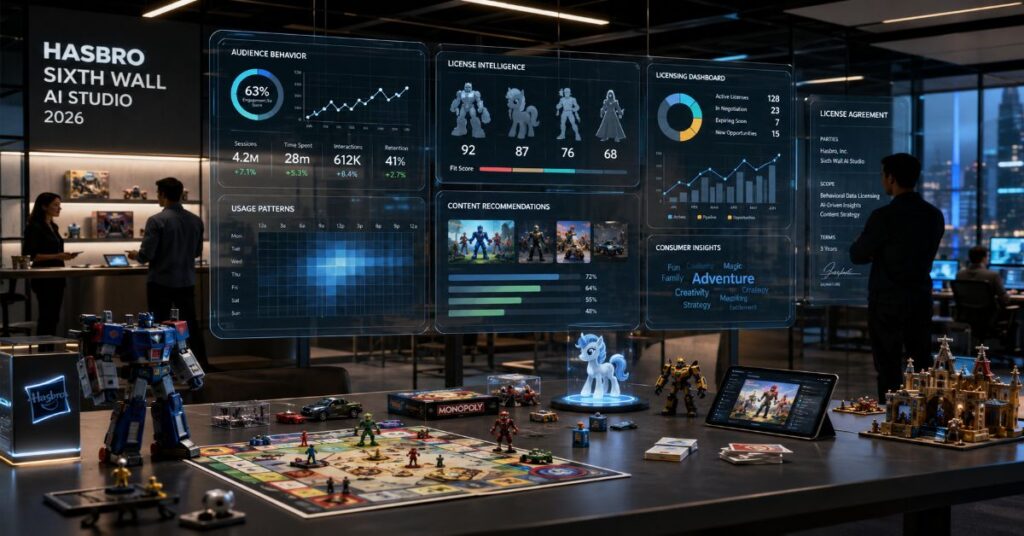
Summary of Major Developments
- Sixth Wall launched June 3, 2026 — receiving broad coverage as of June 10: Hasbro officially launched Sixth Wall on June 3, 2026 — a dedicated AI studio focused on bringing Hasbro’s catalogue of iconic intellectual properties into AI-native interactive experiences. The studio was announced alongside a strategic partnership with ElevenLabs, the AI audio company, and the introduction of Behavioral Licensing — a new category of IP licensing that Hasbro is positioning as the commercial framework for character IP in the AI era. Coverage is expanding significantly this week as the industry digests the implications.
- 12 characters including Optimus Prime, Megatron, Cobra Commander available at launch: Twelve Hasbro characters are available through the ElevenLabs Iconic Marketplace at launch, with voice performances from authorised actors under a compensation model for participating talent. The launch characters include Optimus Prime, Megatron, Cobra Commander, Mr. Potato Head, and characters from the board game Clue. Additional characters are planned for later in 2026. Characters are available for licensed use in interactive experiences and enterprise use cases — chat, voice, gaming, and content creation platforms.
- CharacterOS — the platform that makes Behavioral Licensing possible: Sixth Wall operates through CharacterOS, a proprietary software system that preserves a character’s personality, canonical voice, and safety guardrails across any interactive experience that licences it. CharacterOS is Hasbro’s answer to the proliferation of unauthorised AI character versions: millions of consumers are already encountering non-canonical, unlicensed versions of popular characters in chat bots, voice tools, and gaming platforms. CharacterOS provides an authorised, quality-controlled alternative with a commercial framework that benefits Hasbro, voice talent, and developers simultaneously.
Technical Breakdown: What Behavioral Licensing Is and Why It Is New
Traditional IP licensing covers how a character looks and is named — the visual identity and trademark protections that prevent unauthorised use of a character’s appearance in commercial products. When a toy manufacturer licences Optimus Prime from Hasbro, it licences the right to produce a physical product that looks like and is identified as Optimus Prime. The character’s personality, dialogue, decision-making, and behavioural patterns are not part of the licence — they are the creative output of the production that uses the character.
In an AI-native context, this traditional licensing model is insufficient. An AI-powered Optimus Prime character in a children’s educational game needs to behave consistently with the canonical version — its voice, its ethics, its characteristic phrases, its emotional responses — not just look like him. An unlicensed AI model prompted to roleplay as Optimus Prime can behave in ways that are out of character, offensive, or brand-damaging without any legal mechanism to prevent it. Behavioral Licensing addresses this gap by extending IP protection from appearance to behaviour.
CharacterOS is the technical implementation of Behavioral Licensing. It is a system that encodes a character’s canonical personality traits, dialogue patterns, knowledge base, and behavioural boundaries into a deployable AI model that any licensed developer can access. When a developer integrates Optimus Prime through CharacterOS, the character’s responses are generated by a model that has been trained and constrained to produce responses consistent with Optimus Prime’s canonical characterisation — using authorised source material and voice performances from the actors who hold the professional relationship with the character. The safety guardrails in CharacterOS prevent the character from being used in contexts that violate Hasbro’s content policies or the talent’s participation agreements.
Hasbro CEO Chris Cocks described the commercial logic at the studio launch: ‘CharacterOS is compelling because it unlocks a bigger creative canvas while addressing a real challenge in AI: the unauthorized use of content. It is built around a creator-first model that gives voice talent and creatives a meaningful seat at the table. It gives brands a trusted way to bring characters into new AI-enabled platforms without losing what makes them authentic.’ The talent compensation model — under which voice actors receive payment for AI use of their performances, limited to interactive experiences rather than films or television — is Hasbro’s attempt to build an IP licensing framework that is commercially viable and ethically defensible in a creative industry context where AI use of talent is highly contested.
| Dimension | Traditional IP Licensing | Behavioral Licensing (Sixth Wall/CharacterOS) |
| What is licensed | Visual appearance, name, trademark | Personality, voice, behaviour patterns, canonical knowledge — and appearance |
| How enforced | Legal trademark and copyright | CharacterOS: technical guardrails enforce behavioural boundaries at API level |
| Talent participation | Not relevant to standard IP licence | Authorised voice performances with compensation model for AI use |
| Content safety | Brand guidelines (advisory) | Safety guardrails built into CharacterOS — enforced, not advisory |
| Use cases | Physical products, traditional media | Chat, voice AI, gaming, content creation — AI-native interactive experiences |
| Distribution partner | Traditional licensees | ElevenLabs Iconic Marketplace — AI audio ecosystem |
| Launch characters | N/A | Optimus Prime, Megatron, Cobra Commander, Mr. Potato Head, Clue characters — 12 total at launch |
| Target for children | Included in traditional licensing | Hasbro stated it is NOT currently developing AI products targeted at young children |
Commercial and Enterprise Market Impact
For the broader entertainment and IP industry, Sixth Wall’s launch represents the first commercially structured answer to one of AI’s most significant content rights challenges. The proliferation of AI-generated character content — chatbots pretending to be Marvel superheroes, voice tools impersonating film characters, game NPCs modelled on unauthorised celebrity likenesses — has created a market for unauthorised AI character use that traditional IP enforcement cannot adequately address. Legal action is too slow, too expensive, and too reactive for the pace at which AI content generation proliferates. CharacterOS offers a proactive alternative: an authorised option that is more capable, more authentic, and commercially beneficial to the rights holder than the unauthorised versions it competes with.
The ElevenLabs partnership is strategically significant because it routes Hasbro’s authorised characters into the AI audio ecosystem that is already building the infrastructure for AI voice experiences. ElevenLabs’ Iconic Marketplace positions licensed AI character voices alongside other premium voice products — giving developers a single commercial and technical integration point for adding authorised character audio to their applications. For developers building interactive experiences that involve Hasbro IP, the Iconic Marketplace provides a turnkey solution that avoids the IP risk of generating unlicensed character voices.
“Behavioral Licensing is the IP framework that the AI content industry has been waiting for. Traditional licensing was built for a world where characters appear in fixed media. The AI world requires licensing how characters behave dynamically, across infinite possible interactions, in real time. CharacterOS is the first serious technical implementation of that concept at commercial scale — and Optimus Prime’s voice is a better market entry point than almost anything else in the IP catalogue.” — Entertainment IP and Licensing Analyst, digital media research, June 10, 2026
“The talent compensation model is the detail that separates Sixth Wall from every other AI IP licensing attempt I’ve seen. Hasbro is not just licensing characters to AI platforms — it is creating a revenue channel for the voice actors who built those characters. That creates alignment between the rights holder, the talent, and the licensee. It is the only sustainable commercial model for AI character licensing in an industry where talent relationships matter.” — Digital Entertainment Business Analyst, media technology advisory, June 10, 2026
Frequently Asked Questions
What is Hasbro’s Sixth Wall and what does it do?
Sixth Wall is Hasbro’s dedicated AI studio, launched June 3, 2026, focused on licensing Hasbro’s iconic character IP for AI-driven interactive experiences including chat, voice AI, gaming, and content creation platforms. It operates through CharacterOS — a proprietary platform that preserves a character’s canonical personality, voice, and safety guardrails in any licensed deployment. Sixth Wall addresses the widespread problem of unauthorised AI versions of popular characters by providing an authorised, quality-controlled, commercially structured alternative. It launched with 12 characters available through the ElevenLabs Iconic Marketplace, including Optimus Prime, Megatron, Cobra Commander, and Mr. Potato Head.
What is Behavioral Licensing and how is it different from traditional IP licensing?
Behavioral Licensing is a new IP licensing category introduced by Hasbro with the Sixth Wall launch. Traditional IP licensing covers how a character looks and is named — its visual appearance and trademark. Behavioral Licensing extends the licence to cover how a character thinks, speaks, and behaves in dynamic, interactive experiences. It is enforced through CharacterOS: a technical system that encodes the character’s canonical personality, dialogue patterns, and safety boundaries into every licensed deployment. Instead of licensing a static image of Optimus Prime, Behavioral Licensing licences the dynamic behaviour of Optimus Prime across any interactive context where he might appear.
Are Hasbro’s AI characters safe for use with children?
Hasbro has stated explicitly that Sixth Wall is not currently developing AI products targeted at young children, and is actively contributing to broader industry discussions around safety standards for AI-enabled play experiences. The 12 characters available at launch — including Optimus Prime, Megatron, Cobra Commander, Mr. Potato Head, and Clue characters — are available for licensed use in ‘experiences and enterprise use cases.’ CharacterOS includes safety guardrails that prevent characters from being used in contexts that violate Hasbro’s content policies, but the current launch is not positioned as a children’s product.
Sources
Hasbro Newsroom / Business Wire. (2026, June 3). Hasbro Launches Sixth Wall, a New AI Studio Building the Next Generation of Character Experiences. https://newsroom.hasbro.com/news-releases/news-release-details/hasbro-launches-sixth-wall-new-ai-studio-building-next
Marketing Tech News. (2026, June 10). Hasbro launches Sixth Wall AI studio for authorized character licensing. https://www.marketingtechnews.net/news/hasbro-sixth-wall-ai-studio-character-licensing/
The Wrap. (2026, June 3). Hasbro Launches AI Studio Sixth Wall for Authorized Character Licensing. https://www.thewrap.com/industry-news/business/hasbro-ai-studio-sixth-wall-launch/
License Global. (2026, June 4). Hasbro Launches Sixth Wall AI Studio, Partners with ElevenLabs. https://www.licenseglobal.com/technology/hasbro-launches-sixth-wall-ai-studio-partners-with-elevenlabs-for-character-licensing
ICv2. (2026, June 4). Hasbro Launches AI Studio. https://icv2.com/articles/news/view/62538/hasbro-launches-ai-studio
