
Summary of Major Developments
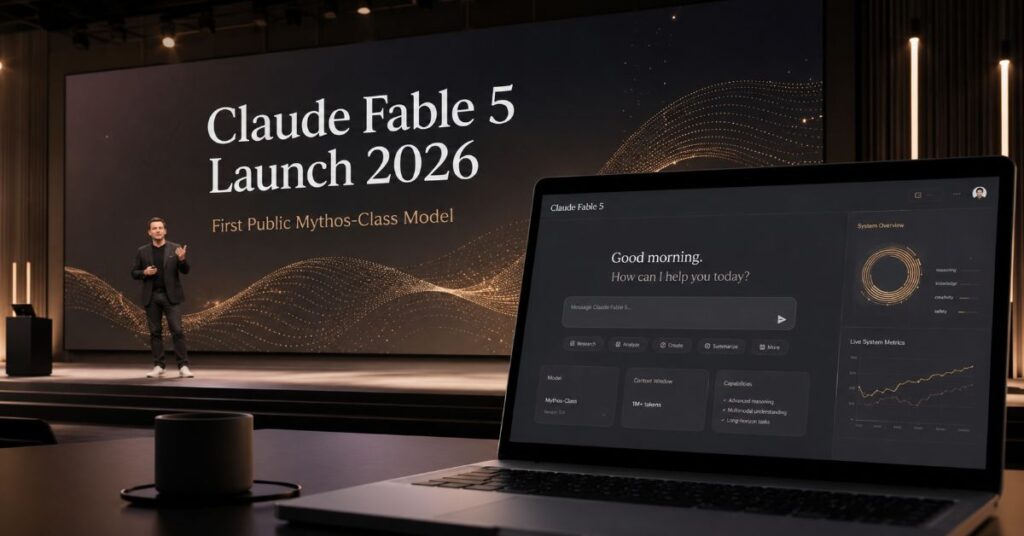
- Released June 9, 2026 — first Mythos-class model available to the public: Anthropic released Claude Fable 5 on June 9, 2026, making a Mythos-class AI capability widely available for the first time. Until now, Mythos-class models were restricted to a select group of vetted organisations through Project Glasswing due to their exceptional ability to find and exploit software vulnerabilities. Fable 5 is the publicly accessible sibling — same underlying capability, with safety classifiers that redirect high-risk queries rather than answering them. The model is available immediately through the Claude API (model ID: claude-fable-5), Claude apps, Amazon Bedrock, Google Cloud, and Microsoft Azure AI Foundry.
- Free for Pro, Max, Team and Enterprise until June 22: Claude Fable 5 is available at no extra charge to Pro, Max, Team, and seat-based Enterprise subscribers through June 22, 2026. After June 22, it transitions to usage-based pricing at $10 per million input tokens and $50 per million output tokens — exactly double Opus 4.8 pricing. A 90% discount applies with prompt caching. The model supports a 1 million token context window and 128,000 maximum output tokens.
- 80.3% on SWE-Bench Pro — compressed months of engineering into days: Anthropic reports that Fable 5 achieves 80.3% on SWE-Bench Pro — compared to 69.2% for Claude Opus 4.8 and GPT-5.5 at 88.7%. In one internal test, Fable 5 migrated a Ruby codebase of 50 million lines in a single day — a task Anthropic says would have taken an entire engineering team more than two months. GitHub confirmed in a statement: ‘Fable 5 is a real step forward for the developers GitHub serves. In our early testing, it took on complex, long-horizon coding tasks with a level of autonomy and reliability that exceeded previous benchmarks.’
Technical Breakdown: Fable 5 vs Mythos 5 — Two Siblings, One Architecture
Fable 5 and Mythos 5 are built on the same underlying model architecture — the distinction between them is not capability but access control. Mythos 5, released simultaneously through Project Glasswing, is the same model with certain safety classifiers removed. It is available only to organisations that have been vetted and approved through Glasswing’s trusted access programme — currently infrastructure providers, government cybersecurity teams, and select life sciences researchers. Fable 5 is designed for the remaining 99% of users: the public API, enterprise deployments, and developer workflows where the full cybersecurity capability would be unsafe to expose without guardrails.
The safety classifier architecture in Fable 5 operates as a router, not a refusal wall. When a query touches high-risk domains — offensive cybersecurity, biology, chemistry, or distillation of dangerous substances — Fable 5’s classifiers detect the risk category and reroute the response to Claude Opus 4.8 rather than answering from the Mythos-class capability. The rerouting is transparent to the user in the sense that they receive a response, but the response comes from a less capable model that was trained without the advanced vulnerability exploitation capabilities that make Mythos-class models dangerous in these domains. The API returns stop_reason: ‘refusal’ as an HTTP 200 status when this rerouting occurs, and the rerouted response is not billed at Fable 5 rates.
The capability improvement that makes Fable 5 commercially significant beyond its cybersecurity applications spans four domains: software engineering, knowledge work, vision, and life sciences research. For software engineering, the 50-million-line Ruby migration benchmark is the headline proof point, but the more commercially relevant figure is the SWE-Bench Pro score of 80.3% — a benchmark that measures the model’s ability to resolve real GitHub issues in production codebases. At 80.3%, Fable 5 leads all comparable models that Anthropic has publicly released on this benchmark. The model is described as ‘working more autonomously than any previous Claude model’, which is significant for Claude Code deployments where the model is operating across large codebases with minimal human intervention between steps.
The context window of 1 million tokens — maintained from Mythos Preview — is critical for the agentic software engineering use cases where Fable 5 is most differentiated. A 1 million token context allows the model to hold the full state of large codebases in its working context, enabling coherent reasoning across interdependent files and modules that would fragment or lose coherence in models with smaller windows. Combined with 128,000 maximum output tokens — the longest maximum output of any model Anthropic has publicly released — Fable 5 can generate complete, large-scale code outputs without truncation.
| Model | SWE-Bench Pro | Input price (per M tokens) | Output price (per M tokens) | Context window | Max output | Safety classifiers | Access |
| Claude Fable 5 | 80.3% | $10 | $50 | 1M tokens | 128K tokens | Yes — reroutes to Opus 4.8 for high-risk queries | Public API, Claude apps, Bedrock, Google Cloud, Azure |
| Claude Mythos 5 | 80.3% (same) | $10 | $50 | 1M tokens | 128K tokens | Partial — some classifiers removed | Project Glasswing only — vetted partners |
| Claude Mythos Preview | Not published | N/A (project access only) | N/A | 1M tokens | 128K tokens | Minimal — original Glasswing deployment | Project Glasswing only — expanded to 150 orgs June 2 |
| Claude Opus 4.8 | 69.2% | $5 | $25 | 200K tokens | 32K tokens | Standard | All paid plans |
| GPT-5.5 (OpenAI) | 88.7% | Varies by tier | Varies by tier | Not separately published | Not separately published | Standard | ChatGPT paid, API |
| Gemini 3.5 (Google) | Not published | Varies | Varies | 1M tokens | 8K tokens | Standard | Google AI Studio, Vertex AI |
Commercial and Enterprise Market Impact
The timing of Fable 5’s public release is commercially calibrated. Anthropic publicly warned — just days before the Fable 5 launch — that frontier AI systems are advancing so rapidly they may soon achieve recursive self-improvement: the ability to autonomously improve themselves without human intervention. The warning, combined with a simultaneous public release of the most capable model Anthropic has ever made available, sent a deliberate dual message to the market: we understand the risks, we are building the safeguards, and we are deploying at scale regardless. This is Anthropic’s stated ‘eventual goal’ — deploy Mythos-class models broadly while maintaining the safety architecture that makes broad deployment responsible.
For enterprise buyers, the free access window until June 22 is both a commercial offer and a technical forcing function. Enterprise teams that evaluate Fable 5 during the free window will generate performance data, build prompts, and develop workflow integrations that create switching costs after the pricing transition. Anthropic is using the free window to drive enterprise adoption velocity ahead of its IPO — each enterprise account that integrates Fable 5 before June 22 is a customer that will be billing at $10/$50 per million tokens from June 23 onward. At that pricing, Fable 5 is 2x Opus 4.8’s cost but delivers the first Mythos-class capability commercially available, which Anthropic expects to justify the premium for the majority of enterprise coding and knowledge work use cases.
“Fable 5 is the most commercially significant Anthropic release since Claude 3 Opus. Not because of the benchmark scores — although 80.3% on SWE-Bench Pro is a genuine capability milestone — but because of what it signals about Anthropic’s deployment philosophy. They are saying: we warned you this technology is dangerous, and now we are shipping it to everyone. The safety classifier architecture is their answer to how you do both simultaneously.” — Enterprise AI Platform Analyst, Fortune 500 technology company, June 10, 2026
“The 50 million line Ruby migration in a day is the number that enterprise engineering leadership needs to put in front of their boards. That is not a productivity improvement — it is a compression of engineering timelines by two orders of magnitude. At $10 per million tokens, the cost to run that migration at Fable 5 quality is a rounding error compared to the labour cost of doing it manually.” — Principal Software Engineering Manager, enterprise technology company, June 10, 2026
Frequently Asked Questions
What is the difference between Claude Fable 5 and Claude Mythos 5?
Both Claude Fable 5 and Claude Mythos 5 are built on the same underlying Mythos-class model architecture released June 9, 2026. The distinction is access control. Fable 5 includes safety classifiers that detect high-risk queries — in offensive cybersecurity, biology, chemistry, and distillation — and reroute those responses to Claude Opus 4.8 rather than answering from the full Mythos-class capability. Mythos 5 has some of these classifiers removed and is available only to vetted organisations through Project Glasswing. Fable 5 is available to anyone through the public API at $10/$50 per million input/output tokens.
How long is Claude Fable 5 free for Pro and Max subscribers?
Claude Fable 5 is available at no extra charge to Pro, Max, Team, and seat-based Enterprise subscribers through June 22, 2026. After June 22, Anthropic will transition it to usage-based pricing and work to restore it as a standard subscription feature as soon as possible. During the free window, Anthropic advises using Fable 5 in standard conversation mode rather than high-effort Workflow mode, which can exhaust daily token limits quickly given the model’s significantly higher token consumption rate versus Opus 4.8.
What does Claude Fable 5 do when it encounters a cybersecurity query?
When Claude Fable 5’s safety classifiers detect that a query touches a high-risk domain — offensive cybersecurity, biology, chemistry, or distillation — the model reroutes the response to Claude Opus 4.8 rather than answering from its Mythos-class capability. The API returns stop_reason: ‘refusal’ as an HTTP 200 status, and the rerouted response is not billed at Fable 5 rates. This architecture allows the model to remain available for legitimate security research and enterprise use while preventing the advanced vulnerability exploitation capability from being accessed through standard prompts.
Sources
Anthropic. (2026, June 9). Introducing Claude Fable 5. https://www.anthropic.com/news/claude-fable-5
TechCrunch. (2026, June 9). Anthropic released Claude Fable 5, its most powerful model publicly. https://techcrunch.com/2026/06/09/anthropic-released-claude-fable-5-its-most-powerful-model-publicly-days-after-warning-ai-is-getting-too-dangerous/
CNBC. (2026, June 9). Anthropic releases Mythos-like AI model to the public, Claude Fable 5. https://www.cnbc.com/2026/06/09/anthropic-mythos-claude-fable-5.html
gHacks Tech News. (2026, June 10). Anthropic Releases Claude Fable 5 to Pro, Max, and Enterprise Users Free Until June 22. https://www.ghacks.net/2026/06/10/anthropic-releases-claude-fable-5-to-pro-max-and-enterprise-users-free-until-june-22/
SD Times. (2026, June 9). Anthropic releases Claude Fable 5, Mythos 5. https://sdtimes.com/anthropic-releases-claude-fable-5-claud-mythos-5/
Codersera. (2026, June 10). Claude Fable 5: Anthropic’s New Mythos-Class Model. https://codersera.com/blog/claude-fable-5-launch-guide-2026/
Simon Willison. (2026, June 9). Initial impressions of Claude Fable 5. https://simonwillison.net/2026/Jun/9/claude-fable-5/
