
Summary of Major Developments
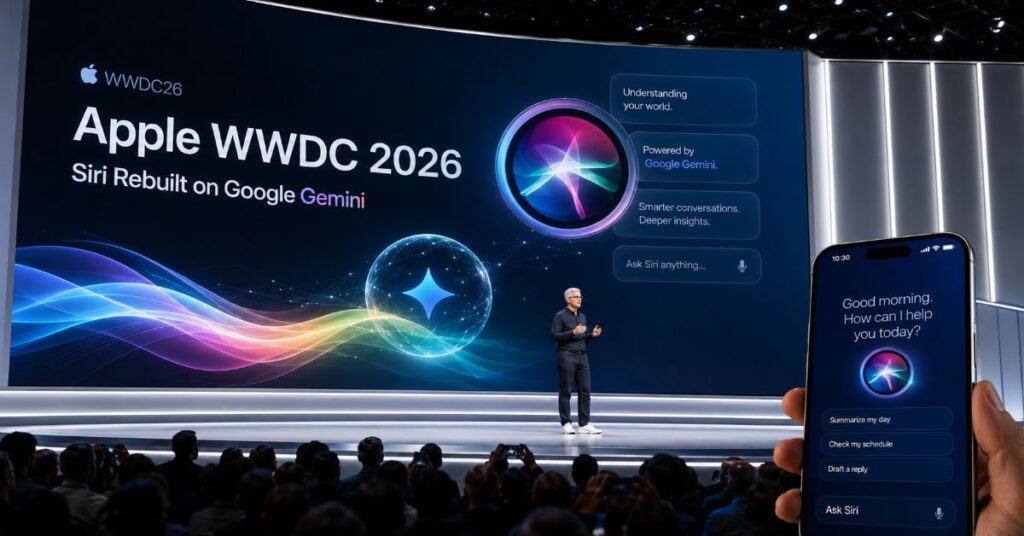
- Siri rebuilt on 1.2 trillion-parameter Gemini model: Apple unveiled a ground-up rebuild of Siri at WWDC 2026, powered by a custom licensed version of Google’s Gemini model with 1.2 trillion parameters. Apple will pay Google approximately $1 billion per year for the Gemini licence. The rebuilt Siri operates through a three-tier routing system: simple tasks stay on-device using Apple’s own models, moderately complex requests route to Apple’s Private Cloud Compute servers, and the heaviest reasoning tasks route to Google Cloud running on NVIDIA Blackwell B200 GPUs.
- iOS 27 lets users choose their AI model: In a major platform policy shift, iOS 27 introduces user-selectable AI model choice. Users can toggle Siri’s underlying model between Google Gemini (the default), OpenAI’s ChatGPT, and Anthropic’s Claude — each with a distinct voice. This makes iOS 27 the first major mobile operating system to offer users genuine choice of frontier AI model at the system level, rather than locking them into a single provider.
- Tim Cook’s final WWDC as CEO: Tim Cook delivered the keynote at Apple Park on June 8, 2026, marking his last WWDC as Apple’s chief executive. Cook announced in April that he will hand the CEO role to hardware engineering chief John Ternus on September 1, 2026, staying on as Executive Chairman. His final act as CEO is defined by the Gemini partnership — the most significant concession to a rival in Apple’s modern history, representing Apple’s acknowledgement that it could not build a competitive frontier AI model independently.
Technical Breakdown: The Siri Rebuild and iOS 27 Architecture
The rebuilt Siri is architecturally different from every previous version in one fundamental way: it no longer relies primarily on Apple’s own language model for complex reasoning. The three-tier routing system Apple disclosed at WWDC places Apple’s on-device models — running on Apple Silicon’s Neural Engine — as the first tier for tasks like timers, alarms, and basic device controls. The second tier routes to Apple’s Private Cloud Compute servers, which Apple has positioned since 2024 as a privacy-preserving cloud inference platform where queries are processed without Apple staff being able to link them to individual users. The third tier — the new addition — routes the most computationally demanding reasoning tasks to Google Cloud, where they run on NVIDIA Blackwell B200 GPU clusters.
The privacy architecture Apple has constructed around this third tier is the most technically significant detail in the Gemini partnership. Apple claims that queries routed to Google Cloud are anonymised and tokenised before transmission, so neither Apple staff nor Google can link specific queries to individual users. This privacy claim is structurally important for Apple’s brand positioning — if it is credible, it means that Apple has maintained its privacy-first user promise even while routing intelligence to a Google data centre. If it is challenged — by researchers, regulators, or privacy advocates — it becomes the central vulnerability of the entire Siri rebuild.
The iOS 27 model choice feature is commercially significant for all three AI companies involved. For Google, being the default model in Siri means that every iOS 27 user who does not actively change settings generates Gemini inference revenue for Google Cloud. For OpenAI and Anthropic, being available as an alternative gives them access to Apple’s installed base — approximately 1.5 billion active devices globally — as an acquisition channel. Users who are already ChatGPT or Claude subscribers may switch Siri’s default to their preferred model, deepening their engagement with those platforms through the iOS interface. For Apple, the model choice feature positions iOS 27 as a genuinely open AI platform — a differentiation from Android’s more fragmented AI assistant landscape.
iOS 27 also introduces a system-wide ‘Search or Ask’ gesture, replacing the previous Siri activation mechanism. The new gesture opens a unified interface that functions as both a traditional search bar and a conversational AI prompt — allowing users to type or speak queries without distinguishing between searching the web and asking an AI. A standalone Siri app with conversation thread history is introduced for the first time, allowing users to maintain multi-turn conversations with Siri across sessions in the same way they would use ChatGPT or Claude. Generative tools are added to Photos and Calendar — locally processed AI features that represent Apple’s on-device AI strength, contrasting deliberately with the cloud-routed Siri intelligence.
| Siri Feature | Previous Version | iOS 27 Version | Processing Location |
| Core language model | Apple’s own LLM (Apple Intelligence) | Custom 1.2T-parameter Google Gemini | Google Cloud — NVIDIA B200 GPUs |
| Simple task handling | Apple LLM | Apple on-device models | On-device — Neural Engine |
| Moderate complexity | Apple LLM / Private Cloud Compute | Apple Private Cloud Compute | Apple servers — privacy-preserving |
| Heavy reasoning | Limited — often failed | Google Gemini via Google Cloud | Google Cloud — anonymised/tokenised |
| Model choice | Apple only — no user choice | Gemini (default), ChatGPT, Claude | User-selectable per preference |
| Conversation history | Not available | Standalone Siri app with thread history | On-device / iCloud |
| Activation gesture | Hey Siri / button press | System-wide ‘Search or Ask’ gesture | On-device |
| Photos AI | Basic Apple Intelligence | Generative AI tools | On-device — Apple silicon |
| Annual licence cost | N/A (Apple’s own model) | ~$1 billion/year to Google | Ongoing commercial agreement |
Commercial and Enterprise Market Impact
The Gemini partnership is the most consequential AI commercial agreement Apple has ever signed and one of the most significant in the history of the consumer technology industry. Apple is paying approximately $1 billion per year to licence the intelligence layer of its primary user interface from a company that is simultaneously its most direct competitor in the smartphone and AI assistant markets. The decision reflects a calculation that building and maintaining a competitive frontier AI model — one that keeps pace with Gemini, GPT-5, and Claude at each generation — requires capital expenditure and research talent that Apple cannot justify allocating when it can licence the output at a commercially reasonable rate.
For enterprise technology buyers, the iOS 27 AI architecture has three direct implications. First, the model choice feature changes the enterprise mobile device management conversation — IT administrators need policies for which AI model is permitted on managed iOS devices, in the same way they currently manage which apps are installed. An employee using Claude as their Siri default on a corporate iPhone is routing queries through Anthropic’s infrastructure, with the privacy implications that entails. Second, the three-tier routing architecture means that enterprise data privacy policies need to account for when and how iOS 27 routes queries to Google Cloud — Apple’s anonymisation claims will need independent verification before regulated industries can rely on them. Third, the $250 million Siri settlement that Apple resolved earlier in 2026 over delayed AI promises means that iOS 27 and the Gemini-powered Siri are under elevated scrutiny — any repeat of the 2024-2025 delay pattern will carry legal and reputational consequences that Apple cannot absorb in a CEO transition period.
“The Gemini deal is Tim Cook’s parting gift and his parting admission. Apple spent years and billions on a frontier AI model strategy that did not produce a competitive result in time. Paying Google $1 billion a year to fix Siri is the most honest public acknowledgement any major AI company has made that building frontier models is genuinely hard and genuinely expensive. Ternus inherits the question of whether to keep paying or to keep building.” — Consumer Technology Strategy Analyst, enterprise digital workplace research, June 8, 2026
“The model choice feature in iOS 27 is OpenAI and Anthropic’s biggest distribution win since the App Store launched. Being available as a selectable Siri model means their products are now one settings toggle away from 1.5 billion iOS users. Neither company had to build an operating system or a hardware platform to get there.” — AI Market Distribution Analyst, enterprise software research, June 8, 2026
Frequently Asked Questions
What AI model powers the new Siri in iOS 27?
The new Siri in iOS 27 is powered by a custom licensed version of Google’s Gemini model with 1.2 trillion parameters, running on Google Cloud infrastructure using NVIDIA Blackwell B200 GPUs. Apple pays Google approximately $1 billion per year for the Gemini licence. Siri uses a three-tier routing system: simple tasks run on Apple’s on-device models, moderately complex queries route to Apple’s Private Cloud Compute servers, and the most demanding reasoning tasks route to Google Cloud. Apple claims queries are anonymised and tokenised before reaching Google’s servers so neither Apple nor Google can link requests to individual users.
Can iOS 27 users choose ChatGPT or Claude instead of Gemini for Siri?
Yes. iOS 27 introduces user-selectable AI model choice for Siri — the first major mobile OS to offer this option. Users can toggle between Google Gemini (the default), OpenAI’s ChatGPT, and Anthropic’s Claude in iOS 27 settings. Each model has a distinct voice. This means iOS users who are ChatGPT or Claude subscribers can set their preferred AI as Siri’s intelligence layer, routing Siri queries through that provider’s infrastructure instead of Google’s.
Why is WWDC 2026 Tim Cook’s final keynote as Apple CEO?
Tim Cook announced on April 20, 2026 that he will step down as Apple CEO on September 1, 2026, transitioning to Executive Chairman. John Ternus, currently Senior Vice President of Hardware Engineering and the executive who oversaw Apple’s transition to Apple Silicon, will become CEO on September 1. Cook has been CEO since August 2011, overseeing Apple’s revenue growth from approximately $108 billion to over $400 billion annually. The WWDC 2026 keynote on June 8 was his last as chief executive, and its centrepiece — the Gemini-powered Siri rebuild — will define his final chapter as CEO.
Sources
TechTimes. (2026, June 8). Apple WWDC 2026: Siri Rebuilt on Gemini, homeOS Previewed in Cook Farewell Keynote. https://www.techtimes.com/articles/317985/20260608/apple-wwdc-2026-siri-rebuilt-gemini-homeos-previewed-cook-farewell-keynote.htm
TechTimes. (2026, June 6). WWDC 2026 Opens Monday: Gemini Powers Rebuilt Siri, iPhone 11 Faces iOS 27 Cut. https://www.techtimes.com/articles/317902/20260606/wwdc-2026-opens-monday-gemini-powers-rebuilt-siri-iphone-11-faces-ios-27-cut.htm
TheStreet. (2026, June 8). Tim Cook’s final act as Apple CEO is now officially underway. https://www.thestreet.com/technology/tim-cook-apple-ceo-ai-focus
LiveNewschat. (2026, June 8). Tim Cook’s Final WWDC Keynote Bets Apple’s AI Future On Google’s Gemini. https://livenewschat.eu/apple-wwdc-2026-tim-cook-siri-gemini-keynote/
TechCabal. (2026, June 6). What to expect at the Apple WWDC 2026 keynote on Monday. https://techcabal.com/2026/06/06/apple-wwdc-2026-what-to-expect/
Redsharknews. (2026). WWDC 2026: new Siri, Gemini deal and iOS 27. https://www.redsharknews.com/apple-wwdc-2026-siri-gemini-ios-27
Phone Arena. (2026). Apple announces the date of WWDC 2026 — Siri powered by 1.2T Gemini model. https://www.phonearena.com/news/apple-announces-wwdc-2026-dates_id179106
