
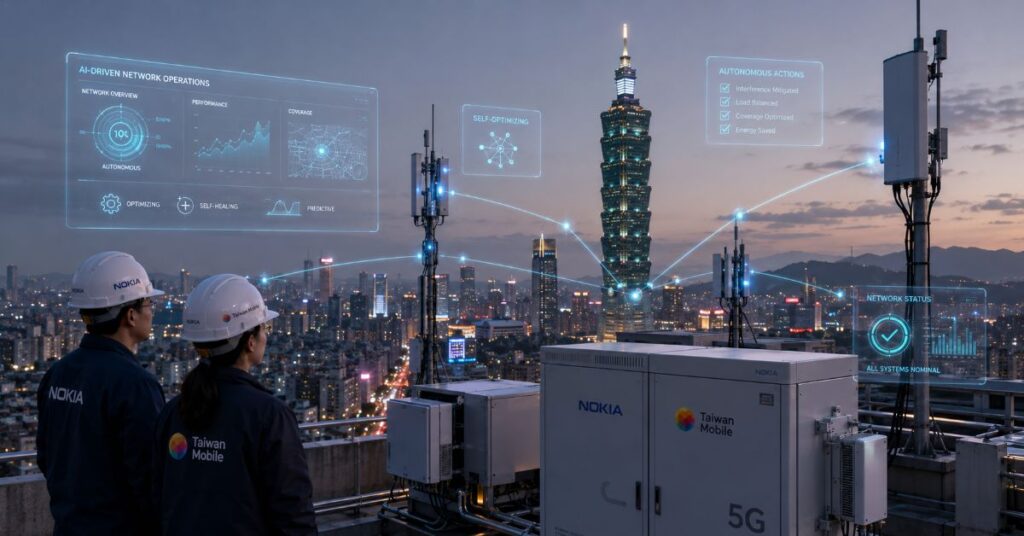
The 5G era was supposed to be about speed. The reality has been more complicated: operators who spent billions on spectrum and infrastructure are now staring at traffic loads driven primarily by AI applications, watching energy bills climb, and scrambling to reduce the operational complexity of networks that are growing faster than their ability to manage them manually. Nokia’s answer, formalised in a new agreement with Taiwan Mobile on July 14, 2026, is a network that uses AI to manage itself.
The two companies signed a 5G expansion agreement under which Nokia will deploy its latest AirScale portfolio — next-generation baseband cards, advanced Massive MIMO radios, and AI-driven software — across Taiwan Mobile’s existing network infrastructure. The goal is not just to expand capacity but to fundamentally change how the network operates: with AI embedded in every layer, from hardware diagnostics to traffic management to energy consumption, performing in real time the optimisation tasks that previously required manual intervention.
🔱 Key Developments
- Nokia and Taiwan Mobile signed a 5G expansion agreement on July 14, 2026, deploying Nokia’s AirScale portfolio and AI-driven software across Taiwan Mobile’s national network.
- Nokia’s MantaRay SON self-organizing network solution and Predictive Hardware Analytics service will automate network operations and enable closed-loop self-healing without human intervention.
- Nokia’s newest AirScale baseband cards consume up to 90% less energy than the previous generation; AI energy management algorithms will dynamically power components down during low-traffic periods.
- The deployment positions Taiwan Mobile for the transition to 5G-Advanced and future 6G, with hardware and software designed for in-place upgrade rather than full infrastructure replacement.
What Was Announced
Nokia announced the Taiwan Mobile agreement via its official Nokia press release issued from Espoo, Finland on July 14, 2026. Nokia will deploy its full AirScale portfolio including next-generation baseband cards, Massive MIMO radio units, and the ReefShark System-on-Chip technology that underpins its latest radio hardware. Mark Atkinson, Nokia’s Head of RAN, described the deal as accelerating Taiwan Mobile’s ‘journey toward AI-native networks’ and setting ‘the foundation for 5G-Advanced and beyond.’ Jamie Lin, President of Taiwan Mobile, confirmed the Nokia collaboration is ‘a key pillar’ of the operator’s strategy to build a ‘high-performance, resilient and sustainable network.’
How the Three AI Layers Work
AI for Network — The Self-Managing Layer
The first layer deploys Nokia’s MantaRay SON (self-organising network) solution and Predictive Hardware Analytics service across Taiwan Mobile’s infrastructure. MantaRay SON uses AI algorithms to continuously monitor network performance, detect anomalies — coverage gaps, interference patterns, degraded cell sites — and make automated adjustments to radio parameters without waiting for an engineer to intervene. This closed-loop assurance model reduces both the time between a network issue emerging and being resolved, and the headcount required to manage a network growing in geographic coverage and traffic complexity. Predictive Hardware Analytics takes a complementary angle: it analyses sensor data from base station hardware to predict component failures before they cause service outages, enabling maintenance to be scheduled proactively rather than reactively.
Network for AI — Building for AI Traffic
The second layer addresses the infrastructure itself. AI applications generate a different traffic profile from the video streaming that dominated early 5G use cases: they involve heavy uplink traffic from edge devices sending data for analysis, low-latency requirements for real-time inference, and burst patterns tied to model update cycles. Nokia’s next-generation AirScale baseband and radio solutions are specifically designed to handle these profiles. Nokia’s Dual Boost technology, powered by ReefShark System-on-Chip processors, enhances both uplink and downlink processing performance for Massive MIMO deployments, increasing the network’s ability to simultaneously serve large numbers of AI-connected devices at the performance levels those applications require.
AI for Energy — The Sustainability Layer
The third layer is arguably the most commercially significant for Taiwan Mobile’s business case. Nokia’s newest AirScale baseband cards consume up to 90 percent less energy than the generation they replace — a significant claim that, if it holds in production, fundamentally changes the economics of running a dense urban 5G network. AI-powered energy management algorithms extend those hardware gains with software intelligence: the system continuously analyses traffic patterns and proactively powers down radio components during low-demand periods, restoring them automatically as demand rises, without service interruption. That matters in a context where the AI infrastructure energy demand surge has drawn significant scrutiny from regulators and investors globally, and where telecoms operators are under increasing pressure to demonstrate credible paths to reduced carbon emissions alongside network expansion.
Backstory: Nokia and Taiwan Mobile’s Previous Partnership
This is not the first time Nokia has supplied AirScale equipment to Taiwan Mobile. A previous agreement introduced Nokia to Taiwan Mobile’s network for the first time, providing AirScale hardware to modernise both 4G and 5G infrastructure. An MoU on AI-driven network operations and ESG cooperation was signed at Mobile World Congress Barcelona in March 2026. The July 14 agreement is therefore the formalisation of a direction both companies had already committed to. Nokia’s broader AI-RAN strategy has been built through a series of partnerships announced over the preceding 12 months: an investment and collaboration agreement with Nvidia on AI-accelerated radio access networks, expanded collaboration with AWS on autonomous network software, and a data platform demonstration with Databricks. The Taiwan Mobile deployment sits within that growing ecosystem as one of the first production AI-native network rollouts under the fully articulated AirScale AI portfolio.
Reactions
Mark Atkinson, Nokia’s Head of RAN, stated that the partnership extends Nokia’s long-standing relationship with Taiwan Mobile and helps accelerate its journey toward AI-native networks, setting what he described as the foundation for 5G-Advanced and beyond. The network, he said, enables Taiwan Mobile to deliver increasing volumes of AI traffic, provide new types of services, and progress toward its sustainability targets.
Jamie Lin, President of Taiwan Mobile, confirmed that the Nokia collaboration is a key pillar in the operator’s strategy to build a high-performance, resilient, and sustainable network powering its growing Telco+Tech businesses. Lin specifically called out how integrating AI across the network for energy optimization, resilience, and service innovation creates a platform that supports next-generation applications with industry-leading customer experiences.
Open Questions: Do the Energy Claims Hold at Scale?
Nokia’s claim that its newest AirScale baseband cards consume up to 90 percent less energy than the previous generation is the most commercially significant number in the announcement, and it warrants scrutiny. The ‘up to’ qualifier is standard in hardware efficiency claims and typically reflects peak-condition performance under optimal network load profiles rather than average real-world operation. A base station that achieves 90 percent energy savings when traffic is at precisely the load level where its dynamic power management works most efficiently may deliver significantly smaller savings during the peak traffic hours when power consumption matters most. Independent, production-scale energy benchmarks from Taiwan Mobile’s actual deployment will be the data point that matters, not the manufacturer’s specification figure. Nokia has historically been willing to publish field-validated efficiency data from operator deployments, and that data from Taiwan Mobile will be a meaningful reference for the dozens of other operators globally who will use this deployment to evaluate whether to follow the same AI-native AirScale path.
How This Fits Nokia’s Global AI Network Strategy
Nokia has been explicit that its competitive position in the radio access network market increasingly depends on software and AI capabilities rather than hardware specifications alone. Its AirScale Modular System architecture separates computing resources across RAN Layer 1, Layer 2, and Layer 3 in a way that allows AI workloads to run alongside real-time radio processing without competing for the same compute resources. That architectural choice allows Nokia’s AI software capabilities to be introduced and upgraded independently of hardware replacement cycles. The Taiwan Mobile deal adds to a growing list of AI-native network deployments Nokia has announced in 2026. The pattern — AI capability being embedded directly into telecom network fabric rather than sitting above it as a management application — mirrors what is happening in adjacent infrastructure sectors, from the Nvidia South Korea semiconductor infrastructure deals to NEC’s physical site digital twins announced the same day.
What Happens Next
Nokia will deploy AirScale hardware and software in phases across Taiwan Mobile’s network, with the AI software features introduced progressively on top of the hardware layer. Taiwan Mobile has not published a specific completion timeline, and the sequencing of hardware installation across Taiwan’s geographic coverage will determine how quickly the energy efficiency and automation benefits materialise at network scale. The 5G-Advanced transition — the next formal generation of standards targeting higher reliability, lower latency, and native AI support in the network protocol layer — is expected to begin in earnest from 2027. Nokia’s deployment with Taiwan Mobile is designed to be a foundation for that transition rather than a terminal point.
Why It Matters
The Nokia-Taiwan Mobile agreement is a concrete example of what ‘AI-native network’ means in practice, at production scale, with a real operator and real hardware. The phrase has circulated in telecom industry discourse for several years without consistent definition; this deployment specifies it precisely: AI embedded in self-organising network optimisation, predictive hardware maintenance, and traffic-aware energy management, running continuously on top of the physical radio and baseband infrastructure. If Nokia’s 90 percent energy reduction claim is confirmed at production scale, it establishes a benchmark that other operators globally will reference in procurement decisions. And if MantaRay SON’s closed-loop automation performs as described, it changes the headcount economics of running a 5G network in a way that has significant implications for how telecoms operators are structured over the next decade.
Sources
Nokia official press release (nokia.com/newsroom), July 14, 2026. TelecomLead, July 14, 2026. TNGlobal, July 14, 2026. Digitimes Taiwan Mobile/Nokia MoU coverage, March 2026.
