
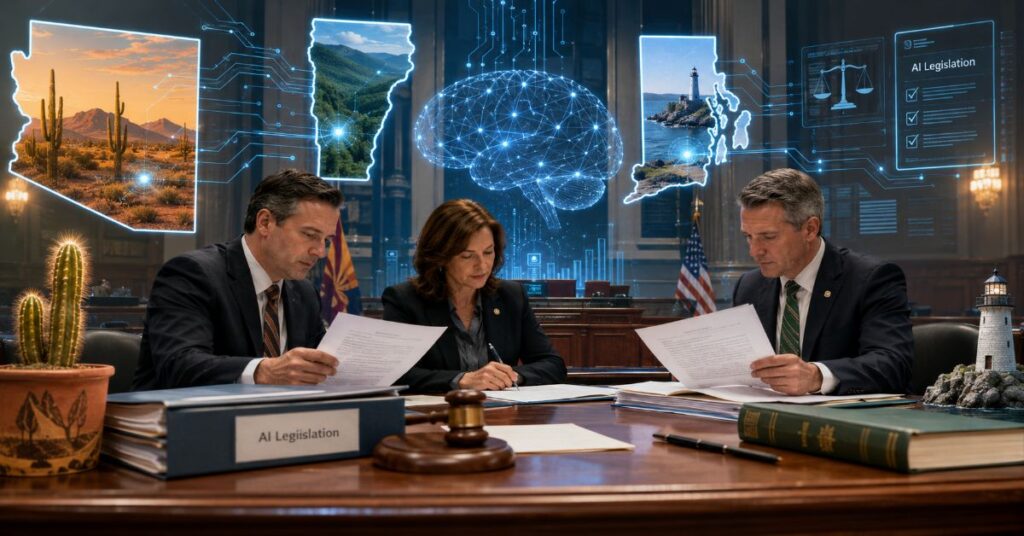
Congress still has not passed a single federal law governing artificial intelligence. State legislatures have stopped waiting. As spring sessions wind down across the country, three states closed out their 2026 calendars this week with AI bills that, taken together, sketch the shape of America’s actual AI regulatory regime: built state by state, statute by statute, with no two legislatures agreeing on quite the same rules.
Arizona adjourned its session having passed three AI-related bills, including a chatbot safety measure and an expanded deepfake disclosure law, all now sitting on Governor Katie Hobbs’s desk. Vermont went further: Governor Phil Scott signed a law banning the use of AI chatbots to provide therapy outright. And in Rhode Island, the House and Senate both passed their own version of a therapy-chatbot restriction this past week, sending it to Governor Dan McKee for signature.
None of these bills exists in isolation. They are three more data points in what legal trackers are now calling, only half-jokingly, the year of the chatbot bill — a count that puts at least 78 chatbot-specific proposals alive across 27 states as of this spring.
Key Developments
- Arizona adjourned its 2026 session on June 13 after passing three AI bills, now on Governor Hobbs’s desk: a chatbot safety law, an expanded synthetic-image disclosure law, and a state-agency AI-adoption mandate.
- Vermont Governor Phil Scott signed H 816 into law on June 17, banning the use of AI chatbots to provide therapy or mental health services.
- Rhode Island’s House and Senate both passed H 7349, a therapy-chatbot regulation bill, this past week; it now awaits Governor Dan McKee’s signature.
- At least 78 chatbot-specific bills remain alive across 27 states this legislative season, according to legislative trackers.
What Happened
Arizona’s legislature wrapped its 2026 session on June 13 after Republican lawmakers reached a final budget deal with Democratic Governor Katie Hobbs the previous week. Three AI bills cleared in the session’s final days. HB 2311 requires chatbot operators to disclose to users that they are interacting with AI, bars sexual content or statements encouraging sexual conduct from any chatbot regardless of user age, prohibits gamified rewards systems that target account holders under 18, and requires parental controls for users under 13; it passed the Senate 28-0 and the House 35-20 before being sent to the governor on June 13. HB 2133 amends Arizona’s existing law on the unlawful disclosure of intimate images to explicitly cover AI-generated “synthetic depictions,” following a conference process that stretched from early April to a final 16-12 Senate vote on June 9. HB 2592 requires every state agency to identify opportunities to deploy AI systems that reduce administrative burden, and to flag regulations that restrict AI adoption.
Vermont moved faster and further. Governor Scott signed H 816 into law on June 17, prohibiting the use of AI chatbots to provide therapy or other mental health services — a flat ban rather than a disclosure-and-guardrails framework. The same day, Scott signed a companion bill, H 211, addressing data brokers and personal information, both passed as lawmakers adjourned their session on May 29.
Rhode Island’s bill followed a more circuitous path. H 7349, which establishes regulations on the use of AI in mental health care, was effectively shelved in March before being revived in early June; a substitute version passed the House on June 8 and the Senate two days later. Unlike Vermont’s outright ban, Rhode Island’s bill is framed as a regulatory structure for AI in mental health treatment rather than a categorical prohibition, and as of this week it remains with Governor McKee, who has not yet signed it into law.
The Mechanism: Two Different Theories of Chatbot Risk
Strip away the state-specific procedural detail and these bills split into two distinct regulatory theories, and the distinction matters more than the headline count of “three states act on AI” suggests. Arizona’s chatbot law and Rhode Island’s mental-health bill both follow a guardrails model: chatbots can keep operating, but operators must build in specific protections — disclosure that the user is talking to AI, restrictions on content for minors, structured oversight for anything touching mental health. Vermont’s law follows a prohibition model instead: AI cannot be used to deliver therapy at all, full stop, regardless of what safeguards a company might build around it.
That split mirrors a fight already playing out nationally. Illinois became the first state to ban AI therapy outright last August, when Governor JB Pritzker signed the Wellness and Oversight for Psychological Resources Act, which bars AI from making therapeutic decisions or interacting directly with patients in a clinical capacity, while still permitting AI for administrative tasks like scheduling and transcription. Utah took the opposite approach the same year, requiring AI mental-health chatbots to disclose that users are talking to a machine without banning the practice. Vermont’s new law places it firmly in the Illinois prohibition camp; Rhode Island’s pending bill, with its regulatory rather than prohibitive framing, more closely resembles Utah’s disclosure-based model — even though both states are acting on the same underlying concern in the same week.
The Backstory
This week’s state action did not emerge from nowhere. Legal trackers monitoring 2026 state legislative sessions have counted at least 78 chatbot-specific bills alive across 27 states this spring, a volume legal analysts have started calling, with some understatement, the “year of the chatbot bill.” Colorado, Illinois, Louisiana, New York, and Hawaii have all moved their own AI legislation through final passage in just the past several weeks, on subjects ranging from frontier-model safety audits to bans on AI-driven rental price-fixing.
The driving force behind the mental-health-specific bills in particular is a string of documented harm cases that have made chatbot-as-therapist arrangements increasingly hard for legislators to ignore. Multiple wrongful-death and product-liability lawsuits have been filed against AI chatbot makers including OpenAI and Character.AI, alleging that extended chatbot interactions contributed to self-harm and suicide among minors and young adults — a pattern visible in a recent California lawsuit against OpenAI alleging the company’s GPT-4o model continued engaging with a user’s disclosed suicidal ideation without activating protective measures. Research compounds the concern: Stanford and Common Sense Media testing released last November found major chatbots, including ChatGPT, Claude, Gemini, and Meta AI, routinely missed clear warning signs of teen mental health distress and showed safety guardrails degrading specifically in the kind of extended, multi-turn conversations that mirror how teenagers actually use these tools.
Arizona’s deepfake and chatbot bills similarly build on groundwork the legislature laid earlier this year, when its Artificial Intelligence and Innovation Committee advanced a slate of proposals aimed at preventing minors from forming simulated romantic relationships with AI chatbots and restricting how AI-generated conversations can be used as evidence in court — part of a broader, bipartisan recognition among Arizona lawmakers that, as one legislator put it earlier this session, a part-time legislature is poorly positioned to keep pace with how quickly the underlying technology moves.
Reactions
None of the three states’ governors had issued extended public statements on the specific bills at the time of writing; Arizona’s and Rhode Island’s bills remain pending signature, and Vermont’s governor’s office has not released formal remarks beyond the signing itself. The clearest public framing of the underlying mental-health concern has instead come from regulators in states that acted earlier: when Illinois banned AI therapy last year, the state’s Department of Financial and Professional Regulation argued residents “deserve quality healthcare from real, qualified professionals and not computer programs that pull information from all corners of the internet to generate responses that harm patients” — a rationale Vermont’s law echoes almost exactly in its flat prohibition rather than a disclosure-based compromise.
The Dispute: Industry Says Vermont’s Ban Sweeps Too Wide
Vermont’s law is not without organized opposition, and the specific objection raised is worth taking seriously rather than dismissing as standard industry pushback. Two trade groups — the Computer & Communications Industry Association and the Software & Information Industry Association — separately urged Governor Scott to veto H 816 before he signed it, both arguing the bill’s definitions are dangerously broad. CCIA specifically flagged that the bill’s definition of “therapeutic communication” as “any advice related to diagnosis, treatment, or recovery” could sweep in routine, non-clinical interactions — general-purpose AI chatbots offering emotional support, wellness apps, or coaching tools that no reasonable observer would call clinical treatment. More pointedly, the coalition warned the law could unintentionally restrict AI-powered crisis intervention systems that provide supportive messaging and route users to the 988 Suicide & Crisis Lifeline, the exact kind of tool the bill’s supporters presumably want to protect, not eliminate.
Supporters of the bill reject that framing. Lynn Currier, executive director of the Vermont chapter of the National Association of Social Workers, has argued the bill is narrowly aimed at stopping AI systems from operating as de facto unlicensed therapists, regardless of how they market themselves: “Even if it calls itself wellness, if it quacks like a duck, walks like a duck, it’s a duck.” Under the enacted law, a licensed mental health provider who relies on AI to make therapeutic decisions or deliver treatment independently commits “unprofessional conduct,” exposing them to consumer-protection enforcement or licensing discipline — a framework that, on its face, targets licensed providers rather than the general-purpose AI tools CCIA worried about. Whether that distinction holds up once the law actually starts being enforced against companies operating outside the licensed-provider relationship entirely is the open question industry groups are betting will eventually force a legal challenge or a legislative fix.
There is also a federalism fight layered underneath all of this. The Trump administration has floated executive action aimed at preempting the growing state-by-state AI patchwork in favor of a uniform federal standard, and the Department of Justice has already intervened in at least one state AI law fight — backing xAI’s challenge to Colorado’s AI Act earlier this year, a case a federal court stayed in April. Every new state bill signed this week effectively raises the stakes of that unresolved jurisdictional question: the more individual state AI laws pile up, the more consequential a federal preemption move would ultimately be.
What Happens Next
Arizona’s HB 2311 and HB 2133, along with Rhode Island’s H 7349, now sit with their respective governors awaiting signature, and neither Hobbs nor McKee has signaled a veto is likely for either bill. Beyond these three states, the legislative wave continues: California still has roughly 30 AI-related bills moving through second-chamber committees ahead of a July 2 summer recess, and the EU AI Act’s own next compliance milestone lands August 2, giving 2026 a second wave of AI regulatory deadlines arriving on both sides of the Atlantic within weeks of each other.
Why It Matters
With Congress still gridlocked on comprehensive federal AI legislation, individual states have effectively become the primary regulators of how AI chatbots interact with the public — and this week’s action shows those regulators are not converging on a single model. A company operating a mental-health-adjacent chatbot nationally must now navigate Illinois and Vermont’s outright bans, Utah and Rhode Island’s disclosure-based frameworks, and whatever each of the dozens of other states with pending legislation eventually decides, all while ongoing litigation over chatbot conversation logs and data retention adds yet another layer of compliance uncertainty. For an industry that built its products to scale identically across every market at once, that patchwork is becoming one of the most consequential operating constraints AI companies face — arguably more immediately binding than anything Washington has yet managed to pass.
Sources
Transparency Coalition AI Legislative Update; Washington Post; Arizona Mirror; LegiScan; StateScoop.
