
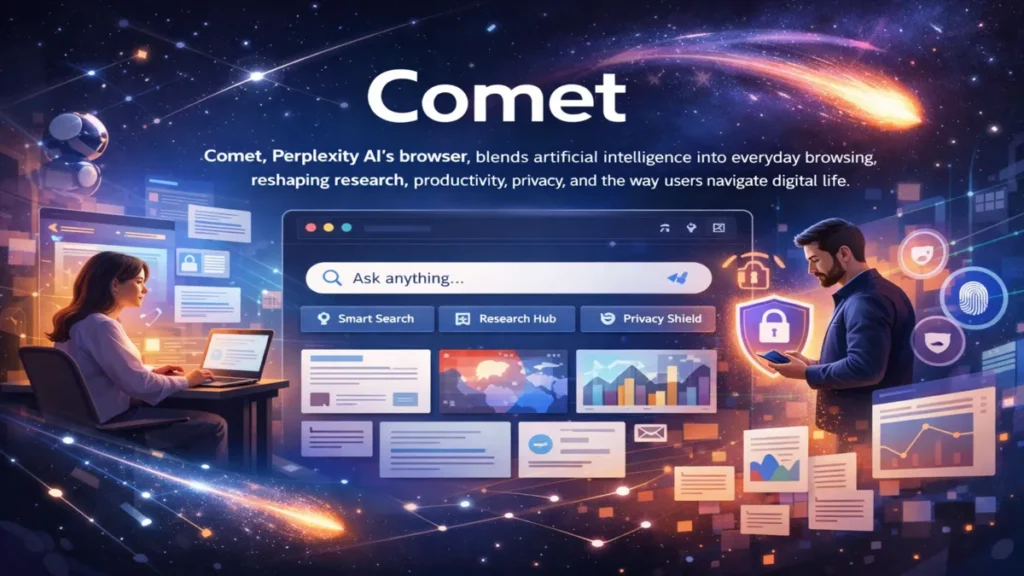
Comet is not simply another web browser. It represents a shift in how people interact with information online. Built by Perplexity AI and launched in 2025, Comet is a Chromium-based browser that integrates artificial intelligence directly into the browsing experience. Instead of treating AI as a separate tool or chat window, Comet embeds it into the interface itself, turning browsing into a collaborative process between user and machine. – comet ai broswer.
In practical terms, Comet allows users to ask questions about the pages they are viewing, automate repetitive tasks, and manage complex workflows without switching apps or tabs. This integration addresses a growing frustration in modern computing: the fragmentation of attention across dozens of windows, platforms, and services. By unifying search, analysis, and action, Comet proposes a more coherent digital environment.
This matters because the browser is one of the most fundamental interfaces in everyday life. It is where people read news, do their jobs, shop, learn, and socialize. Changing the browser changes how people think, decide, and remember. Comet’s emergence suggests that AI is no longer just a tool we consult occasionally, but a layer woven into the fabric of daily digital experience.
The Vision Behind Comet
Perplexity AI designed Comet to move beyond passive browsing. The traditional browser is a viewer, a window onto the web. Comet is an assistant, a collaborator, and in some cases an agent that acts on the user’s behalf.
The idea is that information should not just be accessible, but usable. Instead of opening five articles and manually extracting key points, Comet summarizes them. Instead of copying dates into a calendar, Comet schedules them. Instead of searching again when you forget something, Comet remembers context across sessions.
This vision reframes the browser from a transport layer into an intelligence layer. It is no longer just how we get to the web, but how we interpret and operate within it. – comet ai broswer.
Core Capabilities
Comet’s design centers on a set of tightly integrated AI features that turn browsing into an interactive, adaptive workflow.
The AI sidebar is the most visible element. It stays present as users navigate, offering contextual summaries, explanations, and comparisons of whatever is on screen. It can answer questions about a page, translate text, or synthesize multiple sources without leaving the current view.
Agentic automation allows the browser to perform tasks, not just suggest them. Comet can fill out forms, organize travel plans, manage emails and calendars through integrations, unsubscribe from mailing lists, and move information between services.
Tab intelligence treats open tabs as a workspace rather than clutter. It groups related tabs, identifies duplicates, summarizes collections of pages, and allows users to reference tabs in natural language.
Voice and multimodal input expand interaction beyond typing. Users can speak commands, analyze images, or highlight content and ask questions about it, making the browser more accessible and flexible.
Read: Perplexity and PayPal: Inside In-Chat Commerce
Feature Overview
| Capability | Description | Practical Effect |
|---|---|---|
| AI Sidebar | Contextual assistance for open pages | Faster comprehension |
| Agentic Actions | Automated task execution | Reduced manual work |
| Tab Intelligence | Smart grouping and summaries | Less cognitive overload |
| Voice Input | Hands-free commands | Accessibility |
| Multimodal Tools | Image and media analysis | Richer interaction |
Research and Knowledge Work
Comet excels in research-heavy contexts. Students, analysts, and journalists often juggle dozens of sources at once. Traditionally, this meant managing bookmarks, notes, and tabs manually. Comet’s AI can synthesize information across pages, extract arguments, highlight contradictions, and create summaries.
This changes the pace and shape of research. Instead of spending time gathering information, users spend more time interpreting it. The browser becomes an intellectual partner, helping structure thought rather than simply providing raw material.
However, this also introduces a subtle shift in authority. The AI decides what is important, what is redundant, and what deserves attention. Users must remain aware of this mediation and continue to exercise judgment.
Privacy and User Control
Comet distinguishes itself by emphasizing privacy-forward defaults. It blocks ads and trackers automatically, limits background processes, and allows sensitive tasks to be processed locally on the user’s device.
Users have granular control over what data is stored, how long it is kept, and whether personal information is used at all. They can clear browsing history, cookies, cache, and AI interaction memory directly and set automatic deletion intervals. – comet ai broswer.
This approach contrasts with browsers whose business models depend on data collection and advertising. Comet’s model attempts to align user trust with product value rather than data monetization.
Privacy Comparison
| Aspect | Comet | Typical Browser |
|---|---|---|
| Ad Blocking | Built-in by default | Optional extensions |
| Data Processing | Local for sensitive tasks | Cloud-based |
| Push Notifications | Disabled by default | Frequent prompts |
| Telemetry | Minimal, opt-in | Broad, opt-out |
Human-Computer Interaction
Comet also reshapes how users relate to software. Instead of learning menus and settings, users speak. Instead of memorizing commands, they describe intentions. This lowers the cognitive barrier to complex actions and can make computing feel more humane.
At the same time, it risks creating dependency. When software anticipates needs and remembers context, users may lose familiarity with underlying systems. This trade-off between convenience and understanding is one of the central tensions of AI-mediated interfaces. – comet ai broswer.
Expert Reflections
“Comet signals a transition from tools to partners in computing.”
“The browser is becoming an active participant in cognition, not just a conduit for information.”
“Privacy-forward design in AI tools is not optional, it is foundational.”
Adoption and Access
After an initial period as a premium product, Comet became free worldwide, accelerating adoption. Because it is Chromium-based, users can install familiar extensions and transition without friction.
The browser appeals to professionals, students, and creative workers who benefit from integrated intelligence. Its uptake reflects broader trends toward AI-augmented work environments. – comet ai broswer.
Social and Cultural Implications
When the interface through which people encounter the world changes, culture changes with it. If AI curates what we read, summarizes what we learn, and automates what we do, it becomes part of the cognitive infrastructure of society.
Comet is an early experiment in this transformation. It raises questions about who controls knowledge flows, how biases propagate, and how agency is shared between humans and machines.
Takeaways
- Comet integrates AI directly into browsing
- It transforms search into synthesis and action
- It prioritizes privacy and user control
- It changes the pace and shape of research
- It alters human-computer relationships
- It represents a shift toward AI-native interfaces
Conclusion
Comet is less a product than a proposal. It proposes that the browser can be more than a window, that AI can be more than a tool, and that interaction can be more than navigation. By weaving intelligence into the everyday act of browsing, it reshapes how people find, process, and act on information.
Whether this leads to greater empowerment or deeper dependency depends on how consciously users engage with it. The future Comet points toward is not just technical, but philosophical. It asks what it means to think, decide, and know in a world where software increasingly shares those processes with us. – comet ai broswer.
FAQs
What is Comet?
It is an AI-powered browser built by Perplexity AI that integrates contextual assistance and automation.
How is it different from Chrome?
It embeds AI directly into browsing and emphasizes privacy and automation.
Is Comet free?
Yes, it became free worldwide after its initial premium phase.
Does it replace search engines?
It integrates search and synthesis, reducing reliance on separate tools.
Is user data protected?
It offers local processing and granular privacy controls.
