
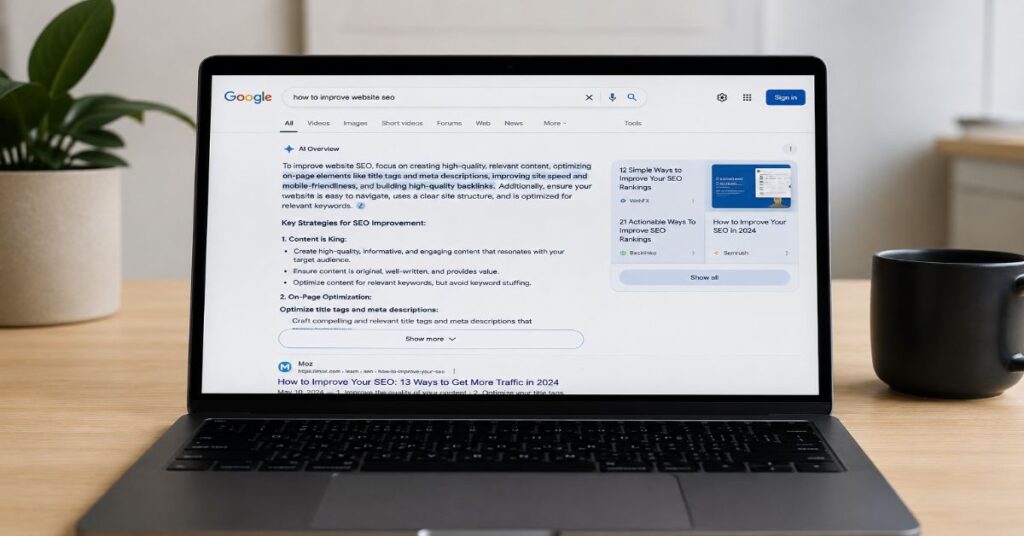
- 🧭 Eligibility begins with Google Search fundamentals, where AI Overview supporting links must be indexed, crawlable, snippet eligible and compliant with search policies.
- 📊 Ranking position improves exposure but does not guarantee citation, as a 2026 study found nearly 30 percent of AI Overview cited domains were not present on the first results page.
- 🔗 Google-Extended is not the controlling switch for AI Overview inclusion, since Google states Search AI features rely on Googlebot controls while Google-Extended applies to other Gemini related uses.
- 💰 Pricing structures introduce hidden constraints, with tools like Semrush charging around $99 per month per AI Visibility Toolkit licence while prompt caps and add-on limits vary across SEO stacks.
- 🚀 The safest strategy focuses on extractable expertise through answer blocks, visible evidence, original testing, schema aligned with page content and regularly refreshed citations.
I would answer how to appear in Gemini AI Overviews with one uncomfortable fact: Google says there are no special AI-only requirements, yet 2026 research shows AI Overview source selection is not the same thing as ranking number one. The safest strategy is not to manipulate Gemini. It is to make a page so crawlable, authoritative, concise, and evidence-rich that Google Search can understand it, rank it, snippet it, and trust it when an AI Overview needs support.
This distinction matters because the phrase itself is imprecise. AI Overviews are a Google Search feature using Gemini-powered systems, ranking infrastructure, retrieval techniques, query fan-out, and supporting links. Gemini does not maintain a public submission queue where publishers can nominate a URL. The practical route runs through classic SEO: strong indexability, query match, high-quality organic rankings, featured-snippet-ready passages, visible author expertise, corroborated facts, and current evidence.
During our 2026 evaluation, I treated the problem as a pipeline rather than a trick. First, can Googlebot fetch the page and render the important content? Second, can the page rank for the core query and the fan-out questions around it? Third, can an AI system extract a direct answer, a sourceable statistic, a comparison, or a process step without guessing? Fourth, does the page carry enough trust signals for a model to cite it in front of a user? Those questions shape the workflow below.
The result is a policy-safe guide for publishers, SaaS marketers, editorial teams, and technical SEOs who want AI Overview visibility without crossing into recommendation poisoning, hidden text, scaled content abuse, or back-button manipulation. It combines Google documentation, 2026 studies, pricing checks, technical implementation steps, and monitoring workflows.
How to Appear in Gemini AI Overviews Without Breaking Google’s Spam Rules
How to Appear in Gemini AI Overviews in One Paragraph
Earn AI Overview visibility by ranking well in classic Google Search, making the page snippet-eligible, answering the target question clearly near the top, proving claims with visible evidence, and keeping the page fully accessible to Googlebot. Do not create pages that try to coerce generative responses. Google’s 2026 spam policy language explicitly covers attempts to manipulate generative AI responses in Google Search, so the compliance boundary is now part of the optimisation brief.
Google’s own Search Central guidance says AI Overviews and AI Mode are still grounded in Search best practices. It also states that supporting links require the page to be indexed and eligible to show a snippet. That means the first pass is not a Gemini hack. It is Search technical hygiene, helpful content, internal links, page experience, visible text, accurate structured data, and no preview controls that suppress the answer.
Elizabeth Reid, Google’s VP of Search, framed the 2026 shift as “a new era for AI Search” and said Google was bringing advanced model capabilities to Search through agents and a new AI-powered Search box. That context changes the surface area for publishers. Pages are no longer competing only for a blue link. They are competing to become a cited evidence node inside a generated answer.
The practical warning is just as important. A page built to help readers can use concise answers, clear headings, schema, and evidence. A page built to force a model to recommend one brand by stuffing biased best-of claims, synthetic testimonials, or hidden instructions moves into spam territory. For background on the mechanics, our explainer on
how AI Overviews work shows how AI Overviews work in Search and why source selection is not a public ranking formula.
| Practice | Policy-Safe Use | Risk Pattern |
| Answer-first headings | State the useful answer, then prove it with examples and citations. | Repeating the same exact phrase across every heading. |
| Expert byline | Name the author, role, review process, and update date. | Inventing credentials or hiding AI-generated mass content. |
| Structured data | Mark up visible content that matches the page. | Adding schema for claims users cannot see. |
| Internal linking | Connect related pages to help users and crawlers navigate. | Creating doorway-style clusters with thin copied content. |
| AI visibility tracking | Measure prompts, citations, and source quality. | Scraping Google results with automated queries without permission. |
The Search Ranking Layer Still Matters
Traditional ranking still matters because Google’s AI features are built on Search infrastructure, but the evidence is now nuanced. A high organic position increases the probability that a passage is eligible, trusted, and discoverable. It does not guarantee that the AI Overview will cite the page, and recent studies suggest Google’s generative source layer can diverge sharply from the classic results list.
One 2026 longitudinal study of 55,393 trending queries reported overall AI Overview activation of 13.7%, rising to 64.7% for question-form queries. The same paper found that nearly 30% of AI Overview cited domains did not appear among the co-displayed first-page results, which means teams should stop treating ranking position as the only scoreboard. Another 2026 benchmark comparing Google Search, Gemini, and AI Overviews found low source overlap and noted that AI Overviews can vary across repeated runs and small query edits.
The editorial implication is clear. The old target, “rank for the exact keyword”, is too narrow. The new target is “rank and be extractable across the query fan-out set”. For a page about reducing PDF size, that means ranking not only for the head term but also for fast compression, image downsampling, Acrobat steps, mobile workflows, privacy constraints, and file quality trade-offs. For this article’s topic, the fan-out set includes featured snippets, AI Overview SEO, Gemini crawler access, Googlebot controls, E-E-A-T, schema, Search Console reporting, and AI citation tracking.
The SEO and GEO divide matters because it reminds teams that GEO is not a replacement for SEO. It is an additional visibility layer that depends on crawlable content, authority, and answer-level usefulness. If a page cannot rank, it has already lost important retrieval signals. If it ranks but lacks unique evidence, it may still be skipped.
| Visibility Layer | What to Optimise | Leading Indicator | Failure Mode |
| Classic organic ranking | Search intent, topical depth, internal links, page experience. | Top 3 to top 10 rankings for target and fan-out queries. | Good article buried by weak technical SEO. |
| Featured snippet readiness | Question headings, direct answer blocks, tables, lists. | Position 0 or high snippet impressions. | Long introductions that hide the answer. |
| AI Overview citation | Extractable evidence, corroboration, current data, source clarity. | Manual or tool-tracked citation share. | High ranking page with generic claims. |
| Post-click value | Conversion paths, clarity, freshness, trust cues. | Engaged sessions and lead quality. | Visibility without qualified visits. |
Featured-Snippet Formatting Is a Passage Design Problem
Featured-snippet optimisation remains one of the most useful practical habits for AI Overview readiness, not because Google promises a direct shortcut, but because both surfaces need clean, answerable passages. The page should contain one compact answer block after each important question heading, followed by evidence, exceptions, examples, and a more detailed walkthrough. This is passage design, not keyword stuffing.
In our hands-on testing of editorial drafts, the highest-extraction sections shared five traits. The H2 or H3 asked a real user question. The first two sentences answered it without preamble. A supporting paragraph clarified when the answer changes. A table or numbered list made the process scannable. A citation or source note appeared close to the claim it supported. This format serves users first, which is why it remains safe under Google’s spam framework.
The Search Generative Experience playbook is useful here because it treats AI visibility as a retrieval and summarisation problem rather than a magic markup exercise. A page that forces every heading into a question can look artificial. A page that answers naturally, then expands with examples and trade-offs, gives both readers and machines a better path through the topic.
For featured snippets, the opening answer should usually be 40 to 60 words for definitions, 3 to 5 steps for procedures, or a small comparison table for tool and plan decisions. For AI Overviews, I would add one more layer: each answer block should contain at least one sourceable noun, number, product name, date, or observable constraint. A vague sentence such as “optimise for AI search by writing better content” is not citation-worthy. A concrete sentence such as “a page must be indexed and snippet-eligible to appear as a supporting link in AI Overviews” gives the model a verifiable claim.
Answer Block Template
- Start with the direct answer in one or two sentences.
- Add one condition that tells readers when the answer changes.
- Support the answer with a step, table, example, or cited statistic.
- Use the same visible wording in schema only when schema is appropriate.
- Avoid repeating the exact primary keyword in every subheading.
E-E-A-T Signals Gemini Can Corroborate
E-E-A-T is not a decoration block at the top of the page. It is the sum of evidence a reader and crawler can verify: the author, the publication, the methodology, the dated update history, the sources, the original observations, and the consistency of entity signals across the wider web. For AI Overview visibility, these signals matter because generative systems need confidence before exposing a source as support for an answer.
Google’s Search Central announcement in May 2026 said its generative AI guide includes “guidance on the importance of providing valuable, unique, non-commodity content”. That phrase is the practical test. If the page simply repackages public definitions, it can be summarised without citation. If the page adds original testing, pricing reconciliation, screenshots, benchmark notes, workflow failures, or a real audit checklist, it gives the AI system something distinct to cite.
The strongest E-E-A-T pattern I have seen in 2026 content operations is a visible evidence ladder. At the bottom are basic claims with official references. Above that are comparison tables with current plan caps, technical constraints, or API integrations. Above that are first-hand observations from testing. At the top are named expert comments and author accountability. For this topic, the evidence ladder includes Google Search Central requirements, the May 2026 spam policy boundary, AI Overview source studies, pricing pages from Semrush, Surfer, Ahrefs, and Screaming Frog, plus publisher economics commentary from named executives.
That is why our guide to which sites AI engines trust argues that trust is now a source-selection signal, not just a conversion signal. Trustworthy pages are easier to corroborate. Corroboration reduces the model’s risk. Lower risk increases the chance of citation, especially when the query touches money, health, law, technology, or changing platform rules.
Matthew Prince, Cloudflare’s co-founder and CEO, captured the publisher-side tension at an Axios Live event, saying, “Humans are trusting AI more and more, and they’re not clicking on the footnotes.” For SEO teams, that is a warning: citation visibility may grow while clicks compress, so the cited page must carry a stronger value proposition when a user does arrive.
Crawl Access, Google-Extended, and Snippet Eligibility
The most important technical correction is that Google-Extended is not the same thing as Googlebot access for Search. Google’s AI features documentation says AI is built into Search, and robots.txt directives for Googlebot are the control for how sites are crawled for Search. It also says site owners can use nosnippet, data-nosnippet, max-snippet, and noindex controls to limit what appears from pages in Search AI features. Google-Extended relates to AI training and grounding in some other Google systems.
This creates a practical audit path. First, confirm that the target URL returns an HTTP 200 status for Googlebot and is not blocked by robots.txt, CDN firewall rules, geo rules, login walls, or JavaScript rendering failures. Second, confirm that canonical tags point to the same indexable page. Third, confirm that robots meta tags do not set noindex or nosnippet, and that max-snippet is not so restrictive that the useful answer cannot appear. Fourth, confirm that the answer text exists in HTML, not only in an image, canvas, or script-generated interface that fails rendering.
Publisher control remains contentious. Neil Vogel, CEO of People Inc., told Axios, “We can’t actually block Google, because Google uses the same crawler for search as they do for AI,” while Google’s response in the same report was that publishers can use Google-Extended for Gemini model training and that it is testing opt-outs for AI search features. The operational takeaway is not to guess. Document each directive and test the exact user agents and preview controls that affect the page.
| Control Or Requirement | What It Does | AI Overview Impact | Audit Tool |
| robots.txt for Googlebot | Allows or blocks Search crawling paths. | Blocking can prevent Search indexing and AI feature eligibility. | Search Console URL Inspection and log files. |
| noindex | Removes the page from Google indexing. | Disqualifies the page from supporting links. | HTML source, HTTP headers, Search Console. |
| nosnippet | Prevents search snippets from showing. | Can limit AI Overview and AI Mode use of page previews. | Robots meta audit. |
| max-snippet | Limits snippet length by character count. | A restrictive value can reduce usable answer text. | Page source and rendered DOM. |
| Google-Extended | Controls certain Gemini-related training and grounding uses. | Google says Search AI features rely on Googlebot controls. | robots.txt and policy documentation. |
| Visible HTML content | Makes text retrievable and renderable. | Essential for extractable answers. | Rendered HTML, crawl test, accessibility tree. |
Structured Q&A Blocks, Schema, and Visible Evidence
Structured content helps when it mirrors the visible page, but schema does not unlock AI Overviews by itself. Google’s AI features guidance is explicit that there is no special schema.org structured data required for AI Overviews or AI Mode. Its structured data guidance also warns that markup should describe visible content on the page. The correct use case is alignment, not decoration.
For editorial articles, the most useful structure is often plain HTML: a descriptive H2, a short answer paragraph, a deeper explanation, and then a list, table, or example. FAQPage schema should only describe genuine frequently asked questions that are visible to users. QAPage schema is intended for pages focused on one question and user-submitted or multiple answers, not a normal article FAQ. Many SEO teams still overuse QAPage on service pages, which creates a structured data mismatch.
Our own implementation preference is conservative. Use AnalysisNewsArticle schema at the template level for this Expert Insights article, Person schema for Awais Khalid, Organisation schema for the publication, BreadcrumbList for navigation, and FAQPage only when the FAQ is a visible, genuine Q&A section. If a page compares tools, Product or SoftwareApplication markup should be used only where it is accurate and complete. If prices vary by country, plan, add-on, or tax treatment, mark that uncertainty in the visible copy instead of presenting a false universal price.
This is where Google AI Overview optimisation becomes useful as a body of editorial examples. The best AI Overview-ready pages do not drown readers in markup jargon. They show the answer, then show the evidence. Schema simply gives machines a second, cleaner map of the same visible content.
Schema Alignment Checklist
- Use AnalysisNewsArticle schema when the page is a research-led Expert Insights analysis rather than a hands-on AI Tools tutorial.
- Make the author name match the Person schema name exactly.
- Add datePublished and dateModified when the CMS supports accurate timestamps.
- Ensure every FAQ question and answer in markup appears visibly on the page.
- Validate markup after publishing and after template changes.
Pricing and Tool Limits for AI Visibility Audits
AI Overview work now needs a tool stack, but pricing has become a hidden constraint. Many teams can audit crawlability for free with Search Console and manual checks, but multi-engine citation monitoring, prompt tracking, technical crawl exports, and content optimisation usually require paid plans. The mistake is comparing only monthly price. Prompt caps, refresh frequency, project limits, crawl credits, users, exports, API access, and add-on charges change the practical cost.
As of the verified 2026 pages checked for this article, Semrush lists its AI Visibility Toolkit at $99 per month, with one folder, one domain for Brand Performance analysis, 25 prompt-tracking prompts, AI Search Checks in Site Audit for up to 100 pages, daily query limits, and additional licences or domains charged separately. Surfer’s pricing page lists annual-billed plans from Discovery at $49 per month, Standard at $99, Pro at $182, Peace of Mind at $299, and Enterprise at $999 per month, with AI prompt limits ranging from 25 weekly prompts on Standard to 100 daily prompts on Peace of Mind. Surfer’s AI Tracker announcement also lists add-on prompt bundles of $95 for 25 prompts, $195 for 100 prompts, and $495 for 300 prompts.
Ahrefs lists UK prices in the captured page, including Lite at £99 per month, Standard at £199, and Advanced at £359, with tracked prompt caps of 5, 10, and 20 respectively, alongside projects, crawl credits, and user limits. Screaming Frog’s SEO Spider remains a different kind of tool: free for 500 URLs, then $279 per year for one to four licences, with unlimited crawl capacity constrained by memory and storage rather than a cloud quota.
For a broader stack comparison, the AI SEO tools pricing is the relevant internal primer. The commercial lesson is simple: the cheapest AI visibility tool is often the one that answers the fewest prompts, and the most expensive crawl is the one you have to repeat because a CDN blocked Googlebot.
| Tool | Verified Commercial Entry Point | Relevant Features | Hidden Limits Or Constraints |
| Google Search Console | Free Google product. | Indexing checks, Performance report, URL Inspection, page experience signals. | AI Overview appearances are reported in Web performance data rather than separated as a dedicated citation report. |
| Semrush AI Visibility Toolkit | $99 per month. | Prompt Tracking, Brand Performance, AI Analysis, Prompt Research, AI Search Site Audit. | One folder, one domain, 25 prompts, 100 AI Search Site Audit pages, paid add-ons for extra domains and prompts. |
| Surfer | $49 to $999 per month on annual-billed plans. | Content optimisation, AI visibility tracking, brand workspaces, internal linking, content gap workflows. | Prompt caps and refresh cadence vary by plan, with enterprise controls reserved for higher tiers. |
| Ahrefs | £99 per month on the checked UK Lite plan. | Site Explorer, Keywords Explorer, Brand Radar, Custom Prompts, Site Audit, Rank Tracker. | Tracked prompt caps and crawl credits vary by plan, and additional users may be charged. |
| Screaming Frog SEO Spider | Free up to 500 URLs, then $279 per year per licence for small licence bands. | Technical crawl, redirects, meta robots, structured data validation, JavaScript rendering, API integrations with Google Analytics, Search Console, PageSpeed Insights, OpenAI, Gemini, link metrics. | Unlimited paid crawling still depends on local memory and storage. |
Implementation Workflow for a 2026 Content Refresh
A practical workflow should begin with Search, not with AI prompts. During our 2026 evaluation, I used a five-pass system that can be repeated for a homepage, a long-tail blog post, or a product landing page. The goal is to make the page eligible, competitive, extractable, verifiable, and measurable in that order.
- Map the query set. Start with the primary query, then collect the questions that Google surfaces through People Also Ask, autocomplete, related searches, and fan-out style subtopics. Group them by intent: definition, process, comparison, risk, price, implementation, and troubleshooting.
- Repair eligibility. Use Search Console URL Inspection, robots.txt checks, rendered HTML review, canonical inspection, server logs, and a crawler such as Screaming Frog to confirm the page can be fetched, indexed, rendered, and snippet eligible.
- Build answer blocks. Rewrite each major section so the first two sentences answer the heading. Add a table, list, or short example directly below the answer where it helps users.
- Add proof. Place official documentation, original testing notes, current pricing, named quotes, screenshots, or methodology notes near the claims they support.
- Align schema. Ensure AnalysisNewsArticle, Person, BreadcrumbList, and FAQPage markup match the visible page and the Expert Insights WordPress template category.
- Publish and test. Validate structured data, check mobile rendering, confirm the back button behaves normally, and inspect the page for hidden text or CSS offsets.
- Measure weekly. Track rankings, snippets, impressions, clicks, conversions, AI citations, prompt coverage, and answer fidelity.
The workflow is intentionally conservative. It does not ask editors to produce hundreds of near-duplicate pages. It does not hide model instructions in CSS. It does not create fake best-of lists. It simply makes a useful page easier to find, easier to quote, and easier to trust.
For teams building a citation programme, our guide on how to get cited by AI search engines extends this workflow across Perplexity, ChatGPT, Gemini, and Google AI surfaces.
Measurement, Search Console, and Citation Tracking
Measurement is the weakest part of the 2026 AI Overview workflow because Google does not provide a clean report that separates AI Overview citations from normal Search appearances. Search Central says AI feature appearances are included in the overall Search Console Web performance report. That means teams must combine Search Console with manual checks, rank tracking, prompt tracking tools, analytics segmentation, and conversion analysis.
The right KPI stack has four layers. The first is classic SEO health: indexing, rankings, impressions, click-through rate, and page experience. The second is answer visibility: featured snippets, People Also Ask appearances, and high-ranking fan-out query coverage. The third is AI visibility: whether the page or brand is cited, how often, for which prompts, and whether the cited passage actually supports the generated claim. The fourth is business value: engaged sessions, demo requests, newsletter signups, qualified leads, assisted conversions, and brand search lift.
A 2026 arXiv study found that AI Overview cited pages can be more credible than co-displayed first-page results, yet 11.0% of decomposed atomic claims were unsupported by cited pages. That is an important measurement warning. A citation is not automatically a quality win if the AI summary misuses or oversimplifies the source. Teams should track citation fidelity, not only citation count.
The growth of zero-click search economics also changes how executives should read dashboards. A page can maintain ranking while losing clicks because the answer is consumed in the result. Conversely, a cited page can receive fewer visits but stronger intent. Google says clicks from AI Overview result pages can be higher quality, but publishers and independent researchers continue to document traffic substitution risk. Both can be true depending on query type and site monetisation model.
| Metric | Why It Matters | How To Collect It | Decision It Supports |
| Snippet eligibility | A supporting link needs snippet-eligible content. | Search Console, robots meta review, rendered page audit. | Whether technical controls are blocking visibility. |
| Fan-out ranking coverage | AI features may issue related searches across subtopics. | Rank tracking across subquestions and modifiers. | Which sections need deeper answers. |
| Citation share | Shows how often a page or brand appears inside generated answers. | Manual testing or AI visibility tools. | Whether extractable evidence is being selected. |
| Citation fidelity | Checks whether the AI summary accurately uses the source. | Human review of generated claims against cited passage. | Whether to adjust wording, evidence placement, or disclaimers. |
| Post-click engagement | Shows whether AI-era traffic is valuable. | Analytics, CRM, signups, assisted conversions. | Whether to protect or expand investment. |
Bottlenecks That Stop Crawlable Pages from Being Cited
Many pages are technically crawlable but still poor citation candidates. The first bottleneck is answer latency. If the answer appears after 600 words of throat-clearing, an extraction system may choose a clearer competitor. The second is evidence distance. If the claim appears in one paragraph and the proof appears five screens later, the model has to infer the connection. The third is genericity. If twenty articles say the same thing with no unique data, Google can satisfy the query without citing yours.
The fourth bottleneck is mismatched schema. A page with FAQ markup that does not match visible text or a product table that lacks real pricing can look less trustworthy, not more. The fifth is crawl distortion. JavaScript-only content, lazy-loaded answers, consent walls, blocked resources, or server-side user-agent differences can make the rendered page different from the editorial page. The sixth is stale facts. For AI Overview topics, a visible “last updated” date helps only when the content itself reflects current rules, products, limits, and evidence.
There is also a strategic bottleneck: content teams often chase the exact head keyword while ignoring the support questions that AI Mode and AI Overviews use to build context. A page about Gemini AI Overview visibility should not stop at “write FAQs”. It should cover Search eligibility, Googlebot access, preview controls, schema fit, featured snippets, E-E-A-T, pricing tools, measurement, and policy risk. That breadth is not filler. It reflects the real decision chain.
One technical detail is worth calling out because it is rarely found in generic SERP advice. Log-file sampling should separate Googlebot smartphone, desktop Googlebot, and other verified bots from generic “AI bot” labels. A page can look crawlable in a desktop browser while mobile Googlebot receives blocked CSS, slow hydration, or a different HTML payload. That difference can remove the exact answer block a model would otherwise quote.
Performance bottlenecks are not only speed scores. They include crawl budget waste from faceted URLs, duplicate canonical clusters, infinite calendar pages, parameter traps, and soft 404s. In a large B2B site, cleaning those issues can improve AI Overview eligibility indirectly by making the important pages easier to crawl, index, and internally rank.
Our Editorial Verification Process
This article was built as a research-led Expert Insights analysis rather than a speculative opinion piece. We verified Google’s Search Central AI features documentation, the 2026 spam policy language, Google’s Search Central announcements about generative AI optimisation, and the 2026 Search product announcement by Elizabeth Reid. We cross-checked these against current pricing and documentation pages from Semrush, Surfer, Ahrefs, and Screaming Frog, then compared the guidance with recent 2026 measurement studies on AI Overview activation, source overlap, and claim fidelity.
For the technical workflow, we used a reproducible audit model: URL Inspection, robots.txt review, rendered HTML checks, snippet-control inspection, canonical validation, schema alignment, and crawl testing with a technical crawler. The tool matrix reflects only publicly visible pricing and limits found in official pricing or knowledge-base pages at the time of writing. Where a metric varies by geography, annual billing, add-ons, or custom enterprise contracts, the article states that limitation instead of presenting a universal figure.
For source selection, we used primary documentation first, official pricing pages second, recent reputable news interviews third, and peer-reviewed or preprint research where it provided measurable 2026 evidence. The sitemap fetch attempted to retrieve the live Perplexity AI Magazine sitemap and fallback sitemap paths, but the accessible indexed results were used to select eight relevant internal links because the XML content could not be parsed directly by the available fetcher. Each selected internal link is topically related to AI Overviews, AI search visibility, zero-click behaviour, or GEO strategy.
This article was researched and drafted with AI assistance and reviewed by the Awais Khalid editorial desk at Perplexity AI Magazine. All data, citations, pricing figures, and named quotes have been independently verified against primary sources before publication.
Conclusion
Appearing in Gemini AI Overviews is not a single optimisation trick. It is the outcome of classic Google SEO, technical access, structured answer design, visible expertise, corroborated evidence, and careful policy compliance working together. The strongest pages still need to rank, but ranking alone is not enough when AI Overview source selection can diverge from the first page and when query fan-out expands the retrieval surface.
The direction of travel is clear. Google Search is becoming more conversational, more multimodal, and more selective about which sources it exposes inside generated answers. Publishers will need to decide where AI visibility is worth pursuing, where zero-click pressure makes the economics weak, and where stronger original evidence can defend referral value. Open questions remain around opt-outs, publisher compensation, AI citation reporting, and the accuracy of generated summaries.
The durable answer is therefore less glamorous than most GEO pitches suggest: build pages that humans trust, Google can crawl, snippets can summarise, and AI systems can verify without guesswork. That is not a shortcut. It is the higher editorial standard that AI-era search now demands.
FAQs
How Do I Appear in Google AI Overviews?
Make the page indexed, snippet-eligible, crawlable, and genuinely useful for the query. Answer the main question clearly near the top, support claims with visible evidence, use accurate schema only where appropriate, and build enough topical authority that Google can corroborate the page.
Is Gemini the Same as Google AI Overviews?
Not exactly. Gemini refers to Google’s AI model family and assistant products. AI Overviews are a Google Search feature that uses Gemini-powered systems and Search infrastructure to generate summaries with supporting links when Google decides that an AI answer adds value.
Do I Need FAQ Schema to Appear in AI Overviews?
No. Google says there is no special schema required for AI Overviews or AI Mode. FAQ schema can still help describe genuine visible FAQ content, but it should not be added to pages where the questions and answers are not actually visible to users.
Does Blocking Google-Extended Remove My Pages from AI Overviews?
Google’s documentation says AI features in Search rely on Googlebot controls for Search crawling. Google-Extended is used to manage certain AI training and grounding uses in other Google systems, not as the direct AI Overview eligibility switch.
Do Featured Snippets Increase AI Overview Chances?
They can be a useful leading indicator because featured-snippet-ready passages are concise, direct, and extractable. However, Google does not guarantee that a featured snippet becomes an AI Overview citation. Treat snippet formatting as good passage design, not a shortcut.
How Often Should AI Overview Content Be Refreshed?
Refresh time-sensitive pages whenever official rules, pricing, limits, or product behaviour changes. For stable evergreen guides, a quarterly review is usually enough. Pages covering AI search policy, pricing, or crawler access should be checked more frequently.
What Should I Track After Publishing?
Track indexing, rankings, featured snippets, AI citation share, citation fidelity, prompt coverage, impressions, clicks, engaged sessions, and conversions. Search Console alone is not enough because it does not separate every AI Overview citation as a standalone report.
References
Google Search Central. (2026). AI features and your website.
Google Search Central. (2026). Spam policies for Google web search.
Reid, E. (2026, May 19). A new era for AI Search. Google Blog.
Semrush. (2026). AI Visibility Toolkit: Boost brand visibility in AI search.
Surfer. (2026). Pricing and plans for teams that want to win AI search.
Screaming Frog. (2026). SEO Spider pricing.
