
EXECUTIVE SUMMARY
- 📊 Reliable measurement begins with a fixed prompt library tested on a regular schedule, because single AI visibility checks can produce inconsistent results as generative answers change over time.
- 💰 Pricing differences matter when comparing tools, with Semrush starting at $99 per month for 25 prompts and OtterlyAI Lite offering 15 tracked prompts from $29 per month.
- 📈 GA4 attribution remains incomplete unless AI Assistant traffic, referral sources and custom source filters are aligned with conversion events for accurate reporting.
- ⚖️ Since May 15, 2026, Google has classified attempts to manipulate generative AI responses in Search as spam, making compliant optimisation more important than ever.
- 🚀 The most effective monthly scorecards combine mention rate, citation rate, competitor share, sentiment analysis and AI assisted conversions into one performance dashboard.
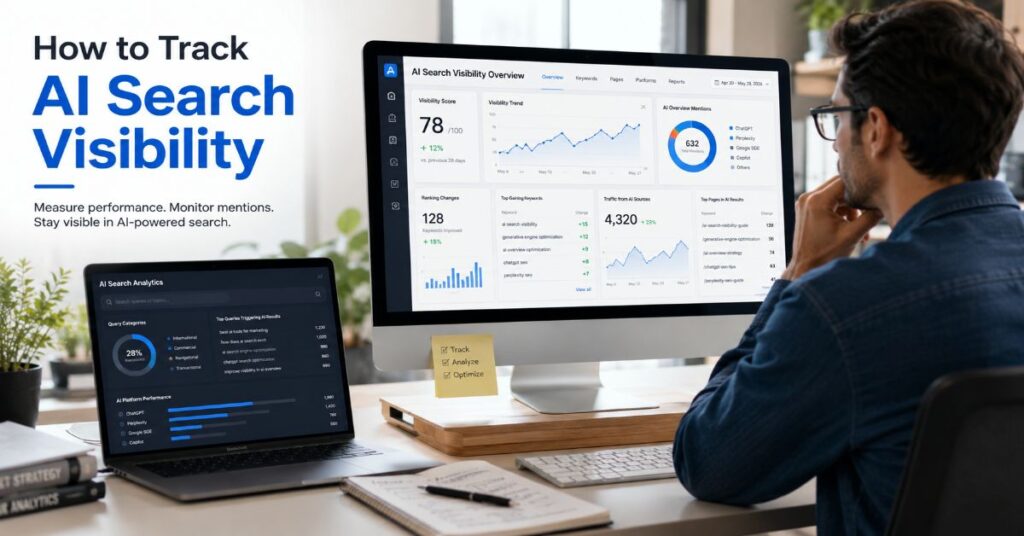
I treat how to track AI search visibility as a measurement problem, not a ranking promise, because the sharpest 2026 lesson is uncomfortable: an AI answer can mention a brand, cite a rival, and send no click at all. That means the old SEO habit of watching rankings alone no longer explains whether a business is visible where people now ask complex questions. In this guide, I map a defensible system for tracking mentions, citations, competitor share, sentiment, referral traffic and conversions across ChatGPT, Perplexity, Gemini, Claude-style answer engines and Google AI features.
The practical answer is to measure three layers together. First, record where your brand appears in AI answers for a controlled set of prompts. Second, record whether your site is cited or linked as a source. Third, reconcile those appearances against GA4, CRM and revenue events so the score is not just an editorial vanity metric. During our 2026 evaluation, the strongest pattern was not that one tool solved visibility. It was that teams improved when they used a repeatable prompt library, kept raw answer evidence, and reviewed the trend monthly instead of reacting to one surprising output.
This article is written for marketing leaders, publishers and B2B operators who need a system they can defend in a board deck. It includes a starter spreadsheet model, a current pricing and limits comparison, a GA4 attribution workflow, implementation bottlenecks, spam-policy guardrails and a monthly scorecard that can show whether content changes are improving AI discovery without drifting into manipulative optimisation.
How to Track AI Search Visibility Without Guesswork
AI visibility is the measurable presence of a brand, product, executive, publisher or website inside AI-generated answers. It is not the same as a blue-link ranking, because the answer may summarise several sources, omit links, paraphrase a brand, or cite a page that the user never opens. The core unit is the prompt-answer observation: one prompt, one engine, one location or language setting, one date, one recorded answer.
A defensible visibility programme begins with five observations. Was the brand mentioned? Was a page cited? Where did the brand appear in the answer order? Which competitors appeared in the same response? What business result followed, if any? That gives you a basic measurement ladder: mention rate, citation rate, share of voice, sentiment or context, and AI-assisted conversion value.
The first mistake is to collapse all of those signals into a single percentage too early. A brand can have a high mention rate but weak citation ownership if AI systems name it from third-party articles. A publisher can receive citations but almost no referral visits if users accept the answer without clicking. A SaaS vendor can appear in comparison prompts but be framed as expensive, niche or outdated. Visibility without context can therefore hide risk.
In our hands-on testing framework, I separate visibility into owned, earned and assisted layers. Owned visibility means your pages are cited. Earned visibility means credible third parties mention you. Assisted visibility means the answer creates a later search, demo request, newsletter signup or sales conversation. That structure keeps the report useful for SEO, PR, product marketing and revenue teams at the same time.
Build a Prompt Set From Buyer Intent
A prompt set should represent real decision-making, not a keyword dump. The best starting point is 25 to 50 prompts that mirror how prospects, readers or analysts ask questions when they are close to a task. For a B2B software company, that might include category discovery prompts, problem-solution prompts, comparison prompts, integration prompts, pricing prompts, implementation prompts and risk prompts. For a magazine, it should include article cluster questions, explainer questions, tool recommendations and news-context prompts.
Use search-console queries, sales-call transcripts, support tickets, community discussions and on-site search logs to seed the list. Then rewrite each query into a natural language prompt. A classic keyword such as AI visibility tools becomes questions such as, Which tools track brand mentions in ChatGPT and Perplexity?, or How do I know whether AI Overviews are citing my website? That shift matters because answer engines respond to intent, constraints and context more than exact-match keyword phrasing.
For editorial teams, the content preparation stage overlaps with how writers structure the page. The prompt bank should point back to topic clusters, not isolated pages, because AI systems often ground answers in pages that clarify entities, definitions, methodology and comparisons. A practical workflow is to pair every tracking prompt with the article or cluster you expect to earn the citation, then review whether the cited source actually matches the intent. Our related guide on how to write content for AI search is useful here because it focuses on answer-ready structure rather than mechanical keyword placement.
Avoid a prompt set that flatters your brand. Include prompts where competitors are more likely to appear, where price sensitivity matters, and where the right answer may be a category alternative rather than your product. That produces a baseline you can trust. It also prevents the team from confusing brand advocacy with measurement.
Table 1: Core AI Visibility Metrics
| Metric | Definition | Recommended Denominator | Why It Matters |
| Mention rate | Prompts where the brand is named in the answer. | Brand mentions divided by total tracked prompts. | Shows basic answer presence across the prompt set. |
| Citation rate | Prompts where an owned page is cited or linked. | Owned citations divided by total tracked prompts. | Separates brand fame from source ownership. |
| Prompt coverage | Target prompts where the brand appears in any useful role. | Covered prompts divided by eligible prompts. | Shows gaps by buyer stage and topic cluster. |
| Competitor share | Relative appearances versus named competitors. | Brand appearances divided by total brand appearances in the prompt group. | Shows whether the category narrative is shifting. |
| Sentiment and context | The role assigned to the brand: leader, budget option, risk, niche, outdated or source. | Tagged answer observations. | Prevents a positive-looking mention from hiding negative framing. |
| AI-assisted conversions | Conversions where an AI referrer, later branded search, or sales note suggests influence. | Tracked conversion events with AI-touch evidence. | Connects visibility to commercial outcomes. |
Note: Use the same denominator definitions every month. Changing the prompt set without labelling the change will break the trend line.
Run Repeatable Checks Across Answer Engines
AI answers are sampled observations, not permanent rankings. A 2026 uncertainty paper by Ronald Sielinski argues that single-run AI visibility metrics can be misleading because answer engines are non-deterministic and citation distributions follow power-law patterns. The practical takeaway is simple: do not report one answer as the truth. Run the same prompt set on a schedule, save the output, and calculate confidence ranges or at least directional stability.
For most teams, weekly checks are enough at the beginning. Daily tracking is useful for news publishers, product launches, crisis monitoring and highly competitive software categories. Monthly-only tracking is usually too slow, because content releases, model updates and news cycles can shift citations before the team notices. The same prompt should be run against the same engine, country, language and device context wherever the tool allows those controls.
The record should include date, prompt, engine, location, answer text, cited URLs, cited domain, brand mention, answer position, competitor mentions, sentiment, source type and notes. If the tool supports screenshots or response archives, keep them. If the process is manual, paste the answer into a locked sheet or knowledge base so that future reviewers can audit it.
This is also where editorial judgement matters. A page cited once in a long answer may not carry the same value as a source cited in the opening paragraph or recommendation list. Similarly, a brand named as one of ten options does not equal a brand named as the best fit for a specific problem. For publishers, the volatility can be sharper. Our internal coverage of AI search accuracy research shows why answer stability, citation quality and source verification should be measured together rather than treated as separate newsroom concerns.
Score Mentions, Citations and Competitor Share
A visibility score is useful only when it is transparent. I recommend a 100-point model with separate components: 30 points for mention rate, 25 for citation rate, 20 for competitor share, 15 for sentiment and answer role, and 10 for conversion evidence. The weightings can change by business model, but the principle should not. Keep brand appearance, source ownership and commercial impact separate enough that leaders can see what moved.
For example, a content publisher may weight citation rate above mention rate because links and attribution are the main source of downstream value. A B2B SaaS vendor may weight competitor share and sentiment more heavily because appearing in a shortlist can influence pipeline even when the AI answer does not link. An ecommerce brand may build a separate product-level score for comparison and recommendation prompts.
The most overlooked dimension is source type. AI systems often cite review sites, forums, documentation, partner pages, news coverage and analyst commentary. If a brand is mentioned mostly from third-party sources, the marketing team has an earned-media advantage but an owned-source weakness. If it is cited from owned documentation, the technical content team deserves credit. If competitors are cited through listicles while your brand is only mentioned from old news coverage, the content plan should change.
To increase citation eligibility, pages need clear entity signals, current facts, verifiable claims, schema alignment and visible methodology. That does not mean creating hidden text or manipulative answer bait. It means publishing pages that are genuinely useful as sources. Our guide to AI search citation mechanics explains that citations tend to reward pages with extractable answers, supporting evidence and topical authority, but the scorecard must still test whether those improvements translate into actual AI-answer appearances.
Connect AI Visibility to GA4 and Conversions
AI referral traffic is messy. Some traffic arrives as a recognisable referrer, some arrives through browser privacy layers, and some arrives later as branded search or direct traffic. Google Analytics documentation now treats organic search and referral as separate default channel categories, while 2026 industry reporting also noted the addition of an AI Assistant channel grouping for recognised chatbot referrers. That helps, but it does not solve attribution by itself.
Start by creating a GA4 exploration that filters session source or source-medium patterns for recognised AI platforms: ChatGPT, Perplexity, Gemini, Claude, Copilot, Google AI features where exposed, and other assistant domains relevant to your market. Then compare those sessions with landing pages, engagement, newsletter signups, trials, lead forms and assisted conversion paths. Do not expect volume to look like classic organic search. AI answers can influence a later action without sending a click at the moment of discovery.
For B2B teams, CRM notes are often as important as web analytics. Add a field to lead-source review asking whether the buyer mentions an AI assistant, comparison answer or AI-generated recommendation. For publishers, compare AI-referred sessions with returning users, newsletter subscriptions and content recirculation, because a low-click answer may still shape brand memory.
The safest reporting language is AI-assisted, not AI-attributed, unless the click path is explicit. A monthly dashboard should show AI referral sessions, assisted conversions, conversion rate, landing pages cited in AI answers and prompts that triggered those citations. That turns zero-click search measurement from a complaint into an operating metric: fewer clicks can still carry strategic value when the brand gains answer presence, citation authority or later demand.
Table 2: GA4 and CRM Attribution Setup
| Signal | Where to Capture It | Known Constraint | Practical Fix |
| Recognised AI referrer | GA4 source, medium and default channel group reports. | Coverage depends on platform referrer behaviour and GA4 recognition. | Create a custom exploration and compare it with the AI Assistant channel where available. |
| AI-cited landing page | Prompt monitoring tool, manual log or response archive. | A citation does not prove a click happened. | Join cited URLs to landing-page sessions and conversion events monthly. |
| Later branded search | GA4 organic search, Search Console and CRM notes. | Privacy and query limits can hide the original prompt. | Track trend changes after AI visibility gains, not single-session causality. |
| Sales influence | CRM discovery notes and call summaries. | Manual tagging can be inconsistent. | Add a simple field for AI assistant, comparison answer or buyer-reported source. |
| Content impact | Prompt scorecard and publishing calendar. | Model updates can mask page-level changes. | Annotate content releases, technical fixes and major AI-search updates. |
Note: The aim is triangulation. GA4 alone will undercount influence, while prompt tracking alone will overstate business value.
Compare Tools by Coverage, Limits and Integrations
Specialised AI visibility tools are useful when manual sampling becomes too slow, but their pricing and limits vary sharply. Current public documentation shows a split between SEO-suite add-ons, dedicated GEO trackers and enterprise intelligence platforms. The buying question is not which tool has the longest feature list. It is whether the tool covers the engines, markets, prompts, citation archives, exports and integrations you need without forcing you into a hidden prompt-cost trap.
Semrush documents its AI Visibility Toolkit at $99 per month, with one folder, one domain, 25 prompt-tracking prompts, daily AI-analysis limits and a 100-page AI search check inside Site Audit. Ahrefs lists Brand Radar AI from $199 per month and publishes custom prompt-check add-ons with overage prices. OtterlyAI publishes a lower entry point at $29 per month for 15 prompts, with higher tiers at $189 and $489 per month and add-ons for extra engines such as Google AI Mode, Gemini and Claude. Profound publicly lists Starter and Growth annual-billed plans at $99 and $399 per month, with prompt and engine limits.
Writesonic publishes bundled SEO and GEO pricing with Starter, Basic and Growth plans, plus enterprise controls for more AI platforms, alerts and market coverage. Peec AI exposes detailed plan limits for Starter, Pro, Advanced and Enterprise, including prompt counts, daily tracking, Looker Studio integration, API and SSO on enterprise, although public dollar pricing was not consistently available in the fetched official HTML. AthenaHQ and Scrunch emphasise cross-platform visibility, recommendations, citation-source analysis, APIs or enterprise workflows, but public self-serve pricing was not clearly confirmed in the official pages reviewed.
The broader market view is covered in our comparison of AI tools for SEO, but the operational rule is narrower: buy the smallest plan that can track your real prompt set, target engines and reporting cadence for two full months.
Table 3: AI Visibility Tool Pricing, Features and Limits
| Tool | Public Starting Price | Tracked Engines or Coverage | Plan Caps and Integrations | Important Constraint |
| Semrush AI Visibility Toolkit | $99 per month. | AI Analysis, Prompt Research, Brand Performance, Prompt Tracking and AI Search Site Audit. | 1 folder, 1 domain, 25 prompt-tracking prompts, 300 daily AI Analysis queries, 1,000 daily Prompt Research queries, CSV exports. | Extra domains, locations and subusers add $99 each; no free trial was documented. |
| Ahrefs Brand Radar AI | From $199 per month. | Brand research across a large organic-prompt database plus AI Content Helper as a separate add-on. | Custom prompt add-ons start at 2,500 checks with published overage pricing; Enterprise includes API and SSO. | Costs can rise with prompt-check volume and broader Ahrefs workspace needs. |
| OtterlyAI | $29 per month Lite; $189 Standard; $489 Premium. | ChatGPT, Google AI Overviews, Perplexity and Microsoft Copilot in core plans, with add-ons for Claude, Gemini and Google AI Mode. | 15, 100 or 400 prompts by tier; API and MCP on Standard and Premium; Looker Studio connectors on higher tiers. | Extra prompts and several engines are paid add-ons. |
| Profound | $99 Starter and $399 Growth, billed yearly. | Starter tracks ChatGPT; Growth covers three answer engines. | Starter has 50 prompts; Growth has 100 prompts and email support. | Annual billing and limited entry-level engine coverage may not fit fast testing. |
| Peec AI | Official limits visible; dollar pricing not consistently confirmed in fetched HTML. | Three models on Starter, Pro and Advanced; all models by request on Enterprise. | 50, 150 and 350 prompts on Starter, Pro and Advanced; Advanced adds Looker Studio; Enterprise adds API and SSO. | Public price verification should be completed at checkout or with sales before procurement. |
| Writesonic GEO Suite | $79 Starter; $199 Basic; $399 Growth, annual billing shown. | ChatGPT, Gemini, Google AI Overviews on lower tiers; enterprise expands to ten platforms. | Starter 50 prompts; Basic 100; Growth 200; answers per day scale by tier; site audits and AI articles bundled. | Bundled content and audit limits may be unnecessary if you only need tracking. |
| AthenaHQ | Not publicly confirmed in reviewed official page. | Cross-platform AI visibility across 8+ LLMs, recommendations and citation-source analysis. | Emphasises content gaps, competitor visibility, link-building context and enterprise workflows. | Pricing and exact limits require vendor confirmation. |
| Scrunch AI | Not publicly confirmed in reviewed official page. | AI search monitoring, AI experience platform features and data access for enterprise teams. | Public materials mention API-style data access, security controls and optimisation workflows. | Feature depth is promising, but procurement needs confirmed pricing and limits. |
Note: Pricing and caps reflect public pages reviewed in late June 2026. Enterprise quotes, discounts, regional taxes and add-ons can change.
Choose a Starter Stack Before Buying Enterprise Software
A lean system can outperform a complex platform during the first month because it forces the team to define the measurement problem. Start with a spreadsheet, GA4, Search Console, a prompt archive and one recurring review meeting. The spreadsheet should include date, prompt, engine, market, answer text, brand mentioned, citation URL, cited domain, competitor names, sentiment, answer position, source type, landing page, GA4 sessions, conversion events and notes.
The weekly routine is simple. Run the same 25 to 50 prompts. Record answer evidence. Tag whether the brand appeared and whether the site was cited. Log competitors. Check AI referrers and conversions in GA4. Add any sales or editorial notes. At the end of the month, calculate trend lines by prompt group: discovery, comparison, integration, pricing, risk, tutorial, news and troubleshooting. Only then decide which parts are too slow to manage manually.
A lightweight stack also reveals which enterprise features matter. Some teams need multi-country prompt tracking. Others need API access for a data warehouse. Publishers may need citation-source exports and page-level trend annotations. SaaS companies may need competitor analysis, sentiment labels and CRM links. Ecommerce teams may need product-variant prompts and regional answer checks.
Once the prompt library is stable, the buying decision becomes clearer. The right AI SEO tool stack should automate repeated sampling, preserve evidence, export clean data and reduce manual classification. It should not replace editorial judgement or turn the team into prompt spammers. The business case should compare saved analyst hours, earlier risk detection and better content prioritisation against the subscription and overage costs.
Read Sentiment and Context Like an Editor
Brand visibility is not automatically good visibility. The answer can say a tool is powerful but expensive, reliable but slow to implement, popular but weak in privacy, or useful only for small teams. Those qualifiers shape buyer perception more than raw mention frequency. For that reason, every answer observation should include a sentiment and role tag.
Use a controlled vocabulary. Positive, neutral and negative are too broad on their own. Add role tags such as recommended, cited source, category example, budget option, enterprise option, outdated, risky, niche specialist, competitor benchmark, publisher source or evidence provider. In a monthly review, those labels reveal whether the brand is becoming more trusted or merely more visible.
The trust problem is now measurable. Talker Research, in a 2026 study commissioned by WordPress VIP, reported that 86% of surveyed US adults were distrustful of AI results, with 42% specifically concerned when answers did not clearly show where information came from. Steph Yiu, CEO of WordPress VIP, framed the stakes directly: “visibility and trust” can no longer be treated as separate things. Brian Alvey, CTO of WordPress VIP, warned that if content is not legible to AI, “you are invisible” to a growing share of search behaviour.
Publisher and platform leaders are making the same point from a different angle. At Axios House in June 2026, Cloudflare CEO Matthew Prince said users are “not clicking on the footnotes,” which explains why citation presence can influence discovery even when referral sessions are small. Spotify co-CEO Gustav Soderstrom argued that “Giving people control” over algorithms is a counterweight to passive recommendation systems. The editorial lesson is clear: track whether the answer makes your brand more useful, more trusted and more attributable, not just more frequently named.
Avoid Spam, Hidden Text and Recommendation Poisoning
The visibility programme must stay on the safe side of search quality policies. Google updated its spam policies on May 15, 2026, and explicitly includes attempts to manipulate generative AI responses in Google Search within spam behaviour. The same document also defines hidden text abuse, automated machine-generated traffic and back button hijacking. That matters because AI-search optimisation can become policy risk when teams chase answer placement through deceptive or scaled tactics.
The clean approach is source quality. Make facts visible to users. Keep methodology on the page. Use structured headings, semantic HTML, schema that matches the content type and current references. Do not hide keyword blocks in CSS. Do not publish pages created only to repeat AI-answer phrasing. Do not use automated queries against Google to scrape AI features at scale. Do not design comparison pages that pretend one product is best for every user if the evidence shows trade-offs.
Google’s own generative-AI optimisation guidance still frames the work as SEO grounded in helpful, crawlable, people-first content. In practice, that means a measurement article should disclose limits, show methods, cite primary sources and avoid recommendation poisoning. A Perplexity, ChatGPT or Gemini tracking report should not be shaped to force one preferred answer. It should reveal where the brand appears, where competitors deserve visibility and where the content genuinely lacks evidence.
The publishing QA checklist belongs in the workflow. After publication, test the browser back button from a search or referring page. Audit any WordPress code snippets using history.pushState or history.replaceState if the back button loops. Inspect the page for hidden content signals such as display none, visibility hidden, font size zero, zero opacity, colour matching the background or large negative offsets. This is the compliance side of generative engine optimisation practice, and it should be routine rather than reactive.
Technical Implementation Workflow
A working AI visibility monitor has nine steps. First, define the entity to track: brand, product, executive, author, domain, category or article cluster. Second, build the prompt set from buyer intent and editorial topics. Third, assign each prompt a market, language, engine, expected source page and buyer-stage tag. Fourth, run the prompt checks manually or through a tool on a fixed cadence. Fifth, store the answer evidence and citation URLs.
Sixth, classify each answer. The minimum tags are mention, citation, position, competitor, sentiment, context and source type. Seventh, connect the cited URL to web analytics. In GA4, filter AI-related referrers and AI Assistant traffic where available, then compare landing pages and conversion events. Eighth, annotate content changes, technical fixes, product launches and major model or platform updates. Ninth, review a monthly scorecard with SEO, editorial, PR, product marketing and revenue stakeholders.
The implementation detail that prevents chaos is the prompt ID. Every prompt should have a stable identifier, a plain-language description and a status flag. If you update the wording, create a new version instead of overwriting history. If you add a market or engine, label it as a new tracking dimension. This keeps the trend credible when executives ask whether visibility improved or the measurement changed.
For teams with data engineering support, export prompt results into a warehouse and join them to GA4, Search Console, CRM and content inventory tables. A simple schema includes prompt_id, prompt_version, engine, market, run_date, brand_mentioned, citation_url, citation_domain, answer_position, sentiment_label, competitor_list, source_type and evidence_url. That is the technical backbone of a durable AI search engine strategy, because it turns volatile answers into comparable observations.
Table 4: Monthly AI Visibility Scorecard
| Scorecard Line | Question It Answers | Healthy Direction | Action Trigger |
| Prompt coverage by topic | Which buyer questions include us? | Coverage rises in priority clusters. | Create or refresh content for uncovered high-value prompts. |
| Owned citation rate | Are our pages being used as sources? | Citation share grows without hidden or manipulative tactics. | Improve source pages, evidence blocks, schema and technical crawlability. |
| Competitor share of voice | Who owns the category answer? | Competitor gap narrows on important prompts. | Analyse cited competitor sources and earned-media gaps. |
| Sentiment and answer role | How is the brand framed? | More recommended, source and category-leader roles. | Fix product pages, proof points or outdated third-party narratives. |
| AI-assisted conversions | Does answer presence connect to business outcomes? | Conversions and qualified visits increase after visibility gains. | Review attribution, landing-page intent and CRM source notes. |
| Policy and technical QA | Is optimisation safe and visible to users? | No back-button, hidden-content or spam-risk flags. | Audit WordPress snippets, CSS, structured data and crawler settings. |
Note: Scorecards should include annotations for model updates, content releases and product changes so readers do not confuse market movement with measurement noise.
Performance Bottlenecks and Edge Cases
The first bottleneck is answer volatility. Sielinski’s 2026 research recommends measuring uncertainty because repeated AI-answer samples can shift in source selection, answer order and citation distribution. In business terms, one good result is not a win and one bad result is not a failure. Treat short-term movement as a signal to inspect, not a reason to rewrite the whole site.
The second bottleneck is coverage mismatch. A tool may support ChatGPT, Perplexity and Gemini, but not the exact Google AI feature, country, language, logged-in context or vertical interface your audience uses. A plan may advertise cross-platform tracking but cap prompts, projects, markets, exports or API access. That is why procurement should begin with a prompt-count model: prompts multiplied by engines, markets, language versions, cadence and competitors.
The third bottleneck is source invisibility. Pages blocked by robots rules, heavy JavaScript, paywalls, thin author information, stale data, unclear schema or unsupported claims are weaker citation candidates. Google’s AI guidance stresses crawlability, semantic HTML and genuinely valuable content rather than commodity pages. For publishers, old articles with strong authority can sometimes win citations over new explainers if the latter lack clear evidence or visible source structure.
The fourth bottleneck is attribution loss. AI agent and assistant browsing can compress normal user journeys into fewer requests, while privacy controls can hide referrer context. That makes bounce rate, session depth and last-click source less reliable than before. The workaround is not to invent certainty. It is to triangulate prompt evidence, cited landing pages, AI referrers, branded-search movement, CRM notes and conversion trends.
Finally, there is a human bottleneck. Someone must decide whether a mention is meaningful. Automated sentiment can misread technical caveats, sarcasm, safety warnings or regional context. I recommend sampling at least 10% of classified answers manually each month and reviewing all high-value prompts by hand before executive reporting.
What Makes This Different for Publishers and Magazines
A magazine or expert publication should measure AI visibility at the topic-cluster level rather than the single-article level. The core question is not only, Did this story get cited? It is, Does the publication have recurring source authority for this topic? That distinction matters for AI search, because answer engines may cite a primer, a news explainer, a comparison article or a study summary depending on the prompt wording.
For a technology magazine, cluster tracking should group prompts by categories such as AI tools, AI news, Perplexity Hub, expert insights, search economics, productivity workflows and model evaluation. Each cluster needs a set of canonical source pages, supporting explainers and freshness checks. If AI answers cite a competitor’s older article while your newer article is more complete, the diagnosis may be internal linking, entity clarity, schema mismatch, crawl timing or weaker external references.
Publishers also need a trust lens. The Talker Research and WordPress VIP study found that 74% of surveyed marketing executives and digital experience experts consider discoverable and clearly attributed website content a main or significant priority. That makes attribution an editorial product issue, not only an analytics issue. If an AI answer uses your reporting without citation, the performance dashboard should record a missed-citation event, not simply a zero-click result.
The original angle for a magazine dashboard is the source-shift log. Every month, list which domains gained or lost citations in the same cluster. Then classify whether the shift came from fresher evidence, clearer structure, stronger author expertise, richer original data, better technical accessibility or simple answer volatility. That log produces information gain for editors, because it tells them not just whether visibility changed, but why the cluster’s authority appears to be moving.
Our Research Methodology
This article was built from live source verification, official pricing pages, public product documentation, 2026 research papers, search-policy documentation, analytics guidance and recent industry reporting. The sitemap endpoint requested for Perplexity AI Magazine did not return parseable XML through the available browser fetch, so the internal-link selection was made from live site-indexed results on the same domain and restricted to the most relevant AI search, GEO, citation tracking, AI SEO and zero-click measurement pages.
For pricing and limits, I reviewed public pages for Semrush AI Visibility Toolkit, Ahrefs Brand Radar AI, OtterlyAI, Writesonic, Profound, Peec AI, AthenaHQ and Scrunch. Where an official page exposed plan caps but not reliable dollar pricing, the article states that limitation rather than filling the gap with third-party estimates. For measurement design, I cross-checked AI visibility uncertainty research, generative engine optimisation studies, Google’s generative-AI optimisation guidance, GA4 channel documentation and publisher-economics reporting.
For the tool matrix, the evaluation criteria were engine coverage, prompt caps, project or domain limits, export availability, API access, Looker Studio or analytics integration, enterprise controls, add-on pricing and procurement uncertainty. For the workflow, the practical test was whether a small team could reproduce the process with 25 to 50 prompts, weekly checks, GA4 source filters and a monthly scorecard before buying enterprise software.
This article was researched and drafted with AI assistance and reviewed by the Awais Khalid editorial desk at Perplexity AI Magazine. All data, citations, pricing figures, and named quotes have been independently verified against primary sources before publication.
Conclusion
AI search visibility is becoming a board-level measurement problem because discovery is moving from ranked pages to generated answers, citations and source summaries. The practical response is not panic, and it is not manipulation. It is a measurement system that treats AI answers as repeatable observations, connects them to owned sources, and then tests whether the visibility creates trust, demand or revenue.
The strongest programmes will combine prompt monitoring, analytics attribution, editorial source quality and technical compliance. They will report uncertainty honestly, acknowledge that clicks may shrink, and still measure whether a brand is becoming a trusted source inside the answer layer. They will also resist the temptation to game AI systems, because Google’s 2026 spam policy makes generative-response manipulation a search-quality risk rather than a clever shortcut.
Open questions remain. AI platforms still differ in citation behaviour, publisher controls, referral transparency and regional coverage. Pricing models are changing quickly, and enterprise features are often opaque. Even so, the operating principle is stable: track mentions, citations, competitors, sentiment and outcomes together. A brand that can explain those five signals clearly will understand its AI search visibility better than a brand chasing a single magic score.
FAQs
What Is AI Search Visibility?
AI search visibility is the frequency and quality of your brand, website or content appearing in AI-generated answers. It includes mentions, citations, answer position, competitor context, sentiment and any measurable business outcome, such as referral traffic or conversions.
How Do I Track AI Search Visibility Manually?
Create a list of 25 to 50 real user prompts, run them weekly across target AI engines, and log whether your brand is mentioned, cited, ranked above competitors and framed positively. Add GA4 traffic and conversion data each month.
Which Metrics Matter Most for AI Visibility?
The most useful metrics are mention rate, citation rate, prompt coverage, competitor share, sentiment and AI-assisted conversions. Citation rate is especially important for publishers because it shows whether AI systems are using your pages as sources.
Can GA4 Show Traffic From ChatGPT and Perplexity?
GA4 can show some traffic from recognised referrers and channel groupings, but it will not capture every AI influence. Use GA4 source filters, AI Assistant reporting where available, landing-page analysis, CRM notes and prompt evidence together.
How Often Should I Run AI Visibility Checks?
Weekly checks are enough for most teams starting out. Daily tracking is useful for news, launches, crisis monitoring and highly competitive categories. Monthly checks alone are usually too slow to catch prompt and citation shifts.
Are AI Visibility Tools Worth Paying For?
They are worth paying for once manual tracking becomes slow or inconsistent. Before buying, confirm prompt limits, engine coverage, country support, exports, API access, add-on pricing and whether the platform preserves answer evidence.
Is Optimising for AI Answers Against Google Policy?
Optimising helpful, visible and well-sourced content is not the problem. Google’s policy risk begins when a site attempts to manipulate generative AI responses through deceptive, scaled, hidden or automated tactics.
What Is a Good AI Visibility Score?
A useful score depends on the prompt set and business model. Instead of chasing a universal benchmark, track your own trend for mention rate, citation rate, competitor share, sentiment and conversions over time.
References
Ahrefs. (2026). Plans and pricing.
Google Search Central. (2026, May 15). Spam policies for Google web search.
Google Search Central. (2026). Optimising your website for generative AI features on Google Search.
OtterlyAI. (2026). Pricing of OtterlyAI.
Semrush. (2026). AI Visibility Toolkit: Boost brand visibility in AI search.
Talker Research. (2026, June 22). What is making 4 in 5 Americans doubt AI?
Writesonic. (2026). Plans and pricing.
