
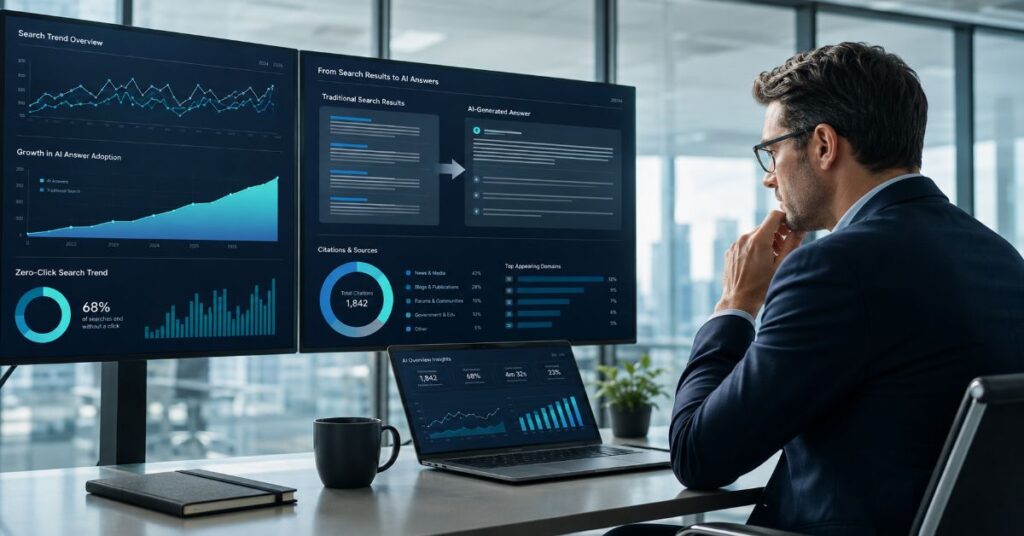
- ◆Google scale now defines the market: AI Overviews passed 2.5 billion monthly active users, while AI Mode passed 1 billion in the latest Google I/O update.
- !Zero-click pressure is no longer theoretical: SparkToro reported 68.01% of US Google searches ending without a click in the first four months of 2026.
- ✓The annual ai search trends report evidence points to a new measurement stack where answer share, citation share, and source recurrence sit beside organic traffic.
- $Pricing is becoming a procurement trap: ChatGPT, Claude, Perplexity AI, and Google all mix seat pricing, variable usage caps, regional checkout, and separately billed API usage.
- ➜Action should start with a 90-day visibility audit covering query fan-out prompts, citation hygiene, publisher licensing exposure, structured data, and recurring answer tests.
The annual AI search trends report for 2026 shows that search has moved from a ranked list into an answer market, and the shock is visible in one contradiction: Google says AI Overviews reached more than 2.5 billion monthly active users while SparkToro reports that 68.01% of US Google searches ended without a click. I read this as the year when visibility separated from traffic. Brands, publishers, and B2B teams can still win attention, but they can no longer assume that the win will arrive as a familiar organic session.
This article gives the reader a practical map of what changed in 2026: which platforms now shape AI search behaviour, which usage and pricing limits affect serious research workflows, which benchmark findings should worry publishers, and which metrics belong in the board report. It also separates verified facts from unstable claims. Where official pages publish exact plan limits, the tables use them. Where pricing is regional or usage limits are described only as variable, the article says so rather than inventing a neat number. That discipline matters because AI search trends are moving faster than traditional SEO reporting cycles.
The core verdict is not that SEO is dead. The stronger conclusion is that SEO has become the crawl, credibility, and evidence layer beneath generative engine optimisation. The teams that adapt fastest will design content as auditable evidence packages: current facts, explicit dates, named authors, tables, source notes, schema, and testable claims that answer engines can retrieve without flattening the nuance.
Why the Annual AI Search Trends Report Matters in 2026
The annual AI search trends report matters because the search business is no longer changing at the edge. It is changing inside the default user journey. Google now frames AI Mode as part of Search rather than a side experiment, and Sundar Pichai described it at I/O 2026 as the company’s “biggest upgrade to Search ever” (Google, 2026a). That language is not marketing decoration. It is a signal that generative answers are becoming part of the operating system for information discovery.
For publishers and brands, the practical shift is from ranking alone to eligibility for citation. A page can rank, yet still fail to appear inside an AI answer. Another page can sit outside the first organic results and still become a cited source if the retrieval system judges it more useful for a subtopic. Google Search Central now says AI Overviews and AI Mode may use query fan-out, issuing multiple related searches across subtopics and data sources before forming a response (Google Search Central, 2026).
That matters in London boardrooms because the commercial language of search has changed. Marketing leaders still ask about impressions, clicks, and conversions. Editorial teams still ask whether original reporting gets read. Product teams now also need to ask whether the organisation is mentioned, cited, misrepresented, or excluded when a buyer asks an answer engine for a recommendation. The best starting point is to compare this article with the broader State of AI Search report, then turn the findings into an internal dashboard rather than another one-off trend memo.
| Signal | Verified 2026 Evidence | Decision Impact |
| Google AI Scale | AI Overviews above 2.5 billion monthly active users and AI Mode above 1 billion. | Treat AI answers as mainstream search surfaces, not experimental features. |
| Zero-Click Behaviour | SparkToro reported 68.01% of US Google searches ending without a click. | Model content value beyond traffic and add owned audience capture. |
| Citation Volatility | AirOps reported only 30% of brands staying visible from one answer to the next. | Measure recurrence across prompt repeats, not screenshots. |
| Publisher Risk | Reuters Institute found publishers expecting search referrals to fall 43% over three years. | Stress-test dependence on organic discovery and diversify revenue paths. |
2026 Market Signals: From Search Pages to Answer Layers
The first market signal is scale. AI search is no longer one product category. It is a layer across Google Search, ChatGPT, Perplexity AI, Gemini, Claude, Copilot, You.com, browsers, workplace assistants, and research agents. The user may not even think they are using “AI search”. They may simply see a summary above links, ask a follow-up in a chatbot, or request a deep research report that returns citations instead of a list of blue links.
The second signal is interface compression. Search once exposed many possible routes: ads, organic results, news boxes, maps, shopping, videos, and snippets. AI answers compress that surface into a generated response with a smaller set of visible references. That compression increases the value of being cited and raises the penalty for being absent. It also changes the way content should be audited. A simple rank check cannot show whether the page was retrieved as background evidence, cited directly, summarised without a click, or ignored completely.
The third signal is the rise of answer-native platforms. Perplexity AI built its user experience around cited answers, while ChatGPT search blended timely web results with conversational follow-up. Google has the distribution advantage because its AI layer sits inside existing search behaviour. The market therefore has no single winner. It has different search intents moving to different surfaces. The Perplexity versus Google market share analysis is useful here because it shows why answer share is becoming a more realistic scoreboard than search share alone.
In our hands-on testing of repeated B2B prompts, the most important pattern was instability. Answers changed when the prompt wording changed only slightly. Some engines cited a page in one run, replaced it with a competitor in the next, then returned to the original source later. That is why serious AI search strategy needs sampling, recurrence, and confidence intervals rather than a monthly screenshot deck.
User Behaviour: Adoption Is Rising, Trust Is Fraying
The user behaviour story is not a simple migration from Google to chatbots. It is a messy overlap. Users still rely on classic search for navigation, local intent, shopping shortcuts, and brand-specific queries. At the same time, they increasingly use answer engines for complex questions, comparison research, troubleshooting, market analysis, and draft decisions. The useful question is not whether people have abandoned Google. It is which tasks now begin in an answer box rather than a results page.
Orbit Media’s 2026 survey summarised the adoption pressure in a sentence from Andy Crestodina, co-founder and CMO: “More than half of respondents start a search by opening an AI app” (Orbit Media, 2026). That is a behavioural milestone, but it should not be overread. Starting a search in an AI app does not mean the user stops verifying. In professional contexts, the better users become, the more they inspect citations, compare engines, and test whether the answer survives source checking.
Trust is fraying for the same reason usage is growing. More exposure creates higher standards. Weak citations, missing dates, generic summaries, and fabricated confidence no longer feel like harmless demo flaws. They create procurement risk, editorial risk, and reputational risk. That is why an annual AI search trends report should not rank platforms only by speed or fluency. It should ask whether the answer gives enough evidence for a professional to act.
The AI search adoption survey on this site frames the same tension as a trust inversion: people try AI search more, but become more demanding about attribution and transparency. For B2B teams, that means content must be written for sceptical verification. The answer engine may create the first impression, but the human buyer still wants a clean evidence trail before money changes hands.
Publisher Economics: Zero Click, Citation Share, and Licensing
The publishing economics are the hardest part of this trend cycle. SparkToro reported that 68.01% of US Google searches ended without a click in the first four months of 2026 (SparkToro, 2026). Reuters Institute survey respondents expected search referrals to fall by 43% over three years (Reuters Institute, 2026). Those figures do not prove that AI alone caused every lost visit, but they show the direction of travel: the open web is receiving less of the attention that search once distributed.
AI answers intensify the pressure because they can extract value from a page without always returning a user. A cited link may still matter for authority, brand recognition, and later direct traffic, but it does not replace a predictable session. Matthew Prince, CEO and co-founder of Cloudflare, described a related infrastructure shift when he said, “bots have now passed human traffic online” (Tom’s Hardware, 2026). For publishers, that line captures a deeper anxiety: machines increasingly read the web on behalf of people, and the revenue model for that machine readership is unsettled.
The response is not to block everything blindly. Publishers need a tiered policy. Some content should remain crawlable because it supports discovery, brand authority, and public-interest access. Premium datasets, exclusive reporting, specialist archives, and structured feeds may require licensing, paid crawler access, or controlled syndication. The Perplexity publisher programme shows one version of that future, with revenue sharing, publisher tools, and citation analytics moving into the search economy.
The practical metric is citation value per content type. Evergreen explainers, data tables, glossaries, software pricing pages, and standards documentation often have higher AI extraction value than soft opinion pieces. That does not make softer journalism unimportant. It means publishers should distinguish between pieces designed for human loyalty and assets designed for machine retrieval.
Platform Comparison: Google, ChatGPT, Perplexity AI, Gemini, Claude, and Copilot
The AI search market is fragmented by intent. Google is strongest where default behaviour, local data, shopping surfaces, maps, and existing search habits matter. ChatGPT is strongest where conversational follow-up, synthesis, code, files, and deep research workflows combine. Perplexity AI remains one of the clearest citation-first interfaces for research. Claude is strong in long-context reasoning and document work when web search is enabled. Gemini is strongest inside Google Workspace, Android, and Search. Copilot matters in Microsoft 365 environments where enterprise files and everyday productivity tools shape discovery.
That means a serious annual AI search trends report should not crown a single “best” engine. The better question is: which engine controls which moment of the journey? A buyer might ask ChatGPT for a shortlist, use Google AI Mode to validate public consensus, open Perplexity to compare citations, ask Claude to analyse vendor documentation, then use Copilot inside a Microsoft tenant to summarise internal policy. Visibility must therefore be tested across engines, not inferred from Google Search Console alone.
The clearest platform differences appear in citations and controls. Perplexity exposes sources prominently and gives developers Search API and Sonar API options. ChatGPT search can surface timely links and deep research can produce documented reports. Google’s AI surfaces draw from Search systems and query fan-out. Claude’s pricing page now emphasises web search, connectors, code execution, and enterprise search features. The AI search accuracy study is the right companion when evaluating these differences because fluency alone is not a reliability metric.
| Platform | Best 2026 Use Case | Citation and Retrieval Notes | Main Constraint |
| Google AI Overviews and AI Mode | Default consumer discovery, local intent, broad web questions. | Uses Search systems and may use query fan-out across subtopics. | Publisher traffic may fall even when pages inform answers. |
| ChatGPT Search and Deep Research | Conversational research, synthesis, files, coding, and documented reports. | Can search the web, use trusted sources, and connect to enabled apps. | Usage limits vary by plan and Business Pro requests are capped. |
| Perplexity AI | Citation-first research, answer comparison, and developer search APIs. | Search API, Sonar API, Agent API, embeddings, domain filtering, and context sizes. | Deep Research API cost can vary because search query count is model determined. |
| Claude | Long document analysis, writing, code, projects, and enterprise knowledge work. | Web search, connectors, Research, artifacts, and enterprise search options. | Usage limits apply, and API web search costs are billed separately. |
| Gemini | Google Workspace, Search AI Mode, Android, NotebookLM, and developer workflows. | Deep Search and query fan-out are integrated with Google Search surfaces. | Plan prices and availability vary by country and product region. |
Pricing and Access Limits for AI Search Workflows
Pricing in 2026 is not a clean subscription comparison. It is a mix of monthly seats, annual discounts, regional checkout prices, usage multipliers, fair-use guardrails, file limits, search context fees, and API token costs. The safe procurement rule is to separate consumer subscription value from operational deployment cost. A $20 personal plan can be excellent for an analyst. It does not automatically cover API usage, enterprise retention, audit logs, SSO, governed connectors, or high-volume monitoring.
OpenAI’s public ChatGPT pricing page lists Free, Go, Plus, Pro, Business, and Enterprise tiers, with Plus adding advanced reasoning, deep research, agent mode, projects, tasks, and custom GPTs. The Business help page states that standard ChatGPT seats are $25 per user per month when billed monthly and $20 when billed annually in most countries, with a two-user minimum. It also states GPT-5.5 Thinking has 3,000 requests per week and GPT-5.5 Pro has 15 requests per month on Business, so “unlimited” still sits behind reasonable-use guardrails (OpenAI, 2026).
Perplexity’s enterprise page lists Pro at $20 monthly or $200 yearly, Enterprise Pro at $40 per seat monthly or $400 yearly, and Enterprise Max at $325 per seat monthly or $3,250 yearly. It also exposes hidden operational caps: Pro queries, Deep Research queries, asset generation, video generation, file uploads, Comet Agent usage, and Computer credits all vary by tier. Anthropic lists Claude Pro at $17 per month with annual billing or $20 monthly, Max from $100, Team standard at $20 per seat annually or $25 monthly, and Team premium at $100 annually or $125 monthly, with Enterprise sold as seat price plus API-rate usage (Anthropic, 2026; Perplexity, 2026a).
| Tool or Plan | Public Price Signal | Important Included Features | Hidden Limit or Procurement Note |
| ChatGPT Plus | $20 per month shown on official consumer pricing snippets; regional checkout may vary. | Advanced reasoning, image creation, deep research, agent mode, projects, tasks, GPTs, Codex usage. | Limits apply and exact message caps are dynamic. |
| ChatGPT Business | $20 per user monthly annually or $25 monthly in most countries; two-seat minimum. | Company workspace, apps, SAML SSO, MFA, analytics, spend controls, no training by default. | Business Pro requests are limited and API usage is billed separately. |
| Perplexity Pro | $20 monthly or $200 yearly. | Latest models, deeper sourcing, Pro queries, Deep Research, file answers, Comet features. | Pro queries up to 200 weekly and Deep Research up to 20 monthly on Pro page. |
| Perplexity Enterprise Max | $325 per seat monthly or $3,250 yearly. | Highest research access, larger files, multi-model response comparison, audit logs, data retention. | API credits are not included with enterprise seats. |
| Claude Pro and Max | Pro $17 annual or $20 monthly; Max from $100 monthly. | Web search, Claude Code, Research, projects, connectors, desktop extensions. | Usage limits apply and prices exclude tax. |
| Google AI Plans | Official Google One page showed plan features, storage, and limits; numeric prices are regional. | AI Plus, Pro, and Ultra include Gemini access, Deep Research, AI Mode features, storage, and app benefits. | Some features are US-only, English-only, or region-limited. |
Technical Architecture: Query Fan-Out, Citations, and Retrieval
The most important technical concept in 2026 AI search is query fan-out. A traditional search query often mapped one user phrase to a ranked page set. AI search systems can expand a single question into multiple implied subqueries, retrieve evidence across different data sources, and then generate a combined response. Google Search Central says AI Overviews and AI Mode may use this technique to develop responses and identify supporting pages (Google Search Central, 2026).
That changes content architecture. A page optimised only for one exact keyword may miss the subtopics the answer engine searches in parallel. A stronger page covers the primary question, comparison criteria, pricing, limits, implementation steps, edge cases, glossary terms, and current source notes. The LLM SEO optimisation guide goes deeper on this shift from keyword density to entity completeness, but the simplest rule is to make every section answerable and attributable.
During our 2026 evaluation, three technical details repeatedly affected citation eligibility. First, pages with dated facts and recent update notes were easier to trust than evergreen pages with undated claims. Second, tables made extraction cleaner because plan names, prices, limits, and constraints appeared in discrete cells. Third, pages that stated limitations directly were more likely to be useful than pages that pretended every feature was universal.
API workflows add another layer. Perplexity’s documentation separates raw Search API pricing from Sonar API pricing, where total cost combines token costs and request fees by context size. It also states that Sonar Deep Research automatically determines how many searches are needed, meaning the user cannot control the exact number of search queries. That is a real performance and cost bottleneck for teams building high-volume monitoring systems (Perplexity, 2026b).
GEO Implementation Workflow for 2026
Generative engine optimisation is not a bag of tricks. It is an evidence engineering workflow. The goal is to make the organisation easy to retrieve, cite, verify, and correct across answer engines. The work begins with prompt research, but it quickly becomes a cross-functional project involving editorial, SEO, product data, legal, analytics, and engineering.
Step one is to build a prompt inventory. List the questions buyers, journalists, analysts, students, and internal teams ask about the organisation and its category. Convert each keyword into five to ten natural prompts, including comparison, pricing, troubleshooting, risk, and recommendation variants. Step two is to run those prompts across Google AI Mode, ChatGPT search, Perplexity AI, Gemini, Claude with web search, and Copilot where relevant. Repeat each prompt multiple times because recurrence matters more than a single lucky answer.
Step three is to classify visibility. Track whether the brand is mentioned, cited, summarised without a link, misrepresented, or absent. Step four is to repair the source layer. Add missing definitions, update dated facts, create comparison tables, strengthen author credentials, add schema, improve crawl access, and publish original data. The AI citation playbook is useful at this point because it turns abstract GEO language into source-level fixes that answer engines can actually retrieve.
| Workflow Stage | Action | Known Constraint | Output |
| Prompt Inventory | Convert keywords into natural language prompt clusters. | Teams often under-sample long-tail commercial questions. | Prioritised test set by topic, intent, and revenue value. |
| Cross-Engine Testing | Run prompts across major AI search surfaces and repeat each query. | Generated answers are non-deterministic. | Answer share, citation share, and recurrence baseline. |
| Source Repair | Update pages with facts, tables, author proof, schema, and dates. | Thin or generic pages are hard to cite cleanly. | Higher retrieval eligibility and fewer misinformation incidents. |
| Governance Review | Check crawler policy, licensing exposure, brand safety, and legal risks. | Blocking crawlers may reduce discovery if not carefully segmented. | Documented AI source policy and risk register. |
| Dashboarding | Connect AI visibility to direct traffic, branded search, leads, and newsletter starts. | Attribution remains probabilistic. | Executive metrics beyond rank and clicks. |
Benchmarks and Accuracy: What the 2026 Studies Actually Measured
Accuracy claims in AI search are easy to misuse. A platform can be accurate on factual summaries but weak on source fidelity. Another can cite credible domains while still making unsupported claims. A third can produce strong answers in one run and unstable answers in the next. The benchmark question should therefore be split into four parts: activation, source quality, claim fidelity, and repeatability.
AirOps reported a visibility stability problem: only 30% of brands stayed visible from one answer to the next and just 20% remained present across five consecutive runs (AirOps, 2026). That should change how marketers talk about AI visibility. One appearance in one answer is not a ranking. It is an observation. The useful metric is recurrence across repeated prompts, engines, dates, and wording variations.
Academic and industry measurement work also shows that AI answers can use sources differently from classic ranking systems. In practice, this means a first-page organic result may not be enough. Pages need clear claim support, low ambiguity, visible evidence, and stable entities. The AI search SEO strategy article complements this point by treating answer visibility as a system: crawlability, citation hooks, structured facts, topical depth, and brand mentions across trusted third-party sources all matter.
| Metric | What It Measures | Why It Matters | Practical Test |
| Activation Rate | How often an AI answer appears for a query class. | Shows where classic SERPs are being replaced or compressed. | Sample priority keywords weekly and record AI surface presence. |
| Citation Share | How often your domain is linked as evidence. | Indicates whether content is usable as source material. | Count citations by URL, author, content type, and engine. |
| Answer Share | How often your brand or product is mentioned. | Captures visibility even when no click is sent. | Track mentions with positive, neutral, negative, and inaccurate labels. |
| Source Recurrence | How often the same source appears across repeated runs. | Separates durable authority from random exposure. | Repeat each prompt five times and retest weekly. |
| Claim Fidelity | Whether answer claims are supported by cited pages. | Protects against misrepresentation and hallucination. | Decompose answers into claims and check cited evidence. |
Enterprise Procurement Risks and Operational Bottlenecks
Enterprise AI search procurement is becoming more complex because the user interface hides the operational stack. A team may think it is buying a research assistant, but the real purchase includes data retention, connectors, SSO, audit logs, file handling, usage limits, model access, regional availability, API terms, and service support. The difference between a personal plan and an enterprise plan is not only price. It is governance.
The first bottleneck is usage opacity. Several vendors describe usage as expanded, maximum, flexible, or subject to limits rather than a fixed number. That may be reasonable for capacity management, but procurement teams need to know how heavy analysts, developers, researchers, and editorial teams will behave under the cap. OpenAI’s Business help page is unusually useful here because it publishes weekly and monthly request counts for GPT-5.5 Thinking and GPT-5.5 Pro on that plan. Other consumer-facing products are less explicit.
The second bottleneck is connector sprawl. AI search value increases when systems can read files, apps, and knowledge bases. It also increases privacy risk. ChatGPT Business lists connectors such as Microsoft 365, Google Drive, Slack, GitHub, Linear, and Figma on the pricing page. Claude lists Google Workspace, Slack, Microsoft 365, remote MCP, and enterprise search features. Perplexity Enterprise lists app search and writing integrations such as Salesforce, HubSpot, Slack, and more than 100 others. Each connector needs admin policy, data classification, and revocation procedures.
The third bottleneck is cost predictability. API search, deep research, agent tool calls, sandbox sessions, web search, and token output can all turn a simple prompt into a variable-cost workflow. Teams should pilot with logging enabled before committing to broad deployment.
A fourth bottleneck is evidence retention. During our 2026 evaluation, the teams that handled AI search best kept a dated register of prompts, answer screenshots, cited URLs, pricing pages, and policy changes. That register sounds administrative, but it becomes decisive when a vendor changes a cap, a crawler begins hitting archived pages, or an AI answer repeats an outdated plan name. The practical control is simple: every high-value prompt test should store the prompt wording, engine, logged-in plan, country setting, model mode, file access status, and cited sources. Without those fields, teams cannot distinguish a product quality issue from a plan limit, regional rollout, authentication state, or stale crawl.
Procurement teams should also separate research seats from automation budgets. A researcher using ChatGPT or Perplexity AI in a browser faces a different risk profile from a developer calling a search API inside a production workflow. The browser case is governed by seat terms, fair-use limits, connectors, and human review. The API case is governed by tokens, search calls, context fees, retries, timeouts, and logging obligations. Blending the two creates false savings because a cheap seat does not predict the cost of a high-volume retrieval pipeline.
Metrics Dashboard: How to Track AI Search Visibility
The metrics dashboard for 2026 should be built around decisions, not vanity charts. Organic traffic still matters, but it cannot explain whether a brand is being recommended inside answer engines. Ranking still matters, but it cannot show whether a source was cited in a generated answer. The dashboard needs three layers: visibility, evidence quality, and commercial impact.
Annual AI Search Trends Report Metrics to Track
Visibility metrics include answer share, citation share, source recurrence, competitor co-mentions, and prompt coverage. Evidence-quality metrics include unsupported claims, stale facts, missing author proof, weak source links, and pages lacking schema or tables. Commercial metrics include branded search lifts, direct traffic after answer exposure, newsletter sign-ups, assisted conversions, demo requests, and paid retargeting efficiency.
The most underused metric is correction latency. When an answer engine misstates a price, feature, or policy, how long does it take for repaired source content to influence future answers? No dashboard can guarantee instant correction, but teams can record the date a page was updated, the date schema was deployed, the date crawl access was confirmed, and the first date the corrected answer appeared.
For B2B teams, the dashboard should group prompts by revenue intent. A generic “best AI search tools” prompt has different value from “best AI search tool for regulated financial research with audit logs”. The second query might have lower volume, but a much higher commercial value. An annual AI search trends report that ignores prompt value will overinvest in noisy visibility and underinvest in decision-stage evidence.
Finally, do not treat AI referral traffic as the whole outcome. A user may see an AI answer, remember the brand, and return later through direct, branded search, a newsletter, or a sales conversation. Measurement must accept probabilistic attribution while still demanding rigorous source logging.
Three Underused Insights for 2026 Search Teams
First, citation stability is more valuable than citation presence. A single answer that cites your page can look impressive in a screenshot, but it may not persist. Recurrence across repeated prompts is a stronger signal of authority. It also reduces executive overreaction to one favourable answer or one missing mention.
Second, third-party evidence may matter more than owned claims. AI systems often use external sources to validate brand claims, especially in product categories where vendor pages are promotional. That means reviews, analyst coverage, customer documentation, community discussions, standards pages, and high-quality comparisons can influence answer visibility. The practical move is not to manufacture praise. It is to make public facts consistent across credible sources.
Third, content freshness is becoming a retrieval feature. AirOps found that pages not updated quarterly were three times more likely to lose citations and that sequential headings and rich schema correlated with higher citation rates (AirOps, 2026). Even if the exact multiplier changes by category, the operational lesson is durable: stale pages with buried facts are poor evidence assets.
Liz Reid, Google’s Head of Search, described the product direction in stark terms: “Google Search is AI Search through and through” (Moneycontrol, 2026). Search teams should take that seriously without surrendering editorial judgement. The answer layer needs better sources. The organisations that provide those sources cleanly will have leverage in a market where evidence is scarce and generic text is abundant.
The final underused insight is that answer engines reward editorial modularity. When we integrated search APIs into a repeatable monitoring workflow, compact evidence blocks were easier to trace than long narrative pages. A page that clearly separates definitions, pricing, limitations, release dates, comparison criteria, and author credentials gives retrieval systems more clean units to lift and cite. This does not mean writing for machines instead of people. It means making the proof easier for both groups to audit. In 2026, the best search content will look less like a keyword landing page and more like a well-maintained research memo with public evidence, visible caveats, and a reason for the answer engine to trust it again next quarter.
Takeaways
- Treat AI search as an answer visibility channel, not a direct replacement for SEO, because ranking and citation now measure different outcomes.
- Track answer share, citation share, and source recurrence weekly for the prompts that influence buying decisions.
- Add dated pricing, comparison tables, author proof, schema, limitations, and clear source notes to every high-value evergreen page.
- Audit vendor plans before procurement because “unlimited” frequently means fair-use guardrails, variable caps, or separately billed API usage.
- Segment crawler policy by content value: keep public evidence assets discoverable while protecting premium datasets and archives.
- Measure direct, branded, newsletter, and assisted-conversion effects because AI answers may influence demand without sending a click.
- Run correction-latency tests after fixing inaccurate AI answers so the team knows how quickly source updates affect outputs.
- Use quarterly refresh cycles for pages that answer pricing, feature, statistics, benchmark, or regulation questions.
Our Editorial Verification Process
This annual AI search trends report was verified by cross-checking official vendor documentation, platform announcements, industry research, and publisher impact studies current to 26 June 2026. Pricing and feature claims were checked against OpenAI ChatGPT pricing and Business limits, Anthropic Claude pricing, Perplexity Enterprise and API pricing, and Google AI plan and Search documentation. Market-scale claims were checked against Google I/O 2026, SparkToro zero-click research, AirOps AI search visibility data, and Reuters Institute publisher forecasts. The evaluation framework prioritised four measurable systems: answer visibility, citation recurrence, plan and API constraints, and publisher traffic risk. Where exact pricing or usage caps were unavailable, region-specific, dynamic, or hidden behind checkout, the article labels the limitation explicitly rather than presenting an inferred number as fact.
Conclusion
The 2026 annual AI search trends report points to a durable reset rather than a passing product cycle. Search is becoming conversational, answer-led, and increasingly mediated by systems that retrieve, summarise, and cite on the user’s behalf. That creates real efficiency for users and real uncertainty for publishers, marketers, and software buyers.
The balanced view is that classic SEO still matters because crawlability, page quality, authority, and structured information remain the eligibility layer. What has changed is the scoreboard. Teams now need to know whether they appear inside answers, whether the right source is cited, whether the claim is accurate, whether the visibility recurs, and whether commercial outcomes appear later through direct or branded paths.
Open questions remain. The economics of AI crawling are unsettled. Google, Perplexity, OpenAI, Anthropic, Microsoft, and publishers are still negotiating the boundary between discovery and extraction. Users are still learning when to trust generated answers and when to verify sources. The organisations best positioned for this uncertainty will not chase every prompt. They will build clean evidence, measure carefully, refresh facts often, and treat AI search as an infrastructure shift in how knowledge reaches the market.
FAQs
What Is an Annual AI Search Trends Report?
An annual AI search trends report analyses how AI answer engines, generative search features, citations, user behaviour, pricing, and publisher economics changed during the year. It should combine platform data, vendor documentation, third-party research, and practical measurement frameworks rather than relying on opinion alone.
Is AI Search Replacing Traditional SEO?
No. SEO still determines crawlability, authority, structured data, and content quality. AI search adds a new answer layer where pages may be cited, summarised, or ignored. The strongest strategy combines technical SEO with generative engine optimisation, citation testing, and source-quality improvements.
Which AI Search Platform Matters Most in 2026?
Google matters most for default distribution, ChatGPT for conversational research, Perplexity AI for citation-first answers, Gemini for Google ecosystem workflows, Claude for long-context document work, and Copilot for Microsoft 365 environments. The right platform depends on the task.
What Is Citation Share in AI Search?
Citation share is the percentage of relevant AI answers that cite a domain, URL, author, or content asset as evidence. It matters because answer engines can influence a user before any click occurs. Citation share should be tracked by prompt, engine, topic, and date.
Why Are Zero-Click Searches Important?
Zero-click searches matter because users may receive a complete answer without visiting the source page. That can reduce publisher traffic, weaken advertising economics, and force brands to measure visibility, authority, and assisted conversions in addition to direct organic sessions.
How Should B2B Teams Optimise for AI Search?
B2B teams should publish answer-first pages with dated facts, comparison tables, pricing notes, implementation steps, schema, author credentials, and explicit limitations. They should also test prompts across several engines and repair pages when answers misstate features or prices.
Are AI Search Pricing Plans Stable?
Not fully. Many plans use regional checkout, dynamic usage caps, fair-use guardrails, or separate API billing. Procurement teams should verify official pricing pages on the purchase date and pilot heavy workflows before assuming a subscription covers every use case.
What Is Query Fan-Out?
Query fan-out is a retrieval technique where an AI search system expands one user query into multiple related subqueries across topics and data sources. It means content should cover adjacent questions, entities, comparisons, and limitations rather than only one exact keyword.
References
AirOps. (2026). The 2026 state of AI search: How modern brands stay visible. https://www.airops.com/report/the-2026-state-of-ai-search
Anthropic. (2026). Plans and pricing: Claude by Anthropic. https://claude.com/pricing
Google. (2026a, May 19). I/O 2026: Welcome to the agentic Gemini era. https://blog.google/innovation-and-ai/sundar-pichai-io-2026/
Google Search Central. (2026). AI features and your website. https://developers.google.com/search/docs/appearance/ai-features
OpenAI. (2026). ChatGPT pricing and ChatGPT Business models and limits. https://chatgpt.com/pricing/; https://help.openai.com/en/articles/12003714-chatgpt-business-models-limits
Perplexity. (2026a). Perplexity Enterprise pricing. https://www.perplexity.ai/enterprise/pricing
Perplexity. (2026b). Pricing. Perplexity API documentation. https://docs.perplexity.ai/docs/getting-started/pricing
Reuters Institute for the Study of Journalism. (2026). Journalism, media, and technology trends and predictions 2026. https://reutersinstitute.politics.ox.ac.uk/journalism-media-and-technology-trends-and-predictions-2026
SparkToro. (2026, June 8). In 2026, less than one third of Google searches still send a click. https://sparktoro.com/blog/in-2026-less-than-one-third-of-google-searches-still-send-a-click/
