
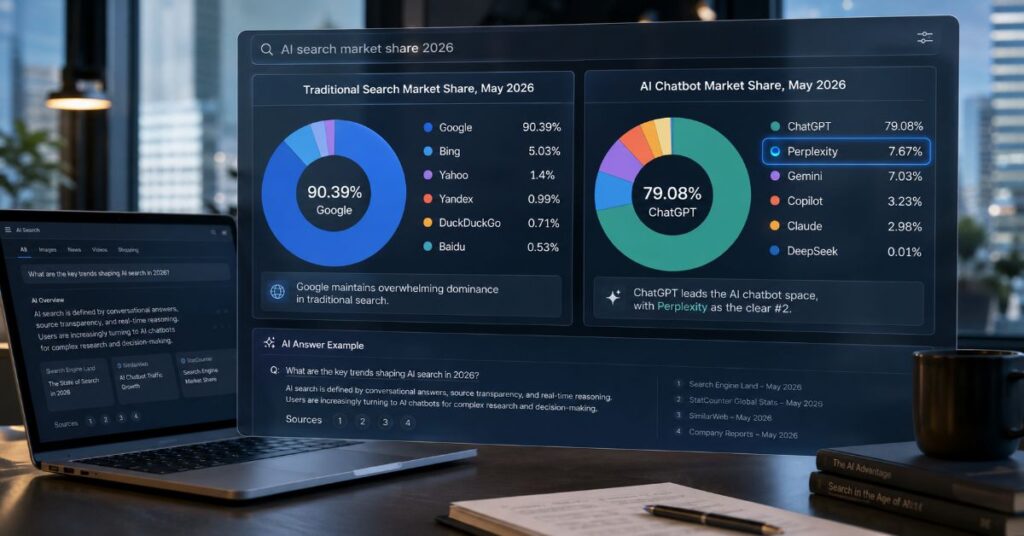
- ◆AI search engine market share data now splits into two markets: Google held 90.39% of traditional search in May 2026, while ChatGPT led AI chatbots at 79.08%.
- ●Perplexity ranked second in StatCounter AI chatbot share at 7.67%, a smaller number than ChatGPT but a cleaner signal for search-native, cited-answer behaviour.
- ↗Google AI Mode complicates the scoreboard because it lives inside Search, where Google says AI Mode has surpassed 1 billion monthly users and queries are more than doubling each quarter.
- £Pricing is the hidden trap: grounded AI search costs combine subscription seats, request fees, token fees, context depth, and search-grounding charges that are not comparable across vendors.
- ✓Publishers should track AI visibility through repeated citation sampling, referral logs, crawler access, and conversion quality rather than relying on one visit-share dashboard.
- ➜B2B teams should use Google for demand scale, ChatGPT for conversational reach, Perplexity for research-intent visibility, and Brave, You.com, or Gemini APIs for controlled measurement.
I read the latest AI search engine market share data as a split-screen story: Google still controlled 90.39% of traditional search in May 2026, while ChatGPT led the AI chatbot layer at 79.08% and Perplexity had already become the second-largest AI answer environment at 7.67%. That contradiction is the market. Search is not being replaced in one clean motion. It is being re-bundled into classic search boxes, AI chatbots, answer engines, browser agents, and enterprise research APIs.
For a publisher, investor, SaaS marketer, or search strategist, the practical question is not simply which company has the biggest share. The better question is which share matters for the job in front of you. Google remains the dominant demand gateway. ChatGPT owns the broadest conversational AI habit. Perplexity is unusually important because its product design is search-native, source-forward, and closer to research intent than many general chat sessions. Google AI Mode then distorts any simple scoreboard because it brings AI answers back inside the world’s largest search platform rather than spinning them out as a separate competitor.
This article separates the public numbers from the operational signals. It covers traditional search share, AI chatbot share, source citation visibility, API economics, plan limits, pricing traps, publisher exposure, and the workflow I would use to monitor AI search visibility in 2026 without mistaking a dashboard for a market.
What the AI Search Engine Market Share Data Actually Measures
The first mistake in this category is treating every number with the words “AI search” as if it measured the same thing. It does not. Traditional search market share usually counts search engine usage, often by page views, referrals, or observed browsing behaviour. AI chatbot share counts visits or usage inside conversational systems. AI answer visibility asks whether a model cites a brand, mentions a page, or summarises a source. API spend measures the infrastructure layer that developers use to build retrieval and answer products. These metrics overlap, but they are not interchangeable.
StatCounter gives one clean illustration. In May 2026, its worldwide search engine table showed Google at 90.39%, Bing at 5.03%, Yahoo at 1.4%, Yandex at 0.99%, DuckDuckGo at 0.71%, and Baidu at 0.53%. On StatCounter’s AI chatbot table for the same month, ChatGPT led with 79.08%, Perplexity followed at 7.67%, Google Gemini sat at 7.03%, Microsoft Copilot had 3.23%, Claude had 2.98%, and DeepSeek registered 0.01%. Both tables are useful. Neither table alone tells a complete AI search story.
A practical AI search engine SEO strategy therefore starts by labelling the metric before making a decision from it. If the metric is query share, it tells you demand scale. If the metric is referral share, it tells you traffic. If the metric is citation share, it tells you perceived authority. If the metric is paid API use, it tells you where developers are building search experiences that users may never see as a branded search engine.
During our 2026 evaluation, the most reliable structure was a four-lane model: consumer search share, AI chatbot share, answer-citation visibility, and developer API adoption. That model prevents the common error of claiming that ChatGPT has “17% of search” or that Perplexity has only “a small share” without asking which market is being measured. In practice, a B2B company needs all four lanes, because each one maps to a different budget owner: SEO, paid media, content, product, and data infrastructure.
| Market Lens | What It Measures | Current Signal | What It Misses |
| Traditional Search Share | Classic search engines and search page usage. | Google at 90.39% worldwide in May 2026. | AI answers embedded inside Google and off-site chatbot research. |
| AI Chatbot Share | Usage of conversational AI destinations. | ChatGPT at 79.08%, Perplexity at 7.67%, Gemini at 7.03% in May 2026. | Whether sessions were search, coding, writing, or productivity. |
| AI Citation Visibility | Which sources are mentioned, linked, or summarised by answer engines. | Useful for publishers and brands tracking generative engine optimisation. | Total demand volume and downstream conversion quality. |
| API Adoption | Developer use of search, grounding, and answer APIs. | Per-request and token pricing from Google, Perplexity, You.com, and Brave. | Consumer brand awareness and unpaid search habit. |
Traditional Search Still Sets the Baseline
Traditional search remains the baseline because it is still where most commercial discovery begins, especially on mobile browsers, shopping journeys, local queries, and news searches. The May 2026 StatCounter search table is blunt: Google’s share is not merely ahead, it is structurally dominant. Bing’s 5.03% share matters for Microsoft ecosystem reach and default distribution, but it does not represent a direct one-for-one challenge to Google’s global search position.
That matters because AI search adoption does not erase the economics built around the default search habit. It changes the shape of the page, the probability of a click, and the number of sources exposed before a user acts. Google is already treating AI as a search feature, not only as a chatbot competitor. At Google I/O 2026, the company said AI Mode had surpassed 1 billion monthly users and that AI Mode queries were more than doubling every quarter. This means Google can absorb AI answer behaviour into the existing search funnel in a way that independent answer engines cannot easily match.
The business implication is direct. A team that abandons conventional SEO because AI chatbots are growing will miss the highest-volume intent channel. A team that ignores AI answers because Google still leads classic search will miss the layer where citations, summaries, and brand mentions increasingly influence choices before a click. The winning interpretation is not “search versus AI”. It is “AI inside search plus AI outside search”.
The AI Chatbot Layer Is Fragmenting Faster
The AI chatbot layer looks very different from traditional search because it is still forming, and because the product category bundles too many jobs into one usage number. ChatGPT’s 79.08% StatCounter AI chatbot share in May 2026 reflects a broad consumer and professional habit that includes writing, summarisation, coding, tutoring, planning, search, and task automation. Perplexity’s 7.67% looks much smaller, but it is more search-concentrated. Gemini’s 7.03% is also strategically important because Google can connect its chatbot, search, workspace, Android, and browser surfaces.
The distinction matters for anyone using AI chatbot share as a proxy for AI search. ChatGPT’s scale gives OpenAI enormous influence over how people ask questions. It does not mean every ChatGPT session is a search session. Conversely, Perplexity’s lower overall share can still matter disproportionately in research-heavy categories, because the product defaults toward cited web answers and source exploration. That is why raw share and search-specific share should be separated in reporting.
A current AI search engine comparison should therefore compare answer quality, citation behaviour, source freshness, browser integration, user intent, and export workflow. A pure visit-share ranking will overstate general-purpose chat systems for search tasks and understate specialised engines that attract fewer but more commercially relevant sessions.
The fragmentation is also technical. ChatGPT Search, Perplexity Sonar, Gemini grounding, Claude web research, You.com Research API, and Brave Search API do not retrieve and rank the web the same way. Some systems lean on proprietary indexes, some on partner data, some on model-mediated query rewriting, and some on API-level retrieval that never appears as a public search engine. If a brand appears in one system but not another, that may reflect crawler access, freshness, source authority, citation policy, or the random variation of generative answers.
| Platform | Search-Relevant Strength | Current Commercial Signal | Main Caveat |
| Google Search and AI Mode | Largest search habit, AI answers inside the default search journey. | Google says AI Mode passed 1 billion monthly users and queries more than doubled each quarter. | AI Mode use may not appear as a separate chatbot market share. |
| ChatGPT | Largest conversational AI habit and built-in web search on paid and free plans. | Free, Go, Plus, Pro, Business, and Enterprise plans include search access. | Share includes many non-search tasks, so market share overstates pure search use. |
| Perplexity | Cited answers, research workflows, Sonar API, and enterprise connectors. | Pro, Max, Enterprise, Sonar, and Deep Research pricing signals are publicly documented. | Consumer share is smaller, and exact query volume is not fully public. |
| Gemini | Google ecosystem reach plus API-level grounding with Google Search. | AI Plus, Pro, and Ultra plans, plus Gemini API grounding charges. | Product limits are compute-based and refresh over usage windows. |
| Brave and You.com | Independent or API-first search infrastructure for builders. | Search and answer APIs priced per request or per call. | Lower consumer mindshare than Google, ChatGPT, and Perplexity. |
Why Google AI Mode Makes Market Share Harder
Google AI Mode is the reason the market-share conversation cannot be handled as a simple challenger narrative. Google does not need users to leave Google Search to experience AI search. It can ship AI answers, query fan-out, agentic follow-up, shopping help, and multimodal search within the same surface that already owns the largest search share. That gives Google an advantage in distribution, default behaviour, and advertiser continuity.
Liz Reid, Google’s Vice President of Search, described the product tension at the Interactive Advertising Bureau 2026 Annual Leadership Meeting. She said users wanted “that sense of conversation” but also “the trust of Search, the speed of Search” and “that connection to the web.” That quote captures Google’s strategic position. It is not pitching AI Mode as a replacement for the open web; it is pitching AI as a way to make the search relationship feel conversational while preserving the trust cues that made Google powerful.
Robby Stein, Vice President of Product for Google Search, made the publisher argument at Reuters NEXT in late 2025. He said, “Google sends billions and billions and billions of clicks out every single day, and the outbound clicks are largely stable.” He also described AI search as an “expansionary” moment, a view that publishers should test against their own referral logs rather than accept at face value.
The catch for measurement is that AI Mode blurs the line between traditional search and AI answers. If a user asks a complex product-comparison query inside Google and gets an AI answer, is that classic search share, AI search share, or both? If the answer contains links but reduces the need to click, how should publishers count value? If an advertiser gains visibility inside an AI answer but loses a blue-link click, is the outcome positive or negative?
This is why market-share dashboards should be paired with behaviour data. Look at the query type, the answer format, the click probability, the cited sources, and the conversion path. A one-line market-share number can tell you who owns the doorway. It cannot tell you whether the doorway still leads to your site.
Perplexity’s Search-Native Advantage
Perplexity is not the biggest AI product by broad usage, but it is one of the most important products for search-specific analysis because its user experience is built around answers, citations, follow-up research, spaces, and source inspection. That makes its 7.67% StatCounter AI chatbot share more meaningful than the same number would be for a general productivity assistant. A smaller but more research-heavy audience can shape journalist sourcing, analyst workflows, technical buying decisions, and executive briefings.
The most useful way to interpret Perplexity user growth signals is to ask what type of behaviour the platform concentrates. Perplexity attracts users who want current answers with citations, not only generated prose. In B2B markets, that behaviour maps closely to vendor discovery, competitive research, regulation checks, technical comparison, and industry briefing work. Those sessions may not produce high-volume traffic, but they can influence high-value decisions.
Perplexity’s commercial stack also points toward a search infrastructure play. Its Sonar API pricing lists separate token charges for Sonar, Sonar Pro, Sonar Reasoning Pro, and Sonar Deep Research. The Deep Research model adds charges for input tokens, output tokens, citation tokens, search queries, and reasoning tokens. That modularity matters because it exposes the economics behind AI answer generation: retrieval, reasoning, citations, and output are separate cost centres.
Aravind Srinivas, Perplexity’s CEO, has framed model choice in economic terms. In a June 2026 CNBC interview reported by Business Insider, he said that if an open-source model could get the job done 90% of the time, he would use it if it was “10 to 20 times cheaper than the frontier model.” That is a market-share clue. AI search competition will not only be about interface loyalty. It will also be about whether retrieval quality, model routing, and inference costs can be combined into a sustainable answer product.
Pricing, Limits, and API Economics
The commercial pricing matrix is where AI search gets operationally messy. Consumer subscriptions are not equivalent to API access. API access is not equivalent across vendors. Search grounding can be priced per request, per 1,000 calls, per million tokens, per grounded prompt, or through bundled plan credits. Teams that compare only headline subscription prices will under-budget production AI search monitoring.
Richard Socher, You.com’s Co-Founder and CEO, framed the infrastructure requirement directly in a 2026 company post: “In order to make an LLM not hallucinate, you actually need to have good search infrastructure to inform that LLM.” That is the pricing story beneath the interface story. Retrieval quality is not free.
OpenAI’s consumer pricing information confirms ChatGPT Go at $8 per month in supported markets, Plus at $20 per month, and Pro at $200 per month, with Go pricing localised in some markets. ChatGPT Business standard seats are $25 per user per month when billed monthly, or $20 per user per month when billed annually, with at least two standard seats. Search is listed across Free, Go, Plus, Pro, Business, and Enterprise plans, but paid plan limits remain dynamic and tied to model and feature usage.
Perplexity’s public API pricing lists Sonar at $1 per million input tokens and $1 per million output tokens, Sonar Pro at $3 input and $15 output, Sonar Reasoning Pro at $2 input and $8 output, and Sonar Deep Research with separate input, output, citation, search-query, and reasoning fees. You.com lists Search API calls at $5 per 1,000 calls, Contents API pages at $1 per 1,000 pages, and Research API Lite calls at $12 per 1,000 calls. Brave prices Search at $5 per 1,000 requests and Answers at $4 per 1,000 queries plus token charges. Google Gemini API grounding varies by model, with free monthly allowances and paid charges for grounded search queries or grounded prompts.
This is why procurement teams comparing the best AI tools for SEO should model three bills: the user-seat bill, the experimentation API bill, and the production monitoring bill. Hidden limits include dynamic usage windows, request-per-second caps, context-depth pricing, weekly compute caps, regional plan availability, and whether search grounding is included or charged separately.
| Vendor or API | Confirmed Pricing Signal | Search or Grounding Features | Hidden Limits and Caps |
| ChatGPT | Go $8/month in listed US pricing, Plus $20/month, Pro $200/month, Business $25 monthly or $20 annual per user. | Search access across Free, Go, Plus, Pro, Business, and Enterprise. | Dynamic usage windows, model routing, feature-specific limits, localised Go pricing, and enterprise access controls. |
| Perplexity | Sonar $1 input and $1 output per million tokens; Sonar Pro $3 input and $15 output; Deep Research adds citation, search, and reasoning fees. | Cited web answers, Sonar models, Deep Research, enterprise data connectors. | Context-depth request fees and separate search/citation costs can change production economics. |
| Google Gemini API | Grounding with Google Search has free allowances, then model-dependent paid search-query or grounded-prompt charges. | Google Search grounding, Gemini app, Workspace integrations, NotebookLM access on AI plans. | Compute-based usage limits refresh over usage windows, and plan availability varies by country and language. |
| Claude | Free, Pro $20 monthly or $200 yearly, Max at $100 or $200 monthly for higher usage. | Research, Microsoft 365 and Outlook access on paid plans, Claude Code and projects. | Five-hour session and weekly usage indicators, model access and regional constraints. |
| You.com | Search API $5 per 1,000 calls, Contents API $1 per 1,000 pages, Research API Lite $12 per 1,000 calls. | Search, news endpoint, live crawl, contents extraction, research answers. | Custom QPS, pay-as-you-go credits, and research depth change the real bill. |
| Brave Search API | Search $5 per 1,000 requests, Answers $4 per 1,000 queries plus token fees. | Independent web index, LLM-ready context, grounded answers. | Answers has lower RPS than Search, and enterprise use may require negotiated scale. |
Technical Implementation Workflow for Market Share Tracking
A reliable AI search measurement workflow should not begin with a vanity dashboard. It should begin with a fixed query universe, a source taxonomy, repeat sampling, and cost accounting. In our 2026 evaluation framework, the minimum viable system has five parts: query selection, engine execution, citation capture, answer classification, and business impact mapping. Without all five, teams tend to collect screenshots that look persuasive but cannot be trended.
Step-by-Step Tracking Workflow
- Build a query set across branded, non-branded, comparison, problem, regulation, and purchase-intent searches.
- Run each query across Google Search, Google AI Mode where available, ChatGPT Search, Perplexity, Gemini, Claude, You.com, and Brave-backed workflows.
- Repeat each query multiple times because generative answers vary across runs, logged-in context, geography, time, and model routing.
- Capture cited domains, cited page URLs, answer position, sentiment, whether competitors are named, and whether the answer recommends an action.
- Join answer visibility to analytics data, CRM source fields, brand-search lift, and pipeline quality rather than clicks alone.
The editorial workflow should sit beside an LLM SEO optimisation guide because optimisation is no longer just about ranking pages. It is about making entities, claims, pricing pages, documentation, author expertise, and structured comparisons easy for AI systems to retrieve and cite.
The implementation constraint is that many AI systems do not provide a stable public ranking page. A traditional rank tracker can check position one through ten. An AI visibility tracker has to store the entire answer, parse citations, tag entities, and compare generated summaries across time. That raises storage cost, evaluation cost, and legal review complexity. It also requires versioning. If a system switches from one model to another, a visibility change might be caused by model routing rather than your content strategy.
| Workflow Step | Implementation Task | Required Data | Performance Bottleneck |
| Query Design | Create fixed prompts by topic, funnel stage, geography, and buyer role. | Keyword data, sales-call language, support tickets, competitor names. | Too few prompts create false confidence; too many prompts create cost noise. |
| Engine Execution | Run repeated tests across search, chatbot, and API surfaces. | Account status, location, model version, time stamp, temperature where available. | Dynamic quotas, rate limits, model routing, and login context. |
| Citation Capture | Store cited domains, page titles, snippets, and final answer text. | Full answers, visible links, source lists, canonical URLs. | Some systems cite sources inconsistently or after answer synthesis. |
| Quality Review | Classify accuracy, freshness, sentiment, and recommendation strength. | Human review rubric and source verification checks. | Single-run measurements are unstable and reviewer bias can drift. |
| Business Mapping | Connect visibility to conversion, sales influence, and content updates. | CRM data, analytics data, paid search data, content change logs. | AI answers may influence demand without sending measurable referral traffic. |
Performance Bottlenecks and User Constraints
The bottlenecks in AI search are not only accuracy problems. They include quota windows, context limits, country availability, crawler permissions, latency, model cost, source freshness, citation policy, and refusal behaviour. OpenAI documents different context windows for business models, Google describes Gemini usage as compute-based with limits that refresh over time, Anthropic shows five-hour and weekly usage concepts for Claude plans, and Brave lists different request-per-second limits for Search and Answers. Those constraints directly affect market-share measurement because they shape how many queries can be tested and how reproducible each answer is.
The most overlooked bottleneck is source volatility. A 2026 arXiv study on generative AI and search found AI Overviews on 11,500 queries and reported that AI-generated answer sources differed strongly from traditional search sources, with very low overlap by Jaccard similarity. Another 2026 study found AI Overview exposure reduced daily English Wikipedia traffic by about 15% across matched article-language pairs. These findings do not prove the same effect for every commercial publisher, but they show why source visibility and traffic cannot be assumed to move together.
Teams trying to get cited by AI search engines should therefore track content freshness, factual specificity, primary-source depth, and crawl accessibility. They should also check whether their robots policies or anti-scraping controls unintentionally reduce retrieval by AI answer systems. Blocking a crawler may protect content in one sense while reducing visibility in another.
Generative variability is another hard constraint. Research on AI visibility uncertainty in 2026 argues that single-run visibility metrics can be misleadingly precise because answer systems vary across runs. For executives, that means a one-off audit is evidence, not a measurement programme. For editorial teams, it means optimisation should be evaluated through repeated sampling, confidence intervals, and change logs rather than one screenshot taken after a content update.
What the Data Means for Publishers and B2B Teams
For publishers, the market-share story is uncomfortable because the platforms that send demand may also summarise demand away. Google’s AI features, ChatGPT Search, Perplexity answers, Gemini, and other systems can cite a page without sending a click. They can also influence a brand search days later, which makes last-click attribution look artificially weak. The most mature publishers are therefore moving from traffic-only reporting to a blend of citation share, source inclusion, brand lift, newsletter conversion, and direct audience retention.
For B2B teams, AI search visibility should be treated as a sales enablement surface. A procurement manager asking an answer engine for “best compliance software for financial services” or “alternatives to vendor X” may be much closer to a buying decision than a high-volume informational searcher. That means lower traffic volumes can carry higher commercial value. The new KPI is not only visits. It is whether the answer names you, describes you correctly, cites your authoritative assets, and frames your category in a way that helps or harms the sale.
The practical content response is to publish more verifiable assets: comparison pages, pricing explanations, implementation notes, API documentation, security pages, changelogs, benchmark methodology, named expert commentary, and case studies with concrete numbers. Thin opinion content is less useful to AI answer systems than primary evidence. So are marketing pages that hide pricing, avoid technical limits, or make claims without named sources.
Deep Research, Prompting, and Source Control
Deep research tools are becoming the professional layer of AI search. Perplexity Deep Research, ChatGPT deep research, Gemini research workflows, Claude Research, and You.com Research API all point to the same product direction: users want synthesis across many sources, not only a list of links. The systems differ in controls, citations, model choice, export options, and cost structure, but the user expectation is converging around auditability.
Josep M. Pujol, Chief of Search at Brave, put the retrieval-model relationship in one compact line when Brave introduced Ask Brave: “Search makes it possible, LLMs glue it together.” The line is useful because it refuses to treat the model as the whole product. AI search depends on the search layer beneath the answer.
A robust Deep Research workflow should start with source constraints, not a broad request for an answer. Define the geography, date range, source quality bar, exclusion list, and output schema before the model begins retrieval. That reduces hallucinated authority and makes the result easier to compare across engines.
Prompting also affects visibility measurement. If a user asks “Who leads AI search?” the answer may favour consumer share. If the query is “Which AI answer engine is best for cited market research?” the answer may favour Perplexity or You.com. If the query is “Which platform has the largest default search distribution?” the answer points back to Google. This is why dashboards should store the exact prompt and not only the output.
The same principle applies when using Perplexity prompting examples for competitive research. A prompt that asks for sources, recency, assumptions, and uncertainty will produce a different decision aid from a prompt that asks for a simple ranking. The market-share figure is only one variable in that workflow.
Source control is the next battleground. Systems that expose citations give brands and publishers something to audit. Systems that summarise without stable citations are harder to challenge. For regulated sectors, this matters because a cited but outdated source can create compliance risk, while an uncited answer can make legal review impossible. AI search governance should therefore include citation archiving, answer versioning, source-quality scoring, and documented escalation paths for incorrect summaries.
Three Market Scenarios to Watch in 2026
The first scenario is Google absorption. In this world, AI search becomes a feature inside the dominant search platform, advertisers keep spending through familiar systems, and independent answer engines grow but do not displace the default habit. The signal to watch is whether AI Mode usage keeps rising without materially weakening Google’s query share or ad economics. If Google can increase AI answer depth while preserving commercial clicks, it owns both the old and new layers.
The second scenario is ChatGPT habit expansion. In this world, users increasingly begin complex queries in ChatGPT because the product combines search, reasoning, memory, files, agents, and writing. That would make ChatGPT a discovery environment even when the session is not labelled search. The signal to watch is not only visit share. It is whether ChatGPT becomes the first stop for product comparisons, local planning, news explanation, and enterprise research tasks.
The third scenario is specialist infrastructure growth. Perplexity, You.com, Brave, Gemini API grounding, and other retrieval providers may win less public mindshare but more developer share. If AI search becomes embedded inside SaaS products, internal knowledge bases, browsers, research portals, and enterprise agents, API economics will matter as much as consumer brand share. The signal to watch is request volume, pricing pressure, and whether independent indexes can remain cheaper, fresher, and legally cleaner than model-provider defaults.
The most plausible 2026 outcome is not one winner. It is a split market: Google for mass demand, ChatGPT for broad conversational habit, Perplexity for cited research identity, Gemini for ecosystem integration, Claude for enterprise reasoning workflows, and API-first search providers for embedded retrieval. Market share will remain useful, but only when paired with task share.
Takeaways
- Treat traditional search share and AI chatbot share as different markets, even when both influence the same buyer journey.
- Use StatCounter’s May 2026 numbers as a baseline: Google dominates classic search, while ChatGPT dominates AI chatbot usage.
- Measure Perplexity separately because its lower total share is more search-native than a general chatbot visit share.
- Track AI visibility through repeated citation sampling, not one-off screenshots, because generative answers vary across runs.
- Budget for grounded search APIs with request fees, token fees, context fees, and search-query fees rather than headline subscriptions alone.
- Keep pricing, documentation, comparison pages, changelogs, and security material public and specific so AI systems can retrieve factual evidence.
- Audit crawler access and robots policies before assuming poor AI visibility is only a content-quality problem.
- Report AI search performance by journey stage: discovery, explanation, comparison, validation, and transaction.
Our Editorial Verification Process
This analysis was built by cross-referencing current search share tables, AI chatbot share tables, official pricing and documentation pages, vendor announcements, named executive statements, and 2026 academic research on AI answer visibility. The verification process separated consumer share, chatbot share, answer-citation visibility, and API economics before drawing conclusions. Pricing and limits were taken from documented OpenAI, Perplexity, Google, Anthropic, You.com, and Brave pages where available. Where a plan uses dynamic usage limits, regional pricing, custom enterprise terms, or compute-based caps, the article states that limitation rather than converting it into a false fixed number. Research papers were used to validate methodology risks, especially source volatility, traffic effects, and the weakness of single-run AI visibility audits.
Conclusion
The 2026 AI search market is not a clean replacement cycle. It is a layered redistribution of attention. Google still owns the dominant search habit, ChatGPT owns the broadest AI conversation habit, and Perplexity has built one of the clearest search-native identities in the answer-engine layer. Gemini, Claude, You.com, and Brave add further complexity because they combine consumer products, enterprise workflows, and API infrastructure.
The open question is how value will be counted. A publisher may lose a click but gain a citation. A SaaS brand may receive fewer visits yet appear in more high-intent answer comparisons. An API provider may power search experiences that users never associate with its brand. That is why the best 2026 measurement stack is multi-metric: share, citations, referrals, conversions, price, and uncertainty.
The direction is clear even if the final scoreboard is not. AI search will reward original evidence, machine-readable expertise, transparent pricing, and source control. It will punish vague content and measurement shortcuts. The winners will be the teams that understand market share as the beginning of analysis, not the end of it.
FAQs
What Is AI Search Engine Market Share Data?
AI search engine market share data measures usage or visibility across search systems that use AI answers, conversational interfaces, or AI-assisted retrieval. The term can refer to classic search share, AI chatbot usage, citation visibility, or API adoption. Those should not be merged without explaining the methodology.
Who Leads AI Search in 2026?
Google leads traditional search by a wide margin, while ChatGPT leads the AI chatbot category in StatCounter’s May 2026 table. For search-native AI answers, Perplexity is especially important because its product is built around cited web answers, even though its overall chatbot share is smaller than ChatGPT’s.
Does ChatGPT Market Share Equal Search Market Share?
No. ChatGPT usage includes search, but it also includes writing, coding, tutoring, summarisation, brainstorming, and agentic work. Treating total ChatGPT usage as search share overstates its search-specific role. It is better to measure search-intent prompts separately.
Why Is Perplexity Important If Its Share Is Smaller?
Perplexity is important because its sessions are more likely to involve cited research, current information, and source exploration. A smaller share can still matter in high-value B2B and publisher contexts if the platform influences expert decisions or vendor shortlists.
How Should Publishers Track AI Search Visibility?
Publishers should track whether AI engines cite them, how often competitors appear, which pages are used as sources, whether summaries are accurate, and whether visibility correlates with direct, branded, newsletter, or paid conversions. Traffic alone is no longer enough.
Are AI Overviews Reducing Website Traffic?
Some 2026 research indicates traffic reductions for certain source types, including a study that found about a 15% daily traffic decline for English Wikipedia pages exposed to AI Overviews. Effects vary by query, publisher type, answer format, and click intent.
What Is the Biggest Pricing Risk in AI Search APIs?
The biggest risk is assuming one subscription covers production use. Grounded search can add request fees, token fees, search-query fees, context-depth fees, and rate-limit constraints. Production monitoring should be budgeted separately from individual user seats.
What Should B2B Teams Do First?
Start with a fixed query set across branded, comparison, problem, and purchase-intent searches. Test it repeatedly across Google, ChatGPT, Perplexity, Gemini, Claude, You.com, and Brave-backed workflows. Then connect visibility to pipeline quality rather than click volume alone.
References
Brave. (2026, February 24). The Brave Search API shows exponential growth and continues to provide the most reliable, independent search API for AI developers. https://brave.com/blog/search-api-growth/
Google. (2026, May 19). A new era for AI Search. https://blog.google/products-and-platforms/products/search/search-io-2026/
Grossman, R., Liu, S., Chen, M. K., Smith, M. D., Borcea, C., & Chen, Y. (2026). How generative AI disrupts search engines and changes web traffic. arXiv. https://doi.org/10.48550/arXiv.2604.27790
Khosravi, M., & Yoganarasimhan, H. (2026). The impact of AI search summaries on website traffic: Evidence from Google AI Overviews. arXiv. https://doi.org/10.48550/arXiv.2602.18455
OpenAI. (2026). ChatGPT pricing. https://openai.com/chatgpt/pricing/
Perplexity AI. (2026). Pricing. https://docs.perplexity.ai/docs/getting-started/pricing
Reuters. (2025, December 4). Google executive sees AI search as expansion for web. https://www.reuters.com/business/media-telecom/google-executive-sees-ai-search-expansion-web-2025-12-04/
StatCounter. (2026). AI chatbot market share worldwide: May 2026. https://gs.statcounter.com/ai-chatbot-market-share
StatCounter. (2026). Search engine market share worldwide: May 2026. https://gs.statcounter.com/search-engine-market-share
