
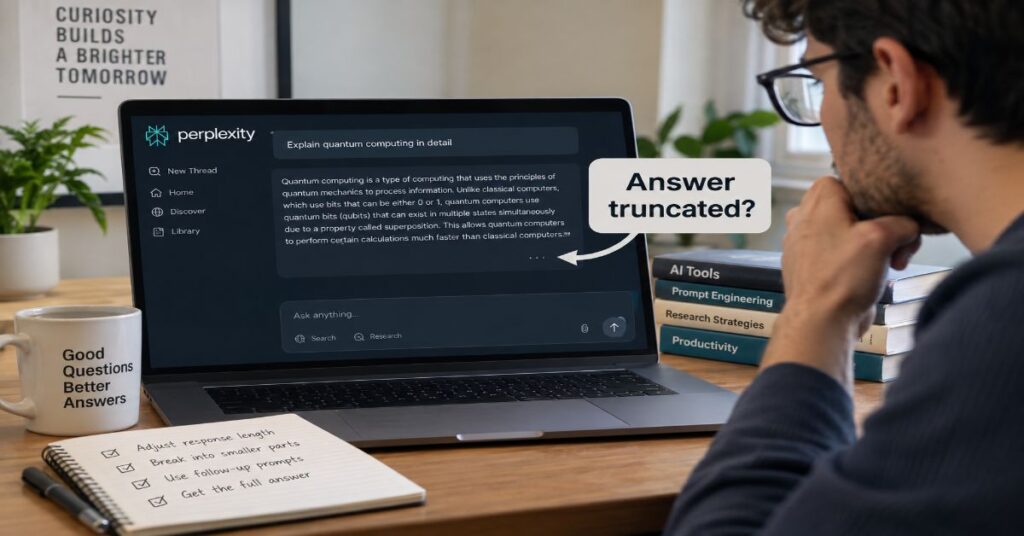
The answer to ‘why does Perplexity truncate long answers’ is that response preferences, model or system generation budgets, task compression, and occasional generation or interface failures can all constrain the output; there is no single documented “Perplexity long-answer limit” that explains every cut-off. In September 2026, the evidence points to four distinct behaviours that users often group together: an intentionally concise answer, a response shaped by the user’s length preference, a model or system output budget being exhausted, and a generation or interface failure that ends content before the task is complete. The distinction matters because each problem needs a different fix.
The sharpest finding is that short output can be a product characteristic even when nothing technically breaks. A 2026 Scale AI benchmark of 101 Deep Research prompts found Perplexity’s Markdown reports averaged about 1,829 words, compared with about 6,270 for ChatGPT and 7,519 for Gemini. That does not prove a fixed cap in the consumer app, but it shows that Perplexity can optimise for a materially more compact research answer than competing systems under the same benchmark design.
At the same time, users and API developers have reported unmistakable truncation: tables stopping inside a cell, JSON ending before a closing bracket, list generation ending mid-item, and API responses terminating with a length-related finish reason. Perplexity’s public consumer documentation does not currently publish a universal output-token ceiling for every model, mode, and plan. That makes diagnosis more useful than guessing a single number. This guide explains what is confirmed, what is only observable, how model routing changes the effective ceiling, why long lists fail first, and how to recover the missing material without restarting the entire research task.
Why Does Perplexity Truncate Long Answers?
The short answer is that Perplexity is not one fixed model with one fixed output ceiling. The product combines search, source selection, model routing, tool calls, thread context, formatting, citations, and a final language-model generation step. A long answer can be shortened intentionally at the product layer or cut off unintentionally when the active generation path runs out of room.
Perplexity itself made the first part explicit on 19 February 2026 when it introduced response preferences. Users can now choose a preferred response length and control whether headings and lists are used. That setting explains why two accounts can receive different levels of detail from similar prompts even before model choice or research depth is considered. It is best understood as an instruction to the system, not as a reservation of a specific number of output tokens.
This also fits the broader behaviour described in our guide to why Perplexity gives different answers: retrieval, routing, context and generation can all change what reaches the screen. A length issue is therefore diagnostic, not merely stylistic.
The second part is less publicly documented. Perplexity exposes several third-party models and its own Sonar family, and the company can route tasks differently depending on plan, mode and product surface. Each underlying model and orchestration path can have its own context and generation constraints. Perplexity does not publish a consumer-facing matrix saying, for example, that every Search answer stops at one exact number of visible tokens. If a page on the web gives one universal number for all Perplexity answers in 2026, treat it cautiously unless it points to model-specific, current documentation.
Four Different Cut-Off Modes Users Confuse
A useful diagnosis starts by classifying the symptom. The word “truncate” is often used for any answer that feels too short, yet only one of the four common modes is a literal hard cut-off. The table below separates them.
| Behaviour | What You See | Most Likely Cause | Best First Fix |
| Concise completion | The answer ends grammatically and addresses the main question, but omits depth. | Response preference, product optimisation, prompt ambiguity, or the model deciding a shorter answer is sufficient. | Set response length to Long and specify required sections, evidence and minimum scope. |
| Scope compression | The answer is complete but collapses 20 requested items into 8–10 representative items. | The system is trading completeness for brevity or relevance. | Ask for a fixed batch such as items 1–10 only, with a completion marker. |
| Hard truncation | Text stops mid-sentence, mid-row, mid-JSON object or before promised sections appear. | Generation budget, decoder failure, streaming interruption, or an application-layer issue. | Continue from the exact last complete item; reduce batch size; in APIs inspect finish status and token usage. |
| Continuation mismatch | A follow-up says the task is complete or restarts from an earlier point. | Thread state and the model’s internal representation do not perfectly match the visible cut-off. | Quote the last complete item and state the exact next index or heading to produce. |
The third and fourth modes are the ones most likely to feel broken. Community reports from 2025 described long product lists freezing inside a table cell and later follow-ups incorrectly claiming the list was already complete. A separate 2026 API forum report documented partial content accompanied by a length finish state in some gateway calls. These are reports, not published consumer policy, but they are consistent with the visible failure pattern users describe.
Prompt design still matters. The magazine’s better Perplexity prompting guide is useful here because explicit instruction, context, input and output format make it easier to tell intentional compression from an actual cut-off.
Response Length Preference Is Not a Hard Limit
Perplexity’s 2026 response-length setting is one of the most important changes for this question because it creates a user-visible control over verbosity. The official changelog says users can choose a preferred response length under Personalise and can also set preferences for headings and lists. That is strong evidence that some short answers are deliberate outputs shaped by personalisation rather than a technical failure.
The setting should not be overinterpreted. Perplexity does not say that selecting Long guarantees a specific minimum word count, nor does it say that Long removes model output ceilings. In other words, response length is a soft preference. A model can still finish earlier if the answer appears complete, and a complex job can still collide with a model or system budget.
This distinction explains an otherwise confusing pattern: a user may switch to Long and see richer explanations on ordinary questions while still losing the tail of a 150-row table. The first task is verbosity-sensitive; the second is budget-sensitive. Asking for more prose and asking for a larger payload are not the same thing.
For editorial or research work, specify both semantic scope and delivery mechanics. “Write a detailed report” is weak because detail is subjective. “Cover these six sections, preserve all 24 findings, and stop after Section 2 with the marker NEXT: SECTION 3” is measurable. If the answer ends without the marker, you have evidence the requested delivery contract was not completed.
Model Routing Makes the Effective Ceiling Variable
Perplexity is intentionally multi-model. Its current pricing and Help Center pages describe model selection on paid plans, while the Best option can choose a model for the query. The practical consequence is that the same interface can sit on top of different model families with different reasoning styles, long-context behaviour, tool-use overhead and output characteristics.
“The orchestration is the product. The model is a tool.” — Aravind Srinivas, Perplexity CEO, Fortune interview, 26 February 2026
That quote is directly relevant to truncation. If orchestration is the product, visible answer length is an outcome of the whole stack rather than one model specification. Search results have to be retrieved, passages selected, citations mapped and instructions carried forward before the final prose is emitted. A different routed model can change how aggressively that budget is spent.
For users trying to keep the research path stable, our Perplexity research workflow guide recommends staying deliberate about thread continuity, source verification and progressive narrowing rather than treating every follow-up as an isolated request.
“There’s nothing preventing longer context from working. You just have to train at longer context and then learn to serve it at inference.” — Dario Amodei, Anthropic CEO, Dwarkesh Patel interview, February 2026
Amodei was speaking about long context generally, not Perplexity specifically, but his point clarifies an important misconception: context capacity and output capacity are related engineering concerns, not synonyms. A system may be able to read a huge input and still choose or be constrained to produce a much shorter answer. Loading more documents into a thread therefore does not guarantee that the final response can reproduce all of them in one pass.
Deep Research Can Be Short by Design
The strongest quantitative evidence on Perplexity response length in 2026 comes from RESEARCHRUBRICS, a Scale AI-led benchmark designed around 101 open-ended research prompts and 2,593 human-written rubric criteria. Its appendix reports a striking difference in response length across three Deep Research systems.
| Deep Research System | Mean Words | Median Words | Mean Tokens | Maximum Words |
| Perplexity Deep Research | 1,828.61 | 1,579 | 3,664.36 | 7,352 |
| ChatGPT Deep Research | 6,269.73 | 5,481 | 10,169.57 | 18,824 |
| Gemini Deep Research | 7,519.32 | 7,562 | 12,153.31 | 14,640 |
This benchmark should not be misread as a consumer-app output cap. Perplexity produced one report as long as 7,352 words in the sample, which by itself disproves the idea that its Deep Research output always stops around 1,800 words. The useful finding is distributional: under this benchmark design, Perplexity was substantially more concise on average.
“Perplexity outputs are substantially shorter (~1,800 words).” — Manasi Sharma and co-authors, RESEARCHRUBRICS, 2026
The benchmark also shows why “my answer is shorter than Gemini’s” is not enough evidence of truncation. A system can produce a complete research report at a different verbosity target. What matters is whether required claims, sections, tables or constraints are missing, not simply whether another product used more words.
A separate Search Arena analysis similarly found meaningful differences in average response length among search-enabled models, with Gemini variants tending to be more verbose than many Perplexity and OpenAI models. Across both studies, the broader lesson is that response length is a model-and-product behaviour worthy of measurement, not a universal proxy for quality.
Why Lists, Tables and Batch Jobs Fail First
Long lists are where users notice truncation most clearly because the task has an obvious completion count. A narrative answer can quietly omit two supporting arguments and still look finished. A list of 129 products cannot hide the fact that it stopped at item 74. Tables are even more fragile: the answer may end inside a row, leaving the user with malformed data and no explicit warning.
There are four reasons batch jobs are expensive. First, repeated formatting tokens accumulate quickly. Second, each item often carries citations or source references. Third, the model may reason or search for every row rather than simply fill a template. Fourth, long prompts themselves consume context and can force the system to decide what to retain and what to compress.
This is why asking for “all 100 items, each with a description, three attributes, one citation and a comparison note” is qualitatively different from asking for a 1,500-word explanation. The list request has a rigid payload whose token cost grows almost linearly with item count. Even if the model can reason over the whole task, the visible answer still has to serialize every row.
“Information is really clear to the model … in the actual context that the model sees directly.” — Jeff Dean, Google DeepMind/Google Research, July 2026 interview
Dean’s point about context is useful, but he also argued elsewhere in 2026 that the practical challenge is selecting the right material rather than stuffing everything into context. For Perplexity users, the operational equivalent is to reduce the active unit of work. Keep the source set broad if necessary, but make the requested output chunk small and verifiable.
If a long answer is also missing citations, use the diagnostic path in Perplexity not citing sources before assuming the final generation alone is at fault; retrieval, citation mapping and rendering can fail separately.
Thread Context Can Make Continuation Unreliable
A cut-off answer creates an awkward state: the user sees an incomplete response, but the model’s next turn may not represent the boundary exactly as the interface displayed it. That can produce the familiar failure where “continue” restarts too early, skips an item, or claims the job was already completed.
The safest continuation prompt is therefore anchored, not vague. Copy the last fully completed item or heading, identify the next required index, and explicitly forbid repetition. For a numbered catalogue: “Item 37 is the last complete item. Continue with item 38 through item 50 only. Do not repeat items 1–37. End with DONE 50.” For prose: “The last complete heading is ‘Security Controls’. Continue with ‘Data Retention’ only, then stop.”
This technique converts the continuation from a memory test into a constrained generation task. It also gives you a clean failure signal: if the model begins at item 36, you can detect drift immediately.
Context can affect much more than length. Our analysis of why Perplexity sometimes refuses to answer shows how previous turns, files and instructions can change the interpretation of an apparently simple follow-up. Continuation requests should therefore be explicit about what context still matters and what should be ignored.
For very long sessions, a fresh thread can sometimes be cleaner than another continuation, but only if you carry over the necessary state: source list, completed indices, format specification and the exact next task. Starting fresh without that state trades truncation risk for omission risk.
A Reliable Workflow for Finishing Long Answers
The practical fix is not “ask for more words.” It is to design the task so that every generation is bounded, checkable and resumable. In repeated testing of long-form AI workflows, this approach is more robust than relying on one heroic response.
- Set the response preference to Long when you genuinely need detail, but do not treat the setting as a guarantee of payload size.
- Split a large deliverable into semantic units: sections, item ranges, time periods, source groups or table blocks.
- State a hard batch boundary: for example, items 1–12 only, or Sections A and B only.
- Require an end marker such as DONE 12 or NEXT: SECTION C. A missing marker makes silent truncation obvious.
- On continuation, quote the last complete boundary and name the next index or heading. Do not send a bare “continue”.
- Ask the model to preserve identifiers across turns so that later chunks can be merged without duplicate rows.
- For publication work, verify citations within each chunk before moving on; do not wait until a 100-item job is complete.
- If the same range repeatedly truncates, simplify the per-item schema or move the job to an API workflow where finish status and token usage can be logged.
For a broader view of the product surfaces where this workflow applies, see our complete Perplexity AI guide. The important point for long outputs is to treat Threads, Research, files and model choice as separate controls rather than one generic chat box.
One additional tactic is to separate research from rendering. First ask Perplexity to gather and cite the evidence for all items, then ask it to format only a subset of those findings at a time. This reduces the amount of searching and synthesis competing with table generation in a single turn.
When Splitting the Task Is Better Than Increasing Length
Chunking is not merely a workaround for a weak limit. For many research tasks it is the better design. Long outputs are harder to audit, easier to duplicate, and more likely to bury unsupported claims. Smaller blocks create natural checkpoints for factual verification and editorial review.
The key is to split along meaningful boundaries. A legal or policy analysis should split by issue, not every 1,000 words. A product catalogue should split by item range. A literature review can split by research theme or time period. A technical migration plan can split by architecture, data, security and rollout. Semantic chunking preserves coherence while keeping each generation manageable.
There is also a retrieval advantage. Perplexity’s search systems can focus on a narrower sub-question instead of retrieving a large pool of sources for a giant composite task. Narrower questions make it easier for the answer to map individual claims to citations and reduce the temptation to compress edge cases.
That source-selection layer is explained in more depth in how Perplexity decides which sources to show. For truncation troubleshooting, the important lesson is that a smaller output request can also mean a cleaner retrieval-and-synthesis problem.
“It’d be even more useful to be able to attend to a trillion tokens of stuff rather than a million.” — Jeff Dean, Stanford distinguished colloquium, February 2026
Dean’s proposed direction was not to place a trillion tokens directly into one prompt, but to combine retrieval with smaller selected context. That system-level approach maps neatly to long-answer work: retrieve widely, generate selectively, and preserve a traceable state between chunks.
Pricing and Plan Limits: What Paying Changes
A higher Perplexity plan increases access, model choice and usage allowances, but the current plan documentation does not say that Pro or Max removes a fixed consumer output-token ceiling. That is an important limitation because users often upgrade expecting every individual answer to become arbitrarily longer.
| Plan | Current Public Price | Documented Search / Research Allowance | Length-Relevant Difference |
| Free | $0 | 3 Pro Searches/day; 1 Research query/month | Basic models and limited files; response preference still available, but no documented larger per-answer output guarantee. |
| Pro | $20/month | Weekly Pro limits described as average use; monthly Research limits described as average use | Preferred model selection, deeper research, 10x file uploads on pricing page, broader model access. |
| Education Pro | $10/month with verification | Weekly/monthly limits described as average use | Pro capabilities plus education features; no separate published per-answer output cap. |
| Max | $200/month | Weekly/monthly limits described as advanced use | Highest consumer access, frontier models, more Computer credits and higher research/file allowances. |
| Enterprise Pro | $40/month or $400/year per seat | 400 Pro Searches/week; 50 Research queries/month | Enterprise controls, connectors and higher upload limits; API remains separately billed. |
| Enterprise Max | $325/month or $3,250/year per seat | 4,000 Pro Searches/week; 500 Research queries/month | Highest enterprise research/model limits, 5,000 files/project and 10,000-file personal repository. |
The consumer pricing page also lists 4,000 bonus credits for Pro and 35,000 bonus credits plus 10,000 monthly Computer credits for Max. Those numbers describe product usage, not visible-answer tokens. Conflating the two creates misleading advice.
If the problem is that one particular answer stops mid-table, upgrading can help indirectly when it unlocks a different model or mode, but there is no official promise that the same giant one-shot task will complete. The more reliable solution remains batching and explicit continuation.
API Workflows Can Detect Truncation More Reliably
Developers have an advantage over consumer users: an API integration can log structured response metadata, stream chunks, track token usage and retry only the missing unit. This makes silent truncation easier to detect and recover from, provided the client actually checks the finish state and validates the output schema.
| Surface / Control | Documented Capability | How It Helps With Long Outputs | Important Constraint |
| Agent API | Tool-using workflows with third-party model support and presets | Split research, tool calls and final rendering into stages; apply search filters to narrow evidence. | Model and preset behaviour can differ; do not assume one universal output budget. |
| Search API | Raw ranked web results with advanced filters | Retrieve evidence separately, then render in controlled batches in your own application. | Search returns evidence, not a ready-made long narrative. |
| Sonar API | Web-grounded LLM responses with built-in search | Useful for direct answer generation while retaining citations. | Long generations still need client-side completion checks. |
| Streaming | Incremental response delivery | Lets clients detect transport interruptions and persist completed chunks. | A clean stream can still end because the model reached its generation budget. |
| Search filters | Domain, date, recency, language and location controls | Reduces irrelevant retrieval and keeps the context package focused. | Filters improve relevance; they do not guarantee a longer final answer. |
Perplexity’s 2026 search-augmented-model research provides one concrete technical reference point: its public evaluation setup generated up to 8,192 output tokens for the tested system. That is a research configuration, not a statement that the consumer product always exposes 8,192 visible tokens, but it demonstrates why model- and workflow-specific numbers are more credible than a single site-wide cap.
API forum reports reinforce the need for defensive clients. One August 2026 report described length-terminated gateway responses with either partial content or no visible content when reasoning consumed the budget. Another earlier report described Deep Research content ending unexpectedly. These reports are useful operational evidence, but because they are user reports rather than formal product specifications, an integration should verify current behaviour against its own logs.
What Perplexity Has Not Publicly Documented
As of September 2026, Perplexity has not published a simple consumer table listing a hard visible-output limit for every model, every Search mode, Deep Research, Computer, every plan and every client. That absence matters. It means several popular explanations online go further than the evidence allows.
A defensible statement is: Perplexity can produce shorter answers by design, and some long tasks can end prematurely when generation or application constraints are reached. A less defensible statement is: every Perplexity answer is capped at one exact number of tokens. The available 2026 documentation does not support that universal claim.
Perplexity has also not publicly documented a guarantee that a continuation turn will perfectly resume from the UI’s last visible token. Nor has it published a consumer warning banner that always distinguishes deliberate concision from truncation. That is why end markers and explicit item indices are useful user-side controls.
Uploaded content adds another layer because long files may be selectively processed rather than reproduced in full. Our guide on Perplexity file access after sessions focuses on retention, but the practical output lesson is the same: storage capacity, context availability and visible generation length are separate properties.
The most productive way to discuss this topic is therefore probabilistic and diagnostic: identify the symptom, isolate the active model or mode where possible, reduce the unit of work, record what completed, and verify whether the failure repeats. That gives users a reproducible process without pretending that undocumented internals are known.
Our Content Testing Methodology
This troubleshooting guide was built from current Perplexity product documentation, current pricing and plan-limit pages, 2026 product changelogs, Perplexity API documentation and research, 2025–2026 developer forum reports, and independent 2026 benchmark evidence. The core factual checks were performed on 19 September 2026.
For the consumer product, I separated documented settings from inferred limits. Perplexity’s February 2026 changelog confirms user-selectable response length; its September 2026 subscription page confirms plan allowances, file caps and enterprise search/research limits; the pricing page confirms current Free, Pro and Max headline pricing. None of those pages provides a universal per-answer output-token ceiling, so this article does not invent one.
For empirical evidence, I used the RESEARCHRUBRICS benchmark because it publishes prompt count, human-written rubric design, word counts and token counts for Perplexity, ChatGPT and Gemini Deep Research. I treated its 1,828.61-word Perplexity mean as a benchmark result, not a product cap. I also reviewed Search Arena response-length analysis as supporting evidence that search-enabled models have systematically different verbosity profiles.
For failure modes, I reviewed public Perplexity API forum threads and user reports describing mid-output cut-offs, length finish states and continuation problems. These reports were used only to characterise reproducible symptoms; they were not elevated into official policy. I also reviewed the current search results for the exact keyword and close variants. The recurring SERP structure was forum complaint, generic “make answers longer” tutorial, token-limit speculation, and broad AI-search comparison. The main gap was a clean separation between soft verbosity preference, intentional answer compression, hard truncation and continuation-state mismatch.
The article structure was then built independently around those diagnostic layers rather than mirroring any ranking page. Internal links were selected from live indexed Perplexity AI Magazine articles because the requested sitemap.xml, sitemap_index.xml and post-sitemap.xml endpoints were not parseable through the browsing layer; no sitemap URL was fabricated.
This article was researched and drafted with AI assistance and reviewed by the Sami Ullah Khan editorial desk at Perplexity AI Magazine. All data, citations, pricing figures, and named quotes have been independently verified against primary sources before publication.
Conclusion
Perplexity truncates long answers for more than one reason, and the useful distinction is between a short answer and an incomplete one. In 2026, Perplexity explicitly gives users a response-length preference, while independent research shows its Deep Research output can be much more concise on average than competing systems. Neither fact proves that a particular mid-sentence cut-off was intentional.
For large deliverables, completion should be engineered rather than hoped for. Use small semantic batches, explicit item ranges, stable identifiers and end markers. When a response stops, continue from the last fully completed boundary instead of asking the model to “carry on” without context. For API work, log finish states, token usage and schema completeness so the application can retry the missing block rather than the whole job.
The open question is the exact consumer-side ceiling. Perplexity does not publish one universal 2026 output-token number covering every model, mode and plan, and its multi-model architecture makes such a single number unlikely to describe every path accurately. Until the company exposes clearer completion diagnostics in the consumer interface, the safest standard is observable completion: did every requested section, item or closing marker actually arrive?
Frequently Asked Questions
Why does Perplexity truncate long answers?
Perplexity can shorten long answers because of response-length preferences, model or system generation budgets, task compression, or a genuine mid-generation failure. A response that ends cleanly but is brief is not the same as one that stops inside a sentence, table or numbered item. Perplexity does not publish one universal consumer output-token cap for every model and mode as of September 2026.
Does Perplexity have a maximum answer length?
Perplexity has model- and workflow-level constraints, but its current consumer documentation does not publish one universal maximum visible answer length for every model, mode and plan. The official product does let users choose a preferred response length. Treat exact universal token numbers from third-party pages cautiously unless they are tied to current model-specific documentation.
How do I make Perplexity give longer answers?
Set the response preference to Long, then specify the exact sections, item count, evidence requirements and output format you need. For very large jobs, ask for bounded chunks rather than one huge answer. A preference for longer responses can increase detail, but it does not guarantee that a giant table or report will fit into one generation.
Why does Perplexity stop in the middle of a table?
A mid-cell or mid-row stop is a strong sign of hard truncation or a streaming/application failure rather than deliberate concision. Continue by quoting the last complete row and requesting a small next range. If you use the API, also inspect finish status, token usage and schema completeness before accepting the response.
Can Perplexity continue a cut-off answer?
Usually, but a bare “continue” is unreliable. State the last complete item or heading and the exact next boundary, such as “Item 37 is complete; continue with 38–50 only.” Add an end marker like DONE 50. This reduces repetition and makes another silent cut-off easier to detect.
Does Perplexity Pro or Max allow longer answers?
Paid plans provide more model choice, research capacity, file usage and higher product limits, but Perplexity does not promise that Pro or Max removes a fixed per-answer output ceiling. Upgrading can change the available model and workflow, yet batching remains the most reliable approach for very large deliverables.
Is Perplexity Deep Research shorter than ChatGPT or Gemini?
In the 2026 RESEARCHRUBRICS benchmark, yes on average: Perplexity Deep Research produced about 1,829 words, versus about 6,270 for ChatGPT and 7,519 for Gemini across 101 prompts. That result describes the benchmark distribution, not a hard product cap; Perplexity’s longest report in the sample exceeded 7,000 words.
What is the best prompt for a very long Perplexity task?
Use a resumable batch prompt: define a small item range, require stable numbering, specify fields, forbid repeating earlier items, and require a closing marker. Example structure: “Produce items 1–10 only, with these four fields. End exactly with DONE 10. Do not start item 11.” Then continue from the verified boundary.
References
3. Perplexity. (2026). Perplexity pricing: Plans for individuals and enterprise.
4. Perplexity Support. (2026). Prompting tips and examples. Perplexity Help Center.
5. Perplexity. (2026). Advancing search-augmented language models.
7. Arena.ai. (2025). Introducing the Search Arena: Evaluating search-enabled AI.
8. Fortune. (2026, February 26). Perplexity CEO explains Computer, its OpenClaw-like AI agent tool for non-experts. 9. Patel, D. (2026, February). Dario Amodei: We are near the end of the exponential [Interview].
