
📋 Executive Summary
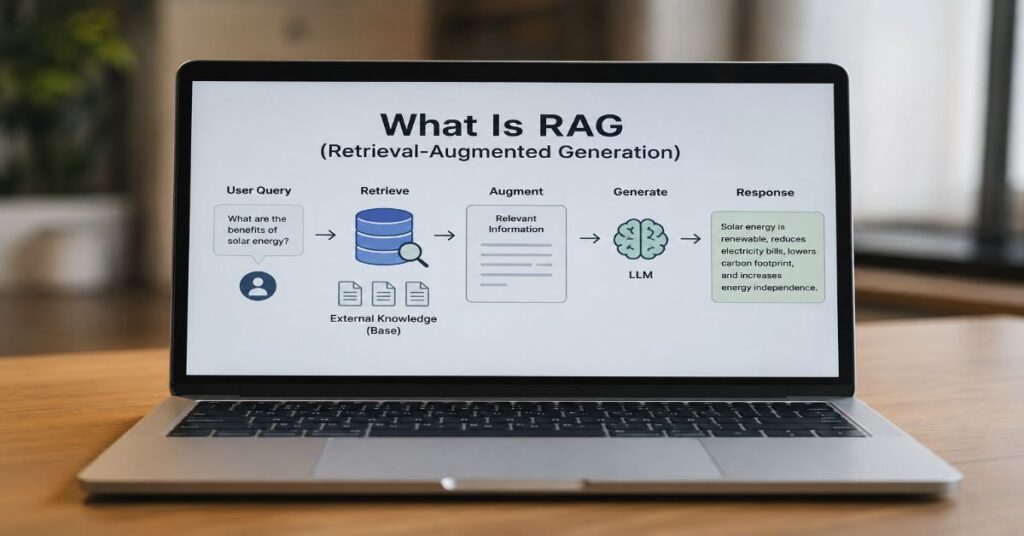
What is RAG (retrieval-augmented generation)? It is an AI architecture that retrieves external evidence before a language model answers, yet its sharpest lesson is uncomfortable: a fluent model can still fail because the wrong paragraph reached its context window. RAG does not make a model truthful by itself. It creates a controllable evidence path between a user’s question, a knowledge source and the generated response.
I find the simplest mental model is an open-book examination. A conventional large language model answers mainly from patterns encoded during training. A RAG system first searches a defined corpus, such as policies, product manuals, research papers, database records or live web pages, then inserts the most relevant passages into the prompt. The model writes from that temporary packet of evidence rather than relying only on memorised statistical associations.
That distinction explains both the excitement and the disappointment around RAG in 2026. It can deliver current, domain-specific and citable answers without retraining a foundation model. It can also retrieve stale documents, ignore access controls, split a crucial sentence from its exception, or present a real citation that does not support the claim. This guide therefore treats retrieval-augmented generation as an engineering system, not a chatbot feature. It explains the architecture, search methods, vector databases, pricing, integrations, implementation workflow, evaluation metrics, bottlenecks, security risks and decision rules that determine whether RAG becomes a reliable knowledge layer or an expensive confidence machine.
What Is RAG (Retrieval-Augmented Generation)?
Retrieval-augmented generation combines information retrieval with generative language modelling. The retriever identifies useful evidence from sources outside the model’s trained parameters. The generator receives that evidence with the user’s request and produces an answer. The word augmented matters because the model is not retrained each time the knowledge base changes. Its prompt is augmented at inference time with selected context.
The original architecture was formalised by Patrick Lewis and colleagues in a 2020 NeurIPS paper that paired a sequence-to-sequence generator with a dense retriever over Wikipedia. Modern production systems are broader. They may search vector indexes, keyword engines, SQL tables, knowledge graphs, document stores, APIs or the public web. Some retrieve once. Others rewrite the query, search several indexes, rerank candidates, verify claims and retrieve again before answering.
Table 1: The Four Stages of a RAG Pipeline
| Stage | Core Operation | Typical Components | Primary Failure |
| Ingestion | Collect, parse, clean and label sources | Connectors, OCR, parsers, metadata, permissions | Missing text, bad OCR, stale or duplicated content |
| Indexing | Split content and build searchable representations | Chunks, embeddings, sparse terms, vector index, graph edges | Context lost through chunking or poor field design |
| Retrieval | Find and rank evidence for a query | Dense search, BM25, filters, query rewriting, reranking | Relevant evidence is absent or ranked too low |
| Generation | Answer from retrieved evidence | Prompt template, LLM, citation formatter, verifier | Unsupported synthesis, citation mismatch or overclaiming |
RAG is best understood as a contract: the system promises to search a defined evidence space, expose relevant context to the model and preserve enough provenance for the answer to be checked. That contract is stronger than ordinary prompting but weaker than a database transaction. Generation remains probabilistic. Retrieved text can be incomplete, contradictory or malicious. A trustworthy design therefore separates three questions: Did the system find the right evidence? Did it pass that evidence faithfully? Did the model stay within it?
The practical value is that an organisation can update knowledge without waiting for a new model release. A changed refund policy, revised safety procedure or new research paper can be indexed and made searchable. The same principle powers a personal AI research assistant, an internal help desk, a legal research tool and a product support agent, although their risk controls should differ substantially.
The Architecture From Question to Grounded Answer
A production request rarely travels straight from a search box to a vector database. The query is usually normalised first. The system may detect language, expand acronyms, resolve an entity, classify intent, apply a tenant or jurisdiction filter and decide whether retrieval is needed at all. A query such as “Can I cancel?” is unusable until the application knows which product, contract, country and date govern the answer.
The retriever then creates one or more search representations. Dense embeddings capture semantic similarity, so “terminate my plan” can match a document containing “subscription cancellation”. Sparse retrieval preserves exact terms, identifiers and rare names. Metadata filters enforce constraints such as document status, region, customer account, publication date and security group. Hybrid retrieval merges dense and sparse scores, while a reranker reads a smaller candidate set and reorders it with a more precise model.
The selected passages are assembled into a context packet. Good systems preserve source ID, title, section, page, timestamp, access label and extraction method. The generator receives that packet with instructions to answer only from the evidence, distinguish fact from inference and abstain when support is insufficient. Some pipelines add a final verifier that maps each claim back to a passage. This is where the hallucination benchmark comparison becomes relevant: answer correctness, retrieval recall and citation faithfulness are separate measurements, and a high score on one does not guarantee the others.
Latency accumulates across every stage. Query rewriting adds a model call. Hybrid search adds two retrieval paths. Reranking adds inference. Verification adds another pass. The architecture should therefore use a retrieval budget, not an unlimited chain. Low-risk FAQ queries may need one search and no verifier. Regulatory or clinical questions may justify several searches, strict filters and mandatory abstention. The engineering goal is not the most elaborate pipeline. It is the smallest pipeline that meets the evidence standard of the use case.
Why Retrieval Quality Matters More Than Model Size
Teams often respond to weak answers by changing the language model. That can improve writing and reasoning, but it cannot recover evidence that never entered the prompt. If the correct clause sits at rank 37 and the system passes only the top 10 chunks, a larger generator simply becomes more articulate about incomplete context. This is why retrieval evaluation should happen before end-to-end answer evaluation.
The most useful baseline is recall at k: for a labelled question, does at least one supporting passage appear in the first k results? Precision matters too, especially when irrelevant passages contain plausible language that can distract the model. Mean reciprocal rank rewards systems that place the first useful result near the top. Normalised discounted cumulative gain is better when several passages have graded relevance. None of these metrics measures whether the final answer used the evidence correctly, so they must be paired with claim-level faithfulness and citation checks.
The 2025 interview study by Brehme and colleagues, based on 13 industry practitioners, found that real deployments were still concentrated in domain-specific question answering, with data protection, security and quality prioritised over ethics, bias and scalability. The study also identified preprocessing as a persistent challenge and human evaluation as the dominant practice. That finding is more operationally important than another model leaderboard. It suggests the bottleneck sits in corpus preparation and evaluation discipline, not only model capability.
A retrieval gold set should contain real questions, known supporting passages, hard negatives and intentionally unanswerable cases. Hard negatives are documents that share vocabulary but do not support the answer. They expose systems that confuse topical similarity with evidence. During a 2026 evaluation, a sensible team would freeze the corpus version, embedding model, index settings and reranker, then compare changes against the same set. Without that control, an apparent gain may come from a changed dataset rather than a better retrieval method.
Search Methods Beyond Basic Vector Similarity
Dense vector search is the familiar centre of RAG, but it is not the whole retrieval layer. An embedding model converts a query and source chunks into numeric vectors. Similar meanings occupy nearby regions, and approximate nearest-neighbour algorithms retrieve close candidates efficiently. Dense search works well for paraphrases and conceptual questions, but it can underperform on exact product codes, legal citations, names, dates and rare terminology.
Sparse retrieval, commonly implemented with BM25 or learned sparse vectors, rewards exact lexical overlap. It is strong when the user includes a distinctive term that must remain intact. Hybrid search combines dense and sparse rankings, often through score normalisation or reciprocal rank fusion. Reranking then applies a cross-encoder or language model to the short list. This is usually more accurate because the reranker reads the query and candidate together, but it is slower and adds cost.
Structured retrieval handles facts that should not be flattened into prose. Prices, balances, dates, inventory, permissions and transaction records are better queried through SQL, typed APIs or graph traversal. A useful pattern is to convert rows into compact natural-language summaries for semantic matching while retaining primary keys, units, timestamps and access labels as metadata. The site’s guide to structured data for generative AI addresses the same design tension: language helps matching, but structure preserves identity and validation.
Graph retrieval becomes valuable when relationships are the answer. A question about ownership, dependency, precedent or a multi-step process may require following edges rather than finding one similar paragraph. Recent 2026 preprints report gains from structured tags and tree-guided navigation, but these results should be treated as emerging evidence until independently reproduced and peer reviewed. The broader conclusion is already defensible: one universal retriever is rarely optimal. Production systems route queries to the retrieval method that matches the information shape.
Dense, Sparse and Hybrid Retrieval
Dense search answers “What means something similar?” Sparse search answers “Where does this exact signal occur?” Hybrid systems are strongest when both questions matter. A technical support corpus, for example, may need semantic matching for symptoms and exact matching for error codes.
Graph and Structured Retrieval
Graph and structured retrieval are not advanced decorations. They are safeguards against turning relational or tabular facts into lossy chunks. The retrieval layer should preserve the native form of evidence whenever that form carries meaning.
Chunking, Metadata and the Context Window
Chunking is the decision about what unit the retriever can return. Fixed token windows are easy to implement, but they ignore document structure. A 500-token slice may cut a policy condition from its exception, a table heading from its values or a research result from its methodology. Semantic chunking follows topic boundaries. Structure-aware chunking follows headings, paragraphs, pages, table rows or code symbols. Parent-child retrieval indexes small chunks for matching but returns a larger parent section for context.
There is no universal chunk size. Small chunks improve retrieval specificity but can remove context. Large chunks preserve context but dilute the signal and consume more prompt tokens. Overlap can protect boundary information, although excessive overlap creates duplicate results and inflates storage. A practical starting point is to align chunks with the smallest independently citable unit, then test several sizes against the gold set rather than copying a vendor default.
Metadata is the control plane of retrieval. At minimum, each chunk should retain document ID, source URI or file ID, title, section, page or record key, version, effective date, ingestion timestamp, content hash, tenant, access group and deletion status. A citation without a stable source identifier is cosmetic. A permission filter applied after retrieval is unsafe because restricted content may already have entered model context or logs.
The context window is not a warehouse. Passing more chunks can lower quality when redundant, stale or contradictory passages crowd the prompt. The system should remove near-duplicates, diversify sources, prefer authoritative versions and surface conflicts explicitly. The editorial analysis in AI hallucinations explained is relevant here because RAG can reduce unsupported answers while creating a new risk: retrieved content may carry prompt injection, poisoned instructions or misleading authority. Evidence must be treated as data, never as system instructions.
RAG Versus Fine-Tuning, Long Context and AI Agents
RAG, fine-tuning, long-context prompting and agents solve different problems. Fine-tuning changes model behaviour or style by updating weights. It can teach a format, classification pattern or domain language, but it is a poor mechanism for facts that change frequently. RAG leaves model weights unchanged and supplies current evidence at run time. Many systems use both: fine-tuning for consistent behaviour, retrieval for changing knowledge.
Long-context models can accept entire documents or large corpora in one request, reducing the need for an external index at small scale. The trade-off is cost, latency and attention. A model may technically accept hundreds of thousands of tokens while still missing a detail buried in the middle. Long context is useful for one-off analysis or a small bounded document set. RAG is better when the corpus is large, repeatedly queried, permissioned or frequently updated.
Table 2: RAG Compared With Adjacent Approaches
| Approach | Best For | Knowledge Freshness | Main Cost | Key Limitation |
| RAG | Changing or private knowledge with citations | Updated by reindexing or live retrieval | Ingestion, search, reranking and generation | Quality depends on retrieval and source governance |
| Fine-Tuning | Behaviour, tone, format and task adaptation | Fixed until another training run | Training plus inference | Poor fit for frequently changing facts |
| Long Context | One-off analysis of a bounded document set | As current as supplied input | Large input-token volume and latency | Attention may degrade across very long inputs |
| Agentic RAG | Multi-step research and tool use | Potentially live across several tools | Repeated model and tool calls | Higher latency, cost and security complexity |
An AI agent is an orchestration pattern that can plan, call tools and act. Retrieval may be one tool inside the agent. Agentic RAG lets the system reformulate a question, inspect results, search again and combine evidence across sources. It helps multi-hop questions, but every loop increases cost and expands the attack surface. The best AI search for research workflow therefore depends on whether the user needs quick source discovery, systematic evidence extraction or autonomous multi-step work.
The selection rule is straightforward. Use fine-tuning when behaviour is wrong. Use long context when the corpus is small and temporary. Use RAG when knowledge is large, changeable, external or must be cited. Use an agent when the task requires decisions across several tools or retrieval rounds. Do not use an agent merely because a single retrieval call feels unfashionable. Complexity should be earned by measured failure.
The RAG Software Stack: Features, Specifications and Integrations
A RAG stack has five layers: source connectors, parsing and enrichment, embedding, retrieval storage, and generation or orchestration. Managed platforms compress several layers into one product. Open-source components give more control but shift operations to the buyer. The right choice depends on data residency, retrieval quality, latency, team skills and the need to swap models or databases later.
OpenAI File Search is a hosted tool in the Responses API. It manages vector stores, file ingestion, semantic and keyword search, and tool execution. The attraction is reduced engineering. The constraint is that retrieval behaviour, storage and tool calls are tied to the platform. Pinecone focuses on managed search infrastructure with dense, sparse and full-text index types, namespaces, inference and assistant services. Weaviate combines a vector database with hybrid search, compression, multi-tenancy, generative integrations, a Query Agent and managed embeddings. Qdrant provides dense, sparse and multivector search, payload filtering, quantisation, real-time indexing and managed, hybrid or private deployment patterns.
Table 3: Representative RAG Platforms, Core Features and Integration Surfaces
| Platform | Core Retrieval Features | Deployment and Governance | Primary API or Integration Surfaces |
| OpenAI File Search | Hosted file ingestion, vector stores, semantic and keyword search, model-triggered retrieval | OpenAI-managed service; project and model controls apply | Responses API, Files API, Vector Stores API, official SDKs |
| Pinecone | Dense, sparse and full-text indexes, namespaces, metadata filtering, reranking, Assistant, inference | Serverless managed cloud, dedicated read nodes, monitoring, enterprise security options | REST, Python, JavaScript, LangChain, LlamaIndex, cloud marketplaces |
| Weaviate | Hybrid BM25 plus vector search, filters, multi-tenancy, compression, reranking, Query Agent, embeddings | Free, shared and dedicated cloud; RBAC, SSO on higher tiers, replication and backups | GraphQL and REST, Python, JavaScript, Go and Java clients, model-provider modules |
| Qdrant | Dense, sparse and multivectors, payload filters, HNSW, quantisation, real-time indexing, snapshots | OSS, managed, hybrid and private cloud; GPU indexing, audit logs and Multi-AZ on eligible tiers | REST and gRPC, Python, JavaScript, Rust and Java clients, Terraform, Pulumi, CLI |
The market is also moving beyond the database label. Weaviate CEO Bob van Luijt wrote in June 2026, “Then we stopped being only a database,” while describing the addition of Query Agent and Engram. At Qdrant’s June 2026 Vector Space Day, CEO André Zayarni framed the company’s engineering thesis as “We Do It the Hard Way.” COO Manuel Meyer and Head of Developer Relations Neil Kanungo sharpened the product distinction: “Qdrant is not a vector database, it is a vector search engine.” These statements are marketing, but they reveal the competitive direction: vendors are packaging retrieval, memory, agents, observability and governance into broader knowledge platforms.
Major integration families include model providers such as OpenAI, Cohere, Google, AWS and local Hugging Face models; orchestration frameworks such as LangChain, LlamaIndex and Haystack; cloud automation through REST, Python, JavaScript, Terraform, Pulumi and command-line tools; and enterprise sources such as object storage, document platforms, collaboration suites and databases. Integration directories change quickly, so production design should rely on API contracts and export paths rather than assuming a named connector will remain stable. The comparison of enterprise AI search options offers useful adjacent context for teams deciding between a custom RAG layer and a packaged enterprise search product.
Current Pricing and the Hidden Cost Structure
RAG pricing is layered. A buyer may pay for document parsing, embedding tokens, vector storage, write operations, read operations, reranking, model input and output tokens, network egress, backups, observability and support. A cheap embedding model can coexist with an expensive retrieval loop. A fixed subscription can hide a per-query tool charge. A free database can still require paid compute, operations and staff time.
OpenAI’s July 2026 API pricing lists File Search storage at $0.10 per GB per day after the first free GB, plus $2.50 per 1,000 File Search tool calls. Tokens consumed by the chosen model are billed separately. The text-embedding-3-small model is listed at $0.02 per million input tokens, while text-embedding-3-large is $0.13 per million. The daily storage rate is easy to underestimate: 100 billable GB maintained for 30 days would be $300 before tool calls and generation.
Table 4: July 2026 RAG Pricing Matrix and Plan Constraints
| Provider or Layer | Published Entry Price | Included or Metered Limits | Hidden or Secondary Cost |
| OpenAI File Search | $0.10 per GB-day after 1 GB free; $2.50 per 1,000 tool calls | Hosted vector-store storage and tool execution | Generation tokens, embedding or ingestion choices, persistent daily storage |
| OpenAI Embeddings | $0.02 per 1M tokens for text-embedding-3-small; $0.13 for large | Input-token metering | Re-embedding after chunk or model changes; vector storage is separate |
| Pinecone | Starter free; paid usage has a $50 monthly minimum | Starter: 2 GB, 2M write units, 1M read units, 1 GB egress | Inference, Assistant ingestion, reranking, backups and regional unit rates |
| Weaviate Cloud | Free tier; Flex from $45 monthly; Premium from $400 | Free: 100,000 objects and one collection; plan-specific request and backup limits | Vector-dimension charges, storage, backup, region and future transfer pricing |
| Qdrant Cloud | Free tier; Standard usage-based; Premium minimum not publicly fixed | Free: 0.5 vCPU, 1 GB RAM, 4 GB disk | Compute, RAM, disk, backups, inference, Multi-AZ and support requirements |
Pinecone’s Starter plan includes up to 2 GB storage, 2 million write units and 1 million read units per month. Its paid usage model carries a $50 monthly minimum applied to usage, with write-unit pricing varying by cloud and region. The pricing page also separates database usage from inference, Assistant ingestion and model tokens. Weaviate lists Flex from $45 per month and Premium from $400 per month, then adds charges based on vector dimensions, storage and backups. Its Query Agent includes a free tier and a paid organisation plan, while managed embeddings are priced per million tokens.
Qdrant’s free tier provides a single node with 0.5 vCPU, 1 GB RAM and 4 GB disk. Standard is usage-based, billed from compute, memory, storage, backups and paid inference tokens. Premium requires a minimum spend that is not publicly fixed on the pricing page. That opacity should be treated as a procurement variable, not filled with an estimate. The correct comparison is a workload model using corpus size, update rate, query volume, top-k, reranking rate, average context tokens, retention and availability requirements.
A Step-by-Step Technical Implementation Workflow
A reliable implementation begins with an answer policy, not a vector database. Define what the system may answer, which sources outrank others, when it must cite, when it must abstain and which actions require human approval. The workflow below is intentionally sequential because skipping governance early usually creates expensive rework later.
Step 1: Define the question set. Collect real user questions and label high-risk categories, entities, jurisdictions and expected answer formats.
Step 2: Inventory sources. Identify owners, update frequency, retention, permissions, canonical versions and deletion obligations.
Step 3: Build ingestion. Parse text, tables, images and metadata, while recording extraction method and content hashes.
Step 4: Design chunks. Preserve headings, page references, table structure and parent-child relationships.
Step 5: Select embeddings and retrieval methods. Benchmark dense, sparse and hybrid approaches on the same gold set.
Step 6: Create the index and permission model. Apply tenant and access filters inside the retrieval query, not after results return.
Step 7: Add query processing. Resolve entities, expand abbreviations and route structured questions to SQL or APIs.
Step 8: Retrieve and rerank. Start with a conservative candidate count, then measure whether reranking improves recall and answer quality enough to justify latency.
Step 9: Generate with constraints. Include source IDs, instruct the model to quote or paraphrase only supported content and require explicit uncertainty. Step 10: Verify. Check claim-to-passage support, citation correctness, prohibited content and policy compliance. Step 11: Observe. Log query version, corpus version, retrieved IDs, scores, filters, prompt, model, latency, cost and user feedback. Step 12: Maintain. Reindex changed content, expire deleted records, test drift and rerun the evaluation set before releases.
The same answer-unit discipline used in writing for AI search applies inside a private RAG corpus: clear headings, explicit entities, stable tables and source-rich statements are easier for retrieval systems to isolate. That is not an invitation to manipulate public generative systems. It is an information architecture principle for making authorised knowledge understandable and verifiable.
What to Log in Production
For every answer, retain the request ID, user or service identity, applied access filters, index and embedding versions, retrieved source IDs, reranker scores, context token count, model version, citations, verification outcome, latency and cost. Sensitive logs need the same access controls and retention policy as the source data.
Evaluation Metrics and the Benchmark Gap
End-to-end accuracy is too coarse for RAG because it hides where failure occurred. A system can retrieve the correct passage and still generate an unsupported answer. It can retrieve incomplete evidence and produce a cautious response. It can answer correctly from model memory while citing an irrelevant source. Evaluation must decompose the pipeline.
Retrieval metrics include recall at k, precision at k, mean reciprocal rank and nDCG. Context metrics assess whether retrieved passages contain the answer, whether they are relevant and whether they conflict. Generation metrics assess correctness, completeness, faithfulness, citation precision, citation recall and abstention quality. Operational metrics include p50 and p95 latency, cost per answered query, index freshness, ingestion failure rate, permission-filter failures and the proportion of questions escalated to humans.
Automated judges can scale evaluation but should not be the sole authority. Their scores change with prompt wording and model version, and they may reward plausible prose. Human reviewers remain essential for high-risk domains and for creating the gold set. The 2025 industry interview study found human evaluation dominant, which reflects both the immaturity of automatic metrics and the difficulty of defining correctness in specialised work.
Vendor benchmarks require careful reading. Pinecone’s July 2026 Nexus announcement reported a Q2 evaluation with 95% accuracy on 20 support and compliance questions, and Jesse Barbour, Q2’s Chief Data Scientist, said, “The hard part is getting an agent to reliably and efficiently assemble the right knowledge for genuinely difficult questions.” The result is informative because the customer ran the evaluation, but it remains a small, vendor-published benchmark. Another legal benchmark on the same page reported 87% accuracy for Nexus against 45% for an agentic RAG baseline, with only retrieval architecture changed. These are promising findings, not universal guarantees.
Two 2026 preprints add useful hypotheses. VecTree-RAG reported higher scores than several dense and tree baselines on scientific question answering while improving evidence-page precision. Structured RAG reported a 30% judge-score improvement after adding semantic tags and structured information to queries and chunks. Both should be labelled as preprints, tested on local data and separated from peer-reviewed consensus.
Security, Governance and Failure Modes
RAG changes the security boundary because data is retrieved dynamically and inserted into a model context. The first control is permission-aware retrieval. A user should never receive a chunk they could not open in the source system. Access control lists, tenant IDs, regional constraints and document classifications must be part of the query filter. Caching must preserve those boundaries, or one user’s authorised answer may become another user’s leak.
Prompt injection is the second control. Retrieved documents can contain instructions such as “ignore previous rules” or requests to reveal secrets. The application must mark retrieved content as untrusted evidence, strip executable instructions where possible, separate system policy from source text and restrict tool permissions. An agent that can retrieve a document and then send email, modify a ticket or execute code has a wider blast radius than a read-only question-answering system.
Source poisoning is a related risk. An attacker may upload misleading content, exploit a compromised connector or manipulate public web pages. Provenance, source allowlists, approval workflows, versioning and anomaly detection reduce the risk. Freshness controls matter because stale but authoritative documents can be more dangerous than obvious spam. The system should know which policy supersedes another and expose effective dates.
Deletion is a governance requirement, not a housekeeping task. Removing a source file does not automatically guarantee that derived chunks, embeddings, caches, evaluation logs and backups disappear. The data lineage should map every indexed object back to the source record and support tested deletion workflows. Qdrant’s April 2026 release added audit logging for queries, upserts, deletes, collection management and snapshots on paid clusters, illustrating how retrieval infrastructure is moving towards traceability. Security teams should still verify coverage, retention and export into their own SIEM.
The final failure mode is false confidence. RAG interfaces often display citations, which users interpret as proof. Citation presence is not citation correctness. A source can be real and irrelevant. A passage can support only part of a sentence. A strong interface lets users inspect the exact passage, document version and access path, and it labels inference separately from sourced fact.
Where RAG Works Well and Where It Does Not
RAG is strong when the answer depends on a changing, private or specialised corpus. Common fits include employee policy assistance, product support, technical documentation, research discovery, contract review, due diligence, regulated procedure lookup, sales enablement and knowledge-centred customer service. It is especially valuable when citations, document-level permissions and fast content updates matter.
It is weaker when the task is mainly creative, when there is no reliable corpus, or when the answer requires deterministic calculation rather than text synthesis. A pricing calculation should call a billing system. A bank balance should come from a transactional API. A safety interlock should not depend on a generative answer. RAG can explain those results, but it should not replace the system of record.
A small corpus may not need a vector database. Keyword search or a relational database can be simpler and more accurate. A one-time review of a few documents may fit directly in a long context window. A static classification problem may be better served by a fine-tuned model or conventional machine learning. A workflow requiring action across tools may need an agent, but the retrieval component should remain separately testable.
The decision should consider answer risk, corpus size, update frequency, permissions, query type, expected latency and audit requirements. When users ask exact identifiers, filters and sparse search matter. When they ask broad conceptual questions, dense retrieval helps. When they ask multi-document or relational questions, graph, SQL or iterative retrieval may be necessary. A mature design does not ask, “Should we use RAG?” It asks, “Which evidence path gives this question the safest, cheapest and most inspectable answer?”
Three Technical Insights Most RAG Explainers Miss
The first overlooked insight is that access control is a retrieval-time join. It is not enough to store a permission label and hope the application checks it later. The retriever must intersect semantic relevance with user entitlement before any text enters the prompt. This makes identity latency, group synchronisation and permission freshness part of search quality. A perfectly relevant restricted chunk is still a retrieval failure.
The second insight is that the delete and update path matters more than the first index build. Demonstrations focus on uploading documents because ingestion is visible. Production systems live with renamed files, superseded policies, merged accounts, revoked access, duplicate records and legal deletion requests. Every chunk should have a stable lineage key, source version and tombstone strategy. Re-embedding the whole corpus after every change may be too slow or expensive, so incremental indexing and version-aware retrieval should be designed from the start.
The third insight is that a retrieval budget should include contradiction coverage, not just top-k. Returning five nearly identical passages creates the illusion of evidence while hiding a dissenting or newer source. A better context builder diversifies by document, authority, date and viewpoint, then tells the model when sources conflict. This is particularly important in research, policy and market intelligence, where the correct answer may be a bounded disagreement rather than one confident sentence.
These ideas connect retrieval engineering with publishing structure. The LLM SEO optimisation guide argues that clean headings, tables, entity naming and source transparency improve extractability. Inside an enterprise corpus, the same traits improve chunk identity and citation quality. The boundary is ethical intent: the goal should be to make legitimate knowledge easier to retrieve, not to poison recommendations or manipulate generative search outputs.
Together, these insights change the success criterion. A useful RAG system is not the one that produces the most answers. It is the one that retrieves only authorised evidence, updates and deletes predictably, represents disagreement honestly and leaves an audit trail another person can follow.
Our Editorial Verification Process
This explainer used an editorial verification process designed for a conceptual and technical article. The definition and architecture were cross-checked against the original Lewis et al. RAG paper, current OpenAI File Search documentation and official explainers from AWS. Commercial claims were verified against the live July 2026 pricing and product pages for OpenAI, Pinecone, Weaviate and Qdrant. Plan caps were included only where a primary page published a numeric limit; opaque enterprise pricing is described as unconfirmed rather than estimated.
The research separated peer-reviewed evidence, industry research, vendor benchmarks and preprints. The 2025 industry interview study is used for practitioner findings. The 2026 VecTree-RAG and Structured RAG results are explicitly labelled as preprints. Pinecone’s Nexus benchmarks are treated as vendor-published customer evaluations, with corpus sizes, question counts and limitations stated. Expert quotations come from named speakers or authors in official 2026 company publications and event recaps.
The requested sitemap endpoints, sitemap.xml, sitemap_index.xml and post-sitemap.xml, were attempted first but did not return parseable XML through the browsing layer. To avoid inventing URLs, the eight internal links were selected from live indexed Perplexity AI Magazine pages and limited to directly relevant articles about research assistants, structured data, hallucinations, AI search and retrieval-aware publishing. Each internal URL appears once, in a separate body section, and none appears in the Introduction, Executive Summary, FAQs or Conclusion.
This article was researched and drafted with AI assistance and reviewed by the Awais Khalid editorial desk at Perplexity AI Magazine. All data, citations, pricing figures, and named quotes have been independently verified against primary sources before publication.
Conclusion
RAG is best understood as an evidence architecture around a language model. It retrieves external knowledge, selects context and gives the generator a chance to answer from sources that can be updated, permissioned and inspected. That makes it one of the most practical ways to build domain-specific AI without repeatedly retraining a foundation model.
The qualification matters. Retrieval-augmented generation does not automatically eliminate hallucinations, guarantee fresh information or make every citation correct. Its reliability depends on source quality, chunking, metadata, search method, reranking, access control, prompt design, verification and maintenance. The model is only the final component in a longer chain, and a stronger generator cannot repair missing evidence.
The direction of the market is clear: vector databases are expanding into search engines, knowledge platforms, memory layers and agent infrastructure. At the same time, research is moving towards structured, graph-aware and iterative retrieval. The open questions concern how these systems should measure faithfulness, manage adversarial content, preserve privacy and balance latency against deeper evidence gathering. RAG will remain useful because those questions are not solved by model scale alone. Its future belongs to teams that treat retrieval as a measurable information system rather than a magical preface to generation.
Frequently Asked Questions
What Does RAG Stand For in AI?
RAG stands for retrieval-augmented generation. It describes a system that retrieves relevant information from an external source and supplies it to a generative model before the model answers. The external source may be a vector database, search engine, document store, SQL database, knowledge graph or API.
How Does Retrieval-Augmented Generation Reduce Hallucinations?
RAG can reduce hallucinations by narrowing the model’s answer to retrieved evidence and enabling citations. It does not guarantee accuracy. The system can retrieve the wrong passage, omit a necessary condition or generate a claim that exceeds the evidence. Retrieval recall, citation faithfulness and abstention must be evaluated separately.
Does RAG Require a Vector Database?
No. Vector databases are common because embeddings support semantic similarity, but RAG can retrieve through keyword search, SQL, knowledge graphs, APIs, file systems or web search. Many production systems use hybrid retrieval, combining dense vectors, sparse terms, metadata filters and structured queries.
What Is the Difference Between RAG and Fine-Tuning?
RAG supplies external knowledge at inference time without changing model weights. Fine-tuning changes model behaviour by training on examples. Use RAG for current, private or citable facts. Use fine-tuning for tone, formatting, classification or task behaviour. The two methods can be combined.
What Is Agentic RAG?
Agentic RAG lets an AI system plan and perform several retrieval steps. It may rewrite the question, search multiple sources, inspect results, retrieve again and verify an answer. This can help multi-hop research, but it increases latency, cost and security complexity compared with a single retrieval call.
How Much Does a RAG System Cost?
Cost depends on ingestion, embeddings, vector storage, reads and writes, reranking, model tokens, backups, egress and operations. A small prototype can use free tiers. Production cost is driven by corpus size, update frequency, query volume, context length, availability and governance requirements.
What Are the Main RAG Performance Bottlenecks?
Common bottlenecks include slow document parsing, poor OCR, oversized chunks, weak metadata, low retrieval recall, reranker latency, large context packets, repeated agent loops and stale indexes. Permission checks, logging and verification add necessary overhead in regulated or enterprise deployments.
When Should a Business Not Use RAG?
Avoid RAG when a deterministic system of record can answer directly, when the corpus is unreliable, or when the task is mainly creative. A small, temporary document set may fit long-context prompting. Exact calculations and transactions should use databases or APIs, with generative AI limited to explanation.
References
Amazon Web Services. (2026). AWS RAG explainer.
Brehme, L., Dornauer, B., Ströhle, T., Ehrhart, M., & Breu, R. (2025). Industry RAG interview study. arXiv.
Lewis, P., Perez, E., Piktus, A., Petroni, F., Karpukhin, V., Goyal, N., Küttler, H., Lewis, M., Yih, W.-t., Rocktäschel, T., Riedel, S., & Kiela, D. (2020). Original RAG paper. Advances in Neural Information Processing Systems, 33.
OpenAI. (2026). OpenAI File Search documentation.
OpenAI. (2026). OpenAI API pricing.
Pinecone. (2026). Pinecone pricing.
Pinecone. (2026, July 1). Pinecone Nexus public preview.
Qdrant. (2026). Qdrant pricing.
Weaviate. (2026). Weaviate pricing.
