
📋 Executive Summary
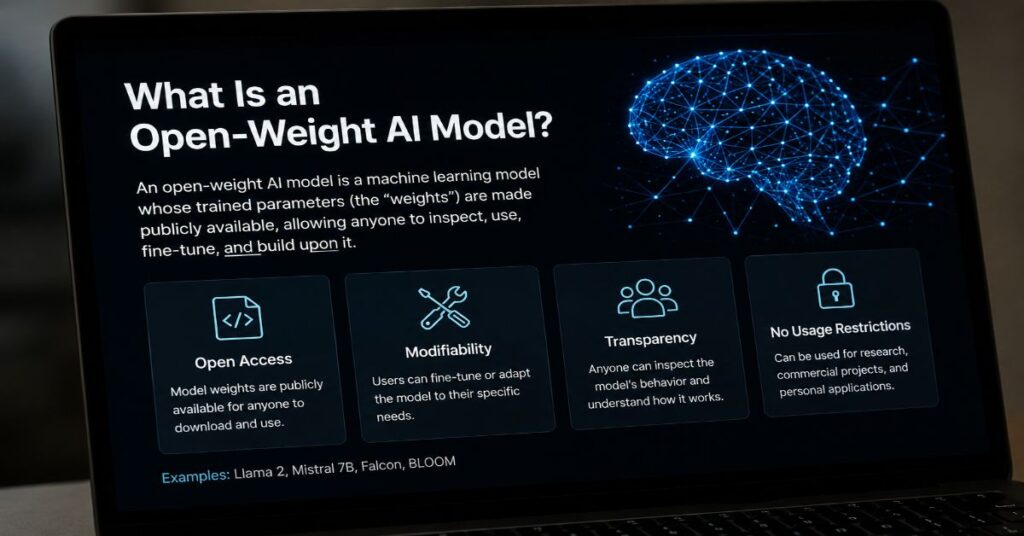
I define an open-weight AI model as a model whose learned numerical parameters can be downloaded and run outside the developer’s hosted service, but that simple answer hides the most important 2026 contradiction: access to the weights can give an organisation real control without giving it the full recipe needed to reproduce, audit, or legally reuse the system without conditions. For anyone asking “what is an open weight AI model”, the decisive point is not whether a file sits on Hugging Face. It is what the licence permits, what development artefacts remain undisclosed, and what infrastructure is required to make the model useful.
That distinction has moved from developer forums into industrial policy. On 24 July 2026, a large coalition of technology companies argued that open weights expand access, competition, security research, and institutional control. NVIDIA chief executive Jensen Huang summarised the case in a public statement: “Open models strengthen safety and cybersecurity, accelerate innovation and diffusion, and enable sovereignty.” Microsoft chief executive Satya Nadella put the commercial point more simply: “Open-weight models are essential to a healthy AI ecosystem.” These claims matter, but they do not erase the costs or risks.
This article separates the label from the engineering reality. It explains what a checkpoint contains, why open weight is not automatically open source, how the leading model families differ, where the bill reappears after a free download, and how teams can deploy, integrate, test, secure, and govern these systems. It also identifies the cases where a managed proprietary model remains the better choice. The goal is not to treat openness as a moral badge. It is to help technical and business leaders decide exactly which freedoms they need and which responsibilities they are prepared to own.
What an Open-Weight AI Model Actually Contains
A modern generative model is not a single piece of software. It is a stack of artefacts created across pre-training, post-training, evaluation, packaging, and deployment. The weights are the learned parameter values inside that stack. During training, optimisation repeatedly adjusts those numbers so the model becomes better at predicting tokens, classifying inputs, routing between experts, or transforming images, audio, and text. When a developer releases the weights, another party can load those parameters into a compatible runtime and perform inference without sending every prompt back to the original vendor.
The Open Source Initiative describes weights as learned parameters overlaid on a model architecture. That definition is useful because it shows what weights do not contain. A checkpoint normally does not reveal the complete training corpus, deleted examples, data licences, filtering rules, annotation process, reinforcement-learning environment, reward models, red-team findings, or the internal decisions that shaped the final behaviour. It may ship with an architecture description, tokenizer, configuration, inference code, model card, and evaluation report, but completeness varies by release.
The operational benefit is still substantial. A team can keep prompts and retrieved documents inside its own network, choose its own inference engine, quantise the model, fine-tune adapters, add a specialised safety layer, or migrate between cloud and on-premises hardware. Google’s current Gemma family shows how this control can span mobile, browser, workstation, and server environments. Our Google Gemma 4 analysis examines that local-first direction in more detail.
A useful mental model is to compare weights with a compiled binary. You can execute and sometimes modify its behaviour, yet you may not possess the preferred human-readable form needed to rebuild it. The analogy is imperfect because model behaviour emerges from data and optimisation rather than explicit instructions, but it captures the practical gap. Download access is meaningful. It is not the same as reproducibility, and it does not automatically grant every downstream freedom associated with open-source software.
Open Weight, Open Source, and Open Access Are Not Synonyms
The AI industry often uses open source as a broad marketing term, while standards bodies apply a narrower definition. This creates avoidable confusion in procurement, journalism, and policy. An open-access model may be available through a public web interface or API. An open-weight model makes trained parameters downloadable. A genuinely open-source AI system, under the Open Source AI Definition 1.0, must provide the freedoms to use, study, modify, and share the system, together with the preferred form for modification and sufficient data information and code.
The distinction is not semantic hair-splitting. It changes whether a competitor can redistribute a modified model, whether a university can study how the result was created, whether a regulated company can document provenance, and whether a public body can avoid a field-of-use restriction. Some model licences permit commercial deployment but add acceptable-use terms, attribution duties, downstream notice requirements, geographic restrictions, or special conditions for organisations above a user threshold. Those releases can be very useful while still falling short of the freedoms expected from open-source software.
The Linux Foundation’s Model Openness Framework approaches the issue as a spectrum. It evaluates the availability and licensing of artefacts across architecture, weights, code, datasets, documentation, evaluation, and other lifecycle components. This is often more useful for enterprise due diligence than a binary label because two downloadable models can differ sharply in reproducibility and auditability.
| Release Type | What You Receive | Typical Freedom | Main Missing Element | Procurement Question |
| Closed hosted API | Remote endpoint and documentation | Use within service terms | Weights, training artefacts, runtime control | Can the vendor meet data, residency, and continuity requirements? |
| Open access | Public interface or limited API | Experimentation and sometimes free usage | Local deployment and modification rights | Is access revocable, rate-limited, or unsuitable for production? |
| Open weight | Downloadable parameters plus varying code and documentation | Local inference, tuning, and custom deployment subject to licence | Often training data, full pipeline, and unrestricted redistribution | Which rights, restrictions, and artefacts are actually included? |
| Open-source AI | System components in preferred modifiable form with required freedoms | Use, study, modify, and share for any purpose | May still lack economical reproducibility at frontier scale | Can another party meaningfully study and modify the system? |
The 2026 Open-Weight Model Landscape
Open-weight models no longer occupy one performance tier or one deployment pattern. The category now covers compact edge models, dense server models, multimodal systems, and mixture-of-experts architectures with hundreds of billions of stored parameters but far fewer active parameters per token. The most important specification is therefore not the headline parameter count alone. Buyers must compare total memory residency, active compute, context length, modalities, licence terms, and the maturity of the supported runtime.
OpenAI’s gpt-oss family illustrates the new efficiency pattern. The 21 billion parameter model activates 3.6 billion parameters per token and supports a 128,000-token context window. The 117 billion parameter model activates 5.1 billion parameters per token. OpenAI says the smaller model can run with 16 GB of memory, while the larger model targets a single 80 GB GPU. Both are text-only, Apache 2.0 releases with tool-use and reasoning controls.
Meta’s Llama 4 Scout and Maverick take a multimodal MoE route. Scout stores 109 billion parameters, activates 17 billion, and advertises a 10 million-token context capability. Maverick stores 400 billion parameters, activates 17 billion, and requires a single H100 host rather than one consumer card. DeepSeek V4 pushes in a different direction with a 1 million-token first-party API, thinking and non-thinking modes, and OpenAI-compatible and Anthropic-compatible interfaces. Our DeepSeek V4 launch coverage explains the competitive context around that release.
Google DeepMind product managers Olivier Lacombe and Gus Martins described Gemma 4 12B as designed to “bring high-performance multimodal intelligence directly to your laptop.” That is a useful ambition, but the model overview is more instructive than the slogan: Google publishes approximate memory requirements by precision and warns that the key-value cache and serving software add overhead beyond static weights.
| Representative Model | Architecture and Parameters | Context | Modalities | Key Deployment Fact |
| gpt-oss-20b | 21B total, 3.6B active MoE | 128k | Text | OpenAI states that 16 GB memory can support deployment. |
| Llama 4 Scout | 109B total, 17B active, 16 experts | Up to 10M | Text and vision | Meta says Int4 fits on one NVIDIA H100 GPU. |
| Llama 4 Maverick | 400B total, 17B active, 128 experts | Long-context multimodal | Text and vision | All weights remain resident; Meta targets a single H100 host. |
| Gemma 4 12B | 12B unified dense model | 256k class | Text, image, video, audio | Google estimates 26.7 GB BF16 or 6.7 GB Q4_0 for static loading. |
| Mistral Small 4 | 119B total, 6.5B active hybrid MoE | 256k | Multimodal model family | Apache 2.0 with chat, agents, tools, structured output, and batch APIs. |
| DeepSeek V4 Pro and Flash | Parameter totals not publicly confirmed on current API page | 1M, up to 384k output | Text and agentic workflows | First-party APIs support OpenAI and Anthropic formats. |
Licences Determine More Than Download Rights
A model can be technically downloadable and commercially awkward. Before a team evaluates quality, it should read the licence as a product requirement. Apache 2.0 and MIT-style releases generally offer broad commercial reuse with notice and patent provisions, but many model-specific licences impose additional conditions. Meta’s Llama licence, Google’s Gemma terms, responsible-AI licences, and research-only releases should not be treated as interchangeable.
Four questions expose most legal surprises. First, may the organisation use the model for its intended industry and geography? Second, may it fine-tune, merge, quantise, and redistribute the result? Third, what attribution, naming, notice, or acceptable-use obligations flow into the application? Fourth, does the licence change for very large platforms, hosted model services, or products above a user threshold? A legal review should also distinguish rights in the weights from rights in model outputs, training datasets, generated code, and third-party adapters.
OpenAI’s gpt-oss and Mistral Small 4 use Apache 2.0, which makes their redistribution story comparatively clear. DeepSeek has used permissive licensing for several releases, but teams must verify the exact repository and version because API availability, model identifiers, and downloadable artefacts can change independently. Google describes Gemma 4 as open weight with responsible commercial use, which is not the same assertion as OSI-compliant open source.
Mark Zuckerberg argued that “open source is the best development stack for you” in Meta’s case for Llama. The commercial value of that statement depends on a narrower document: the actual licence attached to the exact checkpoint. Procurement teams should store the licence, model card, commit hash, checksum, and acceptance date beside the model artefact. That record matters when a repository updates terms, a vendor retires an endpoint, or a fine-tuned derivative is later shipped to customers.
The information-gain point is simple: licence risk is not confined to redistribution. It can affect incident response, merger due diligence, insurance, customer warranties, and the ability to switch inference providers. A model is only portable when both the file format and the legal permissions travel with it.
The Real Cost Is Inference, Not the File
Open weights are frequently described as free, but the zero-dollar line usually refers only to downloading the checkpoint. Production cost moves into accelerators, memory, storage, network transfer, orchestration, observability, evaluation, security review, and staff time. A closed API bundles most of that into a token price. Self-hosting unbundles it, which creates optimisation opportunities and operational obligations at the same time.
The first economic decision is utilisation. A dedicated GPU can be attractive when traffic is steady, prompts contain sensitive data, or a specialised model handles large repeated workloads. It is wasteful when requests are sporadic and the accelerator spends most of its time idle. The second decision is memory. MoE models reduce active computation, but every expert weight may still need to sit in VRAM or high-bandwidth memory. The third is context: a long window increases key-value cache usage, prefill latency, and memory pressure even when the base weights fit comfortably.
The current first-party prices below show why no universal “open is cheaper” rule exists. DeepSeek’s cache-hit discount can make repeated long prompts inexpensive, while a cache miss is materially higher. Mistral Small 4 offers a straightforward per-token rate, but rate limits vary by subscription tier and model. Llama, Gemma, and gpt-oss downloads have no single official token price because the bill depends on the chosen host and runtime. The broader enterprise token-cost decline also reflects routing and infrastructure competition, not only model licensing.
| Model or Access Route | Input Price per 1M | Output Price per 1M | Public Limits and Caps | Hidden Cost or Caveat |
| DeepSeek V4 Flash API | $0.0028 cache hit; $0.14 cache miss | $0.28 | 1M context; 384k maximum output; concurrency 2,500 | Pricing can change; cached economics depend on repeatable prompt prefixes. |
| DeepSeek V4 Pro API | $0.003625 cache hit; $0.435 cache miss | $0.87 | 1M context; 384k maximum output; concurrency 500 | Lower concurrency and higher reasoning cost than Flash. |
| Mistral Small 4 API | $0.15 | $0.60 | 256k context; organisation rate limits vary by tier | Requests per second and tokens per minute are enforced separately. |
| gpt-oss weights | No first-party token tariff | No first-party token tariff | 128k context; local memory depends on model and precision | Compute, storage, serving, monitoring, and support are paid separately. |
| Llama 4 weights | No public first-party token tariff | No public first-party token tariff | Scout up to 10M context; hardware varies by model | Custom licence and partner pricing must be checked. |
| Gemma 4 weights | No single first-party token tariff | No single first-party token tariff | 128k small models; 256k medium models | Static-weight memory excludes runtime and key-value cache overhead. |
A Production Deployment Workflow
A safe open-weight deployment starts with requirements, not a download command. The team should define the task, acceptable latency, concurrency, maximum context, output schema, data classification, languages, tool permissions, and rollback target. That specification narrows the model shortlist and prevents a common failure mode: selecting the largest checkpoint that fits once, then discovering it cannot serve real traffic reliably.
Step 1 is artefact verification. Record the repository owner, model version, commit, licence, checksum, tokenizer, chat template, model card, and any required custom code. Avoid loading unreviewed remote code into a privileged environment.
Step 2 is an offline quality gate using a fixed evaluation set drawn from the real workload. Include adversarial prompts, refusal tests, structured-output checks, tool-call arguments, and multilingual examples where relevant.
Step 3 is runtime selection. Transformers is appropriate for experimentation and custom pipelines. vLLM and SGLang target high-throughput serving. llama.cpp, LM Studio, and GGUF formats support local and CPU-oriented use cases. MLX is valuable on Apple Silicon. Managed endpoints may reduce operations while preserving model choice.
Step 4 is precision planning: compare BF16 or FP16 against official quantised checkpoints before applying community conversions. A model that fits at 4-bit may still fail quality or latency requirements.
Step 5 is interface design. Expose an internal OpenAI-compatible endpoint where possible, enforce schema validation, isolate tools, and cap input and output tokens.
Step 6 is retrieval and agent integration. Treat vector search, browser control, code execution, and external actions as separate trust boundaries. The open-source AI agent tools guide is useful here because model openness does not make an agent framework observable or safe by default.
Step 7 is canary release. Send a small percentage of production traffic, compare quality and cost against the incumbent, and retain a fallback model. Step 8 is continuous evaluation. Monitor latency percentiles, tokens per second, time to first token, cache-hit ratio, refusal drift, hallucination rate, tool-call success, and unsafe-output findings. Open weights make rapid intervention possible, but only if the organisation has versioning, telemetry, and a tested rollback path.
APIs, Agents, RAG, and Integration Paths
An open-weight model becomes a product component only after it is wrapped in stable interfaces. The most portable pattern is an OpenAI-compatible chat-completions or responses-style API, because many application frameworks already understand messages, tools, streaming, structured outputs, and embeddings through that shape. Compatibility is rarely perfect. Reasoning controls, multimodal inputs, token accounting, tool-call identifiers, and chat templates can differ, so integration tests must target each runtime rather than assuming one client library guarantees equivalent behaviour.
Mistral Small 4’s current first-party surface includes chat completions, function calling, agents and conversations, built-in tools, structured outputs, predicted outputs, document question answering, prefix completion, and batching. DeepSeek V4 supports OpenAI and Anthropic API formats, JSON output, tool calls, prefix completion, fill-in-the-middle completion in non-thinking mode, and separate thinking behaviour. gpt-oss is designed for tool use and structured agentic workflows, but local serving still requires a runtime that correctly implements the Harmony chat format and reasoning controls.
For retrieval-augmented generation, the model is only one layer. A production stack also needs document ingestion, parsing, chunk versioning, embeddings, vector or hybrid retrieval, access control, citation generation, refresh policies, and evaluation. Open weights can keep retrieved content inside a private network, yet privacy depends on the entire pipeline. Logs, traces, vector databases, and observability platforms can leak sensitive content even when inference is local.
Agent integrations add another layer of risk. Tool calling should be schema-constrained, least-privilege, and separated from execution. A model may propose a database update, shell command, browser action, or customer message, but a policy engine should decide whether it is allowed. Human approval remains appropriate for high-impact actions. Model Context Protocol connectors can simplify access to tools and data, but they also expand the attack surface and should be inventoried like any other integration.
The practical advantage of open weights is replaceability. When the internal application speaks a stable interface and evaluation is automated, teams can compare a local model, a managed deployment of the same weights, and a proprietary fallback without rewriting the product. That is where openness creates negotiating power rather than merely producing a large file on a server.
Hardware and Performance Bottlenecks
The headline parameter count is an incomplete capacity plan. Total parameters determine weight storage. Active parameters influence compute per token in an MoE model. Precision determines bytes per weight. Context length drives key-value cache growth. Batch size, concurrent sequences, speculative decoding, tensor parallelism, and the serving engine determine whether the theoretical fit becomes a stable service.
Google’s Gemma 4 documentation provides a useful example. The 26B A4B model activates 4 billion parameters per token, but all 26 billion parameters must be loaded for fast routing. Google estimates about 57.7 GB for BF16 static loading, 28.8 GB for SFP8, and 14.4 GB for Q4_0, before adding serving software or context cache. This is why an MoE label should not be translated into “4B model hardware.”
Long context introduces a second trap. A model may advertise 1 million or 10 million tokens, but useful throughput at that length depends on prefill speed, attention implementation, cache placement, and the number of simultaneous users. The maximum window is not a recommended default. Teams should measure the smallest context that preserves task quality and use retrieval or summarisation rather than sending an entire archive on every request.
Quantisation can cut memory and increase availability, but it is not a free compression setting. Weight-only 4-bit formats, activation quantisation, quantisation-aware training, and post-training community conversions have different quality profiles. Tool use, multilingual accuracy, mathematics, and structured outputs can degrade before casual chat appears broken. Official quantised checkpoints deserve priority because the vendor may have calibrated or trained them for the target precision.
Recent work on TurboQuant memory compression highlights how inference optimisation can change the operating curve without retraining the base model. Even so, the reliable engineering metrics remain time to first token, tokens per second at realistic concurrency, p50 and p95 end-to-end latency, peak memory, energy per request, cache-hit rate, and quality after quantisation. A single-user demo number is not a production benchmark.
| Bottleneck | Why It Appears | Observable Symptom | Mitigation |
| Weight residency | All dense or expert weights must be available to the runtime | Out-of-memory errors before generation starts | Use official quantisation, tensor parallelism, smaller models, or more memory. |
| Key-value cache | Long prompts and concurrent sequences consume dynamic memory | Requests fail only at long context or higher load | Cap context, use paged attention, retrieval, summarisation, and cache-aware scheduling. |
| Prefill latency | Large input prompts require substantial attention computation | Slow time to first token despite fast decoding | Reduce prompt length, cache stable prefixes, or use chunked prefill. |
| MoE routing and communication | Experts may sit across devices and require data movement | Scaling adds less throughput than expected | Improve expert placement, interconnect bandwidth, and runtime support. |
| Quantisation drift | Lower precision changes weight and activation behaviour | Tool calls or specialised tasks regress | Evaluate task-level quality and prefer official QAT checkpoints. |
| Queueing | Traffic arrives faster than the model can batch and decode | p95 latency rises while average GPU use looks healthy | Add admission control, autoscaling, batching policies, and a fallback route. |
Security, Privacy, and Governance
Open-weight deployment can improve data control, but it transfers security responsibility from a model provider to the operator. The model file itself is a supply-chain artefact. The serving image, tokenizer, custom Python code, adapters, prompt templates, retrieval corpus, tool connectors, and monitoring stack are additional attack surfaces. Each component needs provenance, scanning, access control, patching, and an owner.
A private deployment does reduce one common exposure: prompts and retrieved documents do not have to leave the organisation for inference. That advantage can be decisive in government, legal, healthcare, finance, and research environments. It is not automatic privacy. Telemetry may capture complete prompts, developers may copy examples into tickets, vector stores may ignore document permissions, and backups may retain deleted content. Data-flow mapping must cover the full system.
Safety also changes after fine-tuning. A small adapter can meaningfully alter refusal behaviour, domain knowledge, or output style. The Gaussian probing model audit story shows why model-level inspection is becoming important for harmful capabilities that cannot be tested casually through normal generation. Text models face a related governance problem: an operator needs evaluation methods that detect unsafe capability changes without assuming the original vendor’s safeguards still hold.
Jensen Huang’s 2026 claim that open models can strengthen cybersecurity reflects the defender’s argument: researchers can inspect, adapt, and run them without waiting for a provider. The opposing concern is persistence. Once capable weights are downloaded, a vendor cannot reliably revoke every copy or enforce a new policy through an API update. Both statements can be true. Openness broadens defensive access and reduces central control over misuse.
A workable governance programme therefore includes an approved-model register, licence records, hashes, vulnerability scanning, evaluation gates, red-team results, data classifications, tool permissions, human review thresholds, incident procedures, and decommissioning rules. The organisation should know which applications use each checkpoint and adapter. Without that inventory, the ability to modify a model becomes an unmanaged configuration risk.
Benchmarks Versus Production Reality
Model launch benchmarks answer narrow questions under controlled prompts. Production systems answer messier questions under changing data, adversarial inputs, concurrent traffic, and tool failures. A model can score well on mathematics or coding while producing invalid JSON, selecting the wrong tool, citing retrieved text inaccurately, or timing out under the context lengths used by the application.
Vendor-reported results remain useful when methodology is visible, but they should be treated as evidence for a shortlist rather than a deployment decision. Compare the evaluation model version, prompt format, reasoning effort, sampling settings, tool environment, and scoring rules. A benchmark run against a base model is not equivalent to an instruct model. A quantised checkpoint is not equivalent to BF16. A hosted endpoint may use optimisations or system prompts that a self-hosted reproduction does not include.
The gpt-oss model card offers a strong example of useful disclosure because it publishes architecture details, active parameters, context length, safety evaluation, and benchmark methodology. Independent evaluations have nevertheless reported cases where the smaller gpt-oss model performs unexpectedly well relative to the larger variant on selected tasks. That does not invalidate the launch results. It shows why task fit and inference configuration matter more than a universal leaderboard position.
During our editorial verification, we did not claim a fresh multi-GPU benchmark run. Instead, we cross-checked current vendor specifications, pricing pages, limits, model cards, and independent research, then separated vendor claims from reproducible facts. Organisations should apply the same discipline. Build a private evaluation set, freeze it, score every candidate, and track regressions after a runtime, prompt, adapter, or quantisation change.
The three production metrics most often missing from public comparisons are operational variance, failure recovery, and change cost. Measure how quality changes at p95 latency, how the system behaves when a tool or vector store fails, and how quickly the team can patch or replace the model. Those factors can dominate a one-point benchmark advantage.
How to Choose Between Open-Weight and Closed Models
Choose open weights when control is a requirement rather than a preference. Strong cases include data-residency rules, offline or edge operation, high-volume stable workloads, specialised fine-tuning, sovereign infrastructure, custom safety research, low-latency local interaction, and a need to avoid dependence on one API provider. The model should still pass a task-specific evaluation and a licence review.
Choose a managed closed model when frontier capability, rapid feature access, low operational overhead, mature safety controls, and elastic global scale matter more than runtime control. A small team with irregular traffic may spend less through an API even when the per-token price looks higher, because the provider absorbs GPU idle time, deployment engineering, patching, monitoring, and capacity planning. Closed services can also offer integrated browsing, code execution, multimodal generation, enterprise identity, and support that would take months to reproduce.
Hybrid architecture is often the best 2026 answer. A local model can handle classification, extraction, sensitive retrieval, and routine agent steps. A managed frontier model can handle difficult reasoning or multimodal tasks. Routing should be based on measured task complexity and policy, not brand loyalty. The Google I/O 2026 model strategy illustrates how vendors increasingly combine open model families, device models, and proprietary frontier services rather than treating them as mutually exclusive.
The decision can be formalised through five weighted questions: What data may leave the boundary? What capability level is required? What latency and volume profile exists? Which modifications are necessary? Which operating responsibilities can the team sustain? Add exit cost as a sixth question. An API can create vendor lock-in, but a heavily customised self-hosted stack can create internal lock-in around one runtime, quantisation format, or GPU architecture.
The sharpest conclusion is that open weight is a control model, not a quality category. Some open-weight systems are excellent; some are weak. Some licences are permissive; others are constrained. Some are economical at scale; others are expensive to serve. The right choice emerges from the application boundary, not the philosophical label.
Our Editorial Verification Process
We built this explainer by cross-referencing the Open Source Initiative’s Open Source AI Definition 1.0, the Linux Foundation’s Model Openness Framework, current model documentation from OpenAI, Meta, Google DeepMind, Mistral AI, and DeepSeek, and peer-reviewed or preprint research on open foundation-model benefits and risks. Technical specifications were taken from current vendor model cards and documentation rather than secondary summaries. Pricing was checked against the live first-party pages available on 29 July 2026.
For model comparisons, we recorded total parameters, active parameters where disclosed, context length, modalities, licence type, memory guidance, API features, and public rate or concurrency limits. We treated vendor benchmark statements as vendor-reported unless an independent paper was available. We did not download and benchmark multi-gigabyte checkpoints for this article, so no original throughput or quality scores are presented as measured results. Where a first-party price, parameter count, or plan cap was not publicly confirmed, the article says so rather than estimating it.
The internal links were selected from indexed Perplexity AI Magazine pages after the XML sitemap endpoint could not be parsed by the browsing interface. Selection was limited to seven contextually relevant articles covering Gemma, DeepSeek, agent frameworks, token economics, inference memory, model auditing, and Google’s wider model strategy.
This article was researched and drafted with AI assistance and reviewed by the Awais Khalid editorial desk at Perplexity AI Magazine. All data, citations, pricing figures, and named quotes have been independently verified against primary sources before publication.
Conclusion
An open-weight AI model gives its user something a hosted API cannot fully provide: possession of the trained parameters and the ability to decide where and how inference runs. That can improve data locality, portability, customisation, and resilience. It can also create a false sense of openness when training data, code, evaluation details, or legal freedoms remain unavailable.
The 2026 market makes the distinction more important, not less. OpenAI, Meta, Google, Mistral, DeepSeek, and many smaller developers now offer models across edge, workstation, server, and agentic use cases. Their releases differ in architecture, licence, context, memory, API support, and operational maturity. The file may be free while reliable service remains expensive.
The balanced decision is therefore practical. Teams should select open weights when they need control and can sustain the engineering, security, and governance burden. They should select managed closed models when capability, convenience, and provider-operated safeguards outweigh local control. Hybrid routing will remain common because no single release model solves every workload.
Open questions remain around reproducibility, training-data transparency, downstream liability, irreversible misuse, and whether frontier-scale openness can coexist with credible safety controls. The term open weight is valuable precisely because it does not pretend those questions have already been answered.
Frequently Asked Questions
What Is an Open Weight AI Model?
An open-weight AI model is a model whose learned parameters can be downloaded and run on infrastructure chosen by the user. The release may also include code, a tokenizer, configuration, and documentation. It does not necessarily include the training data, full training pipeline, safety process, or unrestricted redistribution rights.
Is an Open-Weight Model the Same as Open Source?
No. Open weights provide access to trained parameters. Open-source AI, under the Open Source Initiative definition, also requires freedoms to use, study, modify, and share the system, plus access to preferred modifiable forms, code, and relevant data information. A useful open-weight model can still fall short of that standard.
Can I Use Open-Weight AI Models Commercially?
Often, but the exact licence controls commercial use. Apache 2.0 and MIT-style releases are generally permissive, while custom model licences may impose acceptable-use, attribution, redistribution, scale, or geographic conditions. Review the licence attached to the exact model version before deployment.
Are Open-Weight Models Free?
The weights may be free to download, but production inference is not free. Costs include GPUs or accelerators, memory, storage, electricity, cloud hosting, networking, serving software, monitoring, evaluation, security, and engineering. A managed API can be cheaper for irregular traffic because the provider absorbs idle capacity.
What Hardware Do Open-Weight Models Need?
Hardware depends on total parameters, precision, architecture, context length, and concurrency. A quantised small model may run on a laptop, while a large MoE model can require one or more data-centre GPUs. Active parameters reduce compute, but all expert weights may still need to remain in memory.
Can Open-Weight Models Run Offline?
Yes, provided the model, tokenizer, runtime, and required application data are stored locally. Offline deployment is useful for privacy, disconnected environments, and edge systems. Features such as web search, cloud tools, remote vector databases, and hosted observability will still require connectivity unless replaced locally.
Are Open-Weight Models Safer Than Closed Models?
Neither category is automatically safer. Open weights allow broader inspection, custom safeguards, and local data control, but downloaded copies cannot be centrally revoked and operators must manage supply-chain, fine-tuning, access, and misuse risks. Safety depends on the model, deployment controls, tools, monitoring, and governance.
Which Open-Weight Model Should I Choose?
Start with the workload rather than a leaderboard. Compare task quality, licence, languages, modalities, context, memory, latency, throughput, tool reliability, quantisation quality, and runtime support. Evaluate at realistic concurrency with your own data, then keep a tested fallback for failures or difficult requests.
References
DeepSeek. (2026). Models and pricing.
Google DeepMind. (2026). Gemma 4 model overview.
Kapoor, S., Bommasani, R., Klyman, K., et al. (2024). On the societal impact of open foundation models.
Linux Foundation AI & Data. (2024). The Model Openness Framework: Promoting completeness and openness for reproducibility, transparency, and usability in artificial intelligence.
Meta. (2025). The Llama 4 herd: The beginning of a new era of natively multimodal AI innovation.
Microsoft and signatories. (2026, July 24). Open Weights and American AI Leadership.
Mistral AI. (2026). Mistral Small 4 model card.
OpenAI. (2025). Introducing gpt-oss.
Open Source Initiative. (2024). The Open Source AI Definition 1.0.
