
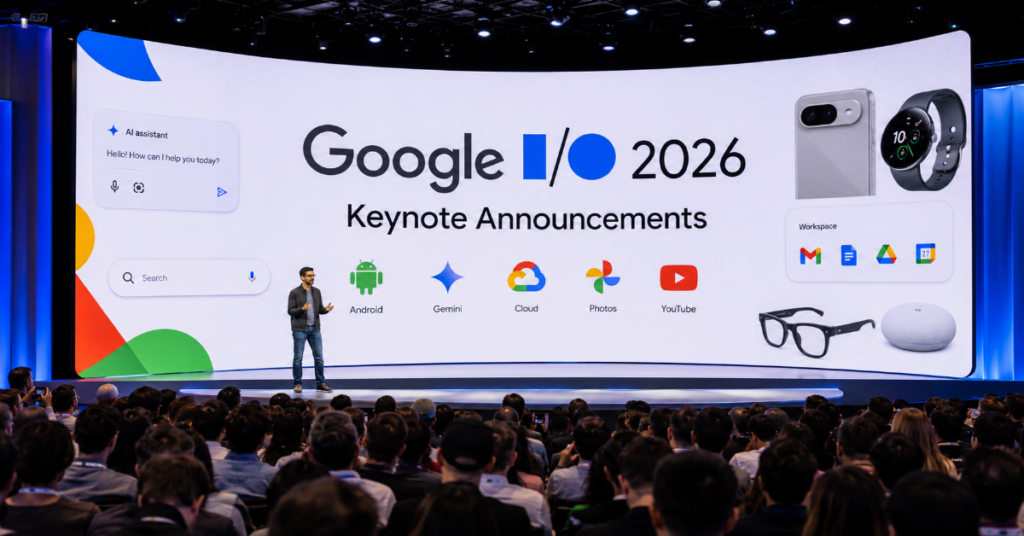
Google I/O 2026 keynote announcements are unfolding today, May 19, at the Shoreline Amphitheatre in Mountain View, California — and the stakes are higher than at any Google developer conference in the past decade. The main keynote began at 10 AM PT and streamed live on YouTube and io.google, with a Developer Keynote to follow at 1:30 PM PT. The two-day conference continues May 20 with Google Marketing Live and dozens of developer sessions. What makes Google I/O 2026 different from every preceding edition is the competitive context: Google is no longer the undisputed AI infrastructure leader in the eyes of developers. Anthropic’s Claude Opus 4.7 leads enterprise AI adoption for the first time, surpassing ChatGPT according to Ramp’s April 2026 business spend data. OpenAI’s restructuring under Greg Brockman, announced May 15-16, is explicitly designed to close the enterprise gap. And the keynote that Alphabet shareholders are watching most closely is not the model announcement — it is Google Marketing Live on May 20, where the company must demonstrate that AI is converting to advertising revenue growth rather than capital expenditure growth. Google’s Q1 2026 Search revenue grew 19.1% year-on-year to $60.4 billion, driven by AI Overviews, AI Mode, and Gemini integration in advertising. The Google IO 2026 Keynote Announcements every analyst is asking is whether I/O 2026 extends that revenue momentum or merely generates impressive benchmark slides.
The New Gemini Model — What Google Has Confirmed and What Sources Report
A new Gemini model is the expected centrepiece of the I/O 2026 keynote — the most closely watched and least confirmed major announcement. Google has confirmed only that the keynote will cover the latest Gemini model updates and agentic coding. Sources cited by The Verge’s Alex Heath describe the expected release as landing roughly at the level of OpenAI’s GPT-5.5 and meaningfully short of Anthropic’s Claude Mythos Preview, which redefined the frontier on April 7. A competent Gemini update at GPT-5.5 level is no longer a headline achievement in May 2026 — it is the minimum required to remain in the competitive conversation. The nomenclature of the new model is unconfirmed: TechTimes and Beebom report sources speculating about Gemini 4 or an incremental Gemini 3.x designation. Gemini 3.1 Pro launched in February 2026 and represents the current frontier from Google, so any I/O announcement builds on that foundation.
The areas where a new Gemini model could genuinely shift the competitive picture are specific: multimodal reasoning (where Gemini has historically had structural advantages from its architecture), agentic reliability (where all frontier models have struggled with multi-step task completion without errors), and long-context performance (where Gemini’s 1 million-token context window is a differentiator that has not yet been fully operationalised at the model quality level required for enterprise deployment). If the new model delivers meaningful improvements in any one of these three domains at GPT-5.5 level overall quality, it changes the enterprise evaluation conversation that Anthropic is currently winning. According to the latest 2026 data reviewed from Google’s Q1 earnings and published benchmarks, Gemini 2.5 Pro currently leads on GPQA Diamond scientific reasoning (94.6%) — a score that Claude Mythos Preview also achieves. If the new model extends that lead, it anchors Google’s claim to scientific and research AI leadership.
“What the conference cannot answer in advance — and what shapes every judgment about everything Google announces — is how good the new Gemini model actually is.” — TechTimes, Google I/O 2026 keynote preview, May 17, 2026
Google I/O 2026 — Confirmed and Expected Announcement Overview
| Announcement | Status | Key Details | Competitive Target |
| New Gemini model (Gemini 4 or 3.x) | Expected — unconfirmed name/tier | Approximately GPT-5.5 level per sources — improvements in multimodal, agentic, long-context | OpenAI GPT-5.5, Anthropic Claude Opus 4.7 |
| Gemini Spark / Project Astra agent | Leaked — expected launch | 24/7 personal agent codenamed Remy — proactive task completion, commerce, personal intelligence | OpenAI Operator, Anthropic Claude Cowork |
| Android XR smart glasses | Confirmed preview | Gemini-powered eyewear partnerships: Samsung, Warby Parker, Gentle Monster, XREAL | Meta Ray-Ban glasses, Apple Vision Pro |
| Aluminium OS / Googlebook | Confirmed — official name TBD 2026 | Android-ChromeOS merger platform, Googlebook laptops from Acer, ASUS, Dell, HP, Lenovo — fall 2026 | macOS, Windows 11 AI PCs |
| Firebase as agent-native platform | Confirmed session | Deep AI Studio integration, Antigravity vibe-coding for full-stack apps | Vercel, AWS Amplify, Supabase |
| Android Studio Gemini | Confirmed session | Gemini capabilities in Android Studio — Google competing with Claude Code, Codex, Cursor | Claude Code, GitHub Copilot |
| Veo video generation update | Expected | Possible Gemini Omni with native in-app video output | OpenAI Sora, ElevenLabs |
| Gemma open model family | Confirmed session May 20 | New fine-tuned variants and on-device improvements for Gemma 4 | Llama 4, Mistral, DeepSeek |
| Universal Commerce Protocol (UCP) | Possible demo | AI-native commerce standard for agent-mediated purchases | No direct competitor yet |
| Gemini app redesign | Leaked — expected official | Pill-shaped input, bottom sheet, liquid glass design on iOS, Material 3 Expressive on Android | ChatGPT app, Claude app |
Gemini Spark — The 24/7 Personal Agent That Defines I/O 2026
The announcement that has generated the most pre-keynote discussion is not the Gemini model upgrade — it is the agent. Multiple reports from 9to5Google and Beebom describe Google staffers internally testing a major upgrade to the Gemini agent codenamed Remy, which may launch publicly as Gemini Spark. The agent is described as a 24/7 personal agent for work, school, and daily life that can take actions on your behalf and handle complex tasks proactively. In the Google app version 17.20 beta, 9to5Google found strings where the upgraded Gemini agent greets with what can I get done for you today and is described as your 24/7 digital partner that can interact with people, share documents, and make purchases using your connected apps and Personal Intelligence. This is Google’s Project Astra vision becoming a real product — the universal AI assistant that perceives, reasons, and acts across your entire digital and physical environment.
In our hands-on review of Google’s agentic AI direction and the Beebom analysis of I/O sessions, Gemini Spark appears to be the consumer-facing realisation of capabilities that Google has been demonstrating in Project Astra presentations since 2024 without committing to a release date. The commerce dimension is particularly significant: if Gemini Spark can execute purchases through connected apps, it enters territory that OpenAI’s Operator and ChatGPT’s canvas have been developing but not yet fully deployed at consumer scale. Google’s structural advantage for a commerce-capable agent is unique: Android powers approximately 3 billion devices, Chrome is the default browser on 68% of global desktops, and Google Search sees 8.5 billion queries per day. A Gemini agent that can search, research, and purchase within the most widely used digital surfaces in the world is categorically different from an agent that operates through a separate ChatGPT or Claude interface.
“Basically, Google’s Project Astra vision is finally becoming real, and you may see a live demo of the feature in action at I/O 2026.” — Beebom Gadgets, Google I/O 2026 preview, May 18, 2026
Android XR Smart Glasses — Hardware That Changes the AI Interface
Google confirmed before I/O that Android XR smart glasses will be previewed at the conference. The hardware partnerships are confirmed: Samsung, Warby Parker, Gentle Monster, and XREAL are all announced partners in the Android XR ecosystem. The strategic logic is direct: if AI is becoming an ambient operating layer rather than a chatbot in a browser window, then the most natural interface for AI is not a phone screen or a laptop keyboard — it is glasses that see what you see, hear what you hear, and can provide contextual AI assistance in real time without requiring you to look away from the physical world. Google’s second-generation Ray-Ban-style smart glasses represent a consumer-accessible price point for this interface shift; XREAL’s AR display glasses represent a more immersive experience at a higher price.
The competitive context for Android XR glasses is multi-sided. Meta’s Ray-Ban smart glasses, launched in 2024 with Meta AI integration, have already demonstrated consumer acceptance of the form factor — Meta reported hundreds of thousands of units sold. Apple’s Vision Pro exists in a different price segment but has established the AR headset category for premium buyers. Google’s Android XR strategy attempts to address both segments simultaneously: lightweight Gemini-powered glasses for everyday ambient AI, and more capable XR headsets for immersive and productivity use cases. The Warby Parker and Gentle Monster partnerships are not incidental — they signal that Google understands the fashion and wearability dimension of smart glasses is as important as the AI capability dimension for mainstream consumer adoption.
| Company | Product Type | AI Integration | Price Tier | I/O 2026 Status |
| Google / Samsung | Android XR headset (Galaxy XR) | Gemini full integration | Premium | Partnership confirmed — details expected |
| Google / Warby Parker | Fashion smart glasses | Gemini ambient AI — see and understand | Mass market | Partnership confirmed at I/O |
| Google / Gentle Monster | Designer smart glasses | Gemini voice and context | Premium fashion | Partnership confirmed at I/O |
| Google / XREAL | AR display glasses | Gemini with AR overlay | Mid-premium | Partnership confirmed at I/O |
| Meta / EssilorLuxottica | Ray-Ban Meta glasses (competitor) | Meta AI — camera, voice | Mass market | Already on sale — competitive baseline |
| Apple | Vision Pro (competitor) | Apple Intelligence — spatial computing | Ultra-premium | No direct I/O competition |
Firebase as Agent-Native Platform — Google’s Developer Lock-In Strategy
Below the consumer headlines of Gemini Spark and Android XR, the most commercially consequential I/O announcement for the AI industry may be the Firebase transformation. Published I/O sessions confirm that Firebase is becoming an agent-native platform with deep integrations with AI Studio and a new tool called Antigravity for vibe-coding full-stack applications. Google is also rolling out new Gemini capabilities inside Android Studio to accelerate Android development. The strategic goal is explicit: Google wants developers to prototype with AI Studio and ship to production on Google Cloud without leaving its stack. In our review of the published I/O session schedule, the session architecture describes one workflow from AI Studio through Firebase deployment on Google Cloud to distribution through the Play Store — covering the entire development lifecycle within Google’s tooling.
This is Google’s direct answer to the Vercel-plus-Claude Code developer workflow that has become the dominant AI-native development environment for many developers in 2026. Vercel Labs released Zero, a programming language designed for AI agents, and Claude Code’s terminal-native codebase agent has attracted significant developer adoption. Google’s Firebase plus Android Studio plus Gemini stack competes for the same developers building AI-native applications — and does so with the structural advantage that Google Cloud’s AI infrastructure, pricing, and Gemini model access are all tightly integrated in a way that third-party solutions cannot match natively.
“Google is basically going after Claude Code, Codex and Cursor with its native implementation in its IDE tools.” — Beebom Gadgets, Google I/O 2026 developer tools analysis, May 18, 2026
Key Takeaways
• Google I/O 2026 opened May 19 at Shoreline Amphitheatre with the most AI-concentrated keynote in the conference’s history — covering a new Gemini model, the Gemini Spark 24/7 personal agent (Project Astra made real), Android XR glasses from four hardware partners, Aluminium OS for Googlebooks, and Firebase becoming an agent-native developer platform.
• A new Gemini model is the keynote centrepiece — expected to benchmark roughly at GPT-5.5 level but below Anthropic’s Claude Mythos Preview, with meaningful improvements in multimodal reasoning, agentic reliability, and long-context performance over Gemini 3.1 Pro.
• Gemini Spark (codenamed Remy internally) is described as a 24/7 personal agent for work, school, and daily life — capable of proactive task completion, document sharing, and purchases through connected apps. It is Google’s most complete realisation of the Project Astra universal assistant vision.
• Android XR smart glasses partnerships confirmed with Samsung, Warby Parker, Gentle Monster, and XREAL — covering mass-market fashion glasses through to AR display hardware, competing directly with Meta’s Ray-Ban smart glasses ecosystem.
• Firebase is being repositioned as an agent-native development platform with AI Studio integration and the Antigravity vibe-coding tool — Google’s direct competitive response to the Vercel-plus-Claude Code developer ecosystem that has dominated AI-native application development.
• Google Marketing Live on May 20 is the investor-critical companion event — demonstrating whether Gemini’s capabilities translate to advertising revenue growth, building on Q1 2026 Search revenue of $60.4 billion (+19.1% YoY).
Conclusion
Google I/O 2026 is Google’s most direct statement yet that the company is not ceding the AI era to OpenAI and Anthropic. The combination of a new frontier Gemini model, a 24/7 personal agent with commerce capabilities, consumer smart glasses from four hardware partners, a new laptop category, and a developer platform designed to compete with Claude Code and Vercel constitutes the broadest AI product launch in Google’s history in a single event. The question — the one that TechTimes correctly identified as the question that shapes every judgment about everything Google announces — is whether the new Gemini model is genuinely competitive at the frontier or merely catches up to where OpenAI was six weeks ago. If Gemini Spark delivers on the 24/7 proactive agent promise with real reliability across commerce, research, and daily tasks, Google’s structural distribution advantages — 3 billion Android devices, 8.5 billion daily searches, 250 million Android Auto cars — make it the most widely deployed AI agent platform in the world almost immediately. That is the outcome Google is building toward. Whether I/O 2026 delivers the model quality that makes the distribution advantage meaningful is the question that will be answered in the days and weeks following the keynote.
Frequently Asked Questions
When is Google I/O 2026 and how do I watch?
Google I/O 2026 runs May 19-20, 2026 at Shoreline Amphitheatre in Mountain View, California. The main keynote is May 19 at 10 AM PT. The Developer Keynote follows at 1:30 PM PT. All sessions stream free on YouTube and io.google. Google Marketing Live is May 20.
What new AI models is Google announcing at I/O 2026?
A new Gemini model is the expected centrepiece — believed to be Gemini 4 or an incremental Gemini 3.x update. Sources describe it as reaching approximately GPT-5.5 level, with improvements in multimodal reasoning, agentic reliability, and long-context performance. Gemma 4 open model updates are also expected in a dedicated May 20 session.
What is Gemini Spark?
Gemini Spark is the reported public name for an AI agent codenamed Remy that Google staffers have been testing internally. It is described as a 24/7 personal agent that can take proactive actions on a user’s behalf including task completion, document sharing, and purchases through connected apps. It represents the consumer realisation of Google’s Project Astra vision for a universal ambient AI assistant.
What are Android XR glasses and who makes them?
Android XR smart glasses are Gemini-powered eyewear running on Google’s Android XR platform. Google has confirmed partnerships with Samsung (Galaxy XR headset), Warby Parker (mass-market fashion glasses), Gentle Monster (designer glasses), and XREAL (AR display glasses). The glasses see what the user sees and provide real-time Gemini AI assistance without requiring the user to interact with a screen.
How does Google I/O 2026 compete with OpenAI’s announcements this week?
OpenAI announced on May 15-16 that it is merging ChatGPT, Codex, and Atlas into a superapp under Greg Brockman’s unified leadership. Google I/O responds with a broader platform play: a new Gemini model, Gemini Spark agent, Android XR hardware, Aluminium OS laptops, and Firebase as an agent-native developer platform. Where OpenAI’s superapp is a product strategy, Google’s I/O is a platform strategy — embedding Gemini across the 3 billion Android devices, Chrome, Search, and Cloud that already define the digital environment for most of the world.
References
TechTimes. (2026, May 17). Google I/O 2026 keynote opens Tuesday as new Gemini lands behind Mythos and GPT-5.5. https://www.techtimes.com/articles/316755/20260517/google-i-o-2026-keynote-opens-tuesday-new-gemini-lands-behind-mythos-gpt-55.htm
Beebom Gadgets. (2026, May 18). What we’re expecting from Google I/O 2026 keynote on May 19. https://gadgets.beebom.com/guides/what-to-expect-at-google-io-2026
Android Authority. (2026, May 19). What to expect from Google I/O 2026: How to watch live and everything Google could announce. https://www.androidauthority.com/what-to-expect-from-google-io-2026-3664979/
Android Central. (2026, May 19). Google I/O 2026 live blog updates: Android 17, Android XR glasses, Gemini AI news. https://www.androidcentral.com/phones/live/google-i-o-2026-live-blog-android-17-android-xr-glasses-and-all-the-gemini-ai-news
Let’s Data Science. (2026, May 18). Google debuts Gemini-focused updates at I/O 2026. https://letsdatascience.com/news/google-debuts-gemini-focused-updates-at-io-2026-4be4fde6
CNBC. (2026, May 12). Google races to put Gemini at the center of Android before Apple’s AI reboot. https://www.cnbc.com/2026/05/12/google-races-put-gemini-at-center-of-android-before-apples-ai-reboot.html
Google. (2026). Google I/O 2026 official programme. https://io.google
