
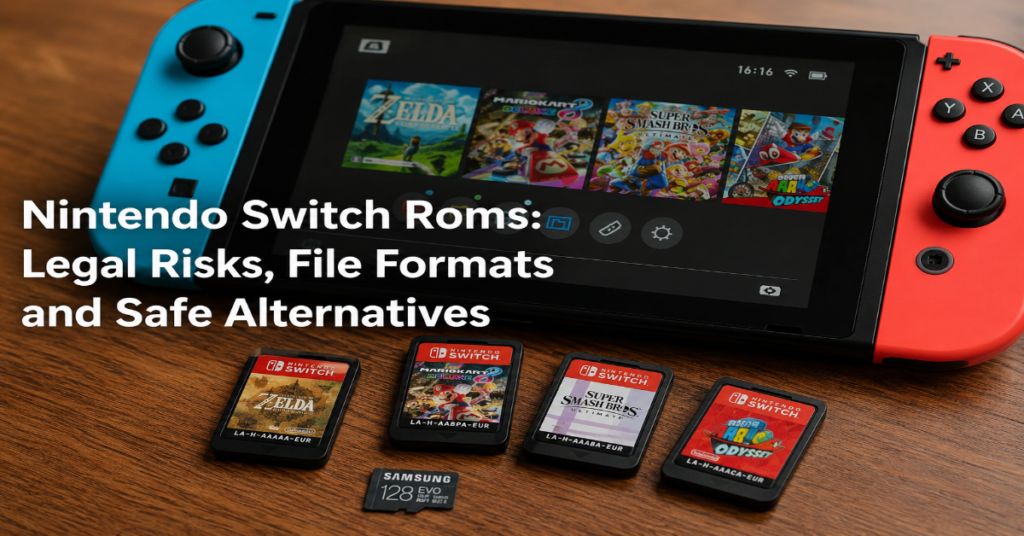
Nintendo Switch Roms are a popular search term because players want to understand game backups, emulation, file formats and the risks around downloaded Switch game files. The short answer is simple: Nintendo treats pirate copies of game files as illegal, and its support material says uploading and downloading those copies violates the law.
That does not mean every discussion of emulation, preservation or backups is automatically piracy. It does mean readers need to separate technical vocabulary from legal permission. A file ending in .nsp or .xci may describe a package type, not a right to possess, share or run copyrighted software outside Nintendo’s authorized systems.
The confusion has grown because Switch emulation, hacked consoles, flash cartridges and online file sharing are often discussed together. That blend creates a risky gray zone for ordinary players. A person may start by searching how backups work and end up on sites distributing unauthorized copies. Nintendo’s own language is direct: authentic games are available through Nintendo eShop, Nintendo’s website or legitimate physical channels, while third-party file-sharing links are unauthorized copies.
This article explains Nintendo Switch Roms from a legal, technical and consumer-safety angle. It does not provide download links, circumvention steps, keys, firmware files or instructions for bypassing console protections. The purpose is to help readers understand the terminology, avoid legal exposure and make safer choices.
What Nintendo Switch Roms Actually Mean
The term “ROM” originally came from read-only memory chips used in older cartridges. In modern gaming culture, it is often used loosely to mean a copy of a game file. Nintendo itself says pirate copies of game files are often referred to as ROMs.
For Switch games, people commonly discuss two file types:
| Format | Common description | Practical meaning | Main risk |
| NSP | Nintendo Submission Package | Often associated with digital package-style game files | Unauthorized sharing or downloading can infringe copyright |
| XCI | Cartridge image format | Often described as a raw game-card style dump | Cloned cartridge data can create account and console risks |
| Official eShop download | Purchased through Nintendo Account | Legal digital access through Nintendo’s own systems | Region, account or service restrictions may still apply |
| Physical cartridge | Game card sold through retail channels | Legal ownership of a physical copy | Used copies can carry risk if cloned or tampered with |
The format itself is not the ethical issue. The issue is how the file was obtained, whether the user has authorization and whether the method bypasses Nintendo’s protections or terms.
Why Downloading Switch ROMs Is Legally Risky
Nintendo’s piracy FAQ is unusually clear. It says Nintendo’s authentic games can be purchased through Nintendo eShop or Nintendo’s website, while games offered through peer-to-peer networks or third-party file hosts are unauthorized copies. It also says uploading and downloading pirate copies is illegal.
That matters because many search results around Nintendo Switch Roms blur three different topics:
- Game preservation
- Personal backups
- Pirated downloads
Only the first two are sometimes discussed in lawful or scholarly contexts, and even then the details vary by jurisdiction. Pirated downloads are the clearest risk. A user does not avoid infringement simply by owning the same game physically, downloading from a mirror or claiming the file is for testing.
Nintendo’s enforcement record also shows that this is not an abstract issue. The Yuzu emulator lawsuit ended in a $2.4 million settlement, with Yuzu development discontinued. The settlement did not create a universal legal rule for all emulators, but it showed how aggressively Nintendo will act when it believes software enables piracy or circumvention.
The Technical Reality Behind NSP, XCI, Firmware and Keys
Switch emulation discussions often mention firmware and keys. These are sensitive topics because they can involve copyrighted files, console security material or bypassing technical protection measures. This article will not explain how to obtain, install or use those components.
The important point is practical: a game file alone is rarely the whole story. Running unauthorized Switch software commonly involves a chain of dependencies, including file conversion, encryption handling, firmware compatibility and account or hardware checks. Each step can add legal, security and device-ban risk.
| Topic | Safe educational summary | What this article avoids |
| Firmware | Console system software that affects compatibility | Download sources or installation steps |
| Prod keys | Sensitive cryptographic material tied to decryption | Extraction, sharing or use instructions |
| Modded consoles | Hardware or software-altered systems | Jailbreak or bypass guidance |
| Emulators | Software that imitates console behavior | Piracy setup walkthroughs |
The safer editorial line is clear: understand the vocabulary, but do not treat technical feasibility as permission.
Legitimate Ways to Play Switch Games
Nintendo’s official digital path is straightforward. A Nintendo Account is required for website purchases, and purchased games can be downloaded to a compatible Nintendo Switch or Switch 2 console through Nintendo eShop access.
Players have several legitimate options:
| Option | Best for | Advantages | Limitations |
| Nintendo eShop | Digital buyers | Account-tied purchases, direct downloads, sales | Requires account and online access |
| Official Nintendo website | Browser-based shopping | Convenient remote purchasing | Still depends on Nintendo Account |
| Physical cartridge | Collectors and resale buyers | Tangible copy, gifting and resale | Risk from cloned used copies in rare cases |
| Nintendo Store app or official store pages | Browsing hardware, software and merchandise | Official ecosystem | Purchase flow may still redirect through web channels |
Digital games are not the same as random file downloads. Official digital purchases are tied to Nintendo’s ecosystem and account infrastructure. That is the difference between licensed access and unauthorized copying.
Consumer Risks Beyond Copyright
The legal risk is only one part of the problem. There are also practical hazards.
First, malware risk is common on piracy sites. Files labeled as game dumps can hide executables, malicious archives, browser redirects or fake installers. Second, account bans can be costly. Nintendo’s Switch 2 user agreement prohibits copying, modifying, reverse engineering, bypassing protections and using unauthorized or pirated software or hardware.
Third, second-hand buyers face a newer problem: cloned cartridges. Reports in 2025 described users facing bans or service issues after using cartridges later believed to be cloned or linked to flash-cart tools. Some cases reportedly involved users who claimed they bought pre-owned games without knowing the history of the cartridge.
That creates an original risk point many basic guides miss: the used-game market can inherit anti-piracy risk from previous owners. If a cartridge’s unique data has been duplicated and used elsewhere, the buyer may face friction even if they acted in good faith.
Storage, Cartridge Size and the Compression Misconception
A common misconception is that every Switch game is small enough to copy, store and move casually. Real storage behavior is more complicated.
Automaton Media reported comments from Japanese engineers noting that Switch cartridge capacity was a bottleneck and that Switch game cards were limited to 32GB, while larger games sometimes required extra downloads to internal storage or a microSD card.
That context matters because file size is not just a convenience issue. It shapes development decisions, compression strategies, update delivery and consumer storage planning.
| Storage factor | Real-world impact |
| 32GB cartridge ceiling | Some large games need extra download data |
| MicroSD usage | Expands storage for official downloads and updates |
| Compression | Helps games fit hardware limits but can affect development workflow |
| Updates and DLC | Increase total storage footprint beyond the base game |
A practical insight: storage limitations are one reason piracy discussions often understate the full cost of ownership. A legal Switch library still needs storage planning, but it avoids the layered risks of unauthorized files.
Strategic Implications for Players, Developers and Publishers
For players, the main implication is risk management. Searching for Nintendo Switch Roms may begin as curiosity, but downloading unauthorized files can expose users to copyright claims, malware, account restrictions and device-level consequences.
For developers, unauthorized copying affects more than large publishers. Indie studios depend heavily on early sales windows. A leaked or pirated Switch build can undercut launch revenue, weaken chart position and damage future platform opportunities.
For Nintendo, strict enforcement protects licensing, eShop revenue, hardware security and publisher confidence. The downside is reputational tension with preservationists, repair advocates and technically sophisticated players who argue that legitimate archival use should be easier.
That tension is not going away. The question is whether platform owners can offer better legal preservation, backup and legacy-access options before piracy fills the gap.
Market and Cultural Impact
The Switch became one of the defining consoles of the last decade because it merged handheld and home-console behavior. That cultural reach also made its software library a piracy target. When a console has mainstream appeal, portable hardware, collectible cartridges and high resale demand, copied game files become a bigger enforcement problem.
Nintendo’s anti-piracy stance also shapes the emulation community. The Yuzu settlement did not end emulation as a technical field, but it chilled mainstream development around current Nintendo systems. Legal scholars and IP commentators have noted that the settlement was not a full court ruling, which means it did not settle every legal question around emulators. Still, it changed developer incentives.
The cultural lesson is blunt: emulation may be a broader technology issue, but current-generation commercial game piracy is where enforcement becomes most intense.
The Future of Nintendo Switch Roms in 2027
By 2027, the future of Nintendo Switch Roms will likely be shaped by three forces: stronger platform enforcement, more cloud-linked ownership systems and continued debate over preservation.
Nintendo’s current user agreement language already prohibits bypassing protections, using unauthorized copies and installing software outside Nintendo-approved distribution methods. That policy direction suggests tighter hardware and account checks, especially around Switch 2 and future platform services.
The second force is digital ownership. As more purchases move through accounts, stores and download rights, users may become less focused on physical game dumps and more focused on whether their purchases remain accessible long term. Reuters reported that Tencent’s Chinese Nintendo Switch eShop services were scheduled to wind down in 2026, showing how regional service changes can affect digital access even inside official systems.
The third force is preservation pressure. Museums, researchers and archivists will keep arguing that games need lawful preservation channels. The unresolved question is whether platform holders will build those channels themselves or continue relying mainly on enforcement.
Practical Takeaways
- File format knowledge does not create legal permission.
- Nintendo’s official position treats pirate ROM uploading and downloading as illegal.
- Used cartridges can carry hidden risk if they were previously cloned or associated with unauthorized hardware.
- Official eShop purchases remain the cleanest route for digital access.
- Emulation law is not the same as piracy law, but current-generation console emulation can become legally risky when circumvention and copyrighted files are involved.
- Storage limits explain why Switch games often involve updates, compression and additional downloads.
- Preservation debates are real, but they do not make public piracy sites safe or lawful.
Conclusion
Nintendo Switch Roms sit at the intersection of technical curiosity, game preservation, consumer convenience and copyright enforcement. The safest reading is not complicated: learning what NSP, XCI, backups and emulators mean is different from downloading or sharing unauthorized Nintendo software. Nintendo’s own materials make its position clear, and recent enforcement around emulators, modded hardware and piracy-linked tools shows that the company is willing to act.
For ordinary players, the practical advice is simple. Buy through official channels, be careful with used cartridges, avoid sites offering free Switch game files and do not assume that ownership of a cartridge gives permission to download a copy from the internet. For the industry, the harder question remains preservation. Until better legal access models exist, the gap between technical possibility and legal permission will keep creating confusion.
FAQ
Are Nintendo Switch Roms legal?
They can refer to different things, but downloading or uploading pirate copies of Nintendo games is illegal according to Nintendo’s piracy FAQ. A lawful backup or preservation question depends on jurisdiction, ownership, method and whether technical protections are bypassed.
What is the difference between NSP and XCI?
NSP is commonly discussed as a package-style digital format, while XCI is commonly described as a cartridge-image style format. The format does not determine legality. The source, authorization and use case matter more.
Can I download a Switch game if I own the cartridge?
Owning a cartridge does not automatically give permission to download a copy from a third-party file host. Nintendo says games offered through peer-to-peer networks or third-party platforms are unauthorized copies.
Is Switch emulation illegal?
Emulation itself is a complex legal topic and varies by facts and jurisdiction. The risk increases when copyrighted games, firmware, keys or protection-bypass methods are involved. The Yuzu case ended in settlement, not a broad final court ruling on every emulator.
What is the safest way to buy digital Switch games?
Use Nintendo eShop or Nintendo’s official website. Nintendo says website purchases require a Nintendo Account and compatible console access to download purchased games.
Can used Switch cartridges cause problems?
Yes, in rare cases. Reports in 2025 described users facing service issues after buying cartridges later believed to be cloned or linked to unauthorized copying tools. Buyers should use reputable sellers and keep receipts.
Methodology
This article was prepared from the uploaded production brief, Nintendo support pages, official Nintendo purchase guidance, legal and industry reporting and recent coverage of enforcement actions. The article avoids operational instructions for piracy, circumvention, keys, firmware or unauthorized downloads. It treats Nintendo’s own support pages as the highest-authority source for Nintendo policy and uses reputable technology and legal reporting for context.
Known limitations: laws differ by jurisdiction, and this article is not legal advice. The emulation debate is broader than one company’s policy position, and some preservation arguments are legitimate. The article therefore distinguishes between technical discussion, lawful access, preservation concerns and unauthorized copying.
Suggested disclosure: This article was drafted with AI assistance and reviewed and verified by the editorial team at Perplexityaimagazine.com. All data, citations and claims should be independently confirmed before publication.
References
Automaton Media. (2025, February 18). The Nintendo Switch kept us busy with its limited CPU and RAM, but it also made optimization a fun puzzle to figure out.
Nintendo. (n.d.). Digital game purchases through the Nintendo website FAQ.
Nintendo. (n.d.). Games, My Nintendo Store.
Nintendo Support. (n.d.). Intellectual Property & Piracy FAQ.
Nintendo Support. (n.d.). Nintendo Switch 2: User Agreement.
Reuters. (2024, November 26). Tencent to end Nintendo Switch eShop sales and services in China from 2026.
The Verge. (2024, March 4). Nintendo Switch emulator Yuzu will utterly fold and pay $2.4 million to settle lawsuit.
Wilson Sonsini. (2024, April 4). Nintendo weakens emulator upstart “Yuzu,” setting off panic within the emulator community.
