
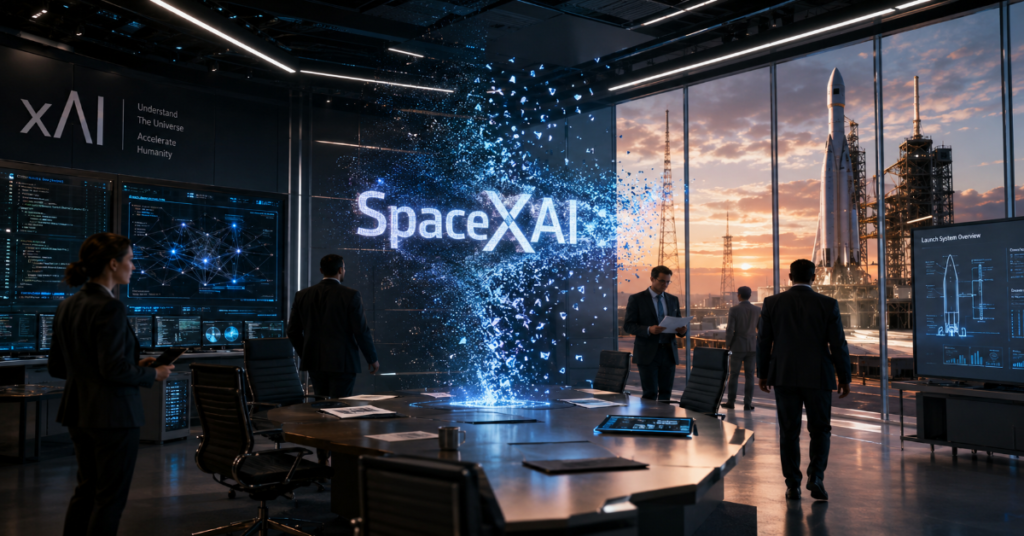
xAI dissolved as an independent company on May 6, 2026, when Elon Musk confirmed in a reply on X that the artificial intelligence startup he founded in 2023 would cease to exist as a separate corporate entity. The announcement came in response to a user commenting on a new compute partnership between SpaceX and Anthropic — a partnership that sees the Colossus 1 supercomputer in Memphis, Tennessee, originally built to give xAI a decisive competitive advantage over OpenAI and Anthropic, now partially leased to the very competitor Musk spent years publicly attacking. Musk’s exact words: ‘xAI will be dissolved as a separate company, so it will just be SpaceXAI, the AI products from SpaceX.’ That sentence ended the roughly two-year existence of one of the most funded, most controversial, and most closely watched AI startups in history. Grok — xAI’s large language model and the product that was supposed to out-compete Claude and ChatGPT — now becomes a SpaceX product under the SpaceXAI division. The xAI engineering team transitions to SpaceX employment. The $12 billion raised by xAI flows through to SpaceX shareholders via an all-stock exchange at respective board valuations. xAI, as a corporate structure, is finished.
The Colossus Inversion — Anthropic Rents xAI’s Supercomputer
The single most striking detail in the xAI dissolution is not the corporate restructuring — it is what SpaceX is doing with Colossus 1. The Memphis data centre was built by xAI in 2024 at a cost exceeding $1 billion, equipped with more than 220,000 Nvidia GPUs including H100s, H200s, and GB200s, delivering approximately 300 megawatts of computing power at peak. It was designed to be xAI’s decisive infrastructure advantage over competitors that could not independently fund compute at this scale. Now, Anthropic — the maker of Claude, the AI model that has most directly competed with Grok for enterprise market share — is leasing Colossus 1’s excess capacity. SpaceXAI does not currently need the full 300 megawatts for its model training and inference workloads; the lease to Anthropic monetises capacity that would otherwise sit partially idle while SpaceX focuses internal development on Colossus 2, the next-generation cluster designed to exceed Colossus 1’s capacity.
Musk confirmed on X that he had recently spent significant time with Anthropic’s senior leadership team and came away impressed. ‘Everyone I met was highly competent and cared a great deal about doing the right thing,’ he wrote — a remarkable reversal from the public statements he had made about Anthropic throughout 2024 and 2025, which included characterising the company as hostile to Western civilisation. Anthropic stated that the deal gives Claude access to significantly more compute. Both companies framed the partnership around shared ambitions in orbital infrastructure — SpaceX’s plans for space-based data centres in low Earth orbit are a natural intersection with Anthropic’s growing demand for frontier compute that is not constrained by terrestrial energy and land availability. According to the analysis site ABHS, SpaceXAI reserves the right to reclaim the capacity if Anthropic’s systems are judged to have engaged in actions that harm humanity — a clause that reflects Musk’s stated condition for the partnership but which would be difficult to operationalise in practice.
“xAI will be dissolved as a separate company, so it will just be SpaceXAI, the AI products from SpaceX.” — Elon Musk, on X, May 6, 2026
xAI Timeline: From Launch to Dissolution
| Date | Event | Significance |
| March 9, 2023 | xAI founded by Elon Musk and 11 researchers | Musk’s entry into frontier AI development |
| November 2023 | Grok chatbot launched on X platform | First product — X Premium integration |
| May 2024 | xAI raises $6B additional funding | Total raised reaches $12B — Sequoia, a16z, sovereign wealth |
| December 2024 | Colossus 1 fully operational in Memphis | 220,000+ Nvidia GPUs, 300MW — largest AI supercomputer at launch |
| February 2026 | SpaceX acquires xAI in all-stock deal | SpaceX valued at $1T, xAI at $250B — combined $1.25T |
| Late March 2026 | All original co-founders except Musk departed | Leadership instability accelerates restructuring decision |
| May 6, 2026 | Musk announces xAI dissolved as separate entity | Grok, X, and AI products become SpaceXAI division |
| May 6, 2026 | Colossus 1 leased to Anthropic | Rival AI company gains access to xAI’s flagship compute asset |
Why Now — The Leadership Collapse and the Capital Logic
The dissolution accelerated beyond what the February SpaceX acquisition alone required because of a cascading leadership departure that left xAI without a single original co-founder in operational leadership. By late March 2026, all eleven co-founders who had joined Musk at xAI’s founding in 2023 had departed. This is not a typical attrition pattern — it is a signal that the internal conditions of the company had become untenable for the people who built it. CNBC reported that the restructuring was framed internally around ‘speed of execution’ — which reads, as the technology analysis site Gagadget noted, less like a strategy and more like damage control after a mass departure. Musk acknowledged the underlying issue directly on X: the company ‘was not built right first time around.’ That admission, from a founder, is a significant concession that the xAI structure failed to retain the talent that created its technical capability.
The capital logic is cleaner than the personnel story. xAI had completed its fundraising — $12 billion total raised — and Colossus 1 was built. The primary purposes for which xAI needed to exist as a separate corporate entity with its own board, its own fundraising overhead, and its own legal infrastructure had been accomplished. Maintaining that overhead when SpaceX could absorb the operation is inefficient. More importantly, the planned SpaceX IPO — rumoured to be among the largest public offerings in history, potentially at a $1.75 trillion valuation — benefits from simplicity. A prospectus describing SpaceXAI as an integrated division of SpaceX is a cleaner story for public investors than a corporate structure that requires explaining the relationship between SpaceX, xAI as a subsidiary, X as a separate entity, and Grok as a product that touches all three.
| Component | Pre-Dissolution Structure | Post-Dissolution (SpaceXAI) | Implication |
| Grok AI model | xAI product | SpaceX product under SpaceXAI | No user-facing change — same model, new corporate home |
| Colossus 1 compute | xAI asset, Memphis | SpaceX asset — leased to Anthropic | Revenue generation from excess capacity |
| xAI investor stakes | xAI equity ($12B raised) | SpaceX equity at exchange ratio | Concentrated AI exposure becomes diversified SpaceX stake |
| API (api.x.ai) | xAI-operated | Migrating to SpaceX-branded endpoint | 12+ month transition — no service interruption |
| Grok development team | xAI employees | SpaceX employees under SpaceXAI | No change in work — change in employment entity |
| Corporate governance | xAI board, separate reporting | SpaceX division — no separate board | Simplified governance ahead of SpaceX IPO |
“Everyone I met was highly competent and cared a great deal about doing the right thing.” — Elon Musk, on X, describing his meetings with Anthropic’s senior leadership, May 6, 2026
What This Means for the AI Competitive Landscape
The xAI dissolution redraws the AI competitive map in ways that are not immediately obvious from the corporate announcement alone. Grok does not disappear — it continues as a SpaceX product under SpaceXAI, with Grok 5 development proceeding on an unchanged technical timeline. But the separation of AI development from a standalone company with AI-specific leadership, AI-specific incentives, and AI-specific fundraising capacity has consequences. SpaceX is fundamentally a space and aerospace company. Integrating frontier AI development into a rocket company’s organisational culture, talent pipeline, and capital allocation process creates a hybrid that has not previously been attempted at this scale. The AI industry will be watching whether SpaceXAI can recruit and retain frontier AI researchers who would otherwise consider xAI, OpenAI, Anthropic, and Google DeepMind as primary destinations.
The Anthropic relationship is the most counterintuitive element. Anthropic now has access to Colossus 1’s excess compute capacity — a substantial infrastructure advantage for a company whose growth has been constrained by the availability of training compute relative to OpenAI and Google. According to the latest 2026 data reviewed from Anthropic’s financial disclosures, Anthropic’s revenue run rate exceeded $30 billion and is growing at a pace that makes compute access the primary constraint on expansion. Leasing Colossus 1 at commercially negotiated rates is cheaper and faster than building equivalent infrastructure from scratch. For SpaceXAI, it converts a partially idle infrastructure asset into a revenue-generating lease without surrendering ownership. Both parties benefit financially. The ideological optics — Musk’s compute infrastructure serving Anthropic — are the price SpaceX pays for that financial rationality.
“Musk shuts down xAI and folds it into SpaceX, admitting it was ‘not built right.'” — Gagadget analysis headline, May 2026, quoting Musk’s own characterisation of the xAI corporate structure
Key Takeaways
• xAI was officially dissolved as an independent company on May 6-7, 2026, with Elon Musk confirming on X that all AI products including Grok will operate under a new SpaceXAI division of SpaceX. The $12 billion raised by xAI flows to SpaceX investors via an all-stock exchange.
• Colossus 1 — xAI’s Memphis supercomputer with 220,000+ Nvidia GPUs and 300MW of compute capacity — is now partially leased to Anthropic, xAI’s primary rival in enterprise AI. SpaceXAI retains ownership; Anthropic pays commercially negotiated rates for access to excess capacity.
• Musk acknowledged the dissolution reflected a failure of the original corporate structure, stating on X that xAI ‘was not built right first time around’ — a significant admission that the leadership departures and operational friction drove the timeline.
• All 11 original xAI co-founders had departed by late March 2026, leaving Musk as the sole founding figure in operational leadership — the immediate structural context that accelerated the decision to fold the company into SpaceX.
• Grok development continues under SpaceXAI; API customers face a 12+ month migration window to a SpaceX-branded endpoint; the model brand and X integration remain unchanged for end users in the near term.
• The SpaceX IPO — rumoured at a potential $1.75 trillion valuation — benefits from the simplified corporate structure. A SpaceXAI division is a cleaner prospectus story than the previous multi-entity structure involving SpaceX, xAI, X, and Grok as separate but related entities.
Conclusion
The end of xAI as an independent company is one of the most consequential AI industry events of 2026, and it was announced in a single X reply rather than a press conference or investor day. That incongruity captures something important about how Musk operates and how the AI industry moves. xAI launched in 2023 with a stated mission to build ‘maximally truth-seeking’ AI and raised $12 billion in two years — enough to build Colossus 1 and develop several iterations of Grok. What it could not build, apparently, was a corporate structure stable enough to retain the team that built those things once SpaceX absorbed the entity. The Anthropic lease is the most symbolically striking outcome: the infrastructure that was supposed to be xAI’s competitive moat is now powering the Claude models that have outpaced Grok in enterprise adoption. Whether SpaceXAI can rebuild the talent base and the organisational identity required to compete at the frontier under a rocket company’s roof — rather than as a dedicated AI lab — is the question that will determine whether this dissolution is a rational capital efficiency move or the beginning of Grok’s slow decline.
Frequently Asked Questions
What happened to xAI?
Elon Musk announced on May 6, 2026 that xAI is dissolved as a separate company and absorbed into SpaceX as a new division called SpaceXAI. All xAI products including Grok continue under SpaceXAI branding. The xAI engineering team transitions to SpaceX employment. xAI shareholders receive SpaceX equity in exchange for their xAI stakes at a ratio set by respective board valuations.
What is SpaceXAI?
SpaceXAI is the new internal division of SpaceX that houses all of Musk’s AI products and infrastructure, including Grok, X’s AI integrations, Colossus 1, and future AI development. It replaces xAI as the organisational home for these capabilities. SpaceX already acquired xAI in an all-stock transaction in February 2026; the May announcement formalises the complete dissolution of the xAI corporate entity.
Why is Anthropic leasing xAI’s Colossus supercomputer?
SpaceXAI does not currently need the full 300MW capacity of Colossus 1 for its model training and inference workloads. Rather than leaving capacity idle, SpaceX leased excess compute to Anthropic — generating revenue on infrastructure assets while focusing internal development on Colossus 2. Anthropic gains training compute at commercial rates without the 12-24 month timeline required to build equivalent infrastructure.
What happens to Grok?
Grok continues as a product under SpaceXAI. The model brand remains. Grok 5 development continues on its existing timeline. X (Twitter) integration is unchanged for end users. The API migrates from api.x.ai to a SpaceX-branded endpoint over a 12+ month transition window. For users, the near-term experience is unchanged; the change is corporate, not product.
Why did all of xAI’s co-founders leave?
Specific reasons for individual departures have not been publicly confirmed for most co-founders. The pattern — all 11 original co-founders departing by late March 2026 — is consistent with significant internal cultural or strategic disagreements that accelerated after the SpaceX acquisition in February. Musk’s acknowledgement that xAI ‘was not built right first time around’ is the closest public statement to an explanation of the underlying problems.
References
Musk, E. (2026, May 6). [Post on X]. xAI will be dissolved as a separate company, so it will just be SpaceXAI. https://x.com/elonmusk/status/
FinanceFeeds. (2026, May 7). Elon Musk says xAI will be dissolved and folded into new SpaceXAI structure. https://financefeeds.com/elon-musk-says-xai-will-be-dissolved-and-folded-into-new-spacexai-structure/
Gautam, A. (2026, May 7). xAI dissolved into SpaceXAI: Musk merges Grok and Colossus into SpaceX. https://www.abhs.in/blog/xai-dissolved-spacexai-elon-musk-merger-grok-colossus-2026
Republic World. (2026, May). Musk dissolves xAI after Anthropic deal, future AI products to launch under SpaceXAI. https://www.republicworld.com/tech/musk-says-xai-will-be-dissolved-as-separate-company-ai-products-to-come-under-spacexai
Gagadget. (2026, May). Musk shuts down xAI and folds it into SpaceX, admitting it was ‘not built right’. https://gagadget.com/en/708826-musk-shuts-down-xai-and-folds-it-into-spacex-admitting-it-was-not-built-right/
AIToolsRecap. (2026). xAI is being dissolved — Grok and X are now SpaceXAI (2026). https://aitoolsrecap.com/Blog/xai-dissolved-spacexai-elon-musk-announcement-2026
Wikipedia. (2026, May). SpaceXAI. https://en.wikipedia.org/wiki/SpaceXAI
