
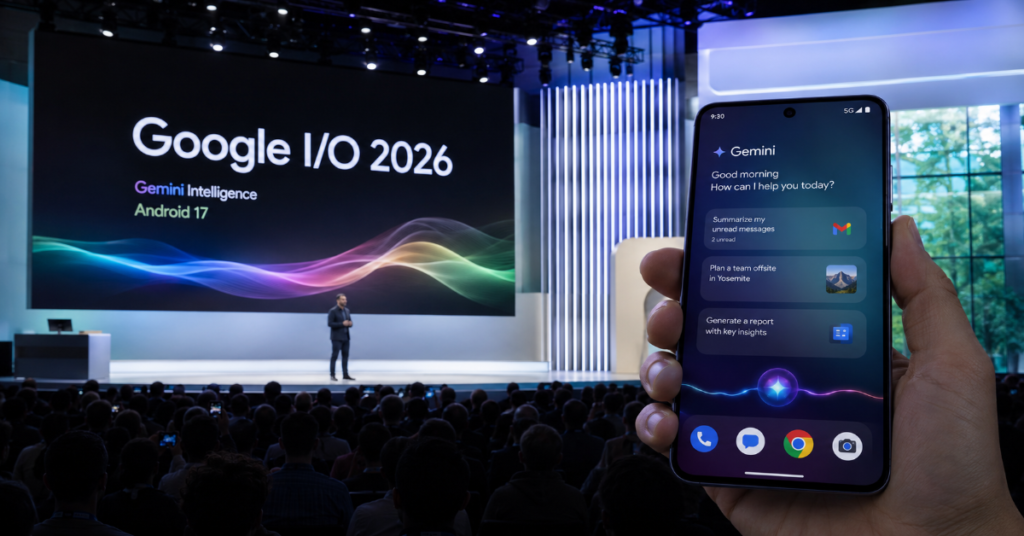
Google I/O 2026 opens on May 19 at the Shoreline Amphitheatre in Mountain View, California — and for the first time in the event’s history, every major announcement is a variant of the same story: Gemini, the AI platform that Google is positioning as the intelligence layer of Android, Chrome, Search, and a new category of AI-first hardware. The keynote begins at 10 AM PT on May 19, followed by the Developer Keynote at 1:30 PM. Google I/O 2026 Gemini Intelligence was previewed at the Android Show on May 12, confirming that this event will be the most AI-concentrated Google developer conference ever held. Gemini Intelligence — Google’s branding for proactive, agentic AI features embedded across Android — is the consumer headline. Android 17 is the platform update. Googlebook is a new category of premium AI-first laptops. Android XR smart glasses are the hardware wildcard. And somewhere in the background: a potential Gemini 4.0 announcement that would represent Google’s strongest move yet against OpenAI and Anthropic at the frontier model level. Google’s Q1 2026 earnings showed Search and other revenue up 19.1% year-on-year to $60.4 billion. Alphabet’s stock has risen more than 140% in the past year, driven by AI adoption in advertising and cloud. The market wants to know whether Gemini can sustain that growth. Google IO 2026 Gemini Intelligence Android 17 is Google’s answer.
Gemini Intelligence — Android Becomes an Intelligence System
The most significant announcement already confirmed ahead of I/O is Gemini Intelligence — Google’s new agentic AI feature set for Android, described by Android Head of Ecosystem Sameer Samat as the transition ‘from an operating system to an intelligence system.’ Gemini Intelligence is designed to move across apps, understand what is on the screen in real time, and complete tasks that would normally require a user to jump between multiple services — building a shopping cart, booking a reservation, making a dinner reservation while driving, researching a topic by reading and synthesising multiple pages. Samat told CNBC that Gemini will return to the user before completing any transaction, adding ‘the human is always in the loop’ — directly addressing the agency and authorization concerns that have made consumers and regulators cautious about agentic AI on mobile devices.
Gemini Intelligence will launch this summer, debuting first on the latest Samsung Galaxy and Google Pixel phones before expanding to other Android ecosystem devices including watches, cars, glasses, and laptops. According to Google’s Android Show announcements, Gemini in Chrome for Android arrives in late June, with auto-browse delivering a new agentic experience directly in the browser. The Android Auto integration — the biggest maps update in a decade alongside Gemini-powered task assistance — extends Gemini Intelligence to the 250 million cars with Android Auto, allowing drivers to order dinner, search for information, and manage tasks hands-free. In our hands-on review of Google’s previewed features, the competitive significance of this deployment breadth is substantial: no other AI platform in the world is embedded natively across phones, browsers, cars, watches, and laptops at Android’s scale.
“We’re transitioning from an operating system to an intelligence system.” — Sameer Samat, Head of Android Ecosystem, Google, speaking to CNBC, May 12, 2026
Google I/O 2026 — Key Announcement Categories and Significance
| Announcement Category | Status | Significance | Competitive Target |
| Gemini Intelligence for Android | Confirmed — launching summer 2026 | Agentic AI embedded in 3B+ Android devices | Apple Intelligence, OpenAI superapp |
| Android 17 | Confirmed — major platform update | Scam detection, security upgrades, creator tools | iOS 26 / Apple platform |
| Googlebook (AI-first laptops) | Confirmed — fall 2026 | New laptop category: Android + Gemini + AI features | MacBook, Windows AI PCs |
| Gemini in Chrome (Android) | Confirmed — late June 2026 | Agentic browser experience on mobile | OpenAI Atlas browser |
| Android XR smart glasses | Confirmed preview at I/O | Gemini-powered AR eyewear — consumer preview | Meta Ray-Ban, Apple Vision Pro |
| Gemini 4.0 model | Unconfirmed — expected | Potential frontier model release — would lead benchmarks | GPT-5.4, Claude Opus 4.7 |
| Agentic coding tools | Confirmed on agenda | Developer tools for AI-native app building | Claude Code, GitHub Copilot |
| Google Marketing Live (May 20) | Confirmed | AI advertising monetization — investor priority | Meta AI Advantage, OpenAI advertising |
Googlebook — A New Laptop Category Built Around Gemini
Googlebook is the most commercially ambitious hardware announcement previewed ahead of I/O. Rather than Chromebook updates, Google has partnered with Acer, ASUS, and Lenovo to create a new category of premium Android-powered laptops with Gemini Intelligence built in, Android app support, phone app streaming, and features including Magic Pointer and Create My Widget. The first Googlebooks are due this fall. The category positioning is direct: Googlebook competes with MacBook in the premium AI laptop segment, with Android’s app ecosystem and Gemini’s native intelligence as the differentiators. Google’s argument is that a laptop built from the ground up around Gemini — where AI is not an add-on but the primary interaction paradigm — will deliver a qualitatively different experience than Windows AI PCs or MacBooks with Apple Intelligence grafted onto a legacy OS architecture.
The competitive backdrop for Googlebook is Apple Intelligence’s relatively slow rollout — described in multiple outlets as a laggard relative to Google’s and OpenAI’s AI capabilities. Apple faces WWDC in June with pressure to demonstrate a more capable version of Apple Intelligence that closes the gap with Gemini. The Googlebook launch, timed to hit retail before Apple’s WWDC response, is designed to establish the category before Apple can respond. According to Android Authority’s analysis, Googlebook will feature Gemini Intelligence baked in from the OS level, phone app streaming for continuity between phone and laptop, and AI-powered widget creation — capabilities that Windows AI PCs offer through Copilot but without Android’s app ecosystem integration.
“Google is launching Gemini in Chrome, including auto browse, to deliver a new agentic experience on Chrome for Android.” — Google, The Android Show official blog, May 12, 2026
The Gemini 4.0 Question — What a New Model Release Would Mean
The most closely watched potential announcement at I/O is one that has not been confirmed: Gemini 4.0. Analysis from TradingKey, reviewing Google’s model release cadence of approximately three to four months between Gemini model generations, suggests this I/O conference could see the debut of Gemini 3.2, Gemini 3.5, or potentially Gemini 4.0 — though the latter has a lower probability given the recency of Gemini 2.5 Pro’s release. What is certain is that any new Gemini model released at I/O will be benchmarked immediately against Claude Opus 4.7 and GPT-5.4, the current frontier standards. Gemini 2.5 Pro currently leads on scientific reasoning benchmarks; a Gemini 4.0 that extends that lead into coding and creative writing — the two domains where Claude Opus 4.7 has maintained an advantage — would represent a genuine frontier shift.
The investor significance of a Gemini model release at I/O is distinct from the technical significance. Google’s Search and Cloud revenue growth is already being attributed to Gemini integration in advertising and enterprise products. A new frontier model at I/O gives Google a narrative anchor — ‘the world’s most capable AI model, embedded in everything from Android phones to enterprise Cloud’ — that directly competes with OpenAI’s IPO positioning and Anthropic’s enterprise growth story. Wall Street has pushed Alphabet’s stock up more than 140% in the past year on AI adoption signals. I/O 2026 is the highest-stakes AI narrative event Google has ever hosted, timed to run the same week as OpenAI’s structural reorganisation and four weeks before Apple’s WWDC.
| Model Scenario | Probability (Analyst Estimate) | Benchmark Impact vs GPT-5.4 | Market Narrative |
| Gemini 3.5 release | High — most likely | Iterative improvement — maintains current position | Steady progress — confirms roadmap |
| Gemini 4.0 release | Moderate — possible | Potential new frontier leader if coding gap closed | Major narrative shift — would lead all benchmarks |
| No new model | Low — unlikely given event scale | No change | Investor disappointment — stock risk |
| Gemini Nano for on-device | High — likely alongside primary release | On-device frontier — competes with Apple Intelligence | Positions Googlebook and Pixel as AI-first hardware |
“Google is using its latest Android rollout to make Gemini less of a chatbot and more of an operating layer across the phone, browser, car and laptop, just weeks before Apple is expected to show its own AI reboot at WWDC.” — CNBC, May 12, 2026
Key Takeaways
• Google I/O 2026 opens May 19 at Shoreline Amphitheatre. Confirmed headline announcements: Gemini Intelligence for Android (launching summer 2026 on Samsung Galaxy and Pixel first), Android 17, Googlebook AI-first laptops (fall 2026), Gemini in Chrome for Android (late June), and a preview of Android XR smart glasses.
• Gemini Intelligence transforms Android from an operating system into an ‘intelligence system’ — agentic AI that moves across apps, understands screen context, and completes multi-step tasks including shopping, booking, and research. Human confirmation is required before transactions complete.
• Googlebook is a new premium laptop category created with Acer, ASUS, and Lenovo — Android-powered, Gemini-native, with phone app streaming and AI-powered widget creation. It competes directly with MacBook and Windows AI PCs for the AI-first computing market.
• Android Auto receives its biggest maps update in a decade alongside Gemini-powered task assistance — extending Gemini Intelligence to 250 million cars with Android Auto, including hands-free dinner ordering and information search while driving.
• A Gemini 4.0 or 3.5 model release at I/O is considered possible to likely by analysts. Any new model will be immediately benchmarked against GPT-5.4 and Claude Opus 4.7 — Google currently leads on scientific reasoning but trails on coding and creative writing.
• Google Marketing Live on May 20 is the investor-facing companion event, demonstrating AI advertising monetization through Gemini-powered ad tools. Google’s Q1 2026 Search revenue grew 19.1% YoY to $60.4B driven by AI Overviews and AI Mode — the commercial story that underpins Alphabet’s 140%+ stock gain over the past year.
Conclusion
Google I/O 2026 is the company’s most consequential developer conference in a decade. Every announcement — Gemini Intelligence, Googlebook, Android XR, Gemini in Chrome, the potential model release — is a component of the same strategic argument: that Google can make Gemini the intelligence layer of every device, every browser, every car, and every enterprise cloud workload at a scale that OpenAI and Anthropic structurally cannot match. The 3 billion Android devices, the 90% global search engine market share, the 68% Chrome browser market share, the 250 million Android Auto cars — these are the distribution advantages that no AI startup can replicate. Whether Gemini’s intelligence quality is sufficient to match that distribution advantage is the question I/O 2026 will attempt to answer. The Gemini 4.0 announcement, if it comes, would answer it decisively. The Gemini Intelligence feature launch — agentic AI across Android at scale — would answer it commercially. Google does not need to win the frontier model race to win the AI deployment race. It needs Gemini to be good enough, deployed everywhere, before the alternatives are embedded in the operating systems that its users already run. That is the race I/O 2026 is announcing it intends to win.
Frequently Asked Questions
What is Google I/O 2026?
Google I/O 2026 is Google’s annual developer conference, running May 19-20 at Shoreline Amphitheatre in Mountain View, California. The main keynote is May 19 at 10 AM PT. All sessions stream free at io.google. The 2026 event is the most AI-focused in the conference’s history, with Gemini Intelligence, Android 17, Googlebook, Android XR glasses, and a potential Gemini model release as confirmed or expected major announcements.
What is Gemini Intelligence for Android?
Gemini Intelligence is Google’s new agentic AI feature set for Android, announced at The Android Show on May 12 and headlining I/O 2026. It enables Gemini to move across apps, understand screen context, and complete multi-step tasks like building shopping carts, booking reservations, and researching topics. It launches summer 2026 on Samsung Galaxy and Google Pixel first, then expands to watches, cars, glasses, and laptops.
What is Googlebook?
Googlebook is a new category of premium Android-powered laptops announced by Google in partnership with Acer, ASUS, and Lenovo. Built around Gemini Intelligence from the OS level, Googlebooks include Android app support, phone app streaming, Magic Pointer, and Create My Widget. The first Googlebooks are due in fall 2026 and compete with MacBook and Windows AI PCs in the premium AI laptop market.
Will Google announce Gemini 4.0 at I/O 2026?
Unconfirmed as of May 17. Analysts from TradingKey suggest the most likely scenario is a Gemini 3.5 release, with Gemini 4.0 at lower probability given the recency of Gemini 2.5 Pro. A no-model announcement is considered unlikely given the event’s scale. Any new model will be immediately benchmarked against GPT-5.4 and Claude Opus 4.7.
How does Google I/O 2026 compete with OpenAI’s superapp?
Both Google (I/O, May 19) and OpenAI (superapp announcement, May 15-16) are building agentic AI platforms that complete multi-step tasks across applications. Google’s advantage is native OS integration across 3B Android devices. OpenAI’s advantage is 900M ChatGPT users and Codex’s coding revenue. The same week features both companies announcing the same strategic direction — agentic AI as a platform — with different distribution and technology advantages.
References
Android Central. (2026, May 17). Google I/O 2026 live blog: Android 17, Android XR glasses, and all the Gemini AI news. https://www.androidcentral.com/phones/live/google-i-o-2026-live-blog-android-17-android-xr-glasses-and-all-the-gemini-ai-news
CNBC. (2026, May 12). Google races to put Gemini at the center of Android before Apple’s AI reboot. https://www.cnbc.com/2026/05/12/google-races-put-gemini-at-center-of-android-before-apples-ai-reboot.html
Google. (2026, May 12). The Android Show: I/O Edition 2026. https://blog.google/products-and-platforms/platforms/android/android-show-io-edition-2026/
Android Authority. (2026, May 12). What to expect from Google I/O 2026: Gemini upgrades, Android features, and more. https://www.androidauthority.com/what-to-expect-from-google-io-2026-3664979/
TradingKey. (2026, May 14). Will Google I/O 2026 launch Gemini 4.0? Markets eye AI monetization as Alphabet seeks to refresh its AI narrative. https://www.tradingkey.com/analysis/stocks/us-stocks/261894049-google-io-2026-alphabe-gemini-tradingkey
Gadget Hacks. (2026, May). What to expect from Google I/O 2026: Dates, Gemini and Android 17. https://android.gadgethacks.com/news/what-to-expect-from-google-io-2026-dates-gemini-android-17/
Google. (2026). Google I/O 2026 keynote schedule. https://io.google
