
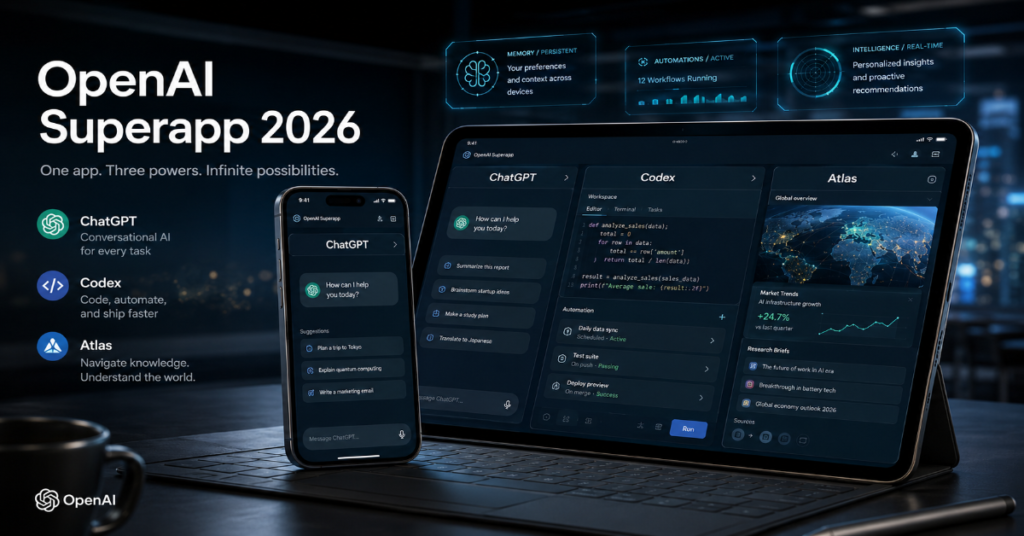
OpenAI’s superapp strategy moved from internal memo to confirmed organisational restructuring on May 15-16, 2026, when the company told employees that co-founder and president Greg Brockman will permanently lead all product strategy — merging ChatGPT, Codex, and the Atlas AI-powered web browser into a single unified organisation under his leadership. The structural overhaul was timed, deliberately or not, three days before Google I/O 2026 opens on May 19 with its own agentic AI agenda, and is being executed with an explicit reference to a prospective initial public offering that analysts expect before the end of 2026. The OpenAI superapp has been in development since an internal memo by Fidji Simo — OpenAI’s CEO of Applications — was reported in March 2026, but the May reorganisation confirms that the plan has moved from strategy to execution. ChatGPT has 900 million weekly active users. Codex is generating just over $1 billion in annualised revenue. Atlas is OpenAI’s AI-native web browser. Bringing all three under one product team under Brockman is OpenAI’s answer to the fragmentation problem that Simo described with the phrase: We realised we were spreading our efforts across too many apps and stacks, and we need to simplify OpenAI superapp ChatGPT Codex Atlas 2026 efforts.
What the Superapp Actually Is — Three Products Becoming One
The superapp’s architecture as reported combines three distinct product surfaces into a unified desktop experience. ChatGPT provides the conversational AI layer and the 900 million user base — the largest consumer AI distribution channel in the world. Codex provides the agentic coding layer; it currently operates as a command centre for managing multiple coding agents, parallel threads, worktrees, skills, automations, and long-running software tasks, and is already used in production engineering workflows at Harvey, Sierra, Ramp, Cisco Meraki, and Duolingo. Atlas provides the AI-native browser layer, enabling agentic web navigation, form completion, research synthesis, and real-time web data access. The integration creates a system where a user can instruct the platform in natural language to complete multi-step digital tasks — research, code deployment, document drafting, scheduling, web navigation — without switching between separate tools. This is the definition of an agentic AI system that operates as a platform rather than a point solution.
The mobile dimension arrived on May 15-16, 2026, when OpenAI simultaneously brought Codex to the ChatGPT mobile app on iOS and Android. According to testing catalogue site TestingCatalog, the Codex mobile preview transforms the phone into a control surface for Codex sessions already running on a laptop, Mac mini, devbox, or remote environment. Developers can start work, inspect active threads, review outputs, approve commands, and follow terminal output, screenshots, diffs, and test results in real time from a phone. Files, credentials, and permissions remain on the machine where Codex is operating — the phone is a management interface, not a compute environment. Remote SSH is now generally available, allowing Codex to connect into approved remote development environments with company dependencies and security policies. Codex is moving from a developer tool tied to a workstation into a long-running agent that can be monitored and directed from anywhere.
“We realized we were spreading our efforts across too many apps and stacks, and that we need to simplify our efforts.” — Fidji Simo, CEO of Applications, OpenAI, internal memo March 2026, cited in WSJ
OpenAI Superapp — Component Comparison
| Component | Current State | Role in Superapp | Weekly / Annual Scale |
| ChatGPT | Conversational AI, separate app | Unified conversational + agentic interface | 900 million weekly active users |
| Codex | Coding agent, separate app | Agentic coding + productivity task layer | $1B+ annualised revenue, 4M weekly users |
| Atlas browser | AI browser, separate app | Web navigation, research, real-time data | Plus/Pro/Business users — no public count |
| Codex Mobile (new) | Mobile preview, iOS + Android | Remote agent management from any device | Rolling out in supported regions |
| Operator (existing) | Computer-use agent | Desktop task automation within unified app | Plus/Pro/Business users |
| Unified superapp | Under development — no launch date | Single agentic platform: chat, code, browse | Target: all 900M ChatGPT users |
The IPO Dimension — Why Product Simplification Is Now a Financial Priority
The timing of the May 15-16 reorganisation — three days before Google I/O — draws the obvious competitive headline. But the more durable driver is the IPO. OpenAI is targeting a public listing as early as Q4 2026. The Wall Street Journal reported in January that the company had begun informal talks with Goldman Sachs, JPMorgan, and Morgan Stanley about advising the offering, with an $852 billion post-money valuation established in the most recent funding round. For any company approaching a public listing, two things suppress a valuation: an unclear product story and visible internal friction. TechTimes reported on May 16 that a prospectus describing three separate product teams competing for compute and headcount invites analysts to discount the multiple. A prospectus describing a single agentic platform with 900 million weekly users and a unified roadmap led by a founding engineer does the opposite. Greg Brockman — co-founder, president, and now permanent product strategy lead — is the narrative anchor for that unified roadmap. The appointment is as much an investor communication as an operational decision.
The competitive pressure from Anthropic is the other half of the context. Decrypt reported that Anthropic’s rise has been described internally as a ‘wake-up call’ — and that employees were told they could not afford ‘side quests,’ a reference to projects consuming resources without sustained impact. Claude Code and Anthropic’s Cowork product have gained significant traction with enterprise and engineering customers, including the migration of significant developer populations away from ChatGPT during the QuitGPT movement that followed OpenAI’s Pentagon AI deal. Anthropic’s revenue run rate exceeded $30 billion in 2026. OpenAI’s response to the enterprise position it has ceded is the superapp: a unified platform that combines consumer scale (900 million ChatGPT users) with agentic coding capability (Codex) and real-time web access (Atlas) into a productivity hub that enterprises cannot easily replicate with point solutions.
“An opportunity to combine the strongest AI consumer app and brand with the strongest agentic app and really leverage our consumer scale to give agentic capabilities to everyone.” — Fidji Simo, CEO of Applications, OpenAI, on the superapp strategy
The Governance Questions — Data Access, Authorization, and the Safety Architecture
An AI system capable of operating a browser, executing code on a user’s behalf, and accessing personal data across applications raises governance questions that OpenAI has acknowledged but not yet fully addressed publicly. TechTimes’ May 16 analysis noted that the desktop application’s defining features — agentic behaviour, built-in browser, code execution layer — create data access and authorisation questions that the company has not yet publicly addressed in detail. These are not hypothetical concerns. An agentic system that can navigate to a user’s banking site, fill out forms, access email drafts, read calendar data, and execute code in a production environment without step-by-step user confirmation at each action is categorically different from a chatbot that answers questions. The GDPR, CCPA, and emerging AI Act obligations that apply to such a system are not yet fully articulated in OpenAI’s public terms.
Google’s comparable Gemini Intelligence announcement for Android — made ahead of Google I/O — explicitly addressed this concern by stating that Gemini will return to the user before completing transactions and that ‘the human is always in the loop.’ Android’s Head of Ecosystem Sameer Samat told CNBC that the transition is ‘from an operating system to an intelligence system’ — the same framing OpenAI is using for the superapp. The difference is that Google has an established mobile OS governance framework; Apple has a privacy architecture; OpenAI is building from scratch on a desktop platform without the regulatory relationships and user trust infrastructure that the incumbents have built over decades. Whether the superapp’s data access architecture matches user expectations and regulatory requirements will be the most consequential product decision OpenAI makes before its IPO.
| Risk Factor | OpenAI Superapp | Google Gemini Intelligence | Apple Intelligence |
| Data governance | Not publicly detailed — in development | Android permissions framework, human-in-loop commits | Private Compute Core, on-device processing |
| Regulatory framework | No established AI Act or GDPR framework | EU Digital Markets Act compliance (Android) | App Store review guidelines, GDPR compliance |
| User trust baseline | 900M ChatGPT users — consumer brand | Android OS trust — 3B+ devices | iPhone — premium privacy brand |
| Enterprise compliance | Enterprise terms under development | Workspace Admin controls, HIPAA possible | Enterprise MDM, HIPAA (iOS) |
| Authorization model | Not publicly specified | Per-transaction user confirmation stated | Per-action biometric/PIN confirmation planned |
“The superapp rollout will be gradual. Codex will expand first to cover productivity tasks beyond coding before ChatGPT and Atlas are folded in.” — TechTimes, citing OpenAI internal communications, May 16, 2026
Key Takeaways
• OpenAI announced on May 15-16, 2026 that co-founder and president Greg Brockman will permanently lead all product strategy, merging ChatGPT (900M weekly users), Codex ($1B+ ARR, 4M weekly users), and the Atlas browser into a single unified organisation and product.
• The unified desktop superapp is designed as an agentic platform — users instruct it in natural language to complete multi-step tasks across chat, coding, web browsing, and document creation without switching applications. No public launch date has been announced.
• Codex launched on ChatGPT mobile (iOS and Android) on May 15-16, allowing developers to manage long-running coding agents from their phones while execution remains tied to laptops or remote environments.
• The reorganisation is timed three days before Google I/O 2026 (May 19), where Google will announce Gemini Intelligence — agentic AI features across Android, Chrome, and Googlebook laptops — representing the same strategic territory.
• The IPO context is explicit: OpenAI is targeting a Q4 2026 public listing at an estimated $852B valuation. A unified product story led by a founding engineer (Brockman) is a cleaner IPO narrative than three separate product organisations competing for resources.
• Data governance, user authorisation architecture, and regulatory compliance for an agentic desktop platform with access to browsers, code execution, and personal data have not been publicly specified — the most significant unresolved risk before the superapp can launch.
Conclusion
OpenAI’s superapp announcement is the company’s most important strategic pivot since the launch of ChatGPT in 2022 — and like that launch, it is happening in public while the product is still being built. The pieces are real: ChatGPT’s 900 million users, Codex’s $1 billion in revenue, Atlas’s browsing capability, and Greg Brockman’s technical credibility as the person who will hold the unified roadmap together. The timing is strategic: Google I/O is four days away, the IPO is three quarters away, and Anthropic has taken meaningful enterprise market share that OpenAI needs to recapture. What is not yet real is the unified product itself. The superapp will roll out gradually, starting with Codex expanding beyond coding before ChatGPT and Atlas are folded in — a timeline with no announced end date. The governance architecture for data access and user authorisation has not been publicly specified. The regulatory framework for an agentic desktop system that operates browsers and executes code on behalf of consumers is uncharted. OpenAI is announcing a direction, not a destination. Whether the destination — a general-purpose agent platform that becomes the primary interface between 900 million people and the digital world — is achievable before the IPO, or before Google’s equivalent reaches its own readiness, will determine whether this is the most important AI product launch since ChatGPT or the most ambitious announced vapourware in recent technology history.
Frequently Asked Questions
What is OpenAI’s superapp?
OpenAI’s superapp is a planned unified desktop platform that combines ChatGPT (conversational AI), Codex (coding agent), and Atlas (AI browser) into a single application. It is designed for agentic AI behaviour — completing multi-step tasks across chat, coding, web navigation, and document creation without the user switching between separate tools. No launch date has been announced.
Why is Greg Brockman taking over OpenAI product strategy?
OpenAI announced on May 15-16, 2026 that co-founder and president Greg Brockman will permanently lead all product strategy. Previously, Fidji Simo held the applications leadership role; she originated the superapp strategy in a March 2026 internal memo. Brockman’s appointment provides founding engineer credibility for the technical and IPO narrative, and consolidates product authority under one leader as the unified superapp enters execution.
Is Codex now available on mobile?
Yes — Codex launched on ChatGPT mobile for iOS and Android in preview on May 15-16, 2026. The mobile app serves as a management interface for Codex sessions running on a laptop, Mac mini, or remote environment. Developers can review outputs, approve commands, inspect threads, and monitor terminal output from their phone. Files, credentials, and compute remain on the machine; the phone is a control surface, not an execution environment.
How does the OpenAI superapp compete with Google Gemini?
Both are building agentic AI platforms that complete multi-step tasks across applications. Google’s Gemini Intelligence (announced at Android Show, May 12; Google I/O, May 19) is embedded in Android OS, Chrome, and Googlebook laptops — leveraging existing OS governance and hardware trust. OpenAI’s superapp is a cross-platform desktop application built around ChatGPT’s user base. Google has device-level integration advantages; OpenAI has a larger established user base and stronger coding agent capability.
What does the superapp mean for OpenAI’s IPO?
OpenAI is targeting a Q4 2026 public listing at an estimated $852 billion post-money valuation. A prospectus describing a unified agentic platform with 900 million weekly users, $1B+ in Codex revenue, and a single product roadmap under co-founder Greg Brockman is a stronger IPO story than three separate product organisations with unclear integration timelines. The superapp announcement is as much an investor narrative management exercise as a product decision.
References
TechTimes. (2026, May 16). OpenAI unifies ChatGPT, Codex, and developer API under co-founder Brockman four days before Google I/O. https://www.techtimes.com/articles/316730/20260516/openai-unifies-chatgpt-codex-developer-api-under-co-founder-brockman-four-days-before-google-i-o.htm
TestingCatalog. (2026, May 16). OpenAI brings Codex to ChatGPT mobile app for iOS and Android. https://www.testingcatalog.com/openai-brings-codex-to-chatgpt-mobile-app-for-ios-and-android/
Decrypt. (2026, March 20). OpenAI plans to merge ChatGPT, Codex and Atlas into one superapp: WSJ. https://decrypt.co/361925/openai-superapp-chatgpt-codex-atlas-merger-anthropic
ALM Corp. (2026, March 21). OpenAI’s desktop superapp: ChatGPT, Codex, and the Atlas browser are merging. https://almcorp.com/blog/openai-desktop-superapp-chatgpt-codex-atlas-browser/
XDA Developers. (2026, March 20). OpenAI is merging ChatGPT, Codex, and its browser into one superapp. https://www.xda-developers.com/openai-is-merging-chatgpt-codex-and-its-browser-into-one-superapp
eWeek. (2026, May 16). OpenAI launches Codex in ChatGPT mobile for its 4M weekly users. https://www.eweek.com/news/openai-codex-mobile-chatgpt-app/
Bitget News. (2026, May). OpenAI is restructuring to merge the ChatGPT and Codex teams. https://www.bitget.com/news/detail/12560605414578
