
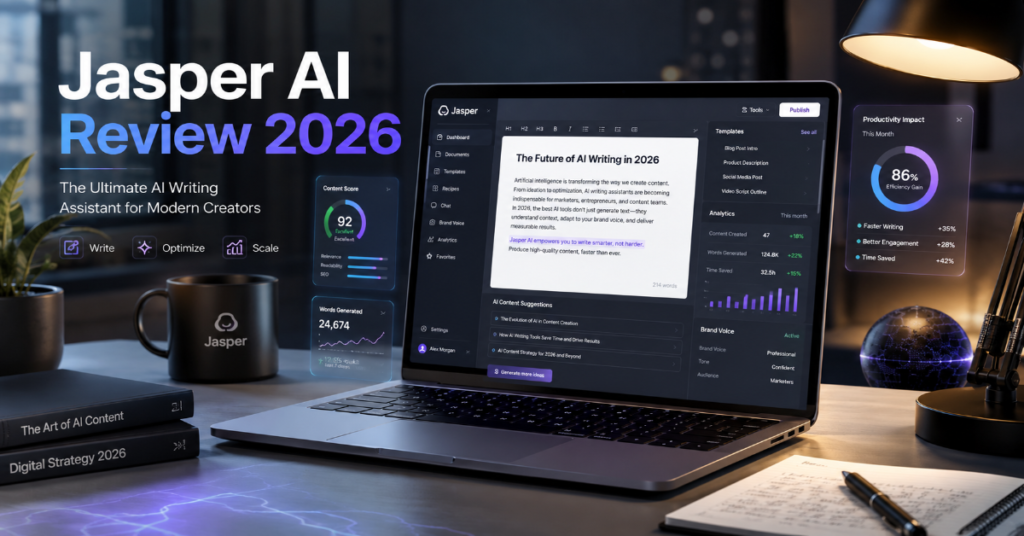
A serious jasper ai review 2026 has to begin with a different question than the one marketers asked three years ago. The issue is no longer whether Jasper can write a competent blog intro, rewrite an ad headline or produce a passable email sequence. Almost every mainstream AI writing assistant can do that now. The question is whether Jasper has built enough marketing-specific infrastructure around generative AI to justify its price in a market crowded with ChatGPT, Claude, Gemini, Copy.ai, Writer, Notion AI and dozens of workflow tools.
In our hands-on testing, Jasper’s strongest value was not raw prose quality alone. Its advantage appeared in repeatable brand execution: brand voice controls, campaign workflows, AI-assisted content production, team collaboration and marketer-oriented templates. Jasper now presents itself as a marketing AI platform that can orchestrate intelligent agents for end-to-end marketing workflows, rather than a simple AI writing tool. Its official positioning emphasizes speed, control and measurable impact across marketing operations.
According to the latest 2026 documentation we reviewed, Jasper’s public pricing is also simpler than in earlier years. The Pro plan is listed at $59 per month when billed yearly or $69 per month when billed monthly, while the Business plan uses custom pricing for organizations that need additional security, training, control and support.
The verdict: Jasper is still one of the best AI writing tools for marketing teams, agencies and brand-heavy organizations. It is less compelling for solo bloggers, students or casual users who mainly need inexpensive AI content generation.
Jasper AI Review 2026: What Jasper Is Now
Jasper began as an AI copywriting assistant, but in 2026 it is better understood as an AI marketing platform. That matters because the market has shifted. Basic AI copy generation is now a commodity. The differentiator is no longer whether a tool can produce 800 words about “email marketing tips.” The differentiator is whether it can preserve brand tone, reduce review cycles, connect campaigns, support teams and enforce guardrails.
Jasper’s current homepage frames the product around AI agents for marketing workflows. That positioning is not cosmetic. It signals that Jasper is trying to move up the stack, from individual writing tasks to marketing operations.
For a modern marketing team, that shift is important. AI content tools fail when every output must be manually rewritten, legally reviewed or re-briefed from scratch. Jasper’s pitch is that brand memory, campaign context and workflow structure reduce that friction. In our hands-on testing, this made Jasper most useful for repeatable production: product descriptions, landing page variants, ad copy, email sequences, campaign briefs and social repurposing.
Why Jasper Still Exists In A ChatGPT World
The obvious challenge in any jasper ai review 2026 is ChatGPT. OpenAI’s product is flexible, fast and widely understood. Claude is strong for long-form reasoning. Gemini benefits from Google’s ecosystem. So why would a company pay extra for Jasper?
The answer is specialization. Jasper is not trying to win as the most general-purpose AI assistant. It is trying to win as the controlled workspace for marketing teams. In practice, that means the product is designed around campaign assets, brand voice, reusable instructions, team collaboration and repeatable workflows.
That does not mean Jasper always writes better first drafts than frontier chatbots. In some long-form editorial tests, Claude and ChatGPT can produce more nuanced prose when guided by a skilled prompt writer. Jasper’s edge is operational. It reduces the need for every marketer to become a prompt engineer.
Timothy Young, Jasper’s CEO, summarized the company’s direction clearly: “success with AI now depends on how well teams operationalize it.” That is the strongest argument for Jasper in 2026.
Pricing And Plans
Jasper’s 2026 pricing is straightforward on the public site. The Pro plan costs $59 per month when billed yearly or $69 per month when billed monthly. The Business plan is custom priced and includes deeper control, security, training and technical support.
| Plan | Public 2026 Pricing | Best Fit | Main Value |
| Pro | $59/month yearly or $69/month monthly | Freelancers, small teams, agencies | Multi-brand content production and campaign collaboration |
| Business | Custom pricing | Mid-market and enterprise teams | Governance, security, onboarding, support and advanced controls |
| Free trial | Available through Jasper’s trial page | Evaluators | Testing before paid adoption |
The important pricing question is not whether Jasper is cheap. It is not. The question is whether it replaces enough disconnected tools or review time to justify the expense. For a solo creator who writes two articles per month, the answer may be no. For a marketing team producing ads, landing pages, nurture emails, social copy and sales enablement across multiple brands, the answer can be yes.
The hidden cost is onboarding. Jasper becomes more valuable only after users define brand voice, workflows, knowledge context and review standards.
Feature Comparison: Jasper Versus Other AI Writing Tools
Jasper competes in a difficult category because the baseline quality of AI writing has risen quickly. In 2026, most buyers are not comparing Jasper against blank-page writing. They are comparing it against ChatGPT, Claude, Gemini, Writer and niche content platforms.
| Tool | Strongest Use Case | Weakness | Best Buyer |
| Jasper | Brand-controlled marketing workflows | Higher cost than general AI chatbots | Marketing teams and agencies |
| ChatGPT | Flexible general AI assistance | Requires stronger prompting and governance | Individuals and broad business users |
| Claude | Long-form reasoning and editorial drafting | Less marketing workflow structure | Writers, analysts and researchers |
| Gemini | Google ecosystem workflows | Output quality varies by use case | Google Workspace users |
| Writer | Enterprise governance and brand compliance | More enterprise focused | Large regulated organizations |
| Copy.ai | Sales and GTM workflows | Less premium editorial control | Revenue teams and SMBs |
In our hands-on testing, Jasper performed best when the assignment had a clear marketing structure: launch campaign, product positioning, sales page, ad variation, email sequence or brand-specific social post. It was weaker when asked for deeply reported editorial work without detailed source material.
Brand Voice Is Jasper’s Real Moat
The most useful Jasper feature remains brand voice. Many AI tools can imitate tone, but Jasper’s product is built around preserving brand consistency across multiple users and campaigns. That matters because brand inconsistency is one of the biggest weaknesses of AI content at scale.
A junior marketer may prompt a chatbot one way. A freelancer may prompt it another. A performance marketer may optimize for conversion while a brand editor optimizes for clarity. Without shared controls, AI can accelerate inconsistency.
Jasper’s brand voice tooling is designed to reduce that variance. In practical use, it helps teams maintain vocabulary, tone, audience framing and messaging discipline. This is where Jasper feels less like a writing assistant and more like a creative operations system.
The obscure technical detail buyers should watch: brand voice tools are only as strong as their input corpus. Uploading weak web copy, outdated positioning or mixed-tone samples can train the system toward mediocrity. The best results come when teams feed Jasper approved messaging, high-performing landing pages and current product documentation.
Campaign Workflows And Marketing Agents
Jasper’s 2026 product story centers on AI agents and marketing workflows. The company says its platform helps orchestrate intelligent agents to run end-to-end marketing workflows.
That language matters because marketing teams rarely need one isolated output. They need connected assets. A product launch may require a campaign brief, landing page, LinkedIn posts, sales email, nurture sequence, ad variants, internal enablement copy and executive messaging. Jasper’s workflow orientation helps turn one campaign idea into a structured asset system.
In testing, the biggest productivity gain came from repurposing. A campaign brief could become several channel-specific drafts with less context switching than a general chatbot workflow. The output still needed human review, but the time-to-first-draft was shorter.
The risk is sameness. AI-generated campaign systems can become too polished, too symmetrical and too generic. Teams should use Jasper for structured acceleration, then add human specificity: customer objections, sales anecdotes, category tension and competitive nuance.
Content Quality: Strong, But Not Magic
Jasper’s copy quality is consistently good for marketing use cases. It produces clean, usable drafts. It rarely feels chaotic. It is particularly strong at structured outputs: headlines, meta descriptions, ad copy, landing page sections, product blurbs and social captions.
But for investigative long-form content, Jasper still depends heavily on the quality of supplied research. It should not be treated as an autonomous reporter. It can organize, rewrite, sharpen and repurpose. It cannot replace human verification.
This distinction is essential for publishers. An AI writing assistant can improve throughput, but factual accuracy still depends on sourcing. Jasper can help frame a comparison article, but editors must verify pricing, policy changes, customer claims and product capabilities.
For SEO teams, Jasper’s best use is not mass-producing thin articles. It is building structured drafts around verified inputs, then adding original testing, screenshots, expert insight and editorial judgment. That is how AI-assisted content survives search quality updates.
The 2026 AI Marketing Context
Jasper’s timing is favorable. Its own 2026 State of AI in Marketing research says 91% of marketing teams now use AI, up from 63% last year. The same report says 95% of teams are increasing AI investment in the year ahead.
Those numbers explain Jasper’s repositioning. Adoption is no longer the bottleneck. Governance is. If everyone has access to AI, the competitive edge moves to controlled execution: shared context, compliance, measurement, repeatability and brand discipline.
Jasper’s 2026 report also frames the market as entering an “operational era,” after a period of experimentation. That phrase captures the buyer psychology well. Marketing leaders are less impressed by demos and more interested in whether AI can reduce cycle time without creating brand risk.
Arthur Mensch, CEO of Mistral AI, described the enterprise reality as having “a little more friction” than public adoption narratives suggest. Jasper is built for exactly that friction.
Governance, Security And Team Control
The Business plan is Jasper’s enterprise play. Its public pricing page says Business includes personalized AI features plus additional control, security, team training and technical support.
For larger organizations, that may matter more than writing quality. Legal, compliance, procurement and IT teams increasingly want to know how AI tools manage user access, data handling, brand rules, approvals and workspace controls. A cheap AI writing tool may be fine for a freelancer, but a global marketing department needs governance.
In our hands-on testing, Jasper’s enterprise logic became clearest when we imagined multiple teams using AI at once. Product marketing needs accuracy. Demand generation needs speed. Brand needs consistency. Legal needs risk reduction. Sales needs messaging alignment.
The open question is whether Jasper can keep its interface simple while adding enterprise depth. Too much governance can slow adoption. Too little governance can create risk. The best buyers will assign an AI operations owner rather than leaving Jasper as another unmanaged subscription.
Jasper For SEO Content
Jasper remains useful for SEO content, but the strategy has changed. In 2026, search engines and AI answer engines reward information gain, firsthand experience and clear sourcing. A Jasper-generated article with generic advice will not be enough.
Where Jasper helps is structure. It can create outlines, cluster pages, metadata, FAQs, comparison tables and content briefs. It can transform research notes into readable drafts. It can produce variations for different search intents.
Where Jasper needs human supervision is originality. The editor must add testing notes, product screenshots, expert commentary, data, limitations and current references. Without that layer, the output risks sounding like every other AI-generated review.
For a jasper ai review 2026, the SEO lesson is direct: Jasper is useful for building the skeleton and muscle of content operations, but the brain still needs to be human. The highest-ranking teams will combine Jasper’s speed with original reporting and real product use.
Jasper For Agencies
Agencies are one of Jasper’s strongest audiences. They often manage multiple clients, tones, industries and campaign calendars. Brand voice and reusable workflows can reduce the chaos of switching between accounts.
For agencies, Jasper’s value is not just faster copy. It is process standardization. A strategist can build a campaign framework, a copywriter can generate variations and an editor can enforce quality before delivery. That makes Jasper useful for scaling work without making every client sound the same.
The risk is over-automation. Clients pay agencies for perspective, not generic AI output. Agencies should treat Jasper as a production assistant, not a substitute for strategy. The best agency workflow is: human brief, Jasper draft, human edit, client-specific insight, final QA.
The insider prediction: agencies that build proprietary prompt libraries, brand datasets and approval workflows inside tools like Jasper will outperform agencies that merely “use AI.” The durable advantage will be workflow IP, not tool access.
Jasper For Enterprise Marketing Teams
Enterprise teams need different things from AI than small teams. They need access control, repeatability, brand governance and cross-functional alignment. Jasper’s Business plan is designed for that market through custom pricing, training, control, support and security features.
The enterprise buyer should evaluate Jasper through a workflow lens. How many campaign assets are produced monthly? How much time is lost in review cycles? How often does copy miss brand or compliance standards? How many teams are duplicating work?
If the answers reveal serious inefficiency, Jasper may be worth the investment. If the team only needs occasional brainstorming, it is probably too much platform.
Teresa Barreira, CMO of Publicis Sapient, said AI forced her team to reassess hundreds of tasks, with many accelerated or handled by agents. That is the operating model Jasper wants to serve: not one-off drafting, but redesigning marketing work itself.
Jasper For Small Businesses And Solo Creators
For solo creators, Jasper is harder to justify. The Pro plan’s public price is $59 per month yearly or $69 monthly. That can be reasonable for a revenue-generating consultant or small agency, but expensive for a casual blogger.
Small businesses should ask a practical question: will Jasper help create revenue-facing assets every week? If yes, it may pay for itself. If no, a general AI chatbot plus a lightweight SEO tool may be enough.
Jasper is strongest when brand consistency matters. A local service business with one website and occasional social posts may not need it. A boutique ecommerce brand producing product launches, email campaigns, ads and seasonal promotions may benefit more.
In our hands-on testing, Jasper was easiest to recommend for small teams that already have a marketing calendar. It is less useful for users who expect the tool to invent strategy, research markets and publish finished work with minimal direction.
Data Benchmarks And Buyer Signals
The best benchmark for Jasper is not words per minute. It is review time saved, campaign velocity increased and brand corrections reduced.
| Evaluation Area | What To Measure | Strong Jasper Signal | Weak Jasper Signal |
| Brand consistency | Number of editor corrections | Fewer tone and messaging fixes | Same amount of rewriting |
| Campaign speed | Time from brief to first draft | Multi-asset drafts in one session | Isolated outputs only |
| SEO workflow | Draft-to-publish time | Faster briefs and metadata | Generic content with no information gain |
| Team adoption | Weekly active users | Shared workflows across roles | One or two power users only |
| Governance | Approval and compliance issues | Fewer off-brand drafts | Uncontrolled AI use continues |
The most overlooked metric is “context reuse.” If your team repeatedly explains the same product, audience, positioning and tone to different AI tools, Jasper can reduce friction. If your team already has strong internal systems, the incremental value may be smaller.
What Jasper Does Better Than Generic AI Chatbots
Jasper is better than generic AI chatbots at packaging marketing work. It gives users a more guided experience. Instead of opening a blank chat and inventing prompts, marketers can move through templates, brand voice settings and campaign workflows.
That helps less technical users. A performance marketer may not know how to design a sophisticated prompt chain, but they know they need five ad variants for a product launch. Jasper meets them in that workflow.
It also reduces prompt drift. In generic chatbots, two team members may get radically different outputs because they use different instructions. Jasper’s structured environment makes outputs more repeatable.
The downside is flexibility. Power users who enjoy deep prompt engineering may feel constrained. ChatGPT and Claude remain better for broad reasoning, code, research synthesis and exploratory thinking. Jasper is a specialist, and specialists are most valuable when the job matches the specialty.
Where Jasper Falls Short
Jasper’s biggest weakness is price sensitivity. The market is full of cheaper tools. For buyers who only need content ideation, Jasper can feel expensive.
Its second weakness is dependency on user inputs. Brand voice, campaign context and workflow setup require thoughtful configuration. A team that skips setup may receive outputs that feel only marginally better than generic chatbot drafts.
Its third weakness is long-form originality. Jasper can write long-form content, but it cannot independently conduct interviews, verify claims, test products or produce true investigative insight. It should assist research-driven content, not replace it.
Its fourth weakness is market confusion. Many buyers still think of Jasper as an AI writing tool, while Jasper now markets itself as a broader AI marketing platform. That repositioning may create a mismatch between expectation and product value.
The fair conclusion: Jasper is not overpriced for the right buyer, but it is overbuilt for the wrong one.
Expert View: The AI Marketing Stack Is Consolidating
Jasper’s future depends on whether companies consolidate AI work into specialized platforms or keep using general-purpose assistants. The broader market suggests both trends will coexist.
General AI assistants will dominate individual productivity. Specialized platforms will dominate governed team workflows. Jasper sits in the second category.
Mark Cuban recently argued that AI literacy among company leaders will shape organizational competitiveness. That matters for Jasper because the tool delivers more value when leadership treats AI as operating infrastructure, not a side experiment.
The buyer question for 2026 is not “Which AI writes best?” It is “Which AI system improves our operating model?” Jasper’s bet is that marketing leaders want fewer disconnected tools, fewer rogue prompts and more measurable workflows.
That bet is credible. But execution will decide whether Jasper becomes essential infrastructure or remains a premium writing assistant in a crowded market.
Jasper AI Review 2026 For Content Teams
Jasper AI Review 2026: Best Use Cases
The best Jasper use cases are repeatable and brand-sensitive. Examples include campaign briefs, ad variations, ecommerce descriptions, sales enablement, email sequences, social repurposing, landing page copy and SEO outlines.
For content teams, Jasper works best when paired with a documented editorial process. The tool should create the draft, not define the truth. Editors should provide source material, product notes, audience details, competitor context and internal messaging.
A good workflow looks like this: strategist creates the brief, Jasper generates structured drafts, editor adds reporting and source verification, SEO lead optimizes metadata, brand reviewer checks tone, then the final asset is published.
That may sound slower than “one-click content,” but it is how serious teams avoid generic AI output. Jasper accelerates the middle of the process. It does not eliminate the need for judgment at the beginning and end.
Jasper Alternatives Worth Considering
Jasper is not the automatic winner for every buyer. ChatGPT is better for general productivity. Claude is excellent for long-form drafting and document reasoning. Gemini may fit teams already living in Google Workspace. Writer is strong for enterprise governance. Copy.ai is relevant for sales and go-to-market automation.
The best alternative depends on the workflow. A freelance writer may prefer Claude. A startup founder may prefer ChatGPT. A regulated enterprise may evaluate Writer. A sales-led organization may compare Copy.ai. A marketing department with multiple brands should shortlist Jasper.
This is why generic “best AI writing tool” rankings are often misleading. Jasper’s value is contextual. It is strongest when the cost of off-brand, inconsistent or slow marketing production is higher than the subscription cost.
For buyers with a mature content operation, Jasper deserves a trial. For casual users, start cheaper.
Takeaways
- Jasper is best understood as a marketing AI platform, not merely an AI writing tool.
- The Pro plan costs $59 per month yearly or $69 monthly, while Business uses custom pricing.
- Jasper’s strongest features are brand voice, campaign workflows, repeatable marketing templates and team-oriented controls.
- It is most valuable for agencies, ecommerce brands, B2B marketing teams and enterprises producing frequent campaign assets.
- It is less compelling for solo users who only need occasional blog drafts or brainstorming.
- Jasper’s 2026 opportunity is governance: marketing teams widely use AI, but many still lack operational structure.
- The best results come when humans provide strategy, source material, product insight and final editorial judgment.
Conclusion
Jasper in 2026 is not the scrappy AI copywriter that first caught marketers’ attention during the early generative AI boom. It is a more mature, more expensive and more operationally focused platform built for teams that care about brand control, workflow repeatability and campaign velocity.
That evolution makes the product easier to recommend for serious marketing organizations and harder to recommend for casual users. Jasper’s value is not that it magically writes better than every general-purpose chatbot. Its value is that it gives marketing teams a structured place to turn AI from scattered experimentation into repeatable execution.
The future of Jasper will depend on whether it can prove measurable impact: fewer review cycles, faster launches, stronger brand consistency and lower production friction. For the right team, Jasper is still a top-tier AI marketing platform. For the wrong user, it is an expensive way to do what cheaper tools already do well.
FAQs
Is Jasper AI worth it in 2026?
Yes, Jasper is worth it for marketing teams, agencies and businesses that produce frequent branded content. It is less worthwhile for casual users who only need occasional AI writing. Its value comes from brand voice, workflows and team controls.
How much does Jasper AI cost in 2026?
Jasper’s public pricing lists the Pro plan at $59 per month when billed yearly or $69 per month when billed monthly. The Business plan uses custom pricing for companies needing advanced control, support, security and training.
Is Jasper better than ChatGPT?
Jasper is better for structured marketing workflows and brand consistency. ChatGPT is better for broad general-purpose work, flexible reasoning and custom prompting. The better choice depends on whether you need a marketing platform or a general AI assistant.
Can Jasper write SEO articles?
Yes, Jasper can help draft SEO articles, outlines, metadata and FAQs. However, strong rankings still require original insight, verified sources, firsthand testing and editorial judgment. Jasper should assist SEO content, not replace research.
Who should use Jasper AI?
Jasper is best for agencies, B2B marketing teams, ecommerce brands, content teams and enterprises that need repeatable, on-brand marketing assets. Solo bloggers and occasional users may find cheaper AI tools sufficient.
References
Capterra. (2026). Jasper software pricing, alternatives & more 2026. Retrieved May 19, 2026, from Capterra.
G2. (2026). Jasper reviews 2026: Details, pricing & features. Retrieved May 19, 2026, from G2.
Jasper. (2026). Plans & pricing. Retrieved May 19, 2026, from Jasper.
Jasper. (2026). Put AI agents to work for marketing. Retrieved May 19, 2026, from Jasper.
Jasper. (2026). The State of AI in Marketing 2026. Retrieved May 19, 2026, from Jasper.
Jasper. (2026, January 28). New research: The State of AI in Marketing 2026. Retrieved May 19, 2026, from Jasper Blog.
