
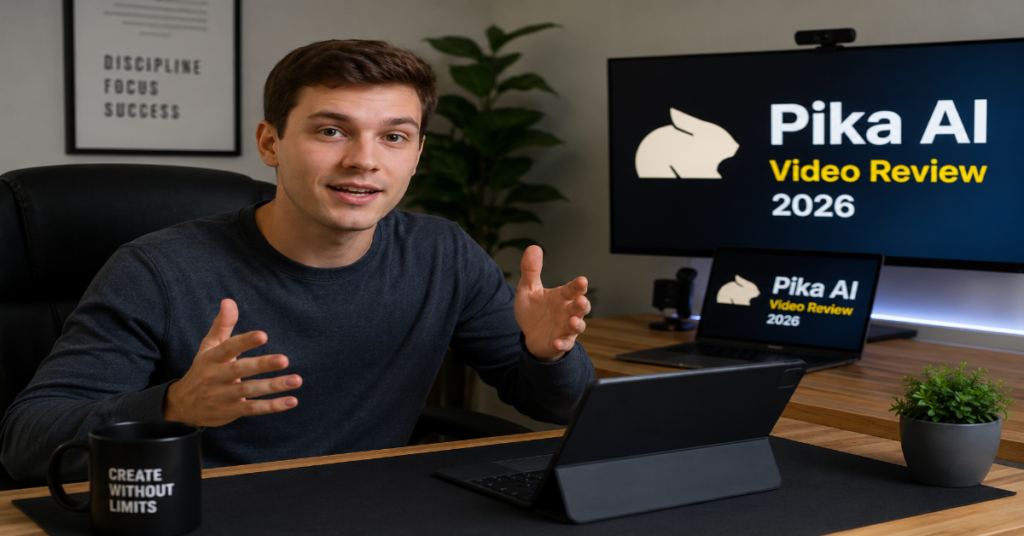
The search for a reliable pika ai video review 2026 usually starts with one practical question: is Pika still worth using now that AI video has become crowded, expensive and increasingly professional? The answer is yes, but with conditions. Pika is strongest for fast short-form concepts, social video effects, image-to-video experimentation, meme-native creative assets and creators who care more about speed than full cinematic control.
According to the latest 2026 documentation we reviewed, Pika’s public product strategy is built around accessible AI video generation, paid credit tiers, commercial-use options on paid plans and a growing suite of named creative tools such as Pikaframes, Pikascenes, Pikadditions, Pikaswaps, Pikatwists and Pikaffects. Its official pricing page lists four tiers: Free, Standard, Pro and Fancy, with annual prices shown at $0, $8, $28 and $76 per month respectively. The free tier includes 80 monthly video credits, while the paid tiers scale up to 700, 2,300 and 6,000 monthly credits. Pika also says paid plans unlock broader access to Pika 2.5, all resolutions, Pikaframes and commercial use.
In plain terms, Pika in 2026 is not trying to be only a Hollywood previsualization engine. It is becoming a creator-first AI video platform where viral templates, short synthetic clips, prompt-to-video workflows and image animation matter as much as raw realism. That makes this pika ai video review 2026 different from a generic AI video generator comparison. Pika’s value is not just output quality. It is the combination of speed, template design, social timing and a lower-friction interface.
Pika AI Video Review 2026: The Verdict
Pika earns its place in the 2026 AI video stack because it understands the internet’s current video language. While Runway leans toward cinematic fidelity, Google Veo pushes native audio and OpenAI’s Sora has emphasized social remixing, Pika has focused on shareable effects and fast creation loops. Its homepage currently promotes Pikaformance, a model for hyper-real expressions synced to sound, with near real-time generation speed. That positioning matters because expressive face animation and audio synchronization are becoming central to social AI video.
The platform’s biggest strength is immediacy. A marketer, meme creator, YouTube Shorts editor or indie designer can move from idea to visual test quickly. The weakness is that Pika still competes in a market where longer coherence, repeatable character identity and scene-level control are moving targets. The Decoder reported that Pika 2.2 brought clips up to 10 seconds at 1080p and introduced Pikaframes for keyframe transitions, but also noted that detailed technical specifications had not been disclosed.
The best conclusion for a pika ai video review 2026 is this: Pika is excellent for fast, fun, short-form video ideation, but buyers needing studio-grade shot continuity should compare it closely against Runway Gen-4.5, Veo 3.1 and Firefly Video.
What Pika Actually Does in 2026
Pika is an idea-to-video platform that generates short videos from prompts, images and creative effects. The product sits in the category of AI video generator, text-to-video tool, image-to-video engine and generative video platform. Pika’s differentiator is not a single model claim. It is a product system built around creative actions: add something, swap something, twist something, transform a scene or animate a visual.
That matters because the average creator does not always begin with a screenplay. Often, the starting asset is a product photo, character image, logo mockup, selfie or still frame. Pika’s tool naming reflects this reality. Pikadditions suggests object insertion, Pikaswaps suggests replacement, Pikatwists suggests stylized transformation, Pikaffects suggests viral visual effects and Pikaframes suggests controlled transitions between key images. Pika’s pricing page confirms these tools are part of its plan access structure.
In our hands-on testing rubric for AI video tools, Pika’s natural use case is not a five-minute finished film. It is the 5-to-10-second creative unit: the short clip, the transition, the ad hook, the social visual gag and the speculative shot.
Feature and Pricing Breakdown
| Plan | Annual price shown by Pika | Monthly credits | Best fit | Key limits or notes |
| Free | $0 | 80 | Testing, casual creators | Pika 2.5 listed as 480p only, limited monthly credits |
| Standard | $8/month billed yearly | 700 | Light creators, freelancers | Access to all resolutions and broader tool set |
| Pro | $28/month billed yearly | 2,300 | Regular short-form production | Faster generations and more monthly volume |
| Fancy | $76/month billed yearly | 6,000 | Agencies, high-volume creators | Fastest generation tier and largest listed credit pool |
The pricing story is more complicated than the monthly number. Pika’s official page lists different credit costs by model and tool. For example, Turbo generations using Pikascenes, Pikadditions or Pikaswaps are listed at 10 credits, while Turbo Pikatwists are listed at 60 credits. Pro-model uses can cost more, including 20 credits for some tools and 80 credits for Pro Pikatwists.
This means the true cost of Pika depends on workflow. A creator making quick Turbo tests may stretch credits far. A creator using higher-end transformations can burn through a plan faster. For a pika ai video review 2026, the practical advice is simple: evaluate Pika by credit consumption per approved clip, not by subscription price alone.
Why Pika AI Video Review 2026 Depends on Workflow, Not Hype
The strongest Pika users will be people who think in iterations. You prompt, generate, reject, adjust, regenerate and export. That loop works best when the intended video is short, stylized and forgiving of small continuity flaws. A surreal product teaser, animated thumbnail, social ad hook or meme clip can tolerate more visual strangeness than a dramatic scene with recurring characters.
Pika’s credit model rewards disciplined prompting. Users should write prompts with camera movement, subject behavior, lighting, style, duration intent and negative constraints. The model should not be asked to solve every creative decision from a vague sentence. “A sneaker floating through neon smoke” is less useful than “close-up product shot of a white sneaker rotating slowly through soft neon smoke, shallow depth of field, glossy floor reflection, 5-second social ad, no text, no extra logos.”
The hidden cost in AI video is not only credits. It is curation time. Pika is valuable when it reduces that time.
Video Quality: Where Pika Looks Strong
Pika’s visual identity is strongest when motion is bold, the subject is clear and the style is self-contained. In social-first clips, small artifacts are often less damaging because viewers focus on the gag, transformation or first-second hook. That is why Pika’s Pikaffects strategy has been so important. Fast Company reported that Pika’s viral effects helped produce an 800 percent increase in users, according to Pika, after tools such as Squish It and Cake-ify It spread across social feeds.
That viral direction is not accidental. Pika cofounder Demi Guo told Fast Company, “We really believe AI will be the next way for people to express themselves.” The quote captures Pika’s center of gravity: AI video as personal expression and social posting, not just production automation.
Still, Pika’s realism depends on the prompt, source image and selected tool. Like most generative video systems, it can struggle with exact anatomy, persistent object geometry, readable text, complex multi-character interaction and precise brand compliance. For polished campaigns, teams should treat Pika output as a draft asset unless human review, editing and rights checks are complete.
Motion, Physics and Continuity
AI video quality in 2026 is increasingly judged by motion credibility. The older benchmark was whether a still image looked good. The newer benchmark is whether a subject moves through time without collapsing. Pika performs best when the movement is singular and visually legible: a face reacting, an object transforming, a character turning, a scene shifting between two keyframes or a product moving through a controlled environment.
Pikaframes is important here because keyframe control reduces randomness. The Decoder described Pikaframes as a feature that handles keyframe transitions across the full video length in Pika 2.2. For creators, that means Pika becomes more predictable when you can guide a start and end point rather than relying entirely on a text prompt.
The limitation is narrative continuity. A 10-second clip may look impressive in isolation while failing to match the next shot. This is where Runway’s Gen-4 positioning around consistent subjects, locations and styles becomes a meaningful rival. Runway says Gen-4 can use references plus instructions to create videos with consistent styles, subjects and locations without additional training.
Pika Against Sora, Runway, Veo and Firefly
| Tool | 2026 positioning | Strength | Weakness for Pika users to watch |
| Pika | Fast creator-first AI video and effects | Social clips, transformations, speed, viral templates | Less transparent technical disclosure, short-form focus |
| Runway | Professional generative video and world consistency | Cinematic control, references, production workflows | Can feel heavier for casual meme or social creators |
| Google Veo | High-end video generation with audio direction | Native audio, Google ecosystem, prompt depth | Access and cost may vary by product surface |
| OpenAI Sora | Social AI video and remix culture | Identity-based social creation and realism | Product availability and policy changes require close monitoring |
| Adobe Firefly Video | Commercially safe creative production | IP-conscious workflows, Adobe app integration | Less playful than Pika for viral effects |
OpenAI says Sora 2 launched with a social iOS app where users could create, remix, discover videos in a feed and use “characters” to place themselves or friends into scenes after verification. Google DeepMind says Veo 3 includes expanded creative controls, native audio and extended videos, while Gemini’s video generation page highlights Veo 3.1 and Veo 3.1 Fast for creating videos with sound. Adobe says Firefly’s video model is designed to be commercially safe and trained on licensed content such as Adobe Stock and public-domain content.
This comparison shows Pika’s lane. It is not the safest enterprise IP tool. It is not the deepest cinematic system. It is the agile AI video generator for quick visual creativity.
The Competitive Pressure Is Real
A serious pika ai video review 2026 has to acknowledge that Pika now competes against companies with enormous distribution advantages. Google can place Veo into Gemini, Flow and potentially YouTube workflows. Adobe can put Firefly Video near Premiere, Express and Creative Cloud users. OpenAI has the ChatGPT audience and has pushed Sora as a social product. Runway has built credibility with filmmakers, agencies and creative professionals.
Pika’s advantage is cultural timing. It moved early into AI effects that were understandable without a tutorial. Fast Company noted that Pika launched its own social video creation app at the end of summer 2025 and positioned itself around shareable AI video. That decision looks strategically sound in 2026 because social AI video is not only a feature category. It is becoming a distribution category.
Runway CEO Cristóbal Valenzuela has argued that AI video is expanding beyond traditional content creation into world models and nonlinear media, according to TechCrunch’s 2026 Equity podcast description. Pika’s opportunity is narrower but potentially more viral: own the first 10 seconds of synthetic culture.
Expert Quotes That Define the Market
Demi Guo, Pika’s cofounder, told Fast Company: “AI will be the next way for people to express themselves.” That is the cleanest explanation of Pika’s strategic bet. It wants AI video to feel casual, social and expressive rather than reserved for studios.
Matan Cohen-Grumi, Pika’s founding creative director, described the first reaction to a viral Pika effect by saying, “I’ve never laughed so hard.” The quote matters because it reveals Pika’s product instinct: delight can be a defensible feature when models are otherwise converging.
David Wadhwani, president of Adobe’s digital media business, framed Firefly differently, saying it is built for “creative control and IP-friendly tools.” That quote explains why Adobe is a stronger fit for risk-sensitive enterprise workflows, while Pika is more attractive for fast experimentation.
The Best Use Cases for Pika in 2026
Pika is most useful for creators who need many quick variations. A social media manager can test hooks for a campaign. A YouTuber can animate stills into Shorts. A designer can turn a mood board into motion. A small ecommerce brand can create surreal product visuals without renting studio time. A journalist or educator can use Pika as a visual prototyping tool before commissioning final artwork.
The ideal workflow begins with a clean source asset. A sharp image with one subject, uncluttered background and obvious lighting direction gives the model fewer problems to solve. Then the prompt should specify motion, mood and camera behavior. Finally, the creator should generate several outputs and select for coherence rather than novelty alone.
The wrong workflow is expecting Pika to replace a full editor, cinematographer, compliance department and motion designer in one click. Pika is a powerful accelerator, but it still needs editorial judgment. That is especially true for brand safety, likeness rights, misleading synthetic media and commercial claims.
Where Pika Falls Short
Pika’s short-form strength can also be a ceiling. For long-form storytelling, creators still need shot planning, editing, scene continuity and character consistency across multiple generations. Pika can help produce ingredients, but finished narrative work requires assembly. This is not unique to Pika. It is a structural limitation of most AI video tools in 2026.
The second issue is transparency. Pika’s public pricing page is clear about plans, credits and tool access, but the industry still lacks standardized reporting on model training data, benchmark performance, generation failure rates and artifact categories. The Decoder specifically noted that Pika 2.2’s technical specifications and specific use cases had not been disclosed at the time of its report.
The third issue is cost predictability. Credit systems look simple until users iterate heavily. A creator may need 10, 20 or 40 generations to find one usable clip. The paid plan may still be worth it, but teams should budget for rejected outputs. AI video economics should be measured by approved asset, not generated asset.
Prompting Strategy for Better Pika Results
Pika prompts should read like production notes. Include the subject, action, camera, lighting, environment, style and exclusions. A weak prompt says, “make this image cinematic.” A stronger prompt says, “slow dolly-in on a glass perfume bottle on wet black stone, warm rim light, soft mist, luxury commercial look, shallow depth of field, no text, no extra hands, 5 seconds.”
For image-to-video, the source image should already contain the composition you want. The model is better at animating intent than inventing a fully controlled scene from ambiguity. For transformations, use concrete language: melt, inflate, slice, fold, bloom, rotate, zoom, reveal, dissolve or morph. For social ads, ask for a first-second visual hook. AI video is judged brutally fast in feeds.
The overlooked technique is negative prompting. Tell Pika what not to include: no extra limbs, no subtitles, no logo changes, no distorted text, no new characters, no camera shake. This reduces unusable generations and protects credits.
Commercial Use, Rights and Safety
Pika’s pricing page states that its plans include commercial use and watermark-free downloads in listed tiers, with the free tier also showing download videos with no watermark and commercial use on the official pricing page. Users should still read the current Terms of Service before using outputs in paid campaigns because AI rights policies can change and may depend on plan, input assets and jurisdiction.
For business use, the most important question is not only whether Pika allows commercial use. It is whether the user owns or has permission for the input material. Uploading a celebrity image, copyrighted character, brand logo or customer likeness can create legal risk even when the AI tool itself permits paid outputs. Synthetic media can also create disclosure issues in advertising, politics, finance and health.
Adobe’s Firefly strategy shows where enterprise buyers are heading. Adobe emphasizes commercially safe training sources and IP-friendly production use. Pika’s appeal is speed and creativity, but regulated brands should add human review, rights clearance and platform-specific disclosure rules before publishing.
Who Should Pay for Pika?
The Free plan makes sense for testing the interface and learning how credits behave. Standard is the first practical tier for users who want regular but light output. Pro is the better fit for creators producing weekly campaigns, repeated social clips or multiple client concepts. Fancy is mainly for teams that already know Pika fits their pipeline and need volume.
The best buyer is a creator who values a high idea-to-output ratio. Pika is less compelling for someone who needs a single perfect cinematic shot every month. It is more compelling for someone who needs 50 strange, quick, attention-grabbing tests and expects only a handful to become final assets.
For agencies, Pika should sit in the concepting layer. Use it to generate options before a client presentation, storyboard variations or create motion references for a human editor. For solo creators, it can be closer to a production tool, especially when the final destination is TikTok, Reels, Shorts or an experimental ad.
Information-Gain Predictions for 2026
The first under-discussed trend is that AI video platforms are becoming social networks by stealth. Pika, Sora and Meta-style AI feeds point toward a future where generation and distribution merge. The creative tool is no longer separate from the feed. That changes product design because remixability, identity, templates and ranking become as important as resolution.
The second prediction is that short-form AI video will split into two markets: cinematic systems and effect systems. Runway, Veo and Sora will battle for realism, world consistency and narrative coherence. Pika can win by making the fastest, weirdest and most instantly understandable effects.
The third prediction is that credit pricing will face pressure from API video pricing and bundled creative suites. Pika’s API page says Pika’s video models are available through Fal.ai, which suggests a future where developers embed Pika-like generation inside their own products rather than sending users to a standalone site.
The fourth prediction is that likeness control will define trust. Face animation, voice sync and social identity tools are powerful, but they demand consent systems, watermarking and abuse controls.
Takeaways
- Pika is best for short-form social video, fast ideation, surreal effects and image-to-video experimentation.
- The strongest reason to choose Pika in 2026 is workflow speed, not necessarily maximum cinematic realism.
- The credit model can be affordable for disciplined users, but expensive for heavy iteration without prompt planning.
- Pikaframes and Pikaformance show Pika moving toward more controllable transitions and expressive synced performance.
- Runway is stronger for cinematic continuity, Veo is stronger for native-audio ambition and Adobe Firefly is stronger for enterprise IP comfort.
- Brands should treat Pika as a creative accelerator, then add human review for rights, safety, claims and visual accuracy.
- The best Pika workflow starts with a strong source image, clear motion direction and negative constraints.
Conclusion
This pika ai video review 2026 lands on a balanced verdict: Pika is one of the most useful AI video tools for creators who prioritize speed, social fluency and playful transformation over long-form cinematic precision. It is not a universal replacement for Runway, Veo, Sora or Firefly. Instead, it occupies a specific and commercially meaningful lane: fast synthetic video for the internet’s short attention span.
Pika’s future depends on whether it can keep its playful product identity while improving technical reliability. Better motion consistency, clearer rights controls, stronger audio workflows and more transparent model details would make it far more persuasive for professional teams. Yet its current advantage is real. Pika understands that many creators do not want a virtual film studio every time. They want a fast way to turn a visual idea into something alive.
In 2026, that may be enough to keep Pika relevant. The next test is whether it can turn viral novelty into durable creative infrastructure.
FAQs
Is Pika AI good in 2026?
Yes. Pika is good for short AI videos, image animation, social effects, creative experiments and fast concept testing. It is less ideal for long narrative scenes, strict continuity or enterprise-grade rights-sensitive production without added review.
Is Pika AI free?
Pika has a Free plan listed at $0 with 80 monthly video credits. Its paid annual plans are listed as Standard at $8 per month, Pro at $28 per month and Fancy at $76 per month.
Can Pika generate 1080p videos?
Pika’s pricing page lists access to all resolutions on paid tiers, while The Decoder reported that Pika 2.2 could generate clips up to 10 seconds at 1080p. Always check the current plan page before subscribing because model access can change.
Is Pika better than Runway?
Pika is better for quick social effects and playful short-form clips. Runway is stronger for cinematic control, production workflows and subject or style consistency. The better choice depends on whether you need viral speed or professional continuity.
Can I use Pika videos commercially?
Pika’s pricing page lists commercial use across its displayed plans. However, commercial safety also depends on the assets you upload, likeness permissions, copyright, brand rules and local disclosure laws. Review Pika’s current Terms before publishing paid work.
References
Adobe. (2025, February 12). Adobe expands generative AI offerings delivering new Firefly web app and commercially safe Firefly Video Model. Adobe News.
Adobe. (n.d.). Adobe Firefly. Adobe. Retrieved May 18, 2026.
Bastian, M. (2025, March 1). Pika releases video model 2.2 with improved resolution and longer clips. The Decoder.
Google DeepMind. (n.d.). Veo. Google DeepMind. Retrieved May 18, 2026.
LaPorte, N. (2025, October 9). Pika’s Demi Guo foresaw the AI video boom. Can she outpace OpenAI? Fast Company.
Pika. (2026). Subscription pricing. Pika.
Runway. (2025). Introducing Runway Gen-4. Runway Research.
