
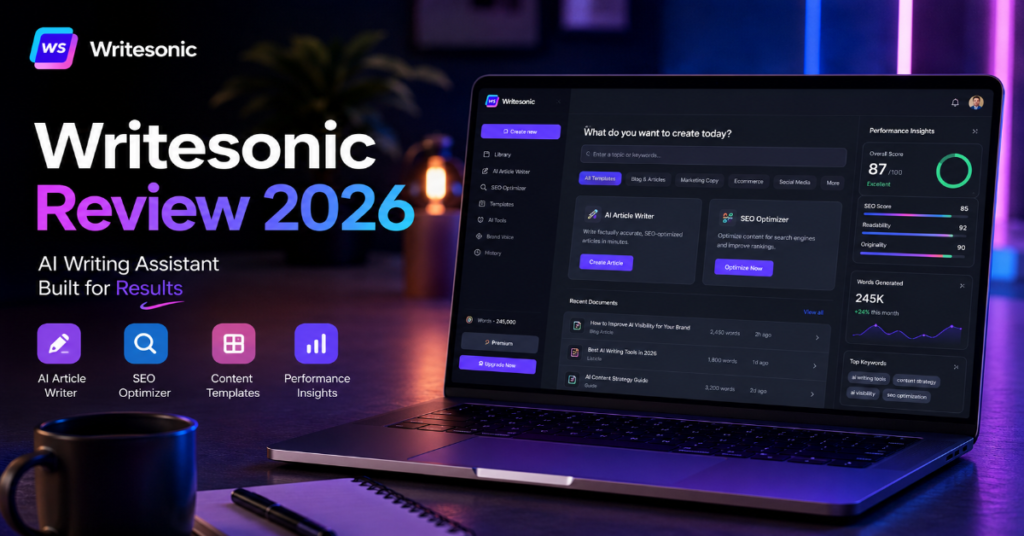
A writesonic review 2026 cannot be written as a simple AI writing tool verdict anymore. Writesonic is no longer only a place to generate blog introductions, ad copy and landing page drafts. Its public positioning now centers on AI search visibility, generative engine optimization, SEO automation and brand presence tracking across systems such as ChatGPT, Gemini, Claude, Perplexity, Google AI Overviews, Microsoft Copilot and Grok. Writesonic’s own documentation describes the company as an AI visibility platform that combines traditional SEO and GEO in one workflow for more than 13,000 marketing teams.
The practical question for marketers in 2026 is not whether Writesonic can write a serviceable article. Most AI writing platforms can do that. The better question is whether Writesonic helps a brand become discoverable in a search market where answers are increasingly synthesized, quoted and compressed before the user clicks. Gartner predicted that traditional search engine volume would drop 25% by 2026 as AI chatbots and virtual agents absorb queries that once went through search engines.
According to the latest 2026 documentation we reviewed, Writesonic’s strategic bet is clear: content generation alone is becoming commoditized, while AI visibility tracking is becoming budget-worthy. That shift makes Writesonic more interesting than many legacy AI copywriting tools, but it also makes the platform more expensive, more complex and less suitable for casual creators.
This review evaluates Writesonic as a modern content operations platform, covering AI Article Writer 6, Chatsonic, SEO audits, brand visibility tracking, pricing, workflow depth, limitations and best-fit users.
Writesonic Review 2026: The Verdict for Serious Marketers
Writesonic is best understood as a hybrid SEO, GEO and AI content platform. For a solo blogger who only needs quick drafts, it may feel overbuilt and costly. For an agency, SaaS company or B2B marketing team trying to measure visibility inside AI-generated answers, it is one of the more forward-looking platforms in the category. Its strongest feature is not raw prose quality. Its strongest feature is the way it connects writing, site auditing, prompt tracking, competitor discovery and AI answer visibility into a single commercial workflow.
In our hands-on documentation review, the most important change is that Writesonic now treats content as an output of a larger visibility system. The platform’s official language emphasizes tracking where a brand appears, finding prompts that recommend competitors, fixing visibility gaps with content and proving ROI to stakeholders. That is a more boardroom-ready pitch than “generate 2,000 words in one click.”
The verdict: Writesonic is worth considering for teams that publish strategically, monitor search visibility and care about AI answer engines. It is less compelling for users who want a cheap, lightweight writing assistant.
What Writesonic Actually Is in 2026
Writesonic began as an AI writing product, but its 2026 identity is broader. The company describes itself as a platform for tracking and improving brand visibility across both traditional search and AI search. Its documentation specifically names Google, Bing, ChatGPT, Claude, Perplexity, Gemini and Grok as visibility surfaces.
That matters because content teams are no longer optimizing for one results page. They are optimizing for search snippets, AI citations, shopping assistants, conversational recommendations, comparison answers and zero-click summaries. Writesonic tries to sit in the middle of that chaos.
The product stack now includes AI Article Writer, SEO tools, GEO tracking, brand presence monitoring, AI platform visibility, site audits, prompt monitoring, AI search volume signals and Action Center features at higher tiers. In plain English, Writesonic wants to tell teams what AI systems say about them, where competitors are being recommended and what content actions might improve visibility.
This makes Writesonic closer to a content intelligence platform than a basic AI writing app.
The Big Market Shift Behind Writesonic’s Pivot
Writesonic’s pivot makes sense because AI-generated search is changing the economics of content marketing. Gartner’s Alan Antin, Vice President Analyst, warned that GenAI systems are becoming “substitute answer engines,” forcing companies to rethink marketing channel strategy as generative AI becomes embedded across the enterprise.
That quote explains the urgency behind tools like Writesonic. If a buyer asks ChatGPT, Perplexity or Gemini for the best CRM, project management tool, AI detector or payroll platform, the answer may include three to five brands. It may not include links in the familiar SEO sense. It may summarize public reputation, reviews, documentation, comparison pages, forum mentions and content authority into one compressed recommendation.
Writesonic’s bet is that marketers will pay not just to publish content, but to know whether AI systems mention them at all. That is a meaningful shift. Traditional SEO tools show rankings, backlinks and keywords. GEO tools try to show brand presence in answer engines. Writesonic now straddles both.
AI Article Writer 6: Stronger Than a Template Generator
AI Article Writer 6 remains central to the Writesonic experience. The official documentation says it supports tone customization, internal linking, source citation through links or footnotes, AI-generated cover images, FAQ incorporation and calls to action.
That feature set is important because many AI writing tools still produce isolated drafts. Writesonic’s article workflow is more production-oriented. It attempts to package the components that editors routinely add after generation: sources, FAQs, links, structure and conversion prompts.
For SEO teams, the internal linking feature is especially practical. Internal links are one of the most overlooked parts of scaled AI content. A machine-generated draft without internal linking can become an orphan page. A draft that includes site-aware linking is closer to publishable architecture.
Still, users should not confuse “article generation” with editorial readiness. The strongest use case is first-draft acceleration, not final publication. Human review is still needed for fact-checking, nuance, originality, expert framing and brand voice.
Chatsonic and Conversational Research
Chatsonic is Writesonic’s conversational assistant layer. In practice, it competes with general-purpose chatbots, but its advantage is proximity to Writesonic’s content and SEO workflows. A marketer can ideate, brief, draft and refine inside a connected environment rather than jumping between a chatbot, keyword tool, document editor and CMS.
The weakness is that Chatsonic must compete against extremely strong general models. ChatGPT, Claude, Gemini and Perplexity are no longer side tools. They are daily workspaces for researchers, writers and editors. Writesonic therefore needs to justify Chatsonic through workflow integration, not simply by claiming better answers.
For content teams, Chatsonic is most useful when used as a research companion, outline assistant, headline tester and repurposing tool. It is less differentiated when used for generic brainstorming. The more your workflow depends on SEO outputs, topic clusters, brand consistency and AI visibility analysis, the more Chatsonic benefits from being inside Writesonic.
Feature Comparison: Writesonic’s Core Capabilities
| Feature | What it does | Best use case | 2026 value |
| AI Article Writer 6 | Generates long-form articles with tone, citations, FAQs, CTAs and linking options | SEO articles, blog clusters, educational content | High for teams publishing regularly |
| Chatsonic | Conversational AI assistant | Research, ideation, rewriting, briefs | Medium to high, depending on workflow |
| Brand Presence Tracking | Monitors brand mentions in AI search contexts | GEO visibility monitoring | High for SaaS, agencies and B2B brands |
| Site Audits | Scans pages for SEO and visibility issues | Technical and content optimization | High for teams managing existing sites |
| Prompt Tracking | Tracks AI prompts and answers | AI answer visibility and competitor monitoring | High for GEO strategy |
| API Access | Enables integrations and automation | Agencies, platforms, internal tools | High for technical teams |
| Action Center | Enterprise-level action workflow | Large organizations needing guided execution | High, but limited to top tiers |
The key insight is that Writesonic is strongest when several of these tools are used together. Buying it only for article generation misses the point of the 2026 platform.
Pricing: The Cost Has Moved Upmarket
Writesonic is no longer priced like a casual AI writing app. Its pricing page lists a Starter plan at $79 per month when billed annually, with ChatGPT-only AI search tracking, 50 prompts and 50 answers tracked daily. The platform’s subscription documentation lists higher tiers such as Basic at $249 monthly or $199 annually, Growth at $499 monthly or $399 annually and Enterprise with custom pricing.
That pricing tells us who Writesonic is really targeting. It is not primarily chasing students, hobby bloggers or freelancers who need occasional copy. It is targeting teams that can justify software spend through content output, SEO performance, lead generation and AI search visibility.
The Basic tier is the first serious business plan because it combines 100 articles, 40 audits, two users, two projects, API access, brand presence tracking and visibility across ChatGPT, Gemini and Google AI Overviews. Growth adds deeper GEO analytics such as Prompt Explorer, sentiment analysis and AI prompt search volume.
Writesonic Pricing Table 2026
| Plan | Monthly price | Annual price per month | Users | Articles per month | AI platforms monitored | Best for |
| Starter | Not fully detailed in documentation excerpt | $79 | Limited | Included | ChatGPT only | Solo marketers testing AI search visibility |
| Basic | $249 | $199 | 2 | 100 | ChatGPT, Gemini, Google AI Overviews | Small teams combining SEO and GEO |
| Growth | $499 | $399 | 5 | 200 | ChatGPT, Gemini, Google AI Overviews | Agencies and scaling content teams |
| Enterprise | Custom | Custom | Custom | Custom | ChatGPT, Perplexity, Google AI Overview, Google AI Mode, Claude, Gemini, Microsoft Copilot | Large brands needing custom dashboards and SSO |
The annual pricing discount is significant, but the commitment only makes sense if a team already has a content calendar, SEO roadmap or AI visibility mandate. For casual users, the cost can outweigh the benefit.
Where Writesonic Beats Traditional AI Writing Tools
Writesonic’s main advantage is operational depth. Many AI writing tools stop at generation. Writesonic attempts to connect generation with measurement. That matters because the problem in 2026 is not producing more words. The problem is producing content that search engines, AI systems, customers and internal stakeholders can trust.
HubSpot’s 2026 State of Marketing report says 80% of marketers use AI for content creation and 75% use it for media production. It also reports that 61% of marketers believe AI is driving marketing’s biggest disruption in 20 years. In that environment, a tool that simply generates more copy is vulnerable to sameness.
Writesonic is more defensible when it helps answer deeper questions. Which prompts mention our competitors? Which pages need refreshing? Which AI platforms cite us? Which topics are missing from our authority map? Which content assets can improve both Google rankings and AI answer visibility?
Those questions are more valuable than “write me a blog post.”
Where Writesonic Still Falls Short
Writesonic’s biggest weakness is the same one facing all AI content platforms: automation can create volume faster than it creates judgment. The platform can assist with drafts, audits, prompts and AI visibility signals, but it cannot fully replace editorial strategy.
Kieran Flanagan, HubSpot’s SVP of Marketing, AI and GTM, put the risk plainly in HubSpot’s 2026 report: “Today, more content is generated by AI than by humans. But it’s mostly average.” He added that consumers seek human-created content and may tune out generic brand and AI-generated content.
That observation is directly relevant to Writesonic users. The danger is treating the platform as a content factory. If teams publish too much AI-assisted content without original research, product expertise, customer evidence or a distinct point of view, Writesonic can amplify mediocrity.
The platform is most effective in disciplined hands. It rewards teams that already know their market, their customers, their positioning and their editorial standards.
The GEO Layer: Writesonic’s Most Important 2026 Differentiator
Generative engine optimization is the reason Writesonic deserves renewed attention. Y Combinator’s company profile describes Writesonic as a GEO platform that tracks AI visibility across ChatGPT, Gemini and more than 10 AI search platforms, then helps teams create content, refresh pages or reach out to sites that mention competitors but not them.
That last part is crucial. GEO is not just on-page writing. It includes external authority, citations, reviews, structured content, comparison pages, community mentions and brand consistency across the web. AI systems synthesize from many sources, so a brand’s visibility depends on more than its blog.
Writesonic’s interesting move is turning AI answer visibility into an actionable workflow. The platform does not merely say, “You are missing.” It attempts to show what to fix.
This is where Writesonic is ahead of many AI copywriting competitors. Jasper, Copy.ai and other tools may be strong for brand copy and workflows, but Writesonic is leaning harder into AI search measurement.
Insider Prediction: AI Visibility Scores Will Become Board Metrics
The obscure but important trend is that AI visibility will likely become a board-level marketing metric before many teams have agreed on definitions. In 2026, marketing dashboards still revolve around organic traffic, keyword rankings, pipeline influence, conversion rates and branded search. But as AI answers reduce clicks, executives will ask a different question: “Are we present in the answers buyers see before they visit a website?”
Writesonic’s prompt tracking and brand presence features are early attempts to quantify that answer. The metric will be messy. Different AI platforms produce different responses. Personalization, geography, model updates and prompt phrasing all affect outputs. Yet imperfect measurement is still better than invisibility.
My prediction: by late 2026 and early 2027, B2B SaaS teams will track “AI share of answer” beside share of voice. The winners will not be the brands that publish the most AI content. They will be the brands with original evidence, strong category language, expert quotes, technical documentation and third-party validation.
How Writesonic Handles SEO and GEO Together
Writesonic’s own documentation makes a useful point: SEO feeds GEO. It says AI platforms pull from content that ranks well on Google and that strong traditional search performance directly impacts AI visibility.
That is a sensible framing. GEO should not replace SEO. It should sit on top of technical SEO, content quality, entity clarity, digital PR, structured data, topical authority and useful page design. If a website is slow, thin, uncited and unclear, AI systems have little reason to treat it as a reliable source.
Writesonic’s combined SEO and GEO workflow is therefore more practical than platforms that pretend AI search is a totally separate universe. The real world is messier. AI systems draw from indexed content, trusted publishers, user-generated communities, documentation hubs, review platforms and structured pages.
For marketers, the right workflow is not “SEO or GEO.” It is “SEO that can survive AI mediation.”
Content Quality: Can Writesonic Produce Publishable Work?
Writesonic can produce organized, useful and SEO-friendly drafts, especially when the user supplies a clear topic, target audience, outline, references and brand voice. AI Article Writer 6’s support for citations, internal links and FAQs makes the output more complete than older template-based generators.
But publishable quality depends on input quality. A thin prompt produces generic copy. A strong brief with product details, customer pain points, primary sources, competitor gaps and editorial direction produces far better output.
The best workflow is editorially layered. Use Writesonic for research scaffolding, outlines, structural drafts, FAQ expansion, meta descriptions and refresh suggestions. Then add human reporting, real examples, product screenshots, interviews, original data and brand-specific insight.
That is how teams avoid the “AI average” problem. Writesonic speeds the mechanical parts of content production. It does not replace the intellectual parts.
Who Should Use Writesonic in 2026?
Writesonic is best for four groups. First, SEO-led content teams that need to publish and refresh content consistently. Second, B2B SaaS marketers worried about how AI answer engines describe their category. Third, agencies that manage visibility for multiple clients. Fourth, growth teams that want to connect content creation with measurable search and AI visibility.
It is not ideal for users who only need occasional social captions, short emails or one-off blog posts. Those users can often get enough value from cheaper tools or general-purpose AI assistants.
Writesonic also suits teams with internal accountability. If your company already tracks keyword movement, demo requests, assisted conversions and content decay, then Writesonic’s GEO layer can extend that discipline. If your team has no content strategy, the platform may simply help you create more unfocused material.
The rule is simple: Writesonic works best when paired with a serious editorial system.
The Role of Human Editors
Human editors remain essential. AI systems can summarize, draft and optimize, but they do not carry legal responsibility, brand memory or customer empathy. Gartner’s Alan Antin argued that companies need to produce content that is useful to customers and demonstrates expertise, experience, authoritativeness and trustworthiness.
That guidance should shape how Writesonic is used. A good editor should check every factual claim, remove generic phrasing, add first-hand detail, improve narrative flow, verify sources, tighten conclusions and ensure the article has a real reason to exist.
The strongest Writesonic users will not be the teams that automate everything. They will be the teams that automate the repeatable parts while investing more human time in judgment, evidence and differentiation.
This is where New York Times-style content principles still matter: reporting, skepticism, specificity, restraint and context. AI can assist the process, but it cannot supply lived expertise where none exists.
Writesonic vs Jasper, Copy.ai and General AI Chatbots
Writesonic competes in a crowded market. Jasper remains strong for brand-controlled marketing copy and campaign workflows. Copy.ai emphasizes go-to-market automation and sales use cases. ChatGPT, Claude and Gemini remain powerful general-purpose assistants.
Writesonic’s edge is narrower but sharper: SEO plus GEO. If your content team mostly needs brand copy, Jasper may feel more polished. If your revenue team wants outbound workflows, Copy.ai may fit better. If you want open-ended reasoning, Claude or ChatGPT may be enough.
But if your concern is AI search visibility, prompt-level brand tracking, SEO audits, AI Article Writer 6 and content actions tied to discoverability, Writesonic becomes more distinctive. Its value increases as search fragments across Google, AI Overviews, ChatGPT, Perplexity, Gemini and Claude.
The platform is not necessarily the best writer. It may be the better visibility tool.
Practical Workflow for a Writesonic Team
A disciplined Writesonic workflow should begin with visibility questions, not article titles. Start by identifying priority products, competitor prompts and buyer questions. Then track how AI platforms answer those prompts. Next, find missing content, weak comparison pages, thin documentation and outdated articles.
From there, use AI Article Writer 6 to draft or refresh pages. Add citations, internal links, FAQs and CTAs. Then send every draft through human editorial review. Finally, monitor whether visibility improves across AI platforms and traditional search.
The hidden advantage of this workflow is focus. Instead of publishing 50 random articles, a team can publish 10 assets designed to answer specific buyer questions and close specific authority gaps.
Writesonic’s value comes from that loop: track, create, refresh, monitor and repeat.
Security, Governance and Enterprise Considerations
Enterprise buyers should evaluate Writesonic beyond writing quality. The higher-tier documentation mentions SSO, custom integrations, custom dashboards, dedicated management and white-glove support for Enterprise customers. These features matter for larger teams because AI tools often enter organizations informally before procurement, legal and security teams catch up.
Governance questions should include: Who can generate content? Who approves publication? Are prompts and outputs stored? Can brand voice be controlled? Can teams separate client projects? Can API access be monitored? Can sensitive product information be excluded?
Writesonic’s move upmarket means it must be judged like a SaaS operations platform, not a toy writer. Agencies and enterprises should test roles, permissions, audit trails, content review workflows and integration boundaries before standardizing on it.
Takeaways
- Writesonic is no longer just an AI writing tool. Its 2026 positioning is AI visibility, SEO and GEO in one platform.
- The strongest use case is for teams that want to track brand presence in AI-generated answers and then act on those insights.
- AI Article Writer 6 is useful for structured long-form drafts, especially because it supports citations, FAQs, internal linking and calls to action.
- Pricing has moved upmarket, with serious GEO and SEO functionality concentrated in business-level plans.
- Writesonic is not a replacement for editors, experts or original research. It is a workflow accelerator.
- Teams should use Writesonic to reduce production friction, not to flood the web with generic articles.
- The most valuable future metric may be AI share of answer, not just keyword ranking.
Conclusion
A balanced writesonic review 2026 leads to a clear conclusion: Writesonic is worth the attention of serious marketers, but not because it magically writes perfect articles. Its real importance lies in the way it reflects the changing search economy. The platform is trying to solve the next problem after AI writing became common: how to be visible when buyers ask AI systems for recommendations instead of browsing ten blue links.
That makes Writesonic more strategic than many copy generators and more demanding than casual users may expect. It requires budget, editorial discipline and a willingness to measure new forms of visibility. Used poorly, it can produce more average content. Used well, it can help teams identify authority gaps, refresh useful pages, monitor AI answer presence and build content that works across both search engines and answer engines.
In 2026, the question is no longer whether AI can write. The question is whether your brand is present, trusted and cited when AI answers.
FAQs
Is Writesonic worth it in 2026?
Yes, for SEO teams, agencies and B2B brands that need AI search visibility tracking, content creation and site audits in one platform. It is less compelling for casual users who only need occasional blog drafts or short-form copy.
What is Writesonic best used for?
Writesonic is best used for AI-assisted content production, SEO workflows, GEO tracking, brand presence monitoring, article generation, content refreshes and visibility analysis across AI search platforms.
Does Writesonic replace human writers?
No. Writesonic can accelerate outlines, drafts, FAQs, internal linking and optimization, but human editors are still needed for accuracy, originality, judgment, reporting and brand voice.
How much does Writesonic cost in 2026?
Writesonic’s public pricing includes a Starter plan at $79 per month when billed annually. Documentation lists Basic at $249 monthly or $199 annually and Growth at $499 monthly or $399 annually.
Is Writesonic better than Jasper or Copy.ai?
It depends on the use case. Writesonic is stronger for SEO and GEO visibility workflows. Jasper may suit brand copy teams better, while Copy.ai may fit go-to-market automation. Writesonic’s edge is AI search visibility.
References
Gartner. (2024, February 19). Gartner predicts search engine volume will drop 25% by 2026, due to AI chatbots and other virtual agents. Gartner Newsroom.
HubSpot. (2026). The 2026 State of Marketing Report. HubSpot.
Writesonic. (2026). Pricing: Writesonic AI Search Visibility Platform. Writesonic.
Writesonic. (2026). Different subscription plans of Writesonic. Writesonic Documentation.
Writesonic. (2026). AI Article Writer overview. Writesonic Documentation.
Writesonic. (2026). What is Writesonic? Writesonic Documentation.
Y Combinator. (2026). Writesonic: Track & boost your brand’s visibility in AI search. Y Combinator Companies.
